
Key facts
- Surf school websites using generic templates see poor conversion due to lack of structured data and slow performance as noted by Gondola.travel.
- 65% of surf lesson bookings are discovered via mobile social media ads per Amra & Elma.
- Integrating scheduling into surf shop websites can boost bookings by up to 26% as seen with Calendly.
- The global surf training market grows annually at 8.2%, projected to reach $2.1 billion by 2026 according to Amra & Elma.
- Video marketing increases surf lesson bookings by 67% as reported by Amra & Elma.
- Online reviews influence 80% of surf lesson booking decisions per Amra & Elma's research.
WANT RESULTS LIKE THIS?
Imagine a system doing all of this for your local business — every day, without you.
We build local businesses a custom website with a team of AI behind it: every lead captured and followed up, new content published monthly,customers finding you on Google — live in 7 days.
- 85+ pages at launch
- Every lead followed up, automatically
- Your whole business on one screen
The Booking Friction Problem: Why Visitors Don't Convert
Visitors abandon surf lesson bookings not because they lack interest, but because the process itself creates friction. Clunky checkout flows and a lack of immediate confirmation are the primary conversion killers on surf shop websites, directly hindering bookings as confirmed by industry research. These pain points leave potential customers frustrated and uncertain, causing them to leave before completing a reservation.
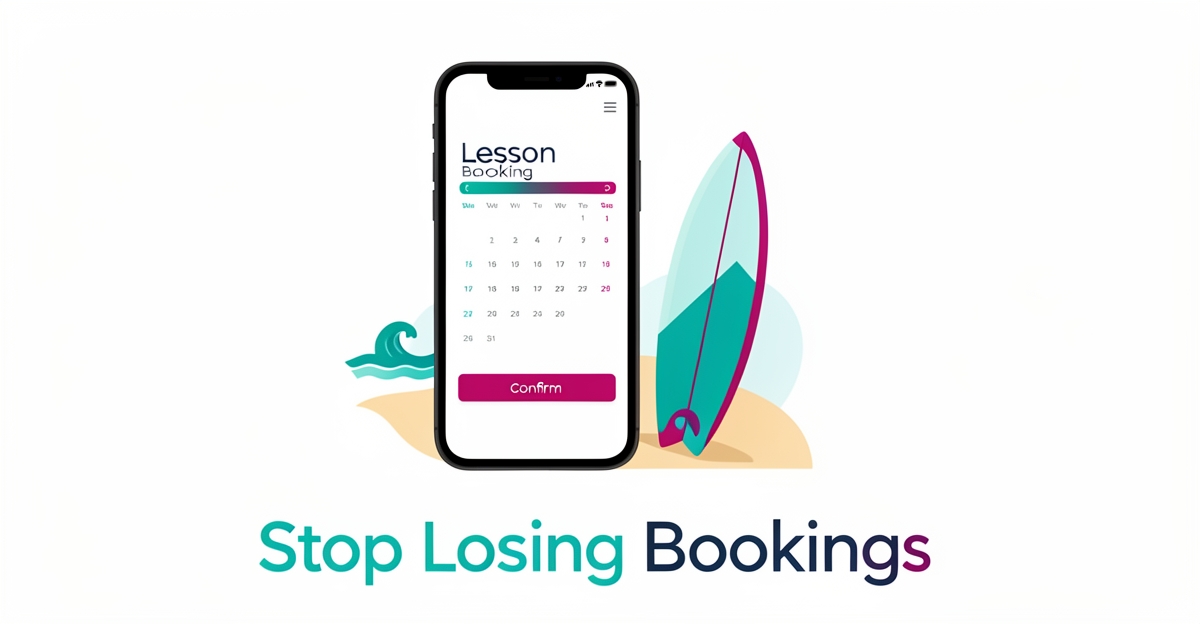
Integrating scheduling directly into the website experience removes these barriers, according to Calendly’s findings, which show that embedded booking tools eliminate the disjointed steps that cause abandonment. When booking happens seamlessly within the site—without redirects or confusing forms—visitors are more likely to follow through. This approach keeps the experience fluid and builds trust at the moment of decision.
The stakes are significant: the global surf training market is growing at 8.2% annually and is projected to reach $2.1 billion by 2026. Every friction point in the booking flow represents lost revenue in an expanding market. For surf shops relying on online visibility, optimizing the booking journey isn’t just about convenience—it’s about capturing a share of this growing demand before competitors do.
Mobile-First Reality: Where Surf Lessons Are Actually Booked
Mobile-First Reality: Where Surf Lessons Are Actually Booked
As the sun rises over the beach, spontaneous decisions to catch the day's waves often lead to last-minute surf lesson bookings. However, many surf shop websites fail to capitalize on this urgency due to a critical oversight: ignoring the mobile-first reality of their customers' booking behavior.
The Spontaneous, On-Beach Booking Experience
Gondola.travel highlights that last-minute bookings are inherently mobile, with users often deciding on lessons while already at or near the beach. This spontaneity demands a mobile-optimized website to facilitate seamless, immediate bookings. Amra & Elma's research reinforces this, showing a 50% growth in mobile ad spend, indicating where potential customers are most active. Furthermore, an impressive 65% of social media discovery happens on mobile devices, underscoring the platform where surf schools are first encountered and often booked.
The Cost of Desktop-First Designs
Surf shop websites designed with a desktop-first approach lose out on these spontaneous bookings. Clunky, non-responsive checkout processes on mobile devices frustrate users, leading to abandoned bookings. Gondola.travel notes that mobile-first design directly impacts conversion and Google rankings, especially for last-minute, location-driven searches like "[beach name] surf lessons near me."
Key Takeaways for Surf Shop Websites:
- Prioritize Mobile Optimization: Ensure booking flows are seamless on mobile to capture last-minute decisions.
- Leverage Mobile-Friendly Booking Systems: Integrated, mobile-responsive scheduling tools can significantly reduce abandonment rates.
- Enhance Local SEO for Mobile Searches: Optimize for "[location] surf lessons" to appear in relevant, high-intent searches.
By acknowledging and adapting to this mobile-first reality, surf shops can transform their websites into effective booking channels, capturing the spontaneity of beachside decision-making and boosting conversion rates. At AI Business Sites, we design websites that not only cater to this mobile-centric behavior but also integrate seamlessly with our built-in online booking capabilities, ensuring surf schools never miss an opportunity to turn a spontaneous beach visit into a booked lesson.
According to Gondola.travel, websites with built-in online booking remove barriers to conversion, a capability our custom websites are designed to leverage effectively. Additionally, Amra & Elma highlights the importance of mobile in discovery, with 65% of students finding surf schools through social media ads, further emphasizing the need for mobile optimization.
Our approach ensures that surf lesson bookings are not only easily accessible on mobile but also seamlessly integrated into the overall website experience, addressing the very friction points that generic, desktop-first designs fail to overcome.
Why Generic Templates Fail Surf Schools Specifically
Surf school websites built on generic Wix or Squarespace templates often resemble those of fitness studios rather than vibrant surf experiences, leading to poor conversion rates. According to Gondola.travel, these templates fail to cater to the specific needs of surf schools, resulting in websites that look out of place and uninviting to potential customers. For instance, a surf school in California using a Wix template might find its website indistinguishable from a local yoga studio, failing to convey the unique appeal of its surf lessons.
Key Limitations of Generic Templates for Surf Schools:
- Missing Structured Data: Generic templates lack the customized structured data (e.g., schema markup for surf lessons) that improves search engine visibility and click-through rates. For example, a template might not include schema for "surf lesson" or "beach activities," making it harder for surf schools to appear in relevant searches.
- Slower Performance: Slow loading speeds, common in heavily featured templates, negatively impact mobile users (critical for last-minute bookings) and search rankings. A slow site can lose potential customers who quickly seek alternatives.
- No Surf-Specific Booking Logic: Templates lack integrated, surf-specific booking systems that remove conversion barriers like clunky checkout processes. Unlike custom solutions, they often require external booking links, adding friction to the process.
In contrast, custom-built solutions like those offered by AI Business Sites are designed around the actual services and geographic areas of surf schools. Hand-built core pages and the absence of unnecessary features ensure faster performance. Moreover, these solutions can be integrated with surf-specific booking logic and structured data, enhancing both the user experience and search visibility.
For example, a custom website for a surf school in Bali might include:
- Structured Data: Schema markup highlighting surf lesson schedules, instructor bios, and beach locations to improve search visibility.
- Surf-Focused Design: A layout emphasizing photos and videos of surfing, clear lesson schedules, and easy, integrated booking that reflects the school's brand and appeal.
- Optimized Performance: Fast loading times, even on mobile devices, ensuring last-minute bookings are seamless.
The Impact of Poor Conversion: A study by Gondola.travel highlights how generic templates lead to poor conversion, with surf schools missing out on bookings due to inability to present their unique value proposition effectively. Furthermore, Calendly's customer success stories show that integrated scheduling can increase website bookings by up to 26%, underscoring the need for tailored solutions.
Breaking Away from Templates: To succeed, surf schools should invest in websites that reflect their brand and cater to their specific booking needs. With the global surf training market growing at an 8.2% annual rate, reaching $2.1 billion by 2026, the opportunity for well-designed, conversion-focused websites is significant.
By moving away from one-size-fits-all templates and towards custom, performance-driven designs with integrated booking systems, surf schools can significantly improve their online conversion rates and capitalize on the growing demand for surfing lessons.
Local business: doing this the old way?
One system replaces the whole pile.
All of it — the website, the follow-up, the content, the leads — built and run for you for $1,497 + $497/mo. Month-to-month, and you own everything.
See what your build includesTrust Signals That Actually Drive Bookings: Video and Reviews
Trust signals are no longer optional extras—they're foundational to conversion. For surf schools, two elements consistently outperform others: video marketing and online reviews. According to Amra & Elma's research, video marketing increases bookings by 67%, while online reviews influence 80% of booking decisions. These aren't promotional tactics—they're infrastructure that builds confidence at the moment a visitor decides whether to book.
Practical implementation starts with video. YouTube tutorials, used by 40% of schools to drive bookings, serve dual purposes: they demonstrate expertise and reduce perceived risk. A beginner watching a pop-up tutorial or safety briefing feels more prepared, making the leap to booking less intimidating. Embedding these videos near lesson descriptions or on homepage banners keeps engagement high without requiring navigation away from the booking path.
Reviews require systematic collection and strategic placement. Schools that automate post-lesson feedback requests see higher volume and more authentic sentiment. Displaying star ratings and testimonials directly above or beside the booking call-to-action leverages social proof at the point of decision. This placement aligns with how visitors process information—validating trust just before commitment.
AI Business Sites supports this approach by embedding review widgets and video sections directly into custom page builders, ensuring these elements appear where they matter most. When trust signals are woven into the design—not tacked on—they don't just support conversions; they actively drive them.
Local SEO and Integrated Booking: The Complete Conversion Stack
Local SEO and integrated booking form a complete conversion stack that addresses the core friction points keeping surf shop websites from converting visitors into lesson bookings. Research shows that optimizing for "near me" searches increases inquiries by 70%, while embedding scheduling directly into the website experience can boost bookings by 26%. These aren't isolated tactics—they work best when combined into a unified system that handles visibility, engagement, and conversion seamlessly.
AI Business Sites delivers this stack as a cohesive solution rather than requiring businesses to piece together multiple tools. The platform includes Google Business Profile setup to capture local search traffic, Cal.com scheduling integration embedded directly into the site experience, and an AI content engine that generates location-specific pages targeting queries like "[beach] surf lessons." This approach ensures that when a potential student searches for lessons nearby, they find a site that not only ranks well but also allows them to book instantly without navigating to external calendars or facing confusing checkout steps.
Gondola's data confirms the power of this combination, showing how operators using their platform achieve 12,000+ first-page Google rankings while powering 400K+ monthly visitors across websites. When that visibility is paired with frictionless booking—where confirmation happens immediately and the process feels native to the site—conversion barriers dissolve. The result is a website that doesn't just attract traffic but actively fills calendars by turning local search intent into confirmed lessons, all while operating as a single, self-maintaining system.
Frequently Asked Questions
Why do visitors abandon surf lesson bookings on surf shop websites?
How can surf shops improve booking conversions on mobile devices?
What impact does video marketing have on surf lesson bookings?
How important are online reviews in influencing surf lesson booking decisions?
Why do generic website templates like Wix or Squarespace underperform for surf schools?
What results can surf schools expect from integrating scheduling directly into their website?
Turn Beach Moments into Booked Lessons
Surf schools lose bookings not from lack of interest, but from friction—clunky checkouts, poor mobile experiences, and generic designs that don’t reflect the surf lifestyle. The data is clear: integrated booking boosts conversions by up to 26%, video marketing increases bookings by 67%, and 80% of decisions are influenced by reviews. Add in mobile-first design and local SEO for 'near me' searches, and you’ve got a conversion stack that captures spontaneous beach decisions and turns them into confirmed lessons. For surf shops ready to stop missing opportunities and start filling calendars, the next step is a website built for your specific needs—one that handles the busywork so you can focus on teaching. See how AI Business Sites helps surf schools convert more visitors into booked lessons with custom websites designed to run your business with you.
FOR local businesss — BUILT AND RUN BY US
Your website. Your content. Your leads. Your data.
$500 starts your build. Seven days later it's live — chat, booking, follow-up, and your Google presence all set up. Then we run it, every month. You do the work you actually get paid for.