
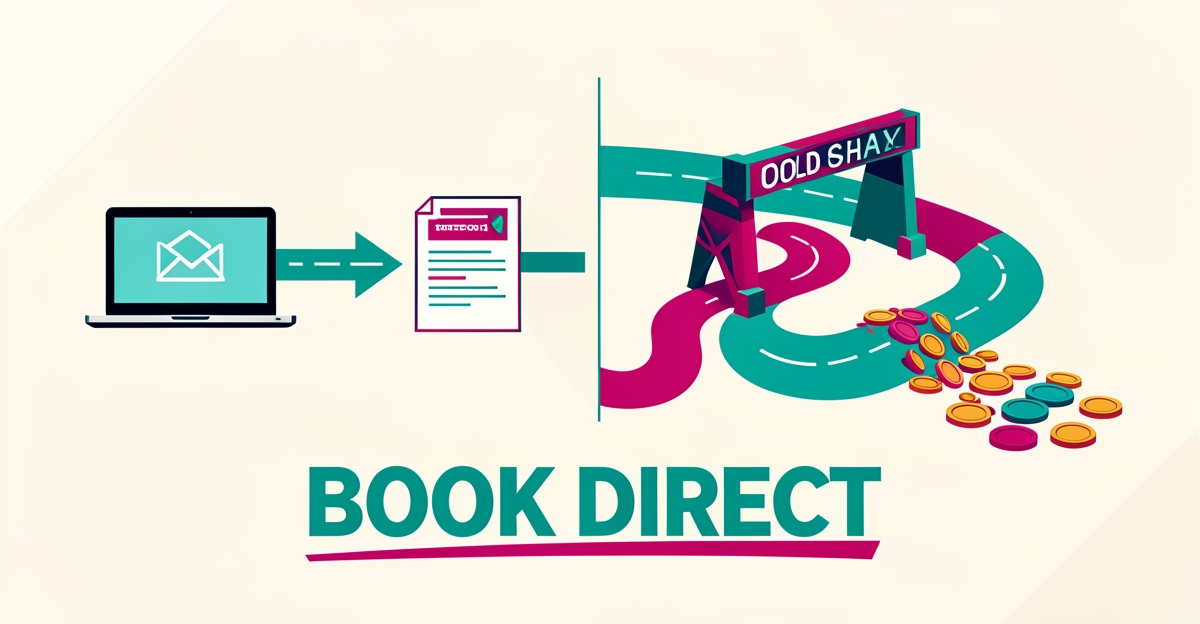
Key facts
- Third-party platforms charge 15–30% commission on every booking, costing a $100K business up to $30,000 annually according to Amadeus Hospitality.
- 81% of shoppers abandon their carts on OTA sites, often due to cumbersome processes or unexpected fees per Perk.com research.
- 52% of bookings are abandoned due to frustrating user experiences on third-party platforms per Perk.com research.
- 80% of travelers visit an OTA during research but convert elsewhere — the billboard effect where OTAs bear acquisition costs without the sale per Perk.com research.
- 60% of travelers prioritize booking with a single brand to maximize loyalty points, rising to 67% among Millennials per Perk.com research.
- 70.5% of global online travel traffic is mobile, yet desktop still generates ~50% of revenue — a mobile UX gap per Perk.com research.
- Direct bookings are surging post-COVID, driven by competitive pricing, trust in supplier sites, and flexible options per Skift Research.
WANT RESULTS LIKE THIS?
Imagine a system doing all of this for your local business — every day, without you.
We build local businesses a custom website with a team of AI behind it: every lead captured and followed up, new content published monthly,customers finding you on Google — live in 7 days.
- 85+ pages at launch
- Every lead followed up, automatically
- Your whole business on one screen
The Hidden Cost of Third-Party Platforms: Fees, Friction, and Lost Control
The Hidden Cost of Third-Party Platforms: Fees, Friction, and Lost Control
When service businesses rely on third-party booking platforms, the true costs extend far beyond the immediate transaction. Behind the facade of convenience lie crippling fees, damaging friction, and a loss of control that can erode profitability and brand integrity.
The Fee Conundrum: 15-30% and Rising Third-party platforms exact a hefty toll, with commission fees ranging from 15% to 30% on each booking (Amadeus Hospitality, Appy Pie). For a service business generating $100,000 in annual bookings, this translates to $15,000 to $30,000 lost to commissions alone. These costs, compounded by the scale of operations, can significantly dent the bottom line.
Friction and Abandonment: The UX Toll Poor user experience (UX) on these platforms is a silent killer, with 52% of bookings abandoned due to frustrating interactions (Perk.com). Furthermore, 81% of shoppers abandon their carts on Online Travel Agencies (OTAs), often due to cumbersome processes or unexpected fees (Perk.com). For service businesses, this means not only lost conversions but also damaged brand trust as customers associate the frustration with the business itself.
Lost Control: Customer Data and SEO Equity Beyond immediate financial losses, third-party platforms usurp control over two critical assets: 1. Customer Data: Businesses are denied full ownership of customer interaction data, hindering personalized marketing and retention strategies. 2. SEO Equity: Dependency on third-party sites dilutes search engine optimization (SEO) benefits, making it harder for businesses to appear in organic searches and maintain a strong online presence (Cvent).
The AI Business Sites Advantage In contrast, custom, AI-operated websites like those offered by AI Business Sites unify booking, CRM, content generation, and analytics under one owned platform. This approach:
- Eliminates Commission Fees, keeping more revenue in the business.
- Ensures Seamless UX, leveraging AI voice and chat agents to handle inquiries and bookings 24/7, significantly reducing abandonment rates.
- Retains Full Control over customer data and SEO equity, empowering targeted marketing and sustainable growth.
Key Takeaways:
- Avoid Hidden Fees: Third-party commissions can eat into 15-30% of your revenue.
- Prioritize UX: Poor experience leads to 52% of abandoned bookings and erodes brand trust.
- Own Your Data and SEO: Third-party platforms compromise control over invaluable customer insights and search engine rankings.
By recognizing these hidden costs and transitioning to a unified, owned platform, service businesses can reclaim control, enhance customer experiences, and drive sustainable profitability. As the market shifts toward direct booking channels, driven by trust, pricing, and flexibility (Skift Research), the importance of owning one's platform cannot be overstated.
According to Skift Research, direct bookings are surging, reshaping competition between suppliers and OTAs, highlighting the strategic imperative for businesses to invest in custom, AI-driven solutions.
Why Direct Booking Is Winning: Trust, Experience, and Ownership
The shift toward direct booking isn't just a trend — it's a fundamental restructuring of how service businesses win and keep customers. Travelers are voting with their wallets: 60% prioritize booking with a single brand to maximize loyalty points, rising to 67% among Millennials. That loyalty used to flow to OTAs, but the dynamic has flipped. Post-COVID, direct bookings are surging as travelers gravitate toward supplier websites for competitive pricing, trust, and flexible options. The "billboard effect" is real — 80% of travelers visit an OTA during research, yet convert elsewhere, leaving third-party platforms bearing acquisition costs without capturing the sale.
What's driving this migration? Three forces converge. First, the economics: OTAs charge 15–30% commission on every booking, a margin that compounds brutally at scale. Second, the experience gap: 52% of bookings are abandoned due to poor UX, and 87% of business travelers want booking as easy as leisure — yet 42% find it harder. Third, the data ownership problem: when you rent a platform, you rent your customer relationships. You don't own the SEO equity, the contact history, or the ability to personalize at scale.
Owning your booking channel changes the math entirely:
- Full retention of customer data and lifetime value
- SEO equity that compounds instead of evaporating
- Ability to embed loyalty perks and value-add packages that protect brand equity
- Mobile-first booking experiences that convert the 70.5% of traffic coming from phones
AI Business Sites builds custom websites that unify booking, CRM, content, and analytics — eliminating the fragmentation that drives abandonment and leakage. When your website handles the busywork automatically, you capture the demand that third-party platforms can't convert.
Local business: doing this the old way?
One system replaces the whole pile.
All of it — the website, the follow-up, the content, the leads — built and run for you for $1,497 + $497/mo. Month-to-month, and you own everything.
See what your build includesHow AI Business Sites Turns Your Website into a Direct Booking Engine
Service businesses lose an average of 15–30% of each booking to third-party platform commissions, money that could stay in the business when customers book directly. This fee structure, combined with the 81% cart abandonment rate common on aggregated sites, means platforms often serve as research tools rather than conversion engines. Travelers browse options elsewhere but complete bookings on supplier websites when the experience is seamless and trustworthy — a pattern known as the billboard effect.
AI Business Sites turns your website into that trusted conversion engine by combining a custom, mobile-first design with built-in tools that eliminate friction at every step. The platform uses Next.js and React — the same technology behind Netflix and Shopify — to deliver fast load times and responsive layouts that keep visitors engaged. Every page is structured around your actual services and service areas, not generic templates, so users find relevant information instantly and are guided toward booking without confusion.
Behind the scenes, an AI assistant answers questions 24/7 using your business’s knowledge base, capturing leads that would otherwise slip through after hours or during busy periods. Every interaction — whether from web chat, phone, or form submission — funnels into a unified CRM where automated follow-ups ensure no lead goes cold. The system tags, routes, and nurtures contacts based on behavior, sending personalized emails or triggering project setup only when human review adds value. This reduces the need for separate tools like live chat software, phone answering services, or standalone CRM platforms.
Content and SEO work continuously to attract the right visitors. The AI content engine researches, writes, and publishes new blog posts, service pages, and location pages each month — all grounded in your actual offerings and local markets. These pages are automatically interlinked to build topical authority, improving rankings without manual effort. Unlike paid ads that stop delivering when the budget ends, owned content compounds over time, drawing in travelers who are already searching for services like yours and prefer to book directly.
You retain full ownership of your website, data, and SEO equity — nothing is rented or locked into a proprietary platform. The code, content, domain, and customer information belong to you, ensuring long-term control and flexibility. By consolidating website hosting, CRM, automation, content creation, newsletter distribution, and project management into one system, AI Business Sites replaces what would otherwise require 8–10 separate subscriptions. The result is a self-running lead and booking system that reduces operational overhead while increasing direct conversions — giving service businesses the UX, cost efficiency, and data control that third-party platforms cannot match.
Frequently Asked Questions
What percentage of bookings are abandoned due to poor user experience (UX) on third-party platforms?
How much can service businesses save by avoiding third-party platform commissions?
Why is owning customer data crucial for service businesses?
What drives the shift toward direct booking channels post-COVID?
How does mobile traffic influence online travel bookings?
What percentage of travelers prioritize booking with a single brand for loyalty points?
Key Takeaways
{ "title": "The Direct Booking Revolution: Reclaiming Control and Profit", "content": "The shift toward direct booking channels is no mere trend—it’s a seismic industry shift driven by trust, competitive pricing, and seamless user experiences. By understanding the crippling fees (15-30% commissions)
FOR local businesss — BUILT AND RUN BY US
Your website. Your content. Your leads. Your data.
$500 starts your build. Seven days later it's live — chat, booking, follow-up, and your Google presence all set up. Then we run it, every month. You do the work you actually get paid for.