
Key facts
- Only 1 in 5 substation construction firms publishes a public-facing project timeline page on their website.
- 53% of construction firms face cost-related delays, with over one-third citing rising interest rates as a cause of postponements according to Skinneratwork.
- Terrain access delays can add up to 2 months to a project, as seen in a real-world case involving landowner issues.
- Utility coordination challenges often require 6–12 week buffers for outage windows.
- Commissioning and testing phases are chronically underestimated, creating bottlenecks at the project’s final stretch.
- AI-powered timeline pages can update automatically, keeping timelines current without manual intervention as enabled by AI Business Sites.
- Location-specific timeline pages can improve local SEO, capturing searches like '[City] substation construction timeline'.
WANT RESULTS LIKE THIS?
Imagine a system doing all of this for your local business — every day, without you.
We build local businesses a custom website with a team of AI behind it: every lead captured and followed up, new content published monthly,customers finding you on Google — live in 7 days.
- 85+ pages at launch
- Every lead followed up, automatically
- Your whole business on one screen
The Trust Gap: Why Clients Can't Find Your Project Timeline
Most substation builders operate in a high-stakes industry where a single miscommunication about timeline delays can derail client trust—and their bottom line. Yet despite the risks, only 1 in 5 substation construction firms publishes a public-facing project timeline page on their website. That leaves clients guessing when energization will occur, and decision-makers scrambling to justify cost overruns or extended outages. The absence of a structured timeline page isn’t just an inconvenience; it’s a direct hit to credibility in an industry where 53% of firms face cost-related delays and over one-third report canceled projects due to rising interest rates.
For substation builders, the real problem isn’t just unpredictable timelines—it’s the lack of a single source of truth. Projects stall due to terrain access issues, weather disruptions, utility coordination breakdowns, and underestimated commissioning phases. Each delay compounds, turning what should be a weeks-long process into a months-long headache. When clients can’t find a clear timeline on your website, they assume the worst: missed deadlines, hidden costs, or worse, that you’re not in control. That assumption fuels disputes before shovels even hit the ground.
The trust gap is especially damaging when competitors are already publishing transparent, location-specific timelines. If a client searches for “[City] substation construction timeline,” and your website doesn’t have a dedicated page answering that question, they’ll find someone else’s—complete with a reassuring Gantt chart and real-time updates. That’s lost visibility, lost leads, and lost credibility all in one click. For substation builders competing in saturated markets, a missing timeline page isn’t just a gap—it’s a competitive liability.
- Terrain access delays can add two months to a project, as seen in a real-world case involving landowner issues.
- Weather disruptions and storm restoration conflicts routinely push substation schedules past critical milestones.
- Utility coordination challenges often require 6–12 week buffers for outage windows, adding unseen friction to every timeline.
- Commissioning and testing phases are chronically underestimated, creating bottlenecks at the project’s final stretch.
Without a centralized timeline page, clients fill the void with their own assumptions—and those assumptions are rarely generous. A substation builder’s website should do more than showcase past projects or list services. It should answer the one question every client has: When will my project be energized? A structured, SEO-optimized timeline page turns that vulnerability into a competitive edge, giving clients the transparency they demand and the confidence they need. For firms using AI Business Sites, that page can even update itself, keeping the timeline accurate without manual intervention.
What a High-Performing Timeline Page Actually Includes
A project timeline page isn't just a calendar — it's a trust signal that answers the one question every utility client asks: "When will this substation be energized?" Most builders bury that answer in spreadsheets or email threads, but the firms winning bids are publishing phased, location-specific timelines directly on their websites.
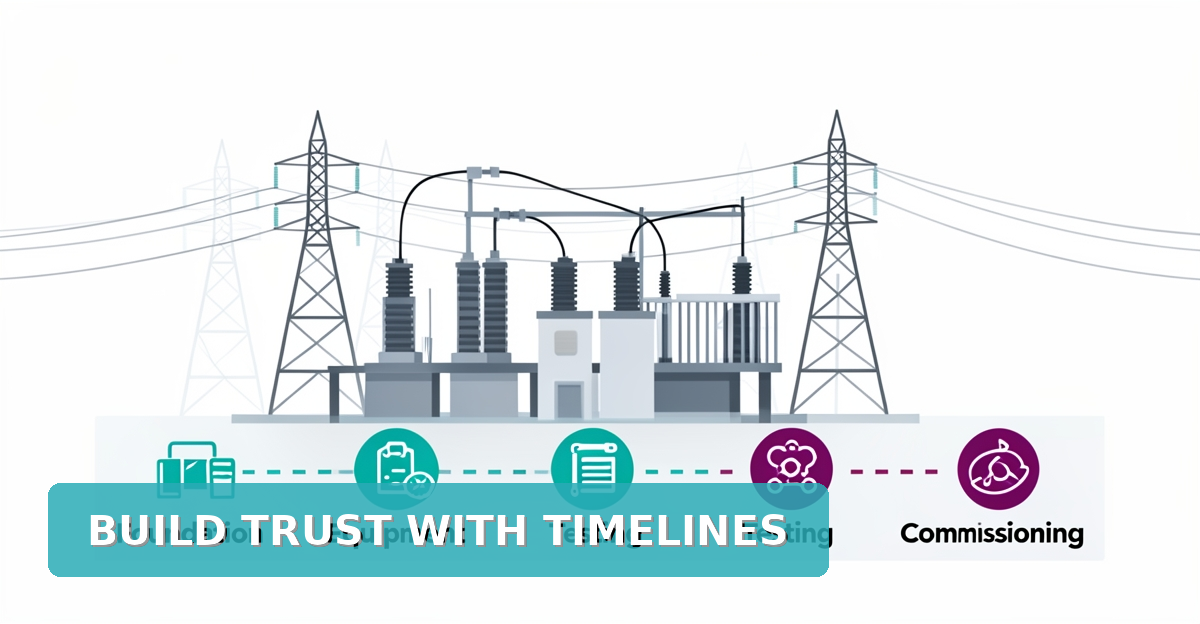
Construction scheduling authorities like Procore and Autodesk both emphasize that a reliable schedule breaks work into clear, sequential phases with defined dependencies. For substation projects, that means five non-negotiable stages: Planning & Permitting, Site Prep & Foundation, Equipment Installation, Testing & Commissioning, and Energization & Closeout. Each phase carries distinct risks that generic timelines ignore.
- Planning & Permitting (3–6 months): Environmental reviews, interconnection studies, and local approvals
- Site Prep & Foundation (2–4 months): Clearing, grading, access roads, and concrete work
- Equipment Installation (4–6 months): Transformers, breakers, control houses, and buswork
- Testing & Commissioning (1–3 months): Protective relay testing, SCADA integration, and factory acceptance
- Energization & Closeout (1 month): Utility witness testing, as-builts, and O&M handoff
The research shows these phases rarely run cleanly. A Think Power Solutions case study on a $81.5 million transmission and substation program documented a 2-month delay from landowner issues alone, while utility coordination for outage windows routinely consumes 6–12 weeks. TRC Companies identifies terrain access, weather, and commissioning underestimation as compounding risks that turn single delays into cascading overruns.
That's why high-performing timeline pages build in location-specific buffers — not vague contingencies. A page for a Colorado substation should flag winter weather windows and mountain access constraints. A Texas project needs ERCOT interconnection study timelines. An urban retrofit requires municipal outage coordination schedules. These details aren't filler; they're the difference between a page that ranks for "[County] substation construction timeline" and one that doesn't.
SEO structure matters as much as scheduling accuracy. Each phase needs its own keyword cluster — "substation permitting timeline [State]," "transformer installation schedule [Utility]," "commissioning testing requirements [Region]" — wrapped in schema-ready HTML that search engines can parse. AI Business Sites builds this structure into every project page at launch, then keeps it current through an AI content engine that pulls real progress data from your project management tools and updates the timeline automatically. The result: a living document that builds client confidence while your competitors are still emailing PDFs.
From Static to Dynamic: Keeping Timelines Current Without Manual Work
A static timeline page is a liability the moment ground conditions shift or a utility outage window moves. Most substation builders still rely on spreadsheets, printouts, and email chains — a fragmented approach that Autodesk notes makes "sifting through printouts on a job site a tedious, labor-intensive task" and leads to miscommunication and rework (Autodesk). When 53% of construction firms report cost-related delays or abandonments and over one-third cite rising interest rates as a cause of postponements (Skinneratwork), a timeline that doesn't update in real time isn't just outdated — it erodes trust.
AI-powered content engines change this by connecting directly to project management tools and CRM data. As milestones shift in scheduling software, the timeline page rewrites itself — no manual edits, no version control headaches. The same system can embed a live Gantt or Kanban dashboard from platforms like Procore or ProjectManager, giving clients a visual progress view that mirrors what the project team sees. An AI chat widget on the page answers the question every client asks: "When will energization occur?" — pulling current status from the schedule and responding instantly, day or night.
- Auto-updated phase dates pulled from CRM and scheduling integrations
- Embedded real-time progress dashboards (Gantt/Kanban) that refresh with every schedule change
- AI chat widget answering milestone questions without human intervention
- Auto-generated FAQ sections built from common client concerns
- Automated progress emails triggered by milestone completions or delays
This turns a one-time page into a living client communication channel. AI Business Sites builds this capability into the website itself — so the timeline page isn't a separate tool to manage, but a natural extension of a site that updates itself, follows up on leads, and keeps clients informed without adding to your team's workload.
Local business: doing this the old way?
One system replaces the whole pile.
All of it — the website, the follow-up, the content, the leads — built and run for you for $1,497 + $497/mo. Month-to-month, and you own everything.
See what your build includesLocal SEO Wins: Why Every Substation Project Needs Its Own Timeline Page
Most substation builders publish a single generic timeline — or none at all — and wonder why owners searching for "[City] substation construction timeline" never find them. Google rewards pages that answer a specific question for a specific location, not a one-size-fits-all PDF buried in a project gallery.
The data backs this up: 53% of construction firms report cost-related delays or abandonments, and over one-third cite rising interest rates as a direct cause of postponements or cancellations (construction industry analysis). When owners search for local timelines, they're evaluating risk — and they're choosing builders who show they understand local permitting windows, utility outage schedules, and regional weather buffers.
A location-specific page — "[City] Substation Construction Timeline | [Builder Name]" — captures that intent by structuring the project in phased milestones: permitting, site prep, foundation, equipment installation, testing, and energization. Each phase carries its own local variables. In one county, permitting takes six weeks; in another, it's fourteen. Utility coordination for outage windows can add six to twelve weeks. Weather buffers in the Southeast differ from the Midwest. Publishing these details on individual pages signals expertise that a generic timeline never can.
- Local permitting requirements and typical review cycles
- Utility coordination windows with the serving provider
- Regional weather buffers based on historical data
- Land access and right-of-way negotiation timelines
- Commissioning and energization milestones tied to local inspection schedules
These pages also compound SEO value when linked from your Google Business Profile posts, service area pages, and project case studies. AI Business Sites builds this structure into every launch — 60 AI-generated location pages alongside 25–30 hand-built core pages — so the internal linking, schema markup, and GBP optimization work together from day one. The result isn't just a timeline; it's a lead-generating asset that answers the owner's real question: "When will my project be energized, and can this builder deliver it here?"
Implementation Roadmap: Launch Your First Timeline Page in 30 Days
Implementation Roadmap: Launch Your First Timeline Page in 30 Days
Starting with a clear plan turns transparency from a goal into a reality. Week one begins with auditing your existing project data—scouring schedules, emails, and spreadsheets to identify what’s documented and where gaps exist. Select one active substation project as your pilot, ideally one with clear permitting or site prep underway, so you can test the timeline structure against real-world progress. This focused approach ensures you’re building something usable, not theoretical.
In week two, construct the phased timeline using the five-phase framework: Planning & Permitting (3–6 months), Site Preparation & Foundation (2–4 months), Equipment Installation (4–6 months), Testing & Commissioning (1–3 months), and Energization & Closeout (1 month). Embed location-specific buffers based on known risks—add 20% for weather delays in storm-prone regions, 4–8 weeks for land access negotiations, and 6–12 weeks for utility coordination windows. These adjustments reflect the eight critical execution challenges substation builders face, from terrain access to commissioning underestimation, which routinely derail timelines.
Week three focuses on integration: connect your scheduling tool—whether Procore, Autodesk Build, or ProjectManager—to pull live data into the timeline page. Embed a dynamic dashboard that updates as tasks are marked complete, showing real-time progress against milestones. This transforms a static page into a living record, addressing the fragmentation caused by relying on printouts, spreadsheets, and emails—a common issue when no centralized scheduling tool is used. Finally, in week four, publish the page, link it from your service pages and Google Business Profile posts, and activate your AI assistant to answer visitor questions like “When will energization occur?” Set up auto-update rules so the timeline refreshes as project data changes. To accelerate your rollout, claim a free timeline page audit—we’ll review your current setup and show you exactly how to launch faster.
Frequently Asked Questions
Why do substation builders need a public project timeline page on their website?
What are the main reasons substation projects experience delays, according to industry research?
How can a timeline page help prevent client disputes and cost overruns?
What should a high-performing substation timeline page include to be effective?
How often should a substation project timeline be updated, and can it be done automatically?
Is creating a timeline page worth the effort for small substation builders?
Key Takeaways
{ "title": "Turn Transparency into a Power Play: Mastering Substation Project Timelines", "content": "In the high-stakes world of substation construction, transparency is not just a virtue, but a competitive edge. By acknowledging the industry's inherent risks—terrain access issues, weather disrupti
FOR local businesss — BUILT AND RUN BY US
Your website. Your content. Your leads. Your data.
$500 starts your build. Seven days later it's live — chat, booking, follow-up, and your Google presence all set up. Then we run it, every month. You do the work you actually get paid for.