
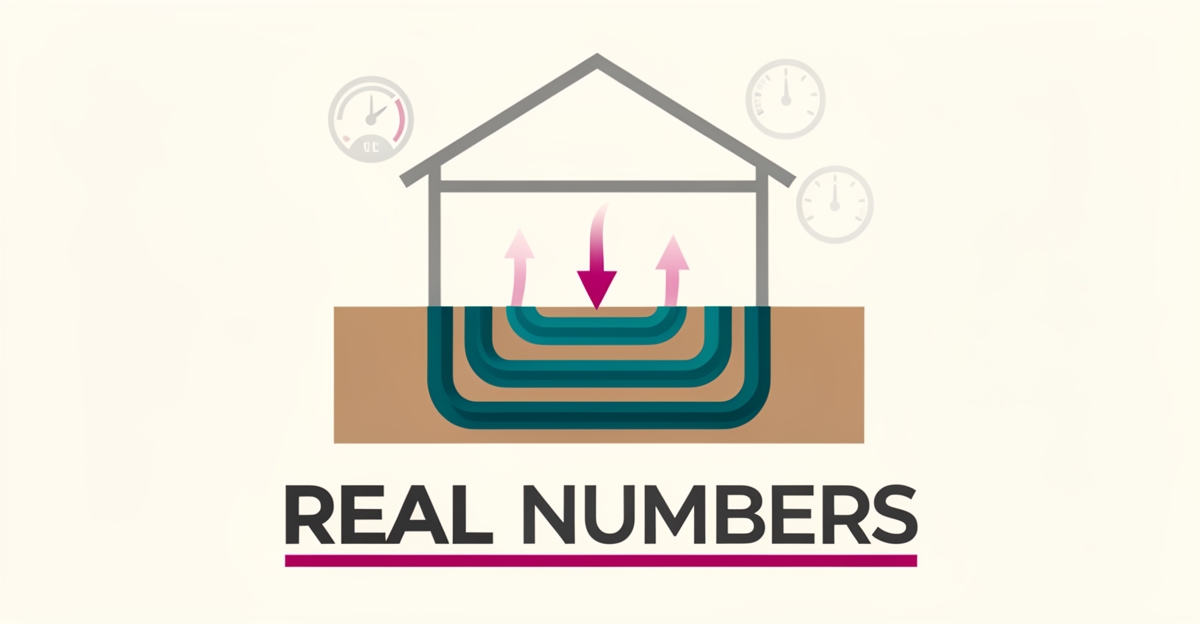
Key facts
- Geothermal HVAC systems consume 25–50% less electricity than conventional HVAC according to market research.
- Systems achieve a Coefficient of Performance (COP) of 3.5 to 5.5, far exceeding traditional furnaces at 70–90% efficiency per industry analysis.
- Vertical closed-loop installation costs dropped 15–20% over five years due to drilling automation per DOE data cited in research.
- 67% of facility managers now require smart monitoring integration for geothermal procurement, up from 38% in early 2024 per primary research.
- Residential geothermal dominates with 60.88% market share ($2.68B in 2024) and 7.96% CAGR per market report.
- Proper system sizing requires Manual J calculations and 10+ factors — no simple rule of thumb works per DOE guidance.
- Louisville Airport's geothermal system with 500-foot wells anticipates $400,000/year in energy savings per DOE case study.
WANT RESULTS LIKE THIS?
Imagine a system doing all of this for your local business — every day, without you.
We build local businesses a custom website with a team of AI behind it: every lead captured and followed up, new content published monthly,customers finding you on Google — live in 7 days.
- 85+ pages at launch
- Every lead followed up, automatically
- Your whole business on one screen
The Efficiency Claims Customers Can't Trust
When exploring geothermal HVAC systems, homeowners are met with a barrage of efficiency claims that promise the world but deliver more confusion than clarity. Manufacturers, government platforms, and market research all chime in with "up to" savings assertions, ranging from 50% to 80% less energy consumption compared to conventional HVAC systems. For instance, while ClimateMaster promises up to 80% savings over existing heating and cooling system costs source, OpenEI documents more modest 70% on heating and up to 50% on cooling costs source. This wide disparity in claimed savings—coupled with the lack of site-specific context—erodes customer trust.
Grounded in verifiable research, geothermal HVAC systems do indeed offer significant efficiency advantages:
- They consume 25–50% less electricity than conventional HVAC systems source.
- They achieve a Coefficient of Performance (COP) of 3.5 to 5.5, far outperforming traditional furnaces' 70–90% efficiency (https://openei.org/wiki/GeoBridge/Heating_and_Cooling and https://www.gminsights.com/industry-analysis/geothermal-heat-pump-market).
- Real-world savings are better reflected in case studies, such as the $400,000/year anticipated energy savings at Louisville Airport source, rather than generic percentage promises.
The primary issue with "up to" claims is their failure to account for site-specific variables:
- Geological Conditions: The suitability of the land for horizontal or vertical loops significantly impacts both cost and efficiency.
- Climate Zone: Savings vary greatly between cooler, heating-dominated climates and warmer, cooling-focused regions.
- System Sizing and Design: Proper sizing, involving Manual J calculations and over 10 factors, is crucial for optimal performance source.
AI Business Sites addresses this challenge by leveraging installation log data to generate:
- Locally Relevant Case Studies: Providing examples like, "A 2,400 sq ft home in [County] with vertical loops saved $1,240/year."
- Interactive, Location-Specific Cost and Savings Calculators: Incorporating real geological data, local drilling costs, and stacked incentives for accurate, ranged estimates.
By moving beyond vague "up to" assertions and embracing data-driven, site-specific content, geothermal HVAC websites can finally offer the clarity and trust that customers demand.
Key Takeaways:
- Geothermal HVAC efficiency claims vary widely (50–80% savings) without clear context.
- Real efficiency is supported by a 25–50% reduction in electricity consumption and COP of 3.5 to 5.5.
- Site-specific factors (geology, climate, system design) are crucial for accurate savings estimates.
- AI-generated, locally relevant content can bridge the trust gap with verifiable data and case studies.
At AI Business Sites, we recognize the need for transparency and accuracy in answering customer questions. Our platform is designed to provide custom, data-backed content that reflects the unique aspects of each location, helping geothermal HVAC businesses build trust with potential customers through informed, locally relevant insights.
Why Installation Costs Can't Be Answered Generically
Most homeowners start their geothermal research with a simple question: what will this actually cost me? The answer is never a single number, and any website that offers one is guessing. Installation costs hinge on geology, loop design, and local incentive stacks that change by county — not by brand or square footage.
Vertical closed-loop systems have seen a 15–20% cost reduction over five years thanks to drilling automation and directional boring, according to U.S. DOE data cited in market research. Yet high upfront cost remains the primary barrier across every major industry report. Horizontal loops cost less to install but demand open land most urban lots don't have. Vertical loops fit tight spaces but require 200–500-foot boreholes spaced roughly 20 feet apart. Soil composition, rock type, and groundwater access all shift the final price in ways no generic calculator can capture.
- Loop type selection driven by land availability and soil conditions
- County-level drilling costs and geological surveys
- Federal 30% tax credit plus state and utility incentive stacking
- Manual J load calculations and blower door testing requirements
Current online calculators illustrate the problem. Manufacturer tools like ClimateMaster's savings estimator explicitly label their output as a demonstration, not a promise, and route users to a dealer for real numbers. That handoff exists because accurate pricing requires site-specific data — geological assessments, utility rate structures, and stacked incentives — that no public tool aggregates. AI Business Sites solves this by building location pages that pull real installation logs, local geology, and current incentive programs into ranged, transparent estimates. The platform's content engine updates these pages monthly as drilling costs shift and incentive programs change, so the answer to "what does it cost now?" stays current without manual rewrites.
The System Design Complexity Websites Ignore
Most homeowners assume a geothermal system is sized like a furnace — multiply square footage by a rule-of-thumb number and call it done. That approach guarantees poor performance, energy waste, and costly modifications, according to the U.S. Department of Energy. Proper design demands Manual J calculations, blower door tests, and professional assessment of 10+ factors including ceiling height, insulation levels, air leakage, duct design, climate zone, window performance, and shading.
- Climate zone and soil thermal conductivity
- Available land area and access for drilling equipment
- Existing ductwork capacity and layout constraints
- Local utility rates and stacked incentive programs
- Ground loop type selection — horizontal, vertical, pond, or open loop
The DOE explicitly warns that "extra consideration may be required when finding a professional" for less common loop types, and industry research confirms contractor expertise is a critical gap. IGSHPA certification and ACCA Manual J competence separate qualified designers from installers who guess — yet most websites never help customers vet for these credentials.
AI Business Sites sees this pattern across service verticals: customers ask specific efficiency and cost questions, but generic content cannot answer them without local installation data, geological records, and incentive stacks. An AI content engine that pulls from actual project logs — loop depth, pre/post utility bills, verified COP readings — can generate the locally relevant case studies and ranged cost estimates that rule-of-thumb calculators never will.
Local business: doing this the old way?
One system replaces the whole pile.
All of it — the website, the follow-up, the content, the leads — built and run for you for $1,497 + $497/mo. Month-to-month, and you own everything.
See what your build includesHow AI-Generated Local Content Closes the Answer Gap
Most geothermal websites still answer "how much will I save?" with a slider bar and a manufacturer's "up to 80%" claim — but industry research shows savings actually range from 25–50% less electricity consumed, with COP values between 3.5 and 5.5. That gap between marketing language and measurable reality is exactly where homeowners lose trust. AI-generated content grounded in actual installation logs changes the equation: instead of a generic calculator, a site can publish a case study showing how a 2,400-square-foot home in your county with vertical loops cut $1,240 off its annual bill — complete with the loop depth, soil conditions, and pre/post utility data that make it verifiable.
- Location-specific cost ranges that stack the 30% federal tax credit with state and utility incentives
- Real geological constraints — horizontal loops need acreage; vertical loops need 200–500 feet of drilling at ~20-foot spacing
- Manual J and blower-door requirements explained in plain language, not engineering shorthand
- Smart-monitoring dashboards that let homeowners verify COP in real time, not just trust the sales pitch
The research is clear: 67% of facility managers now require smart-monitoring integration before they specify a system, up from 38% in early 2024. Residential buyers are following the same logic — they want to see performance, not projections. An AI content engine that pulls from your own project data each month can publish updated incentive stacks, fresh case studies from nearby installs, and verification guides that show exactly how to read a monitoring dashboard. That's what replaces "up to" with "here's what happened three miles from you last quarter."
What a Geothermal Website That Actually Answers Looks Like
The difference between a geothermal website that converts and one that bounces visitors comes down to whether it answers the two questions every homeowner actually asks: what will it cost me, and what will I save. Research shows savings claims swing wildly — from up to 70% on heating to 80% over existing system costs — while installation costs remain highly site-specific despite a 15–20% reduction in vertical loop costs over five years. Generic "up to" claims and manufacturer calculators that require dealer follow-up leave customers skeptical, not sold.
A website built on real business data solves this by replacing marketing copy with locally grounded proof. Instead of broad efficiency ranges, it publishes case studies pulled from actual installation logs — loop type, depth, climate zone, pre- and post-install utility bills — so a homeowner in their county sees what a similar house actually saved. Interactive cost estimators layer county-level geological data, local drilling rates, utility prices, and stacked incentives (federal 30% tax credit plus state and utility programs) into transparent ranged estimates, not single numbers. Contractor vetting guides explain which certifications matter (IGSHPA, ACCA Manual J), what questions to ask about loop design and monitoring, and link to verified local installers. Performance verification content shows homeowners how to track real-time COP and annual output themselves, turning "trust me" into "verify yourself."
- Locally relevant case studies with real dollar amounts from installation logs
- Interactive cost estimators using county-level geological and incentive data
- Contractor vetting guides tied to IGSHPA and Manual J standards
- Performance verification tools for post-install COP monitoring
- Monthly content refreshes that keep incentive stacks and cost trends current
This is the natural output of a website designed to run on business data rather than static pages. AI Business Sites builds sites that pull from your actual installation records, local utility rates, and incentive databases to generate this content automatically each month — so your website answers the efficiency and cost questions with proof, not promises.
Frequently Asked Questions
How much energy do geothermal systems actually save compared to regular HVAC?
Why do savings claims range from 50% to 80% — which one is real?
What does a geothermal system actually cost to install?
Can I just size my system based on my home's square footage?
How do I know if a geothermal installer is actually qualified?
What incentives are available and how much do they reduce the cost?
Key Takeaways
{ "title": "Grounding Trust in Geothermal: From Vagueness to Verified Savings", "content": "The geothermal HVAC industry's reliance on vague efficiency and cost claims undermines homeowner trust. As evidenced by the wide disparity in savings estimates (ranging from 50% to 80%) and the complexity of
FOR local businesss — BUILT AND RUN BY US
Your website. Your content. Your leads. Your data.
$500 starts your build. Seven days later it's live — chat, booking, follow-up, and your Google presence all set up. Then we run it, every month. You do the work you actually get paid for.