
Key facts
- The global water well drilling services market is projected to grow from $3.40 billion in 2022 to $4.31 billion by 2027 according to Yahoo Finance.
- Halliburton achieved 87.4% autonomous drilling without human intervention using AI-driven technology as reported by Halliburton.
- A 1,800x difference in well yields was observed between two nearby wells in Kansas, highlighting local variability per the Kansas Geological Survey (KGS).
- The KGS recommends a minimum yield of 4-5 gallons per minute (gpm) for adequate domestic household water supply as stated by KGS.
- ADNOC Drilling deployed its first AI-powered walking island rig nearly three months ahead of schedule as highlighted by Offshore Energy.
- SLB's Neuro system enabled 25 autonomous trajectory changes in seconds during drilling in Ecuador according to SLB.
- Zanskar's AI-native approach reduced geothermal discovery costs by an order of magnitude as reported by ThinkGeoEnergy.
WANT RESULTS LIKE THIS?
Imagine a system doing all of this for your local business — every day, without you.
We build local businesses a custom website with a team of AI behind it: every lead captured and followed up, new content published monthly,customers finding you on Google — live in 7 days.
- 85+ pages at launch
- Every lead followed up, automatically
- Your whole business on one screen
Why Most Well Drilling Websites Fail to Build Trust
Why Most Well Drilling Websites Fail to Build Trust
When choosing a well drilling service, customers face high-stakes decisions with invisible outcomes, relying on a website to guide their choice. Yet, most well drilling websites falter by relying on generic claims instead of verifiable, site-specific proof. This approach erodes credibility, as evidenced by the Kansas Geological Survey (KGS), which highlights dramatic local variability in well yields—in one case, a 1,800x difference between two nearby wells (one yielding 900 gpm from an alluvial aquifer, the other just 0.5 gpm from bedrock) (KGS). Such variability underscores why generic content fails to reassure potential customers.
The global water well drilling services market, projected to grow from $3.40 billion in 2022 to $4.31 billion by 2027 (Yahoo Finance), indicates a growing demand for trustworthy services. However, websites often miss the mark by not showcasing:
- Site-specific yield data and well records, akin to the KGS's WWC5 forms, which include detailed logs (KGS)
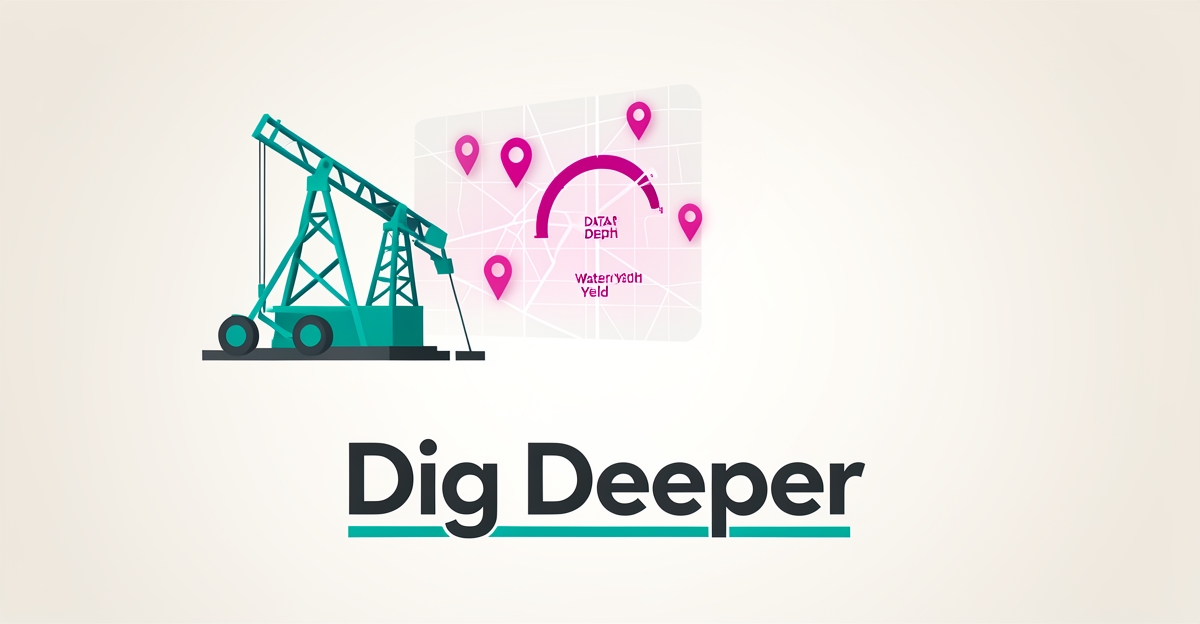
- Interactive mapping tools demonstrating local expertise, such as color-coded well locations by yield or depth (KGS)
- Clear benchmarks for domestic and irrigation needs, like the KGS-recommended 4–5 gpm minimum for household use (KGS)
Industry trends, such as ADNOC Drilling's successful deployment of AI-powered rigs ahead of schedule (Offshore Energy), and Halliburton's 87.4% autonomous drilling achievement (Halliburton), suggest websites should highlight technological innovation to build trust. By failing to incorporate these elements, most well drilling websites leave potential customers uncertain and uninformed, ultimately driving them away. A well-designed website, one that integrates trust signals, clear service offerings, and visual credibility (like those built by AI Business Sites with AI-driven content and local proof), is crucial for standing out in this landscape.
Trust Signals That Actually Convert: Data, Maps & Benchmarks
Trust Signals That Actually Convert: Data, Maps & Benchmarks
When selecting a well drilling website, trust signals that resonate with potential customers are crucial. These signals must mirror the authoritative sources buyers already consult, such as the Kansas Geological Survey (KGS), to build credibility. Here’s how well drilling websites can leverage data, maps, and benchmarks to convert visitors into leads:
In an industry where 87.4% of drilling can be automated without human intervention (as demonstrated by Halliburton's AI-driven technology), showcasing technological prowess is key. Websites should highlight their adoption of AI in operations, following the lead of industry leaders like ADNOC Drilling, which deployed the first AI-powered walking island rig ahead of schedule, enhancing safety and efficiency.
1. Interactive Well Maps: Transparency at a Glance Inspired by the KGS's interactive mapping tool, well drilling websites can feature location-specific, color-coded maps highlighting yield, depth, or static water levels. This visual evidence demonstrates expertise and provides practical value to customers, especially in areas where dramatic local variability in well yields (like the 1,800x difference between alluvial and bedrock aquifers noted by KGS) is a concern.
2. Published WWC5-Style Records: Verifiable Proof By publishing detailed well records (including location, depth, static water level, yield, and lithologic logs) similar to KGS's WWC5 forms, businesses can build trust. These records serve as verifiable proof of capabilities, addressing the $4.31 billion projected market size by 2027, where credibility will be paramount (Source: Global Water Well Drilling Services Market Report).
3. Citable Benchmarks: Setting Realistic Expectations Featuring the KGS's cited 4-5 gallons per minute (gpm) minimum yield benchmark for domestic use educates customers and sets realistic expectations. Additionally, explaining that much larger yields are necessary for large-scale irrigation helps manage customer needs, aligning with the 37% increase in water applied to crops in Australia, indicating growing irrigation demands (Source: Ibid).
Why These Signals Convert:
- Mirroring Authority: By using formats and data types that customers recognize from authoritative sources like the KGS, websites build immediate credibility.
- Addressing Local Variability: Providing site-specific evidence acknowledges the complexities of well drilling, reassuring customers of the business's understanding of local challenges.
- Educational Value: Incorporating benchmarks and detailed records not only builds trust but also educates potential customers, making them more likely to engage.
Actionable Takeaway for Well Drilling Websites: Embed trust signals that speak directly to customer concerns and mirror authoritative sources:
- Interactive Maps: Color-code for yield, depth, or water level to visually demonstrate expertise.
- Detailed Well Records: Publish WWC5-style forms for transparency and credibility.
- Citable Benchmarks: Use recognized standards (e.g., 4-5 gpm for domestic use) to set expectations.
At AI Business Sites, we understand the importance of integrating these trust signals seamlessly into a website, ensuring it not only builds credibility but also converts visitors into leads, ultimately running the business day-to-day with automated lead follow-up, content generation, and more, tailored for local service businesses.
Key Statistic Highlight: The global water well drilling services market is projected to grow from $3.40 billion in 2022 to $4.31 billion by 2027, emphasizing the need for credible online presence (Source: Global Market Report).
Why AI Matters on a Well Drilling Website — Not Just in the Field
Why AI Matters on a Well Drilling Website — Not Just in the Field
Well drilling businesses are increasingly using AI to transform operations in the field—Halliburton achieved 87.4% autonomous drilling without human intervention in Ecuador, while SLB's Neuro system enabled 25 autonomous trajectory changes in seconds during deployment. ADNOC Drilling deployed its first AI-powered walking island rig nearly three months ahead of schedule as part of a $1.54 billion program for six next-generation rigs. These advances signal a shift toward precision, efficiency, and data-driven decision-making that customers now expect across every touchpoint—including your website.
When a well drilling website showcases AI-driven capabilities, it mirrors the technological competence buyers associate with modern field operations. Real-time data integration, such as live yield mapping or depth-specific analytics, demonstrates the same rigor used in autonomous drilling systems. Automated follow-up sequences that personalize responses based on lead source or service interest reflect the adaptive logic behind AI geosteering tools that adjust trajectory in seconds. Even proactive content updates—like seasonal irrigation guides triggered by local weather patterns—echo the predictive maintenance and adaptive in AI-powered rigs.
For well drilling businesses, this alignment isn’t just about appearing innovative—it’s about building trust through consistency. A website that intelligently adapts to visitor behavior, surfaces site-specific yield benchmarks (like the KGS minimum of 4–5 gpm for domestic use), and follows up with timely, relevant information signals the same operational excellence seen in Halliburton’s dogleg severity control of 0.85 deg/100 ft or Zanskar’s AI-native discovery methods reducing costs by an order of magnitude. By integrating these principles into the digital experience—through AI-powered content, lead routing, and localized service pages—AI Business Sites helps well drilling companies extend their field credibility into every online interaction. This approach turns the website from a static brochure into an active extension of the business’s technical capability, where innovation isn’t just claimed—it’s demonstrated in real time.
Local business: doing this the old way?
One system replaces the whole pile.
All of it — the website, the follow-up, the content, the leads — built and run for you for $1,497 + $497/mo. Month-to-month, and you own everything.
See what your build includesService Clarity for Local Needs: Irrigation, Domestic & Geology
A well drilling website earns trust by speaking to the specific job at hand — not by listing every service on a single page. The Kansas Geological Survey emphasizes that well yields vary dramatically over short distances, citing a 900 gpm alluvial well and a 0.5 gpm bedrock well less than half a mile apart — a 1,800x difference. Generic claims cannot bridge that gap.
Domestic customers need to know whether their property can support the 4–5 gpm minimum the KGS identifies for adequate household supply. Irrigation projects demand far higher yields and a driller who understands seasonal drawdown, permitting, and pump sizing. A site that separates these paths — domestic, agricultural, geothermal — shows it respects the complexity of each.
- Domestic well pages anchored to the 4–5 gpm benchmark and water-quality testing guidance
- Irrigation service pages that address yield requirements, aquifer type, and local regulatory context
- Geology-focused content explaining unconfined vs. confined aquifer trade-offs in plain language
- Location-specific yield maps or case studies that mirror the KGS interactive approach
The global water well drilling services market is projected to reach $4.31 billion by 2027, driven by a 37% jump in irrigation water use. That growth means more farmers and landowners are evaluating drillers online — and they're looking for proof you understand their aquifer, not just your rig.
AI Business Sites structures service pages around these distinct customer needs, using local data and verifiable records to replace vague promises. When a homeowner sees a domestic well page that cites the KGS yield benchmark and explains water testing, or a farmer finds an irrigation page that acknowledges unconfined aquifer contamination risks, the site has already answered the first question: Do you know my ground?
Implementation: Building a Website That Runs the Business
Implementation: Building a Website That Runs the Business
A well drilling website should do more than look professional—it should actively work for your business from day one. AI Business Sites builds custom websites designed to capture, qualify, and follow up on leads automatically, turning your online presence into an operational asset. The process starts with hand-built core pages for each service and service area, ensuring content speaks directly to local customer needs like irrigation support or domestic water supply, grounded in verifiable data such as the Kansas Geological Survey’s minimum yield benchmark of 4–5 gallons per minute for household use https://kgs.ku.edu/drilling-water-well-your-land.
These core pages are paired with AI-generated SEO pages that target location-specific searches, such as “well drilling in [county]” or “irrigation well installation near [town].” Every new page is automatically linked to the most relevant existing content, building topical clusters that Google rewards with higher rankings—no manual link building required. This approach leverages the industry trend toward AI integration in drilling operations, where companies like Halliburton achieved 87.4% autonomous drilling using AI-driven technology https://www.halliburton.com/en/resources/first-horizontal-well-via-fully-automated-ai-driven-drilling-technology, signaling technological credibility to visitors.
Lead response happens instantly: web chats, phone calls, and form submissions trigger personalized email replies and funnel into a unified CRM. The AI assistant answers questions using your business’s knowledge base, while the voice agent can book appointments or take messages over the phone—no hold music, no missed calls. Behind the scenes, visual automation tags leads, moves them through your pipeline, and alerts you only when action is needed. Over time, the AI content engine publishes monthly blog posts and location pages, each internally linked to strengthen SEO, while the system cleans up broken links and suggests updates—keeping your site’s authority growing on its own.
Frequently Asked Questions
Why do most well drilling websites fail to build trust with potential customers?
What trust signals should a well drilling website include to convert visitors into leads?
How does AI on a well drilling website build credibility beyond just using AI in the field?
What's the difference between domestic and irrigation well requirements, and why should a website address them separately?
How can a well drilling website demonstrate it understands local geology and aquifer variability?
What makes a well drilling website actively run the business instead of just sitting there?
Your Website, Your Most Reliable Crew Member
A well drilling website that earns trust doesn’t just look professional—it works as hard as your crew does in the field. By showcasing site-specific yield data, interactive maps, and clear benchmarks like the KGS-recommended 4–5 gpm minimum for domestic use, your online presence becomes a credible extension of your expertise. When you also highlight real technological innovation—mirroring the AI-driven advances seen in Halliburton’s autonomous drilling or ADNOC’s ahead-of-schedule rig deployment—you signal to customers that you operate with the same precision and reliability they expect underground. AI Business Sites builds websites that do more than inform: they capture leads, follow up automatically, and keep your content fresh and locally relevant, so your site runs as smoothly as your best rig. If you’re ready to turn your website into a true business asset that builds trust and works for you every day, explore how a custom, AI-powered site can support your growth—starting with a conversation about your local service area and customer needs.
FOR local businesss — BUILT AND RUN BY US
Your website. Your content. Your leads. Your data.
$500 starts your build. Seven days later it's live — chat, booking, follow-up, and your Google presence all set up. Then we run it, every month. You do the work you actually get paid for.