
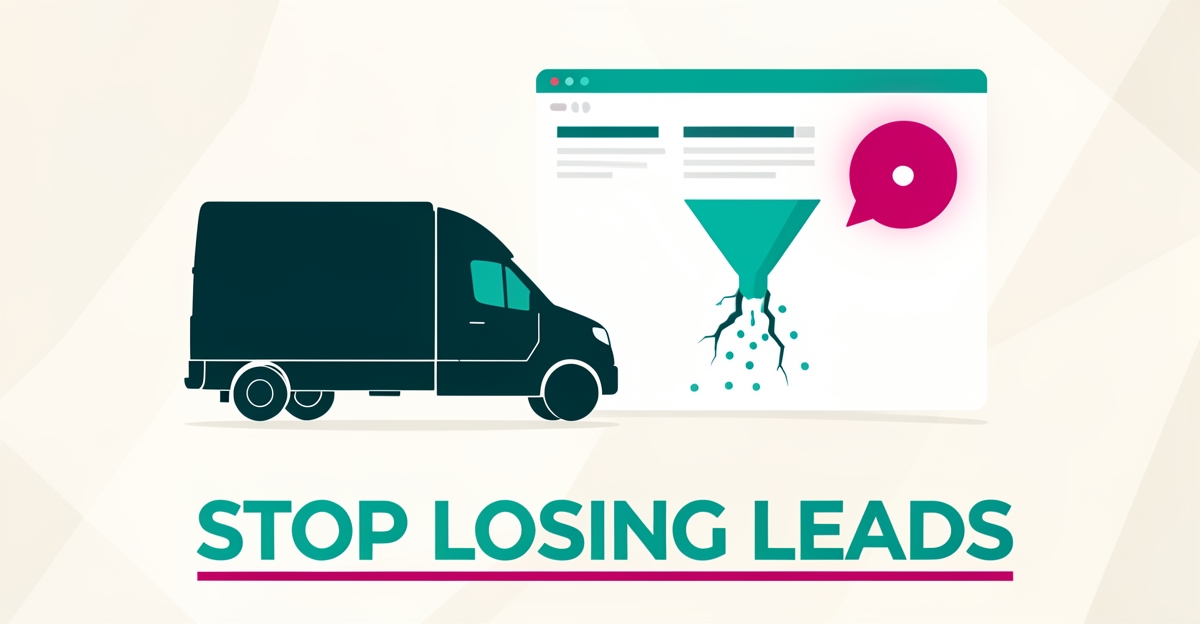
Key facts
- Human sales teams engage with less than 14% of leads before AI implementation according to dealership benchmarks.
- 73% of landing page visits come from mobile devices per FRIKINtech research.
- 63% of service customers drive vehicles they didn't buy from their current provider creating conquest opportunities.
- Digital maintenance menus increase HPRO to 1.8–2.5 and boost customer-pay gross profit by 20% per AutoSuccessOnline.
- The fleet management market is projected to reach $70.26 billion by 2030 at 13.3% CAGR according to G2 research.
- 82% of fleets still use manual tracking methods per Oxmaint analysis.
- Personalized mobile experiences generate 11 average interactions per visit with a 28% return rate per FRIKINtech data.
WANT RESULTS LIKE THIS?
Imagine a system doing all of this for your local business — every day, without you.
We build local businesses a custom website with a team of AI behind it: every lead captured and followed up, new content published monthly,customers finding you on Google — live in 7 days.
- 85+ pages at launch
- Every lead followed up, automatically
- Your whole business on one screen
The Silent Killer: Complex Menus and Missing CTAs
For fleet managers pressed for time, a complex service menu is the first roadblock to conversion. Research shows that overwhelming navigation drives leads to abandon websites before they even reach out—a core reason why lead-to-opportunity funnels break at the first stage. Fleet managers, like other B2B buyers, demand instant clarity. They won’t scroll through 50+ services or decipher vague CTAs; they’ll bounce to a competitor that guides them immediately.
The data is stark: complex service menus and poor navigation are primary drivers of early-stage lead abandonment, with dealerships confirming that human sales teams engage with less than 14% of leads before AI-powered solutions stepped in. Meanwhile, mobile-first visitors—now 73% of landing page traffic—abandon sites that force them to tap through cluttered menus on small screens. Even when they linger, visitors on personalized experiences average just 11 clicks before frustration sets in.
The fix is simple in theory but transformative in practice: replace static menus with AI-driven guidance that captures fleet details before the first scroll. An AI assistant doesn’t overwhelm—it qualifies. It asks two targeted questions (fleet size, vehicle types) and instantly presents a curated menu aligned to their needs, mirroring the digital menu selling strategies that boost HPRO to 1.8–2.5 and lift customer-pay profits by 20%. No more guessing games. No more dead ends.
- Overwhelming service menus force fleet managers to self-qualify, often incorrectly, leading to early abandonment
- Mobile-first visitors (73%) abandon sites with cumbersome navigation, especially when CTAs require multiple taps
- Human follow-up fails at scale, with sales teams engaging <14% of leads before AI tools took over
AI Business Sites builds websites that don’t just look professional—they act as active conversion engines. An AI assistant greets every visitor with guided navigation, captures fleet details in seconds, and routes qualified leads before they navigate away. The result? No more lost leads to poor menus or missing CTAs—just a steady stream of fleet managers ready to convert.
The Response Gap: Why Human Follow-Up Fails Fleet Leads
The Response Gap: Why Human Follow-Up Fails Fleet Leads
Imagine a potential fleet maintenance client visiting your website, only to leave without ever making contact. This scenario plays out repeatedly due to a critical response gap — the chasm between a lead's initial interest and the time it takes for human follow-up.
According to industry research (FRIKINtech), in analogous dealership settings, human sales teams engage with less than 14% of generated leads. The primary reason? Slow or nonexistent follow-up. In stark contrast, AI assistants engage 100% of visitors instantly and significantly outperform human teams in appointment conversion rates, with one study noting AI's conversion rates "crush" those of human efforts (FRIKINtech).
- Missed Opportunities: Every delayed response increases the likelihood of a fleet manager seeking alternatives. Given the $70.26 billion projected market size by 2030 (G2 Learn Hub), the cost of inaction is substantial.
- Conversion Stats:
- Human Engagement Rate: <14% (FRIKINtech)
- AI Engagement Rate: 100% Instant Engagement
-
AI Conversion Outperformance: Significant, though exact metrics vary by implementation
-
Immediate Response: AI assistants engage leads in real-time, capturing critical fleet details (vehicle types, service urgency) before visitors navigate away.
- Personalization at Scale: Unlike human teams, AI can tailor interactions to each lead's specific needs without fatigue or delay.
- Seamless Integration: Leads are automatically routed into the CRM, ensuring no opportunity falls through the cracks.
- Deploy AI-Powered Chat/Voice Assistants: Capture fleet specifics within the first 30 seconds of interaction.
- Mobile-Optimize for Immediate Conversion: Ensure thumb-friendly CTAs, given 73% of landing page visits come from mobile (FRIKINtech).
- Integrate with CRM for Automated Nurture Sequences: Convert "not ready yet" leads through targeted follow-ups.
By embracing AI-driven engagement, fleet maintenance websites can transform the response gap into a competitive advantage, ensuring no lead is lost to delay. As AI Business Sites actively converts website visitors into engaged leads through instant AI engagement, the industry's shift towards automated, personalized customer experiences becomes clearer.
Mobile-First Reality: Where Fleet Managers Actually Browse
Fleet managers don't sit at desks waiting for a quote — they're on job sites, between service bays, scrolling on phones between decisions. When 73% of landing page visits come from mobile devices, a website that forces pinch-and-zoom navigation or buries the contact button below the fold isn't just inconvenient — it's invisible.
The data makes the stakes clear: personalized mobile experiences generate 11 average interactions per visit and a 28% return rate. That's not passive browsing — it's active evaluation. But the typical fleet maintenance site still greets mobile visitors with a desktop menu shrunk to illegibility and a "Contact Us" form demanding ten fields before a human ever responds.
- Primary CTA visible above the fold, thumb-reachable, one tap to start
- AI assistant that asks two qualifying questions — fleet size, urgency — and instantly serves relevant options
- No multi-field forms until the visitor has already expressed intent through conversation
- Click-to-call and click-to-text that work natively on mobile without leaving the page
This is where the conversion engine approach changes the game. Instead of a static brochure, the site becomes an active participant — engaging every visitor the moment they arrive, capturing fleet details before they navigate away, and routing hot leads to the right person instantly. AI Business Sites builds this into every custom website: the AI assistant lives on the page, answers questions using the business's actual knowledge base, and funnels every interaction into a unified CRM so nothing slips through.
The old model assumes fleet managers will hunt through service menus and fill out forms. The data says they won't — they'll tap back to search results and call the competitor whose site made it easy.
Local business: doing this the old way?
One system replaces the whole pile.
All of it — the website, the follow-up, the content, the leads — built and run for you for $1,497 + $497/mo. Month-to-month, and you own everything.
See what your build includesEvery Inquiry Is a Conquest Moment
Every inquiry represents a critical moment where fleet maintenance providers either retain a customer or lose them to a competitor. With 63% of service customers driving vehicles they didn’t purchase from their current provider, each interaction is a conquest opportunity waiting to be captured—or squandered—at first touch. Fleet managers, often juggling tight schedules between jobs, abandon websites that fail to immediately address their specific needs. The average repair order of $518 marks a "frustration point" where dissatisfaction can trigger a switch to another provider, turning routine service into a high-stakes retention battle.
Websites that overwhelm visitors with complex service menus and unclear calls-to-action lose leads before meaningful engagement begins. Research shows that in analogous industries, human sales staff engaged with less than 14% of leads before AI implementation, highlighting the cost of delayed or generic responses. For fleet maintenance, this means inquiries from mobile devices—which account for 73% of landing page visits—must be met with instant, personalized guidance that captures essential details like fleet size, vehicle types, and urgency within seconds.
An AI assistant transforms this vulnerability into a strategic advantage by engaging every visitor immediately, asking just two to three qualifying questions, and presenting a tailored service path instead of a generic menu. This approach mirrors digital menu selling in dealerships, where structured, vehicle-specific recommendations increased HPRO to 1.8–2.5 and boosted customer-pay gross profit by 20%. By capturing fleet details at first touch—before the visitor scrolls or navigates—the website becomes an active conversion engine that routes hot opportunities instantly and nurtures cooler leads with precision.
For AI Business Sites, this means building websites that don’t just display information but actively qualify and convert traffic. The AI assistant lives on the site, answers questions using the business’s knowledge base, and funnels every interaction—chat, call, or form—into a unified CRM where no lead falls through the cracks. In a market where 82% of fleets still rely on manual tracking, the ability to immediately understand and respond to a prospect’s specific fleet profile isn’t just convenient—it’s the difference between winning the account and watching it drive away.
From Static Site to Conversion Engine: The AI Assistant Approach
From Static Site to Conversion Engine: The AI Assistant Approach
Imagine a fleet maintenance website that doesn't just sit passively but actively engages visitors, qualifies their needs, and captures critical fleet details in seconds. This isn't a distant future but a present reality with the AI Business Sites model, designed to transform static fleet maintenance websites into dynamic conversion engines.
The Problem with Static Menus
Fleet managers are time-pressed and seek immediate, personalized solutions. However, traditional fleet maintenance websites often overwhelm them with lengthy, generic service menus and unclear calls-to-action (CTAs), leading to high abandonment rates. Research highlights that complex service menus and poor navigation are the primary drivers of early-stage lead abandonment (First Page Sage).
The AI-Powered Solution
- Instant Engagement with AI Assistants:
- Upon landing, an AI assistant greets visitors, asking a few qualifying questions (e.g., fleet size, vehicle types, service urgency).
-
Less than 14% of leads are engaged by human sales teams in similar automotive contexts, whereas AI assistants can engage 100% of visitors instantly, with conversion rates that significantly outperform human efforts (FRIKINtech).
-
Guided, Vehicle-Specific Recommendations:
-
Based on the input, the AI presents a tailored service menu, mirroring the success of digital menu selling in dealerships, which has seen HPRO increases to 1.8–2.5 and a 20% boost in gross profit (AutoSuccessOnline).
-
Mobile-First for Immediate Conversion:
- Given 73% of landing page visits come from mobile devices (FRIKINtech), the AI assistant and CTAs are optimized for thumb-friendly, one-tap interactions, ensuring no lead is lost due to poor mobile usability.
Actionable Outcomes
- Capture Fleet Details in Seconds: AI chat/voice captures critical information at the first touch, storing it in the CRM for immediate, personalized follow-up.
- Conquest and Retention: Every service inquiry is treated as a potential conquest or retention opportunity, with the AI tagging and routing leads accordingly.
- Content Driven by Fleet Needs: Monthly content (e.g., preventive maintenance schedules, EV-specific guides) is generated to attract and engage fleet managers, with embedded AI chat CTAs for instant lead capture.
Example in Practice
A fleet manager lands on a website, and the AI assistant asks, "How many vehicles does your fleet manage, and what's the primary service needed?" Based on the response (e.g., "20 trucks, urgent tire replacement"), the AI instantly offers a customized service package. This personalized approach not only captures the lead but also sets the stage for a tailored sales process, significantly increasing the chances of conversion.
By embracing the AI Business Sites model, fleet maintenance websites can evolve from passive, lead-leaking platforms into proactive conversion engines, ensuring no potential customer slips away unnoticed. The fleet management market's projected growth to $70.26 billion by 2030 (G2 Learn Hub) underscores the urgency and potential of leveraging AI-driven websites for competitive advantage.
Frequently Asked Questions
Why do fleet maintenance websites often lose leads before the first call?
How effective is human follow-up compared to AI in engaging leads?
What percentage of fleet maintenance website visits come from mobile devices?
Can AI-driven guidance improve the conversion of fleet maintenance websites?
What is the projected market size of the fleet management industry by 2030?
How does the response gap affect fleet maintenance lead conversion, and how can it be addressed?
Your Website Should Work as Hard as Your Fleet Does
Fleet managers don't have time to decode complex service menus or wait days for a callback — they need answers before they reach the next job site. The data is clear: overwhelming navigation drives abandonment, human follow-up engages fewer than 14% of leads, and 73% of visitors are on mobile devices that demand thumb-friendly, instant interaction. Every service inquiry is a conquest moment; 63% of service customers didn't buy their vehicles from their current provider, and the average repair order sits right at the frustration point where loyalty breaks. Replacing static menus with an AI assistant that asks two qualifying questions and delivers a personalized service path isn't a nice-to-have — it's the difference between capturing a fleet account and watching it drive to a competitor. AI Business Sites builds websites that act as active conversion engines: the AI assistant engages every visitor instantly, captures fleet details in seconds, and routes qualified leads into a unified CRM before the conversation cools. Your website should qualify leads while you're under the hood. See how an AI-driven site changes the numbers.
FOR local businesss — BUILT AND RUN BY US
Your website. Your content. Your leads. Your data.
$500 starts your build. Seven days later it's live — chat, booking, follow-up, and your Google presence all set up. Then we run it, every month. You do the work you actually get paid for.