
Key facts
- Small shops using piecemeal tools spend $1,500–$3,000/month on subscriptions that don’t talk to each other according to industry analysis
- Cloud-based SaaS models now capture 63% of fleet management revenue per Mordor Intelligence
- Hybrid fleet management solutions are growing at 20.4% CAGR through 2030 per Mordor Intelligence
- Analytics and reporting tools are the fastest-growing segment at 18.1% CAGR per Mordor Intelligence
- Mid-sized fleets (50–199 units) represent 39.1% of the market per Mordor Intelligence
- Consolidating tools saves small shops $700–$2,200 monthly per AI Business Sites analysis
- Cyber-ransomware risks suppress market growth by 1.9% CAGR per Mordor Intelligence
WANT RESULTS LIKE THIS?
Imagine a system doing all of this for your local business — every day, without you.
We build local businesses a custom website with a team of AI behind it: every lead captured and followed up, new content published monthly,customers finding you on Google — live in 7 days.
- 85+ pages at launch
- Every lead followed up, automatically
- Your whole business on one screen
The Hidden Cost of Playing Tool Whack-A-Mole
Most small fleet operators don't set out to build a software stack — they just need to solve a problem, so they add a tool. Then another. Before long, they're paying for five or six separate subscriptions that barely speak to each other.
The industry has already moved past this model. Cloud-based SaaS now accounts for 63% of fleet management revenue, and hybrid solutions are growing at 20.4% CAGR through 2030, according to Mordor Intelligence. That shift isn't happening because operators enjoy managing more vendors — it's because the cost of disjointed tools has become impossible to ignore.
- Integration complexity eats hours every week as telematics data fails to sync with maintenance and compliance systems
- Driver resistance rises when teams juggle multiple logins and disconnected workflows
- Raw data piles up without structured reporting to turn it into actionable KPIs
- Cybersecurity gaps widen when outdated, piecemeal software lacks basic protections like multifactor authentication
These hidden costs compound fast. Industry analysis shows small shops typically spend $1,500–$3,000/month on separate CRM, automation, scheduling, analytics, and document tools — subscriptions that don't share data, don't automate handoffs, and don't scale together.
AI Business Sites was built to collapse that stack. The $800/month platform replaces those five or six tools with a single system that handles lead capture, follow-up, content generation, project management, and analytics — all connected by design. No integration projects. No duplicate data entry. No security patches across half a dozen vendors.
The alternative isn't just more expensive. It's slower, riskier, and harder to grow with.
Why All-in-One Platforms Win by 2-to-1 on Price
The math doesn't lie. Small shops running separate subscriptions for CRM, booking, communications, and analytics typically spend $1,500–$3,000 per month on tools that don't talk to each other source. An all-in-one platform consolidates those functions for roughly $800/month — a 2-to-1 advantage that compounds every quarter.
Industry data confirms the shift. Cloud-based SaaS models now capture 63% of fleet management revenue, while hybrid solutions grow at 20.4% CAGR through 2030. The fastest-growing segment? Analytics and reporting at 18.1% CAGR — proof that operators want predictive insight, not just raw data.
Mid-sized fleets (50–199 units) already represent 39.1% of the market, signaling that smaller shops are the next adoption wave. They're moving toward integration because the hidden costs of tool sprawl — integration complexity, driver resistance, data overload — quietly erode margins source.
- One platform replaces CRM, automation, content generation, project management, and scheduling
- Built-in AI handles follow-ups, lead tagging, and pipeline movement automatically
- Privacy-first analytics deliver real-time insights without extra subscriptions
- Security and compliance features reduce cyber-ransomware risk from day one
AI Business Sites applies this same consolidation logic to your website — one system that captures leads, follows up automatically, generates SEO content, manages projects, and sends newsletters. The $800/month model isn't just cheaper. It eliminates the integration tax that keeps small shops stuck in reactive mode.
Local business: doing this the old way?
One system replaces the whole pile.
All of it — the website, the follow-up, the content, the leads — built and run for you for $1,497 + $497/mo. Month-to-month, and you own everything.
See what your build includesSecurity and Compliance: Why Small Fleets Can’t Afford DIY
Most shop owners think cybersecurity is an enterprise problem — until a ransomware attack locks their customer records and repair histories. Small fleets running outdated or piecemeal software are disproportionately targeted because attackers know these operators lack dedicated IT staff and multifactor authentication. Industry research confirms that mid-sized carriers often run maintenance systems without basic security controls, widening the threat surface for every shop connected to them.
- Fragmented tools create unpatched gaps between CRM, scheduling, and telematics platforms
- Manual data transfers between systems expose sensitive customer information
- Regulatory compliance (ELD, DVIR, IFTA) falls through the cracks when no single system owns the data
- Cyber-ransomware risks and fragmented data-sharing rules already suppress market growth by 1.9% and 1.4% CAGR respectively
The shift toward integrated platforms isn't just about convenience — it's a defensive move. Cloud-based SaaS models now capture 63% of fleet management revenue, largely because they centralize security updates, access controls, and audit trails in one place. An all-in-one platform handles multifactor authentication, data sovereignty, and automated compliance reporting without the shop owner becoming a part-time sysadmin.
AI Business Sites builds this protection into the website itself — the same system that captures leads and manages projects also enforces security policies, tracks every data interaction, and maintains compliance-ready logs automatically. When your website runs your business, security isn't an add-on. It's the foundation.
Step-by-Step: Migrating From Chaos to One System
Step-by-Step: Migrating From Chaos to One System
Are you tired of juggling multiple subscriptions for your small shop's fleet management, only to find yourself drowning in a sea of disjointed tools? You're not alone. 63% of fleet management revenue now comes from cloud-based SaaS models, indicating a clear shift towards integrated solutions source. Here’s a practical 3-phase migration plan to consolidate your operations into an all-in-one platform, aligning with the gradual adoption and full data ownership approach of AI Business Sites:
- Tool Inventory: List all current subscriptions (CRM, booking, communications, etc.).
- Cost Analysis: Calculate total monthly spends. Small shops often spend $1,500–$3,000/month on redundant tools source.
- Feature Mapping: Identify essential features across all tools.
-
Platform Selection: Choose an all-in-one platform (e.g., AI Business Sites’ $800/month model) that covers 90% of your mapped features.
-
Week 3:
- Data Export: Extract data from all tools.
- Platform Onboarding: Begin setup with the new platform’s support.
- Weeks 4-5:
- Data Import & Integration: Migrate data, ensuring minimal loss.
- Staff Training: Educate team members on the new unified system.
- Week 6:
- Go Live: Fully transition to the new platform.
-
Initial Optimization: Fine-tune settings based on early usage insights.
-
Monthly Reviews: Analyze platform performance, identifying areas for improvement.
- Feature Adoption: Gradually introduce advanced features (e.g., predictive maintenance, AI-driven content generation).
- Scaling: As the business grows, leverage the platform’s scalability to maintain efficiency.
Key Statistic to Keep in Mind: By consolidating tools, small shops can save $700–$2,200 monthly source, redirecting resources towards growth.
- Simplified Operations: One login for all business needs.
- Enhanced Security: Built-in security features protect against cyber threats.
- Data-Driven Decisions: Unified analytics for clearer insights.
By following this phased approach, small shops can seamlessly migrate from the chaos of multiple tools to the efficiency of a single, powerful platform, setting the stage for sustainable growth and competitiveness. AI Business Sites streamlines this process, offering a custom website that "runs itself," handling lead capture, automation, content generation, and more, all while ensuring full data ownership for its clients.
Frequently Asked Questions
Why do small fleets end up with so many separate tools for things like CRM, scheduling, and analytics?
How much money can an all-in-one platform actually save me compared to using separate tools?
Isn't it risky for a small shop to move all our data and workflows into one platform?
What if I only need one or two of the features in an all-in-one platform? Won't I be paying for stuff I don't use?
How hard is it to switch from multiple tools to one all-in-one platform?
What kind of support do I get when moving to an all-in-one platform?
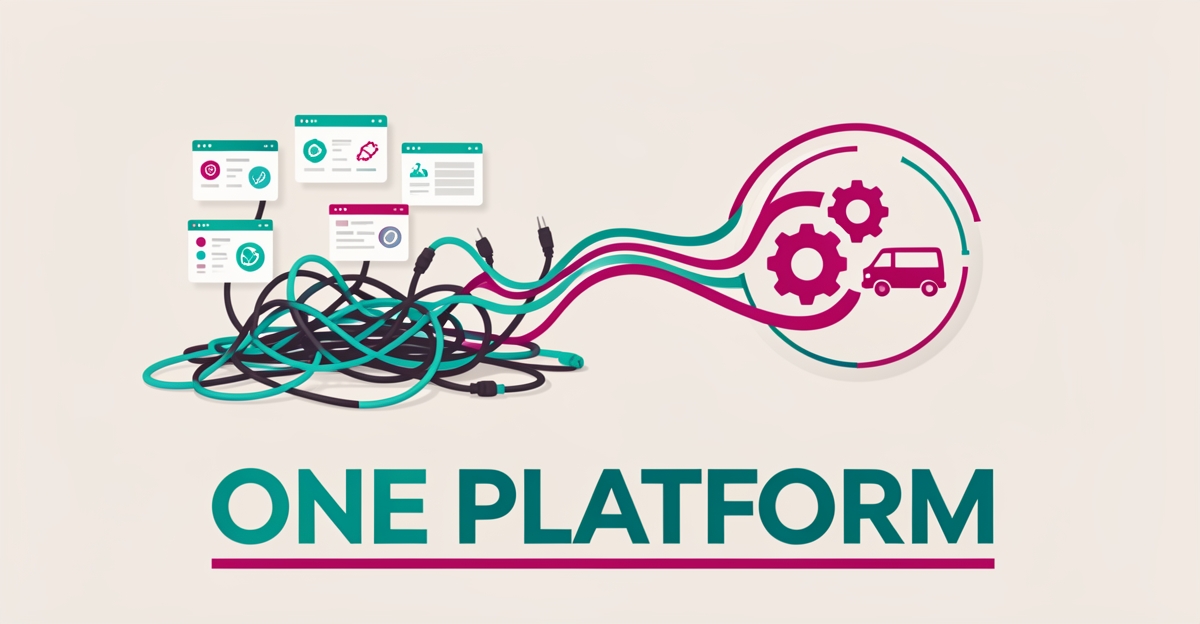
One Platform. One Login. One Bill.
The math is clear: small shops running five or six disconnected subscriptions are spending $1,500–$3,000 a month on tools that don't share data, don't automate handoffs, and don't scale together. That's not a technology strategy — it's a tax on growth. The industry has already voted with its wallet: 63% of fleet management revenue now flows through cloud-based SaaS, and the fastest-growing segment is analytics at 18.1% CAGR, because operators want predictive insight, not raw data. Consolidating into a single system eliminates the integration complexity, security gaps, and driver resistance that quietly erode margins. AI Business Sites applies that same logic to your website — one platform that captures leads, follows up automatically, generates SEO content, manages projects, and sends newsletters for $800/month. You own the code, the content, and the data. No lock-in. No integration projects. Just a website that runs your business with you. Ready to see what consolidation looks like for your shop? Explore the platform and calculate your savings.
FOR local businesss — BUILT AND RUN BY US
Your website. Your content. Your leads. Your data.
$500 starts your build. Seven days later it's live — chat, booking, follow-up, and your Google presence all set up. Then we run it, every month. You do the work you actually get paid for.