
Key facts
- 56% of small repair facilities consider advanced software cost-prohibitive at $50–$300 per technician monthly according to Persistence Market Research
- Cloud-based platforms now dominate 63% of auto repair software deployments with subscription licensing at 68% share per market research data
- 44% of technicians struggle to adapt to modern software platforms while 41% of shop owners cite training difficulties reports Persistence Market Research
- The management software segment leads at $1.1 billion in 2024 and is projected to reach $2.3 billion by 2035 according to WiseGuyReports
- AutoLeap acquired RepairShopr in March 2025 to create a unified platform for scheduling, invoicing, and customer communications per industry analysis
- 67% of SMEs are actively implementing automated workflow solutions to reduce admin time reports Persistence Market Research
- Independent repair shops represent 55–69% of the market share across general and collision repair segments per market research data
WANT RESULTS LIKE THIS?
Imagine a system doing all of this for your local business — every day, without you.
We build local businesses a custom website with a team of AI behind it: every lead captured and followed up, new content published monthly,customers finding you on Google — live in 7 days.
- 85+ pages at launch
- Every lead followed up, automatically
- Your whole business on one screen
The Hidden Cost of Juggling Multiple Software Subscriptions
Most shop owners don't realize how much their software stack actually costs until they add up the separate subscriptions for CRM, scheduling, invoicing, and customer communication. Each tool carries its own monthly fee, its own login, and its own learning curve — and none of them talk to each other.
Research shows 56% of small repair facilities consider advanced software cost-prohibitive, with monthly subscriptions ranging from $50–$300 per technician. When you multiply that across a team, the bill rivals a lease payment — but the real drain isn't just the money. It's the time lost re-entering customer data across disconnected systems, the leads that slip through because the CRM doesn't see the scheduler, and the training hours burned teaching technicians four different interfaces.
- Separate CRM, booking, and email tools create data silos that break the customer journey
- Each new hire needs training on multiple platforms — 44% of technicians struggle to adapt to modern software
- Owners spend admin hours stitching together reports that should be automatic
- Subscription costs compound silently while margins stay tight
The market is responding. Management software now dominates the segment at $1.1 billion because it "consolidates various processes, enhances efficiency, and manages shop activities effectively" — exactly what fragmented tools can't do. Cloud-based, subscription-driven platforms have captured 63% of deployments and 68% of licensing share for a reason: they replace the patchwork with one system that handles scheduling, invoicing, customer communication, and follow-up in a single workflow.
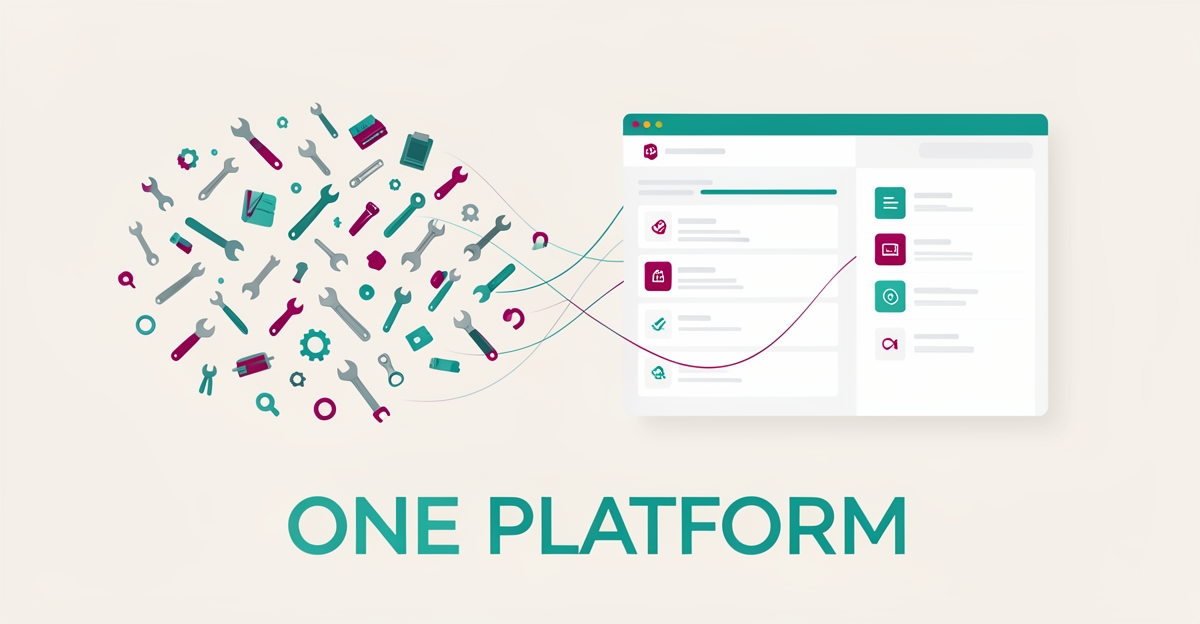
AI Business Sites applies the same consolidation logic to the digital side of the business. Instead of a website that just sits there — plus a separate CRM, a separate email tool, a separate scheduler, and a separate content writer — the site itself runs the operations: capturing leads, booking appointments, sending follow-ups, and publishing SEO content automatically. One platform. One login. One predictable cost.
Why Integrated Platforms Are Becoming the New Standard
Why Integrated Platforms Are Becoming the New Standard
The auto repair industry is witnessing a seismic shift towards unified, cloud-based platforms, leaving fragmented software solutions in the dust. This paradigm shift is driven by the undeniable benefits of consolidation, cost efficiency, and enhanced customer experiences. According to industry research, the global auto repair software market, projected to grow from $2.76 billion (2025) to $5.6 billion (2035) at a 7.4% CAGR, clearly indicates a preference for integrated solutions source.
Key Drivers of the Shift to Integrated Platforms
- Cloud Dominance and Cost Efficiency: Cloud deployment accounts for 63% of market demand, offering predictable costs and eliminating large capital expenditures, a crucial factor for independent shops operating on tight margins source.
- Market Consolidation: Strategic moves like AutoLeap's acquisition of RepairShopr in 2025 to create a unified platform for scheduling, invoicing, and customer communications, validate the industry's move toward integration source.
- Management Software Segment Growth: This segment dominates due to its ability to consolidate various processes, enhance efficiency, and manage shop activities effectively, projected to grow from $1.1 billion (2024) to $2.3 billion (2035) source.
The Business Case for Integration
- Reduced Complexity, Lower Long-Term Costs: Replacing multiple subscriptions (e.g., CRM, scheduling, invoicing) with a single integrated platform reduces overhead. For instance, platforms like AutoLeap ($179/month) and Shopmonkey (~$179/month) offer comprehensive suites that replace 5-8 separate tools, significantly lowering total cost of ownership source.
- Meeting Rising Customer Expectations: Integrated platforms facilitate seamless, transparent customer experiences through features like online scheduling, digital assessments, and contactless services, now expected by consumers source.
- Enhanced Efficiency with AI Integration: Platforms incorporating AI-assisted work order optimization (e.g., ShopWare) and AI receptionists (e.g., AutoLeap) are reshaping operational efficiency and reducing workforce training burdens (https://www.wiseguyreports.com/reports/Auto%20Shop%20Software%20Market; https://cleanfleetreport.com/top-7-auto-repair-shop-software-in-the-market/).
For Auto Shops, the Writing is on the Wall
As the industry continues its rapid shift towards cloud-based, integrated platforms, auto shops must adapt to remain competitive. By embracing unified solutions, shops can streamline operations, reduce costs, and deliver the seamless experiences modern customers demand. The future of auto shop management is unmistakably integrated.
Integrated Platforms: A Clear Advantage
- Consolidated Cost Structure: One subscription replaces multiple, reducing overhead.
- Enhanced Customer Experience: Seamless, transparent interactions across all touchpoints.
- Future-Proof Technology: AI-driven automation and specialized modules for emerging needs like EV repairs.
With 67% of SMEs already implementing automated workflow solutions and the market's clear trajectory, the move to integrated platforms is not just beneficial—it's imperative source.
Local business: doing this the old way?
One system replaces the whole pile.
All of it — the website, the follow-up, the content, the leads — built and run for you for $1,497 + $497/mo. Month-to-month, and you own everything.
See what your build includesHow One Smart Website Replaces Your Entire Tool Stack
Most auto shops don't set out to build a fragmented tech stack — it happens one subscription at a time. A CRM here, a scheduling tool there, an email platform for follow-ups, and suddenly you're managing five logins that don't talk to each other while leads slip through the cracks.
The numbers back up what shop owners already feel: 56% of small repair facilities consider advanced software cost-prohibitive, with monthly costs ranging from $50–$300 per technician across disconnected tools. Meanwhile, 67% of SMEs are actively implementing automated workflow solutions to cut admin time and respond faster to customers. The market is moving toward consolidation — not because it's a trend, but because fragmented tools create data silos that cost shops real money in missed follow-ups, double-booked appointments, and manual data entry.
A single smart website with built-in CRM, AI assistant, automation, and content engine replaces that entire stack. Instead of duct-taping together separate subscriptions, you get one platform where every lead — whether it comes from a web form, phone call, chat, or booking — lands in the same system with instant, personalized follow-up already in motion. The AI assistant answers questions 24/7 using your actual shop knowledge, books appointments, and captures details without hold music or missed calls. Behind the scenes, visual automation handles tagging, pipeline movement, and follow-up sequences so you only step in when judgment is actually needed.
- One login replaces CRM, scheduling, email, chat, and content tools
- Every lead gets an instant, personalized response — automatically
- AI handles after-hours calls and chat without a receptionist on payroll
- Content publishes monthly for local SEO without you writing a word
- You own the code, content, and data — no renting your own website
AI Business Sites builds custom websites that run on this exact model: a Next.js foundation with the operations platform built underneath, so the site generates leads, follows up, publishes content, and manages projects while you focus on the shop floor. The consolidation isn't theoretical — it's what happens when the CRM, scheduler, AI assistant, and automation engine all share the same data from day one.
Frequently Asked Questions
Why are auto shops moving away from fragmented software solutions?
What is the average monthly cost range per technician for fragmented software subscriptions?
What drives the growth of integrated platforms in the auto repair software market?
How do integrated platforms improve customer experience in auto repair shops?
What percentage of SMEs are implementing automated workflow solutions, and why?
Why is workforce training a challenge for auto shops adopting new software?
From Fragmented Tools to Focused Growth
The real cost of juggling multiple software subscriptions goes beyond monthly fees—it’s in the lost time, missed leads, and frustrated technicians struggling to keep up with disconnected systems. As the data shows, 56% of small repair shops find advanced software cost-prohibitive, yet the market is clearly moving toward integrated platforms that consolidate CRM, scheduling, invoicing, and customer communication into one predictable solution. For auto shop owners ready to stop patching together tools and start running a more efficient business, the next step is simple: evaluate how much time and money you’re losing to manual workarounds, then explore platforms that unify your operations under one login. When your website works as hard as you do—capturing leads, following up automatically, and keeping your calendar full—you get back what matters most: time to focus on the cars and the customers. See how a smart website can replace your entire tool stack and start running your business with you.
FOR local businesss — BUILT AND RUN BY US
Your website. Your content. Your leads. Your data.
$500 starts your build. Seven days later it's live — chat, booking, follow-up, and your Google presence all set up. Then we run it, every month. You do the work you actually get paid for.