
Key facts
- AI website builder market is projected to reach $6.3 billion in 2026 according to Sintra.ai analysis.
- 98% of small businesses now use AI-enabled tools per vendor projection.
- Wix AI starts as low as $17/month and Squarespace at $16/month in Sintra.ai pricing comparison.
- There is no universal best AI website creator, choice depends on quick launch versus growth system per Sintra.ai.
- DIY template builders score lower on workflow automation beyond the site and long-term support per evaluation criteria.
- AI Business Sites launches 85+ pages live within 7 days for a $1,497 one-time setup.
- Managed service includes 14+ new SEO-optimized pieces monthly as part of $497/month fee.
WANT RESULTS LIKE THIS?
Imagine a system doing all of this for your local business — every day, without you.
We build local businesses a custom website with a team of AI behind it: every lead captured and followed up, new content published monthly,customers finding you on Google — live in 7 days.
- 85+ pages at launch
- Every lead followed up, automatically
- Your whole business on one screen
The Hidden Cost of 'Fast' Website Builders
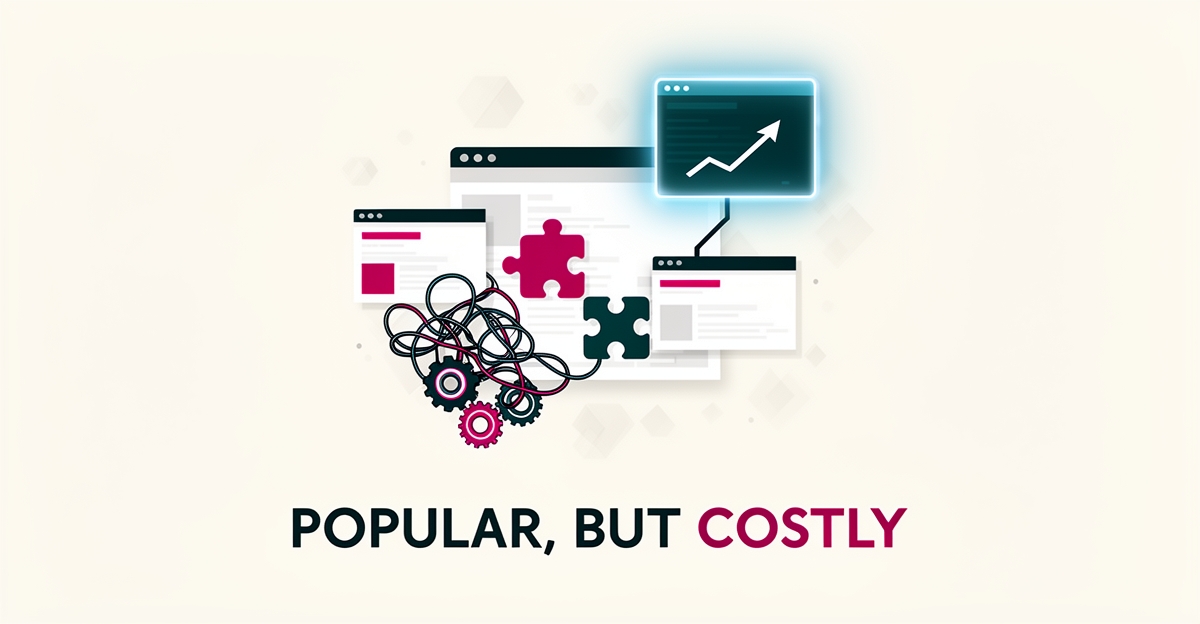
The promise of a website built in minutes is undeniably tempting. DIY AI website builders like Wix AI and Squarespace market themselves on speed and simplicity, offering a polished template with just a few clicks. However, this initial ease often masks a significant long-term burden for small business owners who soon find themselves managing not just a website, but a fragmented ecosystem of tools. According to Sintra.ai's analysis of the AI website builder market, popular DIY options focus primarily on fast template generation, leaving the owner responsible for ongoing content creation, tool integration, and system maintenance—a trade-off that becomes unsustainable as the business grows. Their research highlights that while Wix AI starts as low as $17/month and Squarespace at $16/month, these base prices rarely cover the full scope of what a growing business actually needs.
This hidden cost reveals itself in three critical areas. First, content creation becomes a relentless obligation. AI Business Sites includes 14+ new SEO-optimized pieces monthly as part of its $497/month managed service—blogs, service pages, location pages, and comparison guides—written and published by a specialized AI engine. In contrast, DIY builders provide no such ongoing content engine; owners must either write content themselves (diverting time from core operations) or hire freelancers, adding unpredictable monthly expenses. Second, the tool stack fragments rapidly. To achieve basic functionality like email marketing, social scheduling, or lead tracking, DIY users often subscribe to 5–10 separate SaaS tools, each with its own login, learning curve, and renewal date. Sintra.ai’s evaluation criteria explicitly note that template builders score lower on "workflow automation beyond the site" and "long-term support," forcing owners to manually bridge gaps between platforms. Their comparison confirms that while Wix AI offers "strong built-in SEO and e-commerce tools," it lacks the deep operational automation needed for service-based businesses to run quote-to-invoice loops or manage jobs without add-ons.
Finally, the illusion of low cost dissolves when scaling begins. A contractor using Squarespace’s $49/month Commerce plan might still need to pay extra for appointment scheduling, invoice reminders, or review requests—features AI Business Sites includes in its base monthly fee. As Sintra.ai observes, there is "no universal 'best' AI website creator," and the right choice hinges on whether the owner prioritizes a quick launch or a sustainable, AI-powered growth system. For those who discover too late that "fast" means "high-maintenance," the true price isn’t just in the subscription—it’s in the hours lost, the leads dropped, and the system that never quite works as a cohesive whole. AI Business Sites positions itself as the alternative: a done-for-you operating system where the website doesn’t just exist—it runs the business.
Why WordPress Isn't the Simple Answer It Seems
Despite WordPress powering a significant portion of the web, its ongoing ecosystem activity doesn’t translate to simplicity for business owners. WPMet highlights continuous premium plugin development and strong user satisfaction, signaling that the platform remains dynamic and widely used within its ecosystem. Meanwhile, Search Engine Journal notes Matt Mullenweg’s return to Automattic with full board support, underscoring WordPress’s continued relevance in the website platform market as a foundational player. Yet popularity alone doesn’t eliminate the operational demands that come with it.
For owners focused on running their business, WordPress often requires more than just initial setup. Theme updates, plugin compatibility checks, security patches, and performance tuning become recurring tasks—especially as sites grow. Even with managed hosting, the responsibility for content creation, SEO maintenance, and lead follow-up typically falls on the owner or their team. This creates a hidden workload: managing a website becomes a part-time job in itself.
What’s more, the flexibility that makes WordPress powerful also introduces complexity. With thousands of plugins and themes available, choosing the right combinations—and keeping them updated—demands technical vigilance. A single outdated plugin can compromise site speed, security, or functionality. For service businesses juggling client work, invoicing, and scheduling, these overheads distract from core operations.
AI Business Sites removes this burden by treating the website not as a static asset but as an operating system. Instead of requiring owners to manage updates, content, or integrations, the platform handles publishing 14+ SEO-optimized pages monthly, maintains CRM and automation systems, and keeps the site secure and performant—all included in the $497/month managed fee. The result is a website that doesn’t just exist but actively supports the business: capturing leads, answering questions, quoting jobs, and processing payments—without the owner needing to touch a plugin dashboard or write a line of code.
This isn’t to dismiss WordPress’s capabilities, but to highlight that popularity doesn’t equal ease of use for non-technical owners. When the goal is to run a business—not maintain a website—the trade-offs of self-managed platforms become clear. The real cost isn’t just in subscriptions or setup fees; it’s in time, attention, and the constant need to stay technically engaged. For owners who want their website to work for them—not the other way around—a done-for-you system offers a fundamentally different value proposition: one where the website runs the business, so the owner doesn’t have to run the website.
Local business: doing this the old way?
One system replaces the whole pile.
All of it — the website, the follow-up, the content, the leads — built and run for you for $1,497 + $497/mo. Month-to-month, and you own everything.
See what your build includesThe Done-for-You Alternative: AI-Powered Business Systems
For small business owners weighing website options, the promise of a "quick launch" often masks a deeper trade-off: speed today for ongoing work tomorrow. While DIY builders like Wix AI or Squarespace can generate a basic site in minutes, they leave the owner responsible for hosting, updates, content creation, lead follow-up, and integrating disparate tools — effectively turning the website into another job to manage. Research confirms this pattern is widespread in the AI website builder space, where platforms prioritize fast template generation over sustained business operation, noting that buyers seeking a complete system rather than just a site face limited options. Sintra.ai’s analysis highlights that the market has fragmented into distinct approaches, with template builders excelling at speed but scoring lower on workflow automation and long-term support — critical gaps for owners who want their website to actively run parts of the business.
This is where a done-for-you model like AI Business Sites’ $1,497 custom build diverges sharply from the DIY path. Instead of handing over a static site and a login, the service delivers a live, AI-operated website and back office within seven days, complete with 85+ pages at launch, ongoing content generation (14+ pieces monthly), automated lead follow-up, and integrated tools like quoting, invoicing, and online selling — all managed by the provider. The owner’s role shifts from website administrator to business operator, with the system handling the technical and marketing workload behind the scenes. Crucially, this isn’t a SaaS toolkit requiring assembly; it’s a managed operating system where updates, monitoring, and improvements are handled continuously, eliminating the need to juggle multiple subscriptions or learn complex platforms.
The distinction isn’t just about convenience — it’s about ownership and outcomes. Unlike template builders that lock businesses into proprietary ecosystems or per-seat pricing models, AI Business Sites transfers full ownership of the code, content, data, and domain to the client, with the ability to exit anytime and take everything with them. This approach directly addresses the hidden cost of "free" or low-cost DIY options: the time spent maintaining the site, chasing leads, and writing content. As the research notes, the AI website builder market is projected to reach $6.3 billion by 2026, reflecting growing demand for solutions that go beyond site creation to deliver measurable business results. Vendor projections suggest 98% of small businesses now use AI-enabled tools, yet many still struggle to turn those tools into cohesive, self-running systems — a gap the done-for-you model is designed to close. For owners tired of trading speed for sovereignty, the choice isn’t between platforms, but between building a website and building a business that runs itself.
Frequently Asked Questions
What is the most popular website platform according to the research?
Is WordPress still widely used for business websites?
Do DIY website builders like Wix AI and Squarespace include ongoing content creation in their base plans?
What hidden costs do small business owners face when using DIY website builders?
How does AI Business Sites differ from DIY website builders in terms of long-term support and automation?
What do I own if I cancel my AI Business Sites subscription?
Pick the Platform That Runs Your Business, Not the Other Way Around
The most popular website platform isn't the one with the fastest template — it's the one that lets you stop running the website and start running your business. DIY builders like Wix AI and Squarespace win on speed, but the hidden cost shows up in content you have to write, tools you have to connect, and leads you have to chase. WordPress remains active and powerful, yet popularity doesn't equal ease; updates, plugins, and ongoing maintenance become a part-time job for non-technical owners. The real choice is between a quick launch and a sustainable growth system. For owners who want a custom site that answers questions, writes content, follows up on leads, and handles quotes to invoices without a stack of subscriptions, a done-for-you model shifts the workload to a managed team you own outright. If you're weighing options, audit for workflow automation and long-term support, not just launch speed. Book a free strategy call to talk through your goals with no obligation, and see what a 7-day, 85+ page build looks like for your business. The AI website builder market is projected to reach $6.3 billion in 2026 as more owners seek systems over sites.
FOR local businesss — BUILT AND RUN BY US
Your website. Your content. Your leads. Your data.
$500 starts your build. Seven days later it's live — chat, booking, follow-up, and your Google presence all set up. Then we run it, every month. You do the work you actually get paid for.