
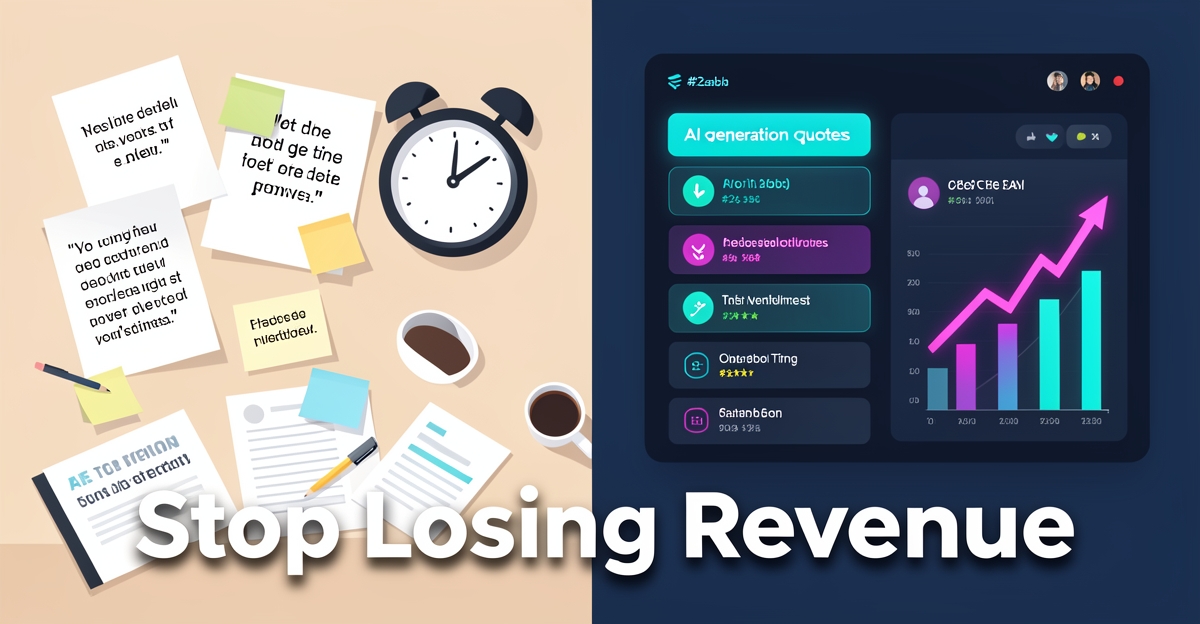
Key facts
- 80% of consumers consider pricing transparency 'very important' when choosing a service provider per recent findings.
- Businesses using online quoting tools report conversion rates as high as 60% according to industry data.
- Structured follow-up sequences (Day 0, 2, 4, 5) significantly boost win rates per B2B sales research.
- Manual quote edits create bottlenecks that slow revenue cycles per CPQ vendor insights.
- AI Business Sites integrates 140+ tools and 25+ triggers to run business operations automatically as demonstrated by the platform.
- Most small business websites are static and require manual updates, unlike AI-powered sites that run themselves per company overview.
- Manual quote tracking leads to lost opportunities, inconsistent pricing, and lack of oversight per industry research.
WANT RESULTS LIKE THIS?
Imagine a system doing all of this for your local business — every day, without you.
We build local businesses a custom website with a team of AI behind it: every lead captured and followed up, new content published monthly,customers finding you on Google — live in 7 days.
- 85+ pages at launch
- Every lead followed up, automatically
- Your whole business on one screen
Why Manual Quote Tracking Is Quietly Killing Your Revenue
Most service businesses don't realize how much revenue slips away while they're copying job details between spreadsheets, scrolling through email threads, and returning voicemails. Every hour spent on manual quote tracking is an hour not spent on billable work — and the hidden costs compound fast.
Research shows that 80% of consumers consider pricing transparency "very important" when choosing a service provider, yet businesses relying on manual processes often deliver quotes hours or days after the initial inquiry. By then, the lead has moved on. Competitors offering instant online quoting tools report conversion rates as high as 60%, while manual follow-ups stall at a fraction of that.
The breakdown happens in three places:
- Delayed responses — leads go cold while you're gathering details
- Inconsistent pricing — no standardized templates mean every quote is a reinvention
- No pipeline visibility — you can't follow up on what you can't track
Structured follow-up sequences — sending a quote on Day 0, then checking in on Days 2, 4, and 5 — have been shown to significantly improve win rates. But without automation, that cadence falls apart. Manual quote edits create bottlenecks that slow the entire revenue engine, introducing errors and duplicating effort across teams.
AI Business Sites builds websites that handle this automatically. When a lead comes in — whether through a form, chat, or phone call — the system captures the job details, generates a quote using your pricing rules, and routes it to the right technician. Follow-ups trigger on schedule. Nothing falls through the cracks. The admin overhead drops. And you're not duct-taping together five tools that don't talk to each other.
What Happens When a Lead Comes In — And No One Follows Up Fast Enough
When a potential customer reaches out about a job, most service businesses treat it like a hot potato—one that quickly goes cold. A quote request lands in an inbox or spreadsheet, sits untouched for hours or days, and ends up forgotten in the shuffle between calls, emails, and service calls. The result? A lost opportunity that slips through the cracks before anyone even realizes it’s there.
Research shows that speed and follow-up cadence directly impact win rates. A structured sequence—respond on Day 0, follow up on Day 2, Day 4, and Day 5—can significantly boost conversion chances, yet manual systems make executing this sequence nearly impossible. Without automation, each step becomes a potential failure point: no revision tracking, no clear pipeline visibility, and no way to route the job to the right technician. Leads pile up unassigned, information gets duplicated across emails and spreadsheets, and customer trust erodes as delays stretch into days.
Manual quote tracking creates systemic inefficiencies that hinder both sales performance and customer experience. Businesses relying on Word docs, Excel sheets, and inboxes struggle to maintain oversight, leading to inconsistent pricing, lost leads, and a fragmented view of the sales pipeline. Meanwhile, customers increasingly expect instant transparency—with 80% prioritizing pricing transparency and competitors offering online quoting tools that convert at rates as high as 60%.
Here’s where manual systems fall short:
- No real-time status tracking — without a visual pipeline or automated alerts, it’s easy to lose track of which quotes are pending, accepted, or lost.
- Delayed follow-ups — manual processes make it nearly impossible to execute a structured Day 0/2/4/5 cadence, reducing engagement and conversion chances.
- Duplicated effort — the same job details get re-entered across emails, forms, and spreadsheets, wasting time and increasing error risks.
- Broken routing — without automated technician assignment, the right expert may never see the request, slowing down response times.
A website built to run itself changes this. Instead of relying on scattered tools and human memory, an AI-driven system can auto-capture job details, generate a quote, and route it to the right technician—all before the customer has time to second-guess their choice. No lead slips through the cracks. No follow-up gets missed. And no one has to juggle spreadsheets, inboxes, and phone calls just to keep the business moving.
How an Automated Website Captures, Quotes, and Routes Jobs Without You Lifting a Finger
The difference between a lead that converts and one that ghosts you often comes down to what happens in the first five minutes. When a job request arrives — whether through a web form, a phone call, or a chat message — most businesses still rely on someone to notice it, transcribe it, calculate a price, and send a reply. That delay costs deals. Research shows four out of five consumers consider pricing transparency very important when choosing a service provider, and businesses offering instant online quotes see conversion rates as high as 60%.
A website built to run your operations changes that sequence entirely. The moment a request lands — from any channel — the system captures every detail, applies your actual pricing rules, and generates a professional quote without you opening a spreadsheet. It then routes the job to the right technician based on skill, location, or workload, and logs everything in a visual pipeline with five clear status stages so nothing stalls unnoticed. This isn't a separate dashboard you have to check; it's your website doing the work behind the scenes.
- Auto-captures job details from web forms, voice calls, chat, and bookings into one unified lead record
- Generates accurate quotes using your pricing logic — no manual calculations or version errors
- Routes each job to the right technician automatically based on rules you set once
- Triggers personalized follow-ups on a proven cadence: Day 0, 2, 4, and 5 after quote delivery
- Tracks every deal through a visual pipeline with five status stages for full visibility
The automation engine behind this handles over 25 trigger types and 20 action types — from tagging leads by source to alerting your team only when a deal needs human attention. Your AI assistant, equipped with 140+ tools, can draft the follow-up email, propose the next step, and even generate the proposal document, all while you stay in control with approve-first or autopilot modes. AI Business Sites builds this directly into your custom website so the same platform that attracts the lead also captures, quotes, routes, and follows up on it — no duct-taped tools, no manual handoffs, no leads slipping through.
Local business: doing this the old way?
One system replaces the whole pile.
All of it — the website, the follow-up, the content, the leads — built and run for you for $1,497 + $497/mo. Month-to-month, and you own everything.
See what your build includesThe Operational Shift: From Admin Overhead to a Business That Runs Itself
Most service businesses still run on a patchwork of Word docs, Excel sheets, email threads, Calendly links, Mailchimp lists, Asana boards, and a separate CRM that never quite talks to the others. Each tool solves one problem — and creates three more: duplicated data, missed handoffs, and a quote-to-cash cycle that drags on for weeks.
Research shows that manual quote tracking using disconnected tools leads to lost opportunities and inconsistent pricing because there's no central system to enforce standards or track status. One study found that businesses relying on spreadsheets and email lack revision tracking, template management, and deal pipeline reporting — gaps that directly hurt win rates. Meanwhile, 80% of consumers consider pricing transparency "very important" when choosing a service provider, and companies offering instant online quoting report conversion rates as high as 60%.
- Lead capture, quoting, and follow-up all happen in one place
- Projects kick off automatically when a deal is won — no manual handoff
- Client approvals, signatures, and file sharing live in a portal that requires no login
- Weekly AI-generated business reports land in your inbox with real insights, not just data
The shift isn't about adding another tool. It's about replacing 8–10 subscriptions with a single system that handles the entire lifecycle — from the moment a visitor asks a question on your website to the day the project wraps and the invoice is paid. AI Business Sites builds this into every custom website: the AI assistant captures job details, generates the quote, routes it to the right technician, and follows up on a structured cadence (Day 0, 2, 4, 5) without anyone lifting a finger. The owner only steps in when judgment is actually needed — approving a custom scope, reviewing a tricky negotiation, or making a hiring call.
Behind the scenes, a visual automation builder with 25+ triggers and 20+ actions handles the busywork: tagging leads, moving deals through stages, sending personalized emails, and alerting the team only when something stalls. Two-way email conversations live in the CRM alongside every call, chat, and form submission. Documents — proposals, contracts, presentations — generate on request, branded and ready to send. And because it's all one system, the weekly business report isn't a spreadsheet you build on Sunday night. It's written by AI, grounded in your actual leads, deals, calls, content performance, and project velocity — delivered before your Monday coffee.
What to Do Next If You're Still Tracking Jobs Manually
If you're still tracking jobs manually, it's time to audit your quote-to-cash flow for gaps where leads fall through. Start by mapping every touchpoint — from web form submissions and phone calls to referrals and chat inquiries — and ask where details get lost, duplicated, or delayed. Many businesses using spreadsheets or email chains lack revision tracking, template management, and real-time pipeline visibility, creating operational bottlenecks that slow responses and erode win rates according to industry research. Without a centralized system, it's easy for leads to decay while you wait for callbacks or chase down missing information.
Next, evaluate whether your website is merely a static brochure or an active operations hub. If it doesn’t instantly capture leads from every source — web, voice, chat, referral — and trigger personalized follow-ups, you’re likely losing customers to competitors who offer transparent, real-time quoting. Studies show that 80% of consumers consider pricing transparency very important, and businesses with online quoting tools report conversion rates as high as 60% per recent findings. Manual processes not only delay responses but also hand business to competitors who meet modern expectations for speed and clarity.
To close these gaps, begin with three practical steps: implement instant online quoting to capture job details and generate quotes automatically, set up automated follow-up sequences (e.g., Day 0, 2, 4, 5) to keep leads engaged, and adopt a unified system that consolidates lead capture, CRM, and workflow automation in one place as demonstrated by AI Business Sites. Such a platform eliminates manual entry, routes jobs to the right technician, and ensures no lead slips through the cracks — turning your website into a self-running business asset that reduces administrative overhead while boosting conversion potential.
Frequently Asked Questions
How much revenue am I actually losing by tracking quotes manually instead of using an automated system?
What's the real problem with using spreadsheets and email to track quotes — isn't that how everyone does it?
How fast do I really need to respond to a quote request before the lead goes cold?
Can an automated system actually handle the complexity of my pricing rules and technician routing?
What happens to my existing tools if I switch to an automated website — do I have to replace everything at once?
Is automation going to make my business feel impersonal to customers?
Key Takeaways
{ "title": "Your Website Should Be Working While You Sleep", "content": "The math is simple: every hour spent chasing quotes in spreadsheets is an hour not spent on billable work, and every delayed response is a lead that likely won't come back. Manual tracking doesn't just create administrative
FOR local businesss — BUILT AND RUN BY US
Your website. Your content. Your leads. Your data.
$500 starts your build. Seven days later it's live — chat, booking, follow-up, and your Google presence all set up. Then we run it, every month. You do the work you actually get paid for.