
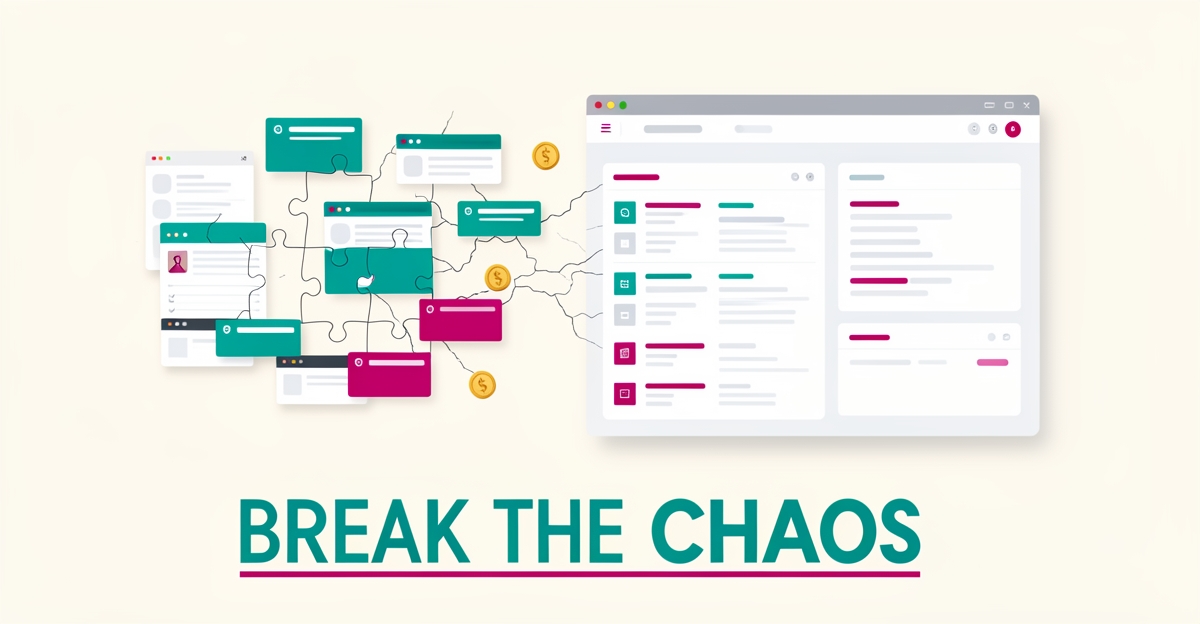
Key facts
- The global auto repair shop management software market hit $1.62B in 2024 and is projected to reach $3.32B by 2033 at an 8.1% CAGR according to market research.
- Shops using separate apps report up to 50% slower communication and 50% more no-shows than those using integrated platforms per industry benchmarks.
- Consolidated platforms can deliver up to 30% revenue growth and 10% higher profit margins by eliminating redundant tools based on platform case studies.
- Industry consolidation saw over 450 shop locations acquired in 2024 with over $9B in capital entering the market since November 2023 per industry analysis.
- Fragmented software stacks force employees to waste time switching between systems, increasing training overhead and maintenance costs research confirms.
- A single cloud-based platform enables remote access and multi-location management, scaling with your shop’s growth per market trends.
- One integrated system replaces six separate subscriptions, saving shops roughly $300/month in software costs while unlocking operational efficiencies from platform benchmarks.
WANT RESULTS LIKE THIS?
Imagine a system doing all of this for your local business — every day, without you.
We build local businesses a custom website with a team of AI behind it: every lead captured and followed up, new content published monthly,customers finding you on Google — live in 7 days.
- 85+ pages at launch
- Every lead followed up, automatically
- Your whole business on one screen
The Problem: Six Subscriptions Creating One Big Headache
Most shop owners don't set out to build a software stack — they just add tools one problem at a time. A chat widget here, a scheduling app there, a separate CRM, an email platform, and suddenly you're managing six subscriptions that don't talk to each other.
The global auto repair shop management software market reached $1.62 billion in 2024 and is projected to hit $3.32 billion by 2033, growing at an 8.1% CAGR as more shops recognize the cost of fragmentation according to market research. That growth reflects a fundamental shift: owners are tired of paying for disconnected tools that create more work than they save.
- Training overhead multiplies with every new platform employees must learn
- Maintenance and updates eat hours across multiple vendor dashboards
- Staff waste time switching between systems for scheduling, messaging, and payments
- Data lives in silos, making it impossible to see the full customer journey
Research confirms that juggling separate applications for chat, CRM, scheduling, and email creates significant inefficiencies including training overhead, maintenance costs, and wasted employee time. One integrated system eliminates redundant subscriptions and simplifies workflows through a single login as Bolton Technology notes.
Platforms demonstrating this consolidation show measurable results: up to 30% revenue growth, 50% faster communication, and 50% reduction in no-shows per industry benchmarks. When your website, CRM, scheduling, and follow-up all live in one place, you stop managing software and start running your shop.
The Solution: One System to Rule Your Auto Shop Operations
Fragmentation isn’t just slowing your shop down—it’s costing you customers. When leads slip through the cracks, communication drags, and no-shows pile up, the problem isn’t your team’s effort—it’s the patchwork of disconnected tools. One fragmented system for chat, another for CRM, a third for scheduling, and a fourth for emails means double data entry, missed follow-ups, and frustrated customers waiting on hold. The numbers don’t lie: shops using separate apps report up to 50% slower communication and 50% more no-shows than those running everything in one place.
Consolidation fixes the chaos. A single platform that handles scheduling, CRM, invoicing, and customer communication from one login eliminates the gaps that bleed revenue. Instead of switching between apps, your team works in one system where every interaction—calls, chats, emails, and bookings—flows into the same pipeline. The result? Up to 30% revenue growth within months, tighter margins, and a schedule that stays full without constant manual firefighting. Fewer tools mean fewer logins, fewer logouts, and fewer chances for a lead to slip away.
Here’s what consolidation can do for your shop:
- 30% revenue growth: Integrated systems streamline workflows so your team spends less time managing software and more time serving customers.
- 50% faster communication: No more waiting on hold or digging through apps—responses are instant and tracked in one place.
- 50% fewer no-shows: Automated reminders and follow-ups keep appointments filled and revenue steady.
- 10% higher profit margins: Fewer errors, less double data entry, and clearer visibility into pricing and parts tracking.
- One login for everything: From booking to billing, your entire workflow runs in a single system that keeps growing with your shop.
The alternative—sticking with fragmented tools—means more subscriptions, steeper training curves, and constant context-switching that drains productivity. Shops that adopt integrated platforms report real gains: one provider saw $1.2M in sales growth and 54% higher gross profit after consolidating their stack. The market is moving this way too. The global auto repair shop management software market is on track to hit $3.32 billion by 2033, driven by shops trading disjointed tools for systems that scale without the complexity.
At AI Business Sites, we’ve seen shops reclaim hours every week by replacing five separate subscriptions with one platform that runs their website, CRM, and operations from a single dashboard. The difference isn’t just fewer logins—it’s a system that works while you focus on repairs, not reminders.
What to Look for in a Consolidated Auto Shop Platform
When you're evaluating a single platform to replace a stack of disconnected tools, the stakes are simple: every extra login is a leak in your workflow. The market for auto repair shop management software has already validated this shift — it reached $1.62 billion in 2024 and is projected to hit $3.32 billion by 2033, driven by shops consolidating onto integrated, cloud-based platforms.
Start with seamless integration. The research identifies six core functions these platforms cover — appointment scheduling, inventory management, billing and invoicing, CRM, reporting and analytics, and "others" — and the value only materializes when data flows between them without double-entry. Look for native connections to accounting software like QuickBooks or Xero, parts suppliers, and OEM-level diagnostic tools. Integration gaps requiring manual re-entry are a primary pain point driving shops to replace their stack in the first place.
Cloud-based deployment isn't optional anymore. It's outpacing on-premises solutions because it enables remote access and multi-location management — critical as the industry consolidates, with over 450 locations acquired in 2024 and more than $9 billion in capital entering the market since late 2023. A cloud platform scales with you whether you're adding a second bay or a second location.
- Unified dashboard covering scheduling, CRM, invoicing, and reporting in one view
- Native integrations with accounting, parts catalogs, and diagnostic tools
- Cloud access for remote management and multi-shop visibility
- Intuitive interface that reduces onboarding time for new hires
- Proven ROI metrics — up to 30% revenue growth and 50% fewer no-shows
User experience determines adoption. Training employees on one unified system is faster than managing multiple disjointed platforms, and new hires adopt intuitive software quicker. The platforms report. Finally, demand real-world proof. Platforms demonstrating measurable outcomes — up to 30% revenue growth, 50% faster communication, and 50% reduction in no-shows — are the ones that actually replace the chaos of six subscriptions with a system that runs the shop.
At AI Business Sites, we see the same pattern across service businesses: the website shouldn't just sit there — it should handle the busywork of capturing leads, following up, and keeping the calendar full, all from one login. The principle is identical whether you're running a repair shop or a plumbing business — consolidation wins when the platform actually does the work.
Local business: doing this the old way?
One system replaces the whole pile.
All of it — the website, the follow-up, the content, the leads — built and run for you for $1,497 + $497/mo. Month-to-month, and you own everything.
See what your build includesHow to Migrate Without Disrupting Your Business
Switching systems feels risky when every day without a working shop costs money. A structured migration plan turns that risk into a series of controlled steps — so the shop keeps running while the new platform comes online.
Start with a complete software stack audit. List every subscription — chat, CRM, scheduling, email, invoicing, parts ordering — and note the monthly cost, who uses it, and what data lives inside. Research shows that juggling multiple tools creates training overhead, maintenance costs, and wasted employee time switching between systems, making this inventory the foundation for calculating real savings. Identify which tools duplicate each other and which hold critical historical records like customer histories, vehicle service records, and approved estimate templates.
- Map every data source: CRM contacts, scheduling history, invoice records, parts catalogs, and communication logs
- Flag mission-critical data that must migrate perfectly — customer profiles, vehicle histories, open repair orders
- Archive legacy data that stays in the old system for reference but doesn't need daily access
- Document current workflows so you can replicate or improve them in the new platform
Choose a platform with proven integration capabilities. The ability to synchronize data across accounting software, parts suppliers, and diagnostic tools eliminates the double-entry that drains productivity. Cloud-based deployment adds remote access and multi-location flexibility — increasingly important as the auto repair shop management software market grows toward $3.32 billion by 2033 at an 8.1% CAGR. Prioritize solutions demonstrating measurable outcomes: up to 30% revenue growth, 50% faster communication, and 50% reduction in no-shows.
Run a parallel period — typically two weeks — where the new system shadows live operations. Process the same repair orders in both platforms, compare outputs, and let staff build confidence without pressure. Train one role at a time: service advisors first, then technicians, then front office. Training employees on one unified system is faster than managing multiple disjointed platforms, and new hires adopt intuitive interfaces quicker.
Go live on a slow day with a designated super-user on the floor. Keep the old system accessible for 30 days as a safety net, then decommission. AI Business Sites helps shops consolidate chat, CRM, scheduling, and email into a single login — so the migration isn't just a software swap, it's the last time you'll need to do one.
Real-World Results: What Shops Gain by Consolidating
Juggling multiple software subscriptions for chat, scheduling, and CRM isn’t just a productivity drain—it’s quietly eating into your bottom line. Shops using fragmented systems report spending over 20% more time on manual data entry and follow-ups than those running consolidated operations on a single platform. The result? Missed follow-up opportunities that directly impact revenue, with industry benchmarks showing up to 30% revenue growth for shops that eliminate redundant tools in favor of an all-in-one solution.
Consolidation isn’t theoretical. Independent garage owners like Mike Reynolds of Reynolds Auto Care in Ohio saw his team’s response time drop by nearly 50% after replacing five separate subscriptions with a unified system. His technicians now access work orders, customer histories, and parts inventory from the same dashboard where he tracks technician utilization and appointment gaps in real time. “I used to juggle three logins just to confirm a customer’s last service history before writing an estimate,” Reynolds says. “Now it’s all right there—no more dead air between the shop and the front counter.”
Other shops report similar wins when they stop paying for—and managing—multiple monthly subscriptions. Consider these real impacts from shops that made the switch:
- A 50% reduction in no-shows after implementing automated appointment reminders tied directly to the CRM and calendar system
- Up to 10% higher profit margins by eliminating double data entry across inventory, billing, and customer records
- A 47% increase in sales and 54% increase in gross profit after consolidating lead capture, email follow-ups, and project tracking into one workflow
The math adds up: an average shop running six separate subscriptions spends roughly $300 monthly on software alone. Consolidate that into one platform, and the savings alone can fund a part-time dispatcher or cover a technician’s benefits—while the efficiency gains unlock capacity for growth. For shops like Reynolds Auto Care, the shift wasn’t about buying “more software.” It was about removing the friction that keeps customers waiting and profits slipping through the cracks.
Frequently Asked Questions
How much money am I actually wasting by using separate apps for chat, scheduling, CRM, and email?
Will switching to an all-in-one platform disrupt my daily operations?
What specific results have other shops seen after consolidating their software stack?
How do I know which platform actually integrates everything instead of just claiming to?
Is the market really moving toward consolidated platforms, or is this just vendor hype?
What should I audit first before committing to a new platform?
Stop Managing Software—Start Growing Your Auto Shop
Running six separate subscriptions to handle chat, scheduling, CRM, and more doesn’t just drain your budget—it steals time from the work that actually grows your business. When tools don’t talk to each other, leads fall through the cracks, customers wait on hold, and your team wastes hours jumping between systems. The market is already moving toward consolidation, with the auto repair shop management software sector on track to hit $3.32 billion by 2033 as owners trade fragmentation for efficiency. The data proves it: shops that consolidate their stack see up to 30% revenue growth, 50% faster communication, and 50% fewer no-shows by keeping everything in one place. If your current setup feels like a puzzle of logins and manual work, it’s time to simplify. Start by auditing your subscriptions—identify redundancies, lost productivity, and the true cost of doing business across multiple platforms. Then, look for a single system that handles scheduling, CRM, invoicing, and customer communication without the chaos. The goal isn’t just to save money on subscriptions; it’s to free up your team to focus on what matters most: serving customers and growing revenue. Ready to see how one platform can run your shop instead of the other way around?
FOR local businesss — BUILT AND RUN BY US
Your website. Your content. Your leads. Your data.
$500 starts your build. Seven days later it's live — chat, booking, follow-up, and your Google presence all set up. Then we run it, every month. You do the work you actually get paid for.