
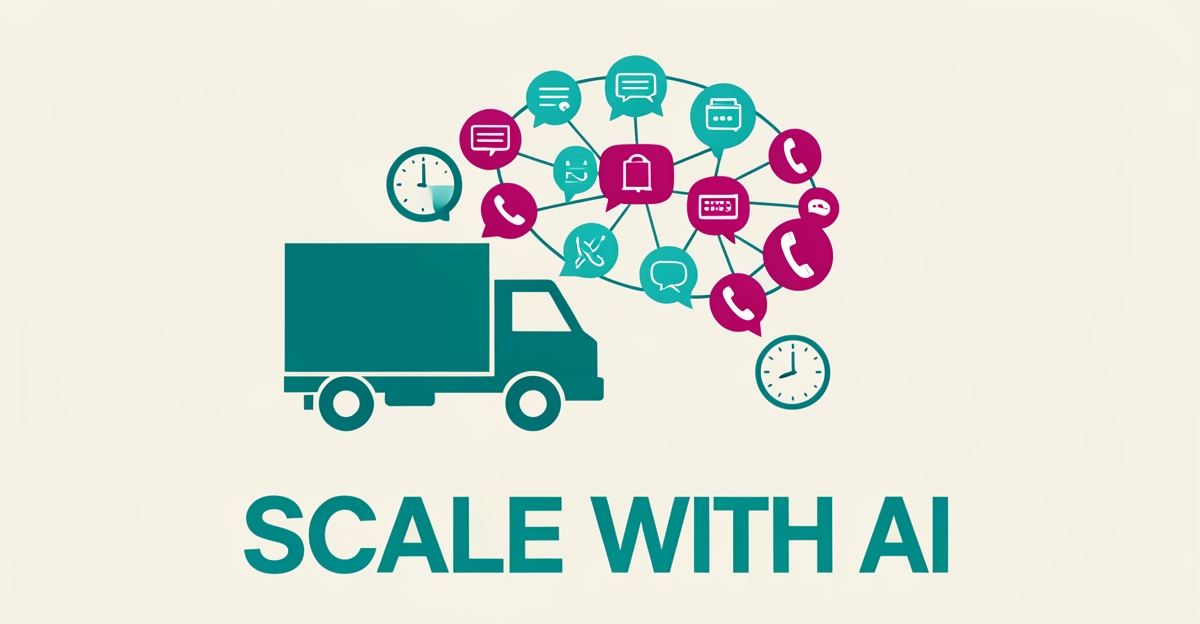
Key facts
- 67% of global service managers use generative AI for real-time hyper-personalization according to IBM.
- Conversational AI reduces cost per contact by 23.5% and increases revenue by 4% on average IBM reports.
- 70% of service teams use AI for predictive sentiment analysis to prevent escalations as found by IBM.
- Summer search volume exceeds winter by 31% in the moving industry Supermove analyzed.
- Mature AI adopters in service see 17% higher customer satisfaction and 15% higher agent satisfaction IBM research shows.
- AI adoption is the top-cited trend for 2025 among moving company professionals Supermove's survey reveals.
- Rising operational costs are the single biggest challenge facing moving companies, with AI positioned as the primary solution JK Moving highlights.
WANT RESULTS LIKE THIS?
Imagine a system doing all of this for your local business — every day, without you.
We build local businesses a custom website with a team of AI behind it: every lead captured and followed up, new content published monthly,customers finding you on Google — live in 7 days.
- 85+ pages at launch
- Every lead followed up, automatically
- Your whole business on one screen
Why Manual Communication Is Costing Your Moving Business
Manual communication is quietly bleeding your moving business dry. Missed after-hours calls, tangled email threads, and unanswered follow-ups aren’t just annoyances—they’re costing you real revenue during the busiest months of the year. When corporate clients can’t reach someone on a Friday evening or a weekend, they don’t leave a message; they move to the next mover on their list. That single missed call can mean a contract lost to a competitor who answered instantly.
Rising operational costs are the single biggest challenge facing moving companies this year, and AI is being positioned as the primary way to push back. Industry leaders call AI a game-changer, with voice agents specifically highlighted for handling after-hours and weekend calls. Yet most moving businesses still rely on manual processes that can’t scale—leaving you stretched thin while corporate clients expect real-time updates and proactive communication.
- After-hours calls: Most moving companies stop answering at 5:00 p.m., even though summer demand peaks in August and searches exceed winter volumes by 31%.
- Email threads: Fragmented conversations across inboxes and team members lead to delayed responses and missed details, especially when leads come in from multiple sources at once.
- Follow-up gaps: Manual CRM updates mean leads sit untouched over weekends or holidays, while competitors automate responses and stay top of mind.
- Corporate client expectations: Large accounts demand consistent status updates, and 70% of service teams now use AI for predictive sentiment analysis to prevent escalations before they happen.
The result is a direct hit to your bottom line. Conversation-ready AI systems reduce cost per contact by 23.5% and increase annual revenue by 4% on average, yet most moving businesses still operate with tools that weren’t designed for modern customer expectations. A centralized communication system that handles two-way email, voice, chat, automated follow-ups, and CRM-integrated status updates becomes not just an efficiency play—it’s the difference between winning the corporate contract and watching it slip away.
How AI-Powered Communication Systems Solve the Moving Industry’s Biggest Gaps
Moving businesses are drowning in fragmented communication — missed after-hours calls, scattered email threads, and manual status updates that eat up time and erode client trust. A centralized, CRM-integrated AI communication system solves these gaps by automating routine interactions while preserving human oversight where it matters most.
According to IBM research, 66% of global service managers use generative AI for real-time hyper-personalization, and 70% use it for predictive sentiment analysis to prevent issues before escalation. This means moving companies can deploy AI to tailor status updates based on client history and emotional tone — sending a reassuring message when a delay is detected, for example — without manual effort. The system handles these proactive touchpoints 24/7, ensuring corporate clients stay informed throughout the move lifecycle.
Hybrid AI-human models are now the industry standard for 2026, as highlighted by Gleap’s analysis: AI resolves repetitive requests like booking confirmations or crew dispatch alerts, copilots assist agents with conversation summaries, and humans manage complex or relationship-sensitive moments with full context. For moving businesses, this means AI can automate lead follow-ups and milestone notifications — such as when loading is complete or delivery is scheduled — while flagging exceptions like pricing disputes or special handling requests for human review. This approach keeps operations scalable without sacrificing service quality.
Multichannel continuity is equally critical. Customers expect seamless support across chat, email, and phone, with all interactions sharing the same context instead of creating fragmented conversations. A centralized platform ensures every touchpoint — whether a web form submission at midnight or a voice call during peak season — lands in one CRM timeline with automated tagging, pipeline progression, and status updates. AI Business Sites’ platform enables this by unifying lead capture, two-way email, and proactive updates under a single system, reducing the manual effort required to keep corporate clients informed while maintaining the personal touch that builds long-term trust.
Local business: doing this the old way?
One system replaces the whole pile.
All of it — the website, the follow-up, the content, the leads — built and run for you for $1,497 + $497/mo. Month-to-month, and you own everything.
See what your build includesImplementing AI Communication in Your Moving Business: A Step-by-Step Approach
Moving companies that still rely on scattered email threads and voicemails are losing leads before they even pick up the phone. A centralized communication system changes that by turning every inquiry — whether it comes through a web form, a late-night call, or a chat widget — into a tracked conversation that moves itself forward.
Start by deploying an AI voice agent that answers every call, captures details, books appointments, and syncs to your CRM around the clock. Mark Miyashita, CTO of Supermove, calls this "a major technology trend for moving companies in 2025, particularly for handling after-hours and weekend calls" that integrate directly into automations for faster response. IBM research confirms conversational AI reduces cost per contact by 23.5% while increasing revenue 4% on average.
Next, bring every channel into one CRM-integrated platform so nothing falls through the cracks. Gleap emphasizes that customers expect "seamless support across chat, email, in-app widgets, and social channels; a unified platform ensures AI and human agents share the same context instead of creating fragmented conversations." This is where AI Business Sites fits naturally — your website already captures leads, and the platform behind it routes every interaction into a single timeline with automated tagging and pipeline progression.
- Set up automated status triggers for every move milestone: booking confirmed, crew dispatched, loading complete, in transit, delivery scheduled, delivered
- Configure two-way email updates clients can reply to — AI drafts the response, your team reviews only when needed
- Use confidence-based escalation: full autopilot for routine confirmations, approve-first for scope changes, manual review for complaints
Finally, let the system nurture leads while you focus on the move. MoversDev lists "Automation in Client Communications" as the #1 AI benefit for movers, noting it enhances client communication "without additional manual effort." With automated follow-ups, proactive delay notifications, and milestone confirmations running in the background, your team stays informed without staying glued to the inbox.
Frequently Asked Questions
Why is manual communication costing my moving business revenue?
How does AI-powered communication solve the moving industry's biggest gaps?
What is the impact of not adopting AI for client communications in the moving industry?
How does a hybrid AI-human model work in moving business communications?
What are the key benefits of implementing AI communication in my moving business?
How soon can I expect to see results from implementing an AI-powered communication system?
Your Website Should Work While You Sleep
The moving industry isn't waiting — 70% of service teams already use AI for predictive sentiment analysis, and companies deploying conversational AI see 23.5% lower cost per contact with a 4% revenue lift. The gap between manual communication and a centralized, CRM-integrated system isn't just operational; it's the difference between capturing every corporate lead and watching them slip to competitors who answer instantly. AI Business Sites builds custom websites that handle this automatically: an AI voice agent answers after-hours calls, two-way email keeps clients updated at every milestone, and automated follow-ups nurture leads while your crew focuses on the move. Everything lives in one timeline — no scattered threads, no missed details, no weekend gaps. You own the code, the content, and the data, with no long-term contracts. Ready to stop losing leads to voicemail? See how a website that runs your business changes the math.
FOR local businesss — BUILT AND RUN BY US
Your website. Your content. Your leads. Your data.
$500 starts your build. Seven days later it's live — chat, booking, follow-up, and your Google presence all set up. Then we run it, every month. You do the work you actually get paid for.