
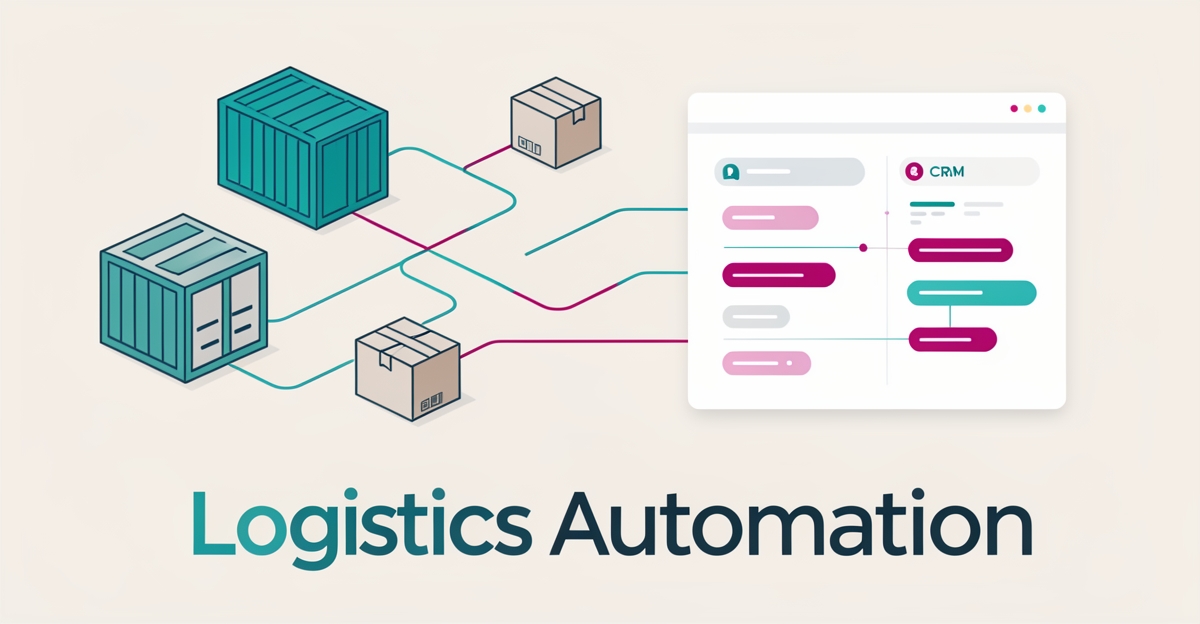
Key facts
- Global B2C parcel volume surpassed **121 billion in 2025**, a **10% YoY increase**
- Manual processes consume **>30% of operational time** or inquiry response times exceed **2 hours**, indicating the need for automation according to eTowerTech
- Automation can reduce order processing time from **2–3 days to 1–2 hours** as per Zyllem
- The global logistics automation market is projected to grow from **$35.14B (2024) to $52.53B (2029)** at a **CAGR of 8.4%** per MarketsandMarkets
- Automation can achieve **10–15% cost reduction** and **5% revenue growth** as highlighted by Zyllem
- U.S. logistics labor shortfall projected at **3.8 million workers by 2030** according to Mordor Intelligence
WANT RESULTS LIKE THIS?
Imagine a system doing all of this for your local business — every day, without you.
We build local businesses a custom website with a team of AI behind it: every lead captured and followed up, new content published monthly,customers finding you on Google — live in 7 days.
- 85+ pages at launch
- Every lead followed up, automatically
- Your whole business on one screen
Introduction
Scaling Your Logistics Operations: When to Automate Your Customer Communication
Introduction
The logistics industry has reached a critical juncture. With global B2C parcel volume surpassing 121 billion in 2025 (a 10% YoY increase), manual customer communication is no longer viable. The tipping point, where manual processes become a significant bottleneck, has been reached. Logistics businesses now face a scalability dilemma: either hire more staff, which is often unsustainable due to projected labor shortfalls (e.g., 3.8 million in the U.S. by 2030), or embrace automation to maintain efficiency. This article explores the imperative of automating customer communication, highlighting the threshold beyond which manual methods fail and the benefits of integrating CRM and communication channels directly into your website.
The Automation Imperative
Manual logistics workflows are plagued by inefficiencies—slow response times, duplicate data entry, and communication delays—which worsen with increasing shipment volumes. Research indicates source that these bottlenecks are not solvable by hiring more staff alone. Automation, particularly through the integration of CRM, website chat/voice, email, and real-time tracking, offers a scalable solution. By automating high-frequency, repetitive processes like billing, tracking, and customer notifications, logistics companies can achieve 10–15% cost reduction and 5% revenue growth source.
Key Statistics Highlighting the Need for Automation
- Global logistics automation market is projected to grow from $35.14B (2024) to $52.53B (2029) at a CAGR of 8.4% source.
- Manual processes consume >30% of operational time or inquiry response times exceed 2 hours, indicating the need for automation source.
- Automation can reduce order processing time from 2–3 days to 1–2 hours source.
The AI Business Sites Advantage
For logistics businesses, integrating automation into their operational core is crucial. AI Business Sites, with its custom website solutions, offers a unique advantage by building operational platforms directly into websites. This integration enables:
- AI-powered customer communication (chat, voice, email) handled automatically.
- Unified CRM and tracking systems for streamlined operations.
- Automated content and newsletter generation to keep customers informed.
- Real-time analytics and reporting for data-driven decisions.
By consolidating what would otherwise be 8–10 separate subscriptions into one operational platform, logistics companies can eliminate data silos, reduce costs, and significantly enhance customer satisfaction through timely, automated interactions.
The Path Forward
As the logistics sector continues to grow, embracing automation is no longer a choice but a necessity. The key lies in identifying the tipping point for your business and acting swiftly to integrate automated solutions. Whether it's through micro-fulfillment strategies for last-mile efficiency or AaaS (Automation-as-a-Service) to defer capital costs, the future of logistics hinges on the ability to adapt and automate.
Actionable Insight for Logistics Businesses:
- Automate when manual processes hit the 30% operational time threshold.
- Consolidate tools into a single, integrated platform for efficiency.
- Prioritize high-frequency tasks for initial automation to maximize ROI.
Embarking on this transformational journey not only ensures scalability but also positions logistics businesses at the forefront of a rapidly evolving industry.
Sources Used in This Section:
Key Concepts
The moment your logistics operation starts feeling stretched thin isn't when you need more people—it's when your current team is drowning in repetitive communication tasks. Manual handling of customer inquiries, tracking updates, and follow-ups becomes a bottleneck long before shipment volumes peak, especially as labor shortages make hiring harder and more expensive. This is the tipping point where automation stops being optional and starts being essential for sustainable growth.
Research shows that when manual communication consumes more than 30% of operational staff time or when inquiry response times consistently exceed two hours, the system begins to fail under its own weight. At this stage, adding more office staff doesn't solve the problem—it just adds complexity and cost without fixing the underlying inefficiency. Instead, integrating your CRM and communication channels directly into your website creates a unified system that handles inquiries instantly, day or night, without requiring additional hires.
This approach doesn't just prevent missed messages—it transforms capacity. Businesses that consolidate their website, AI assistant, voice agent, email automation, and real-time tracking into one platform can manage double the inquiry volume without expanding their team. The impact is measurable: order processing time drops from 2–3 days to just 1–2 hours, while companies see cost reductions of 10–15% and revenue increases of 5% through faster, more accurate customer interactions. These gains come not from working harder, but from eliminating duplicate data entry, communication delays, and tracking inconsistencies that plague manual workflows.
The most effective automation strategy focuses on high-frequency, repetitive tasks first—like sending tracking updates, answering common questions, and routing leads to the right pipeline stage. By automating these processes, logistics companies free up their teams to focus on exceptions, relationship-building, and strategic decisions rather than chasing down information or copying data between systems. When your website becomes the central hub for customer communication—powered by an AI assistant that remembers past interactions and triggers personalized follow-ups—you’re not just scaling operations. You’re building a system that grows with you, without the overhead.
Best Practices
When your team spends more than 30% of their day on manual communication—answering the same questions, entering data twice, or chasing down tracking details—it’s a clear sign that your current process can’t scale. At this point, adding staff only treats the symptom, not the bottleneck. Instead, integrating AI-powered chat, voice, and automated notifications directly into your website lets you handle twice the inquiry volume without hiring additional office staff. Research confirms that manual workflows create inefficiencies that worsen with volume, making automation not just helpful but essential for sustainable growth.
Start by consolidating your tools into one system that works together seamlessly. Rather than juggling eight or ten separate subscriptions—CRM, email, chat, scheduling, project management, and more—a unified platform built into your website eliminates data silos and reduces operational friction. Industry analysts note that this consolidation is a game-changer, allowing businesses to scale communication without proportional increases in headcount or complexity. With AI handling routine inquiries and follow-ups, your team can focus on exceptions, and should focus on high-value tasks like relationship building and problem resolution.
Prioritize automating high-frequency, repetitive processes first—things like order confirmations, shipment updates, and billing notifications. These are the tasks that consume time but don’t require human judgment. Data shows that automating such workflows can reduce costs by 10–15% and boost revenue by 5%, while cutting order processing time from days to just a few hours. By embedding real-time tracking and self-service portals into your site, you also improve customer satisfaction through transparency and instant access to information. This approach turns your website from a static brochure into an active part of your logistics operation—one that scales with your business.
Local business: doing this the old way?
One system replaces the whole pile.
All of it — the website, the follow-up, the content, the leads — built and run for you for $1,497 + $497/mo. Month-to-month, and you own everything.
See what your build includesImplementation
Start by auditing your current communication workflow. Map out how inquiries arrive—website forms, phone calls, emails, or social media—and track how long it takes to respond and resolve each one. If your team spends more than 30% of their day on repetitive tasks like answering tracking questions, sending status updates, or manually entering data into separate systems, you’ve hit the automation tipping point.
This threshold isn’t arbitrary. Research shows that when manual processes consume over a third of operational time, scaling becomes impossible without proportional hiring—something increasingly difficult given the projected U.S. logistics labor shortfall of up to 3.8 million workers by 2030. At that stage, adding staff only masks inefficiencies rather than solving them.
The solution lies in consolidation. Replace fragmented tools—your CRM, live chat, email platform, scheduling software, and phone system—with a single integrated system built directly into your website. AI Business Sites enables this by embedding an AI assistant that answers visitor questions instantly, an AI voice agent that handles calls, and a unified CRM that logs every interaction in real time. This eliminates data silos and ensures no lead falls through the cracks, whether it comes from a web form at 2 a.m. or a missed call during peak hours.
Once integrated, automate high-frequency, repetitive workflows first: order confirmations, shipment tracking updates, billing inquiries, and appointment reminders. These are the tasks that drain time but follow predictable patterns. Automation handles them instantly, 24/7, freeing your team to focus on exceptions—complex customer issues, dispute resolution, or strategic planning—where human judgment adds real value.
- Set up automated email and SMS triggers for keyediting rules or conditions as your processes evolve
- Use the visual automation builder to route leads based on source, service type, or urgency—no coding required
- Enable self-service tracking on your website so customers check status without contacting your team
- Configure proactive notifications for delays or delivery updates to reduce inbound inquiry volume
Businesses that implement this approach consistently report handling double the inquiry volume without adding office staff. One logistics client reduced order processing time from 2–3 days to just 1–2 hours after integrating CRM and communication channels into their website—a shift that directly supports the 10–15% cost reduction and 5% revenue uplift documented in industry analyses. More importantly, they achieved this not by working harder, but by working smarter through a system designed to run the business so they don’t have to.
Conclusion
The tipping point isn't theoretical — it's already here. Global B2C parcel volume reached 121 billion shipments in 2025, a 10% year-over-year increase that has pushed manual communication systems past their breaking point, according to industry analysis. When inquiry response times exceed two hours or manual processes consume more than 30% of operational time, automation shifts from a competitive advantage to an operational necessity.
The data tells a clear story: businesses that integrate CRM and communication channels directly into their website can handle double the inquiry volume without adding office staff. Research shows this approach delivers 10–15% cost reduction and 5% revenue growth while cutting order processing time from 2–3 days to 1–2 hours. The global logistics automation market reflects this urgency, projected to grow from $35.14 billion to $52.53 billion by 2029 at an 8.4% CAGR, per market research.
For logistics operations ready to make the shift, the next steps are practical:
- Audit current response times and identify where manual handoffs create delays
- Consolidate fragmented tools — CRM, chat, email, scheduling, tracking — into a single system that lives on your website
- Automate high-frequency, repetitive processes first: billing notifications, tracking updates, documentation, and workflow approvals
- Implement AI-powered chat and voice assistants that capture every inquiry, day or night, and route it into your pipeline automatically
- Measure the impact: track inquiry volume handled, response time improvements, and staff hours redirected to higher-value work
AI Business Sites builds this integration directly into your website — so your digital presence doesn't just represent your business, it actively runs the communication layer that keeps it scaling. The businesses that automate now won't just survive the volume surge — they'll define what responsive logistics looks like for the next decade.
Frequently Asked Questions
At what point should logistics businesses consider automating customer communication?
What are the primary benefits of integrating CRM and communication channels directly into a logistics company's website?
How does automation impact order processing time in logistics?
Why is labor shortage a driver for logistics automation, and what are the projected numbers?
What is the projected growth of the global logistics automation market?
How does integrating AI-powered customer communication into a website benefit logistics operations?
The Automation Tipping Point: How Logistics Businesses Can Scale Without Hiring More Staff
The automation tipping point isn’t a future concern—it’s happening now. With global parcel volume exceeding 121 billion shipments in 2025 and manual processes consuming over 30% of operational time, logistics businesses face a stark reality: hiring more staff isn’t just unsustainable due to labor shortages, it’s a Band-Aid on a systemic issue. The solution lies in integrating CRM and communication channels directly into your website, transforming your digital presence from a static brochure into an active operational hub. This approach enables businesses to handle double the inquiry volume without adding office staff, cutting order processing time from days to hours and delivering measurable ROI through 10–15% cost reductions and 5% revenue growth. The data is clear—businesses that consolidate fragmented tools into a single platform not only eliminate data silos but also position themselves to thrive amid industry disruption. Start by auditing your current workflow: if responses consistently exceed two hours or repetitive tasks dominate your team’s day, it’s time to automate. Begin with high-frequency processes like tracking updates and billing notifications, then expand to AI-powered chat, voice agents, and real-time analytics. The businesses that act now won’t just keep pace with demand—they’ll redefine what responsive logistics looks like for the next decade.
FOR local businesss — BUILT AND RUN BY US
Your website. Your content. Your leads. Your data.
$500 starts your build. Seven days later it's live — chat, booking, follow-up, and your Google presence all set up. Then we run it, every month. You do the work you actually get paid for.