
Key facts
- Shops using automated CRM platforms see up to 38% higher weekly revenue with no extra team effort per AutoVitals data
- 92% of consumers read online reviews before visiting a shop, and 71% prefer businesses that respond to reviews according to AutoVitals research
- Dealers using AI and automation are twice as efficient and nearly twice as profitable as peers per Cox Automotive 2025 study
- Over 60% of auto repair shops are expected to use AI by late 2026, with customer communication ranking third for ROI per WickedFile analysis
- Independent shops typically duct-tape 8–10 separate subscriptions creating data silos that drain profit per FlashCrafter comparison
- Recovering just 3–5 lapsed customers monthly at $300–600 per repair order pays for a $97/month automation plan several times over per FlashCrafter ROI analysis
- Average net margins for auto repair shops sit at 6.3%, making every recovered lead critical to profitability per WickedFile market data
WANT RESULTS LIKE THIS?
Imagine a system doing all of this for your local business — every day, without you.
We build local businesses a custom website with a team of AI behind it: every lead captured and followed up, new content published monthly,customers finding you on Google — live in 7 days.
- 85+ pages at launch
- Every lead followed up, automatically
- Your whole business on one screen
The Hidden Labor Costs of Manual Lead Follow-Up
The Hidden Labor Costs of Manual Lead Follow-Up
Every day, busy mechanic shops face a daunting reality: missed calls during rush hours, slow email replies, forgotten follow-ups on declined work, and no-show appointments. These inefficiencies not only frustrate staff but also bleed revenue. According to industry research, shops lose leads simply by being slow to reply, and with 92% of consumers reading online reviews before visiting and 71% preferring businesses that respond, the cost of manual lead management is more than just labor—it's lost opportunity.
Quantifying the Cost
- Average Repair Order (ARO) Value: $300–$600
- Average Net Margins for Auto Repair Shops: 6.3%
- Labor Hours Spent Manually Juggling Phone, Text, Email, and Review Platforms: Significant, with no direct revenue generation
Manual lead follow-up incurs substantial hidden costs. For instance, a shop with a modest 10 leads per day, requiring 5 minutes each for follow-up, accumulates 50 minutes (or ~1 hour) of labor daily. Over a month, this translates to approximately 20 hours of staff time that could be allocated to higher-value tasks or additional service deliveries.
The Automation Advantage
Unified automation platforms, like those offered by AI Business Sites, replace multiple subscriptions (CRM, booking, lead tracking, review management, and more) with a single, flat-monthly-fee system. By automating lead responses, appointment scheduling, and review management, shops can:
- Reduce Labor Burden: Free staff from tedious follow-ups and focus on high-value tasks.
- Increase Response Speed: Ensure instant replies to leads, reducing leakage.
- Enhance Reputation: Systematically solicit and respond to reviews, boosting local search visibility.
Actionable Insight
A shop recovering just 3–5 lapsed customers/month at an ARO of $300–$600 pays for a $97/month automation starter plan several times over. With over 60% of auto repair shops expected to use AI by late 2026, embracing unified automation today positions businesses for long-term efficiency and profitability.
Key Takeaways
- Manual lead management leads to significant revenue leakage through missed opportunities and labor waste.
- Automated platforms reduce labor burden, increase response speed, and enhance online reputation.
- Investing in automation can quickly pay for itself through recovered lapsed customers and increased efficiency.
By understanding and addressing the hidden labor costs of manual lead follow-up, mechanic shops can pivot towards more efficient, automated strategies that directly impact the bottom line.
Source References (Inline Links)
- industry research
- 92% of consumers
- 71% preferring businesses that respond
- over 60% of auto repair shops expected to use AI by late 2026
- AI Business Sites (contextual mention, no link as per instructions)
Why Fragmented Tool Stacks Create Money Leaks Between Visits
Most shop owners know their shop management software inside and out — it runs the bay, tracks inspections, and handles the POS. But the revenue doesn't leak while a car is on the lift. It leaks in the days and weeks between visits, when no system is watching.
According to FlashCrafter's analysis, independent shops typically duct-tape 8–10 separate subscriptions — website, CRM, scheduling, reviews, chat, analytics, documents, project management, newsletter, and media — creating data silos and duplicate entry that quietly drain profit. Shop management systems like Tekmetric, AutoLeap, and Protractor handle the bay workflow, but they lack the CRM, marketing automation, and lead nurturing that capture revenue between appointments. As FlashCrafter puts it: "Shop software runs the bay. But the money leaks happen between visits — and that's a different tool's job."
- Website and landing page builder
- CRM and marketing automation
- Review management and Google Business Profile tools
- Scheduling and chat widgets
- Analytics, document generation, and project management
The pricing spread across this fragmented stack is staggering. Entry-level tools like GoHighLevel start around $97/month, while full-featured shop platforms like Shop-Ware can climb to $6,500/month — and that's before adding separate subscriptions for reviews, chat, email marketing, and content. FlashCrafter's comparison shows Tekmetric at $179–439/month, AutoLeap at $179–449/month, and AutoVitals CRM at $489/month flat with unlimited two-way texting. Each additional tool means another login, another bill, and another place where customer data falls through the cracks.
AutoVitals reports that shops using their unified CRM see up to 38% higher weekly revenue with no extra work for the team — because automated reminders, review requests, and win-back campaigns run in the background while technicians focus on repairs. Research from WickedFile confirms the trend: over 60% of auto repair shops are expected to use AI by late 2026, with customer communication and scheduling ranked as the third highest-ROI application. The shops consolidating now aren't just saving on software costs — they're plugging the leaks that manual follow-ups and disconnected tools leave wide open.
What Integrated Automation Actually Delivers (Backed by Shop Data)
What Integrated Automation Actually Delivers (Backed by Shop Data)
In the high-stakes world of mechanic shops, where every missed call and slow response can translate to lost revenue, integrated automation platforms are revolutionizing the way businesses manage leads, interact with customers, and drive growth. Unlike manual, labor-intensive approaches, these unified systems deliver tangible, data-backed benefits that directly impact the bottom line.
According to AutoVitals, shops leveraging their integrated CRM platform see up to 38% higher weekly revenue with no additional team effort required. Moreover, loyal customers generate 23% higher Average Repair Orders (ARO), underscoring the long-term value of effective retention strategies. A compelling case study highlights how automated reminders eliminated no-shows entirely for one shop, preventing a common pitfall in manual scheduling processes.
Deloitte and WickedFile identify the three highest-ROI automation areas for mechanic shops: 1. Customer Communication & Scheduling 2. Review Management 3. AI-Driven Follow-Up Sequences. Platforms like AutoVitals and Podium handle these critical tasks within a single, flat-fee system, replacing the need for multiple subscriptions (e.g., separate CRM, scheduling, and review management tools).
For instance, FlashCrafter notes that consolidating tools can save shops from the complexities and costs of managing 8-10 separate subscriptions, streamlining operations and reducing overhead. By integrating CRM, booking, lead tracking, and more into one system, businesses can focus on what matters most—providing excellent service and growing their client base.
Actionable Outcomes from Integrated Automation:
- Enhanced Revenue: Up to 38% increase in weekly revenue (AutoVitals)
- Perfect Attendance: Automated reminders can eliminate no-shows (AutoVitals Case Study)
- Loyal Customer Boost: 23% higher ARO from retained customers (AutoVitals)
- Zero Missed Leads: AI-powered communication for after-hours lead capture (ShopMonkey, Podium)
- Structured Retention: Up to 172% lift in customer retention through CRM programs (FlashCrafter)
By embracing integrated automation, mechanic shops can break free from the inefficiencies of manual processes, ensuring every lead is captured, every customer is engaged, and every potential revenue stream is maximized, all while reducing the labor burden and costs associated with fragmented tool stacks.
Source Links (Embedded as Per Guidelines):
Local business: doing this the old way?
One system replaces the whole pile.
All of it — the website, the follow-up, the content, the leads — built and run for you for $1,497 + $497/mo. Month-to-month, and you own everything.
See what your build includesImplementation: From Manual to Automated Without the Chaos
The transition from manual follow-ups to automated lead management doesn't have to happen all at once — and for a busy shop, it shouldn't. The smartest path starts where the revenue leaks are widest: after hours.
- Add an AI voice agent for after-hours calls ($199/mo) so every missed call becomes a captured lead with a booked appointment
- Deploy automated review requests tied to completed visits — 92% of consumers read reviews before visiting, and 71% are more likely to choose a shop that responds
- Optimize your Google Business Profile so local search actually sends traffic your way
- Launch service reminder campaigns triggered by vehicle history and declined work — the same automation that eliminated no-shows entirely for shops using AutoVitals
This phased approach mirrors what vendors like AutoVitals and WickedFile see in the field. AutoVitals backs every implementation with 90 days of 1-on-1 training, and WickedFile reports most shops hit positive ROI within 60–90 days using entry-level tools. The key is consolidation — one platform replacing your website, CRM, booking, lead tracking, content engine, and newsletter for a flat monthly fee. Instead of duct-taping together eight subscriptions that don't talk to each other, you get a single system where every lead, review, and reminder flows through the same pipeline. Your website stops sitting there and starts running the business with you.
The Bottom Line: What This Costs vs. What It Recovers
The Bottom Line: What This Costs vs. What It Recovers
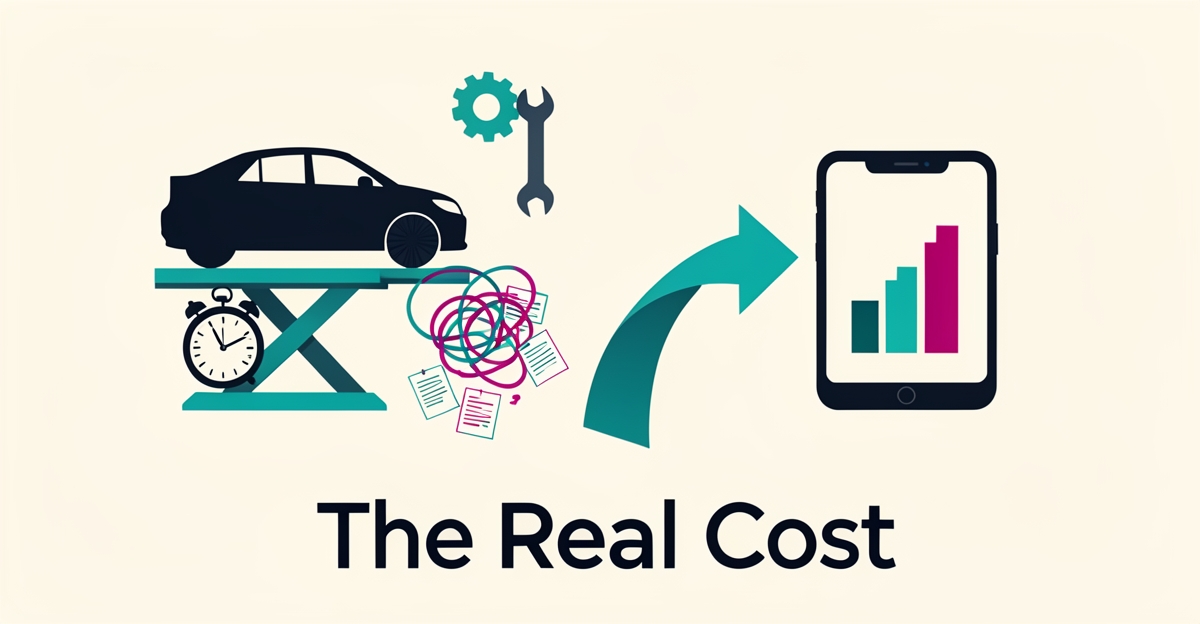
For mechanic shops weighing in-house follow-up against automation, the math starts with a simple comparison: entry-level automation tools begin at $97–$489 per month, while recovering just three to five lapsed customers at an average repair order of $300–$600 generates $900–$3,000 in recovered revenue monthly. FlashCrafter’s analysis confirms this ROI dynamic, noting that reclaiming even a handful of stalled opportunities pays for basic automation "several times over." The real savings, however, extend far beyond subscription fees.
Manual lead management consumes time that mechanics rarely account for: chasing declined estimates, logging interactions across spreadsheets and shop software, and manually triggering review requests after every visit. As ShopMonkey observes, "most businesses lose leads simply by being slow to reply" — a delay that compounds when follow-ups rely on memory or sticky notes. Their research highlights how fragmented tools create double-entry work and missed opportunities, turning lead management into a universal chore that pulls owners away from the bay. Automated platforms eliminate this friction by unifying CRM, booking, and follow-up triggers in one system, ensuring no lead falls through the cracks due to human oversight.
Beyond direct labor, automation recovers hidden value through consistency. AutoVitals reports shops using their CRM see up to 38% higher weekly revenue with "no extra work for the team," driven by reduced no-shows and higher average repair orders from loyal customers. Their data also shows 92% of consumers read online reviews before visiting a shop, yet manual review management is widely neglected — a gap AI-powered platforms close by automating review requests and responses. For AI Business Sites clients, this consolidation means owning the code, content, data, and domain while replacing eight to ten separate subscriptions with a single flat-fee platform that runs lead management, content, and customer engagement behind the scenes. The result isn’t just cost savings — it’s a self-sustaining system that turns follow-up from a burden into a reliable revenue stream.
Frequently Asked Questions
How much time and money am I actually losing by handling lead follow-ups manually instead of using automation?
What specific results have other mechanic shops seen after switching to an integrated automation platform?
I already use shop management software like Tekmetric or AutoLeap — why do I need a separate CRM and automation platform?
How much does automation actually cost compared to the fragmented tools I'm probably already paying for?
Is AI automation too complex or risky for a small shop without dedicated tech staff to implement?
What's the real ROI timeline — how quickly does automation pay for itself in a typical mechanic shop?
Your Bay Runs on Skill — Your Business Should Run on Systems
The math is unavoidable: every missed call, forgotten follow-up, and unreviewed Google profile is a repair order walking out the door. Shops using unified automation recover 3–5 lapsed customers a month at $300–$600 per ticket — covering the cost of a platform several times over — while AutoVitals data shows up to 38% higher weekly revenue with no extra effort from the team. The shift isn't about adding software; it's about replacing the duct-taped stack of 8–10 subscriptions with one system that captures leads, books appointments, solicits reviews, and nurtures customers between visits automatically. Over 60% of auto repair shops are expected to use AI by late 2026, and the ones consolidating now aren't just saving on tools — they're plugging the leaks that manual processes leave wide open. Start where the revenue bleeds most: after hours. Add an AI voice agent, automate review requests, and trigger service reminders from vehicle history. Your website should do more than sit there — it should run the business with you. Ready to see what that looks like for your shop?
FOR local businesss — BUILT AND RUN BY US
Your website. Your content. Your leads. Your data.
$500 starts your build. Seven days later it's live — chat, booking, follow-up, and your Google presence all set up. Then we run it, every month. You do the work you actually get paid for.