
Key facts
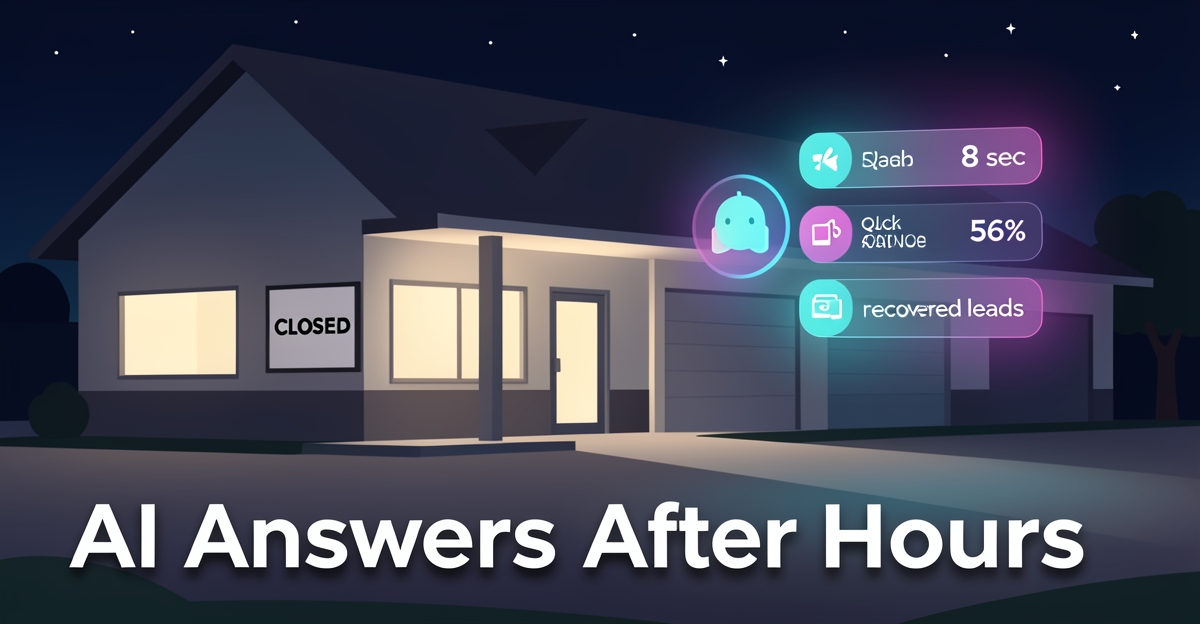
- 56% of new sales leads arrive after business hours when no one is available to respond according to Usefl.ai.
- AI reduces average response times from 4.2 hours to just 8 seconds as seen in a case study.
- 60% of customers hang up after waiting just 1 minute on hold highlighted by Usefl.ai.
- AI handles 75% of initial customer inquiries automatically as demonstrated in a dealership case study.
- Responding within 5 minutes increases lead qualification chances by 21x according to research.
- 44% of salespeople give up after just one follow-up attempt noted in a sales study.
- AI implementation improved customer satisfaction ratings from 72% to 89% in a documented case.
WANT RESULTS LIKE THIS?
Imagine a system doing all of this for your local business — every day, without you.
We build local businesses a custom website with a team of AI behind it: every lead captured and followed up, new content published monthly,customers finding you on Google — live in 7 days.
- 85+ pages at launch
- Every lead followed up, automatically
- Your whole business on one screen
The Rural Dealership Staffing Gap
Rural farm equipment dealers face a structural staffing problem that goes far beyond hiring difficulty. Industry research shows that 56% of new sales leads arrive after business hours when no one is available to respond, yet only 37% of dealerships manage to reply within an hour. Meanwhile, customers calling during the day encounter average hold times of 8 minutes and 12 seconds, and 60% hang up after just one minute on hold.
The economics of solving this with human staff alone are staggering. A case study of a multi-location dealership network calculated that providing true 24/7 human coverage would require 140 additional staff and cost over $8 million annually — equivalent to 185,000 staff hours per year. For rural operations with smaller teams and tighter margins, that level of investment simply isn't viable.
The consequences ripple through every part of the business:
- Missed after-hours leads — more than half of all inquiries arrive when the dealership is closed
- Abandoned calls — 32% of customers won't wait on hold at all, and 63% prefer a callback
- Inconsistent follow-up — 44% of salespeople give up after one attempt, though 80% of sales require 5–12 touches
- Plummeting satisfaction — unanswered calls drop Net Promoter Scores to 27
Phone frustrations directly erode customer loyalty, and in rural markets where reputation and word-of-mouth drive business, every missed interaction carries outsized weight. The staffing gap isn't just a scheduling problem — it's a revenue leak that compounds daily.
AI Business Sites works with rural dealerships to close this gap by building websites that handle inquiries automatically, day and night. The AI assistant answers questions instantly, captures lead details, and routes high-intent conversations to your team — so you're not paying for 24/7 coverage you can't afford, and you're not losing the leads that come in while you're closed.
What the Data Shows: AI Performance vs. Human Limits
What the Data Shows: AI Performance vs. Human Limits
In the quest for efficient customer inquiry management at rural dealerships, data unequivocally supports the superiority of AI systems over traditional human-only approaches in key metrics. A striking example is the dramatic reduction in response times, from an average of 4.2 hours with human teams to just 8 seconds with AI implementation, as highlighted in a case study by Business+AI source.
Speed and Consistency: The AI Advantage
- Response Time: AI reduces average response times from hours to seconds, ensuring immediate engagement. For instance, one dealership saw a drop from 4.2 hours to 8 seconds after adopting AI source.
- After-Hours Coverage: AI captures the 56% of leads that arrive outside business hours, a challenge for human-staffed dealerships, as noted by Usefl.ai source.
- Lead Management: AI handles 75% of initial inquiries automatically, freeing human staff for high-value tasks, according to Business+AI's case study.
The Bottom Line: Customer Satisfaction and Conversion
- Customer Satisfaction: AI implementation in one dealership improved satisfaction ratings from 72% to 89% source.
- Conversion Rates: Leads sourced through AI converted 18% higher than traditional leads in the same study.
- Follow-Up Persistence: AI eliminates the 44% of salespeople who quit after one follow-up attempt, ensuring consistent pursuit of leads source.
Key Takeaways for Rural Dealerships
- Prioritize AI for Initial Response: Harness AI's speed to be the first responder, especially for after-hours leads.
- Hybrid Model for Complex Interactions: Escalate complex inquiries to human staff for personalized handling.
- Monitor and Adjust: Continuously evaluate AI's performance and adjust strategies based on feedback and conversion data.
By embracing AI for what it does best—speed, consistency, and scalability—rural dealerships can significantly enhance their customer inquiry management, leading to higher satisfaction rates and improved conversion rates, all while maintaining the personal touch through strategic human intervention. AI Business Sites, with its integrated AI-powered website solutions, can facilitate this transition by providing a seamless platform for immediate responses, automated lead management, and enhanced customer engagement.
Why the Hybrid Model Wins for Equipment Dealers
For equipment dealers in rural markets, the most effective approach isn't choosing between human staff and AI—it's strategically combining both. Research shows that 31% of all customers, and 51% of Gen Z, already prefer using AI for routine service bookings, signaling strong acceptance for automated initial contact according to industry insights. This preference creates an opportunity to deploy AI as a first responder while preserving human expertise for what matters most.
The data reveals a clear division of labor where AI excels: handling initial inquiries, qualifying leads, and managing routine questions around the clock. One implementation found that AI managed 75% of initial customer inquiries, freeing human staff to focus on high-value activities as documented in a case study. This shift allowed sales teams to reduce time spent on repetitive questions by 65%, redirecting energy toward complex negotiations and relationship building that drive equipment sales.
However, generic AI falls short in critical areas that require industry-specific knowledge. Studies show 91% of automated responses lack payment details and 89% omit alternative vehicle suggestions—gaps that are especially problematic when discussing high-value farm equipment based on follow-up analysis. For rural dealers, this means AI must be trained on equipment specifications, financing options, and trade-in values to provide meaningful first responses before escalating qualified leads.
The hybrid model works best when structured around clear handoff protocols. AI handles initial contact, gathers essential information, and qualifies buyer intent, then seamlessly transfers high-potential prospects to human sales staff for detailed discussions. This approach leverages AI’s strength in speed and consistency—responding in seconds rather than hours—while ensuring complex negotiations benefit from human judgment and product expertise as demonstrated in operational improvements. For AI Business Sites clients, this means configuring their website’s AI assistant to recognize equipment-specific queries and trigger escalation paths that connect serious buyers with knowledgeable staff, turning automated efficiency into personalized service where it counts.
Local business: doing this the old way?
One system replaces the whole pile.
All of it — the website, the follow-up, the content, the leads — built and run for you for $1,497 + $497/mo. Month-to-month, and you own everything.
See what your build includesImplementation: From Resistance to Routine
The technology works. The harder part is getting your team to trust it. In one multi-location deployment, sales team resistance emerged as the biggest non-technical challenge — not integration issues, not data quality, but culture. The fix wasn't more training. It was changing how the rollout happened.
Start with after-hours coverage. That's where 56% of new sales leads arrive, and only 37% of dealerships respond within an hour. An AI assistant handling those nights and weekends captures revenue that currently evaporates while also giving your staff a low-stakes way to see the system work. They come in Monday morning to qualified appointments, not cold web forms.
- Deploy AI for lead qualification and scheduling first — not negotiation
- Restructure commissions to reward closed deals, not first touches
- Choose a system that integrates with your existing DMS/CRM rather than adding another dashboard
- Let AI handle the 5–12 follow-up touches that 44% of salespeople abandon after one attempt
The goal is fewer tools, not more. When AI Business Sites builds a website for a rural dealership, the AI assistant lives inside the same platform that runs the CRM, the automation, and the content — so leads from chat, phone, forms, and bookings all land in one place. No duplicate entry. No "which system has the latest note?" The average response time drops from hours to seconds, and the team spends 65% less time on routine inquiries. That's not a technology outcome. That's a workflow outcome — and it only sticks when the rollout respects the people who have to use it.
What This Means for Your Dealership Next Month
Start with the math that matters. Calculate your current cost per lead — including the 56% that arrive after hours when no one answers. Map every inquiry type by complexity: pricing checks, availability questions, and basic specs are low-complexity; trade-in negotiations and custom configurations are high. Then pilot AI on the highest-volume, lowest-complexity channel — usually web chat or after-hours phone.
- Measure response time against the 5-minute benchmark that makes leads 21x more likely to qualify
- Track lead-to-appointment rate — dealers improving ILE scores from under 40 to over 80 sell 50% more units from the same leads
- Quantify staff hours redirected from repetitive questions to high-value customer conversations
The research shows AI handles 75% of initial inquiries while cutting response time from 4.2 hours to 8 seconds. That's not a technology metric — it's a revenue metric. At AI Business Sites, we build websites that capture every inquiry, qualify automatically, and hand off ready-to-buy customers to your team — without hiring a night shift. Your website becomes the front desk that never closes, the follow-up engine that never forgets, and the qualification filter that lets your people do what they do best: close deals.
Frequently Asked Questions
How much does it really cost to staff a rural dealership for 24/7 coverage compared to using AI?
Will customers actually talk to an AI instead of a person, especially for expensive equipment?
What happens when a customer asks something the AI can't handle, like trade-in values or custom financing?
How fast does AI actually respond compared to our current team?
Our sales team is worried AI will replace them — how do we get buy-in?
Does AI follow-up actually work better than our salespeople who already try to follow up?
Key Takeaways
{ "title": "Revolutionizing Rural Dealerships: Where AI Meets Business Value", "content": "The staffing gap in rural farm equipment dealerships is not just a scheduling challenge, but a significant revenue leak. By embracing AI for initial response and lead qualification, dealerships can slash r
FOR local businesss — BUILT AND RUN BY US
Your website. Your content. Your leads. Your data.
$500 starts your build. Seven days later it's live — chat, booking, follow-up, and your Google presence all set up. Then we run it, every month. You do the work you actually get paid for.