
Key facts
- ["Mature AI adopters see a 17% increase in customer satisfaction IBM", "AI chatbots reduce customer service costs by up to 30% Softwired Web", "Conversational AI cuts cost per contact by 23.5% IBM", "67% of customers frustration stems from repeat explanations Kustomer", "Predictive analytics enable 17% higher customer satisfaction ROI Call Center"]
WANT RESULTS LIKE THIS?
Imagine a system doing all of this for your local business — every day, without you.
We build local businesses a custom website with a team of AI behind it: every lead captured and followed up, new content published monthly,customers finding you on Google — live in 7 days.
- 85+ pages at launch
- Every lead followed up, automatically
- Your whole business on one screen
The Volume-Personalization Paradox in Vehicle Search
The Volume-Personalization Paradox in Vehicle Search
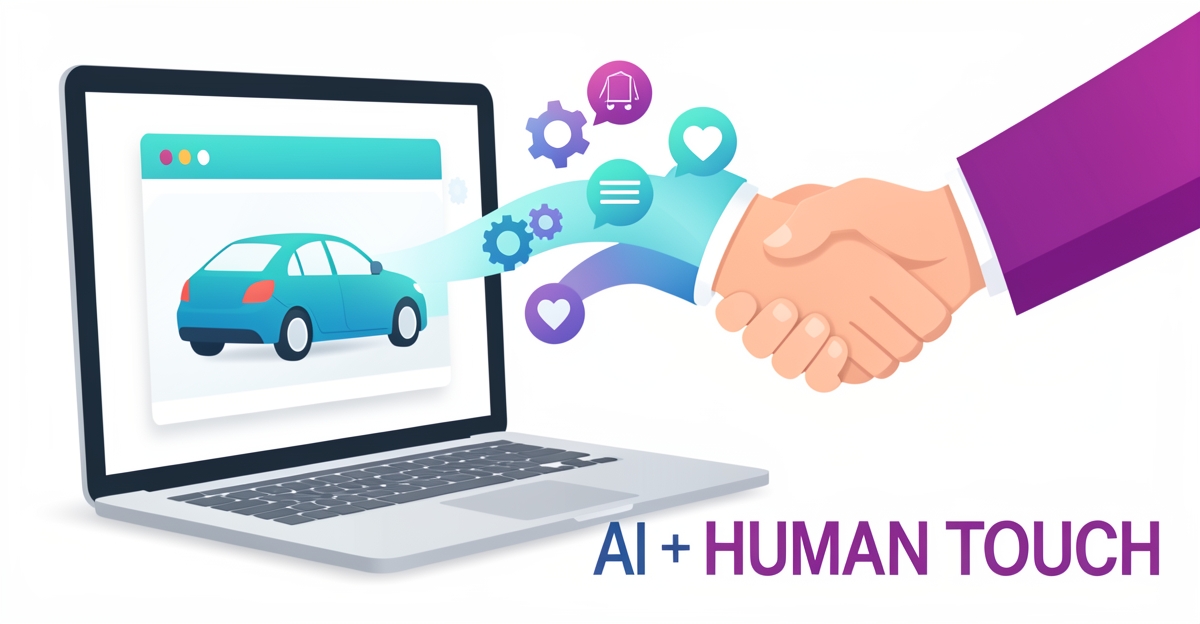
In the fast-paced world of vehicle sales, teams are often overwhelmed by high-volume search requests, forcing a daunting choice between swift responses and personalized service. This paradox can be a significant obstacle, potentially leading to lost sales and dissatisfied customers. However, embracing strategic automation can bridge this gap, leveraging technology to enhance, rather than replace, human interaction.
The Automation Advantage
Studies highlight the potential of AI in reducing operational costs while boosting customer satisfaction. For instance, businesses that adopt AI chatbots can see up to a 30% reduction in customer service costs (Source: recent analyses on AI integration). Moreover, mature AI adopters have reported a 17% increase in customer satisfaction (Source: IBM's insights on the future of customer service), indicating that well-implemented automation can indeed support personalized experiences.
Balancing Automation with Human Touch
Achieving this balance is key:
- Automate Initial Searches and Routine Inquiries: AI can efficiently handle basic vehicle searches and lead qualification, freeing human agents for more complex, emotionally nuanced interactions.
- Ensure Seamless Handoffs: Design workflows that enable effortless transitions from AI to human agents for high-value, personalized interactions, such as discussing custom vehicle modifications or addressing customer concerns.
- Leverage Predictive Analytics: Utilize historical data and machine learning to predict customer preferences, offering tailored vehicle suggestions and enhancing the personalization of the search experience.
At AI Business Sites, our approach to automation is centered around enhancing the human experience, not replacing it. By integrating AI-driven tools into our custom website solutions, businesses can automate repetitive tasks, such as initial customer inquiries and data organization, while maintaining the personal touch that drives long-term customer relationships. This strategic use of automation ensures that teams can focus on what matters most—the intricate, high-touch aspects of vehicle sales that build trust and secure deals.
Embracing the Solution
For vehicle search requests, this might mean using AI to quickly process and categorize initial queries (e.g., "Find all 2022 Toyota Camrys under $25K") and then seamlessly transferring more complex or emotionally charged requests to human agents. By doing so, businesses can maintain the efficiency of automation while preserving the personal, empathetic interactions that are crucial in the automotive sector.
In this balanced approach, automation is not a barrier to personal service but a strategic enabler, allowing teams to scale their operations without sacrificing the quality of customer experience. As the automotive industry continues to evolve, embracing this harmony between technology and human insight will be pivotal for success.
Where AI Handles the Heavy Lifting (And Where Humans Close the Deal)
The sweet spot in modern vehicle sales isn’t choosing between automation and personalization — it’s knowing where each belongs. AI excels at handling the initial legwork: processing search requests like “Find 2022 Camrys under $25K,” qualifying leads based on budget and preferences, and answering routine inquiries about inventory or financing. This allows dealerships to manage high volumes efficiently, with research showing AI adopters see up to a 23.5% reduction in cost per contact through conversational AI. Meanwhile, human agents step in for moments that require judgment, empathy, and negotiation — test drives, trade-in evaluations, and custom requests where trust and rapport close the deal.
This division of labor creates a seamless experience where technology supports, rather than supplants, the human connection. As AI evolves from a simple tool into a real-time partner for agents — suggesting responses and managing background tasks — it frees staff to focus on high-value interactions that drive loyalty and revenue. In fact, mature AI adopters report a 17% increase in customer satisfaction, proving that automation, when applied strategically, enhances rather than diminishes the personal touch. Predictive analytics further amplifies this effect by enabling personalization at scale; for instance, if a customer has previously shown interest in hybrid vehicles, the AI can prioritize similar models in future searches while flagging the opportunity for a human follow-up.
The key to success lies in designing workflows that ensure smooth handoffs between AI and human agents. When an AI system identifies a customer’s readiness for a test drive or detects hesitation in their tone, it can instantly alert a sales representative with full context — past interactions, vehicle preferences, and budget parameters — so the human agent steps in informed and prepared. This approach aligns with findings that emphasize AI as an aid to, not a replacement for, human support, particularly in emotionally nuanced situations. For businesses using platforms like AI Business Sites, this balance is built in: the AI receptionist handles initial inquiries and lead routing, while the integrated CRM and automation tools keep humans in the loop for the conversations that matter most. The result is a system that scales efficiently without sacrificing the trust and personal attention that turn browsers into buyers.
Designing Seamless Handoffs That Preserve Context and Trust
Choosing between speed and personalization in vehicle search requests doesn’t have to be a trade-off. Research shows that businesses using AI for initial inquiries while preserving human touch for complex needs see a 17% boost in customer satisfaction and cut service costs by 23.5%. The key lies in designing handoffs where AI captures intent, history, and preferences upfront—then passes everything to your team without the customer needing to repeat themselves.
Building this workflow starts with AI that remembers. According to Kustomer research, effortless transitions happen when systems retain context across channels like chat, voice, and email. Their AI receptionist, for example, recognizes returning visitors and surfaces their past interactions—so whether someone emails about a 2022 Honda Accord or chats about financing options, the next human contact already has the full picture. This eliminates the friction of starting over, which 67% of customers cite as their top frustration during support handoffs based on customer service trends.
The handoff itself should feel intentional, not abrupt. Map out triggers that move conversations from AI to human agents only when necessary:
- Queries involving custom configurations, trade-ins, or emotional decisions like “I need a family-friendly SUV by Friday.”
- Customers who ask follow-up questions about pricing, availability, or vehicle history—signals that nuance is required.
- High-intent signals such as scheduling a test drive or requesting a quote comparison.
- Repeat visitors whose prior searches suggest deeper needs (e.g., someone who’s checked EVs multiple times).
- Moments where sentiment analysis detects frustration or urgency.
Behind the scenes, your platform’s automation keeps the rhythm steady. New leads get instant, personalized responses—preventing the 75% of leads lost to slow follow-ups according to automation benchmarks. Meanwhile, predictive analytics can prioritize which handoffs matter most by analyzing past behavior. If your system sees a customer frequently returning to hybrid listings, it flags that lead for a human agent with deeper product knowledge.
For businesses using AI Business Sites, this integration is built-in. Your AI assistant doesn’t just answer questions—it tracks every interaction and surfaces the right context automatically. When a customer transitions from “Find me sedans under $30K” to “Can I test drive this one tomorrow?” the system not only routes the request but includes the vehicle details, budget range, and previous chat history. The result? Faster resolutions, higher trust, and a service experience that feels human from start to finish.
Local business: doing this the old way?
One system replaces the whole pile.
All of it — the website, the follow-up, the content, the leads — built and run for you for $1,497 + $497/mo. Month-to-month, and you own everything.
See what your build includesUsing Predictive Intelligence to Make Automation Feel Personal
When a customer searches for "2022 Toyota Camrys under $25K" at 11 p.m., they don't want a generic form — they want to feel understood before they even speak to a person. Predictive intelligence makes that possible by turning historical search data into anticipation rather than reaction. Mature AI adopters see a 17% increase in customer satisfaction precisely because the system learns what each buyer values before the first human conversation begins.
The mechanism is straightforward: machine learning models analyze past searches, clicked listings, and saved preferences to build a living profile for every lead. If someone has repeatedly filtered for electric vehicles, the platform surfaces new EV inventory first — no manual tagging required. This isn't theoretical; predictive analytics enable personalized solutions at scale, letting dealerships prioritize relevance over volume. The result feels like a concierge, not a catalog.
- Historical search patterns train the model to rank results by individual buyer intent
- Real-time inventory changes trigger automatic re-prioritization for active searchers
- Lead scoring adjusts dynamically as behavior evolves — test-drive requests weigh more than casual browsing
- Human agents receive pre-qualified context so every conversation starts at step three, not step one
Emotional intelligence in AI adds another layer. Sentiment analysis on chat transcripts and call recordings flags frustration or excitement early, prompting the system to escalate high-stakes buyers to your best closers immediately. ROI Call Center notes that this blend of predictive analytics and emotional intelligence lets automation anticipate needs instead of just reacting — a distinction that separates helpful from hollow. Behind the scenes, AI Business Sites applies the Business Sites handles the routing, tagging, and follow-up sequences so your team only engages when judgment matters most. The automation doesn't replace the personal touch — it clears the path for it.
Implementation: Start With the Searches That Drain Your Time
The daily grind of fielding endless vehicle search requests is the fastest way to burn out a dealership’s team. Research shows that mature AI adopters see a 17% lift in customer satisfaction and cut contact costs by 23.5%—yet most dealerships still lose hours to broad filters, after-hours inquiries, and repeat questions that never convert. The smart play is to flip the script: automate the searches that drain your time while keeping the moments that seal deals firmly in human hands.
Start by auditing your inbox and call logs for the last 30 days. Tally every search type that meets three criteria—it consumes more than 15 minutes per interaction, arrives when staff are offline, and closes at a rate below 8%. Common culprits include broad ZIP-code sweeps, generic “any automatic” requests, and after-hours “what’s in stock?” messages. These are perfect automation candidates because they’re high-volume, low-value, and easy to templatize.
Next, map each high-drain search to a repeatable workflow your website can run on autopilot. Broad filters become dynamic pages that update inventory in real time; after-hours inquiries trigger an AI assistant that answers with the day’s stock and invites a callback; repeat questions get answered instantly via a self-serve knowledge base. Each interaction lands in the same CRM pipeline your team already uses, so nothing slips through the cracks. Behind the scenes, a visual automation builder lets you drag-and-drop triggers like “new lead > push to pipeline > send instant confirm email > tag ‘hot lead’” without writing a line of code.
Keep the personal touch alive for high-touch moments: custom searches, trade-in appraisals, and test-drive bookings. Your AI can pre-qualify buyers and flag VIP leads, but the handoff to a human happens in seconds with full context already attached. That way, when a shopper types “I need a 2022 Toyota Camry under $25K with less than 40K miles,” the AI instantly surfaces matching stock and schedules a follow-up call—freeing your team to focus on the 12% of leads that actually convert.
- Broad filters → dynamic inventory pages that update in real time
- After-hours “what’s in stock?” → AI assistant replies with live availability and invites a callback
- Repeat inquiries → self-serve knowledge base answers that cut repeat tickets by 30%
- VIP leads → instant human handoff with full conversation history
- Test-drive bookings → automated calendar sync with confirmation emails
Key Takeaways
{ "title": "Harmonizing Efficiency and Empathy in Vehicle Sales", "content": "As the automotive industry accelerates towards a future of high-volume demands and personalized expectations, embracing strategic automation emerges as the pivotal solution. By leveraging AI to handle initial vehicle searc
FOR local businesss — BUILT AND RUN BY US
Your website. Your content. Your leads. Your data.
$500 starts your build. Seven days later it's live — chat, booking, follow-up, and your Google presence all set up. Then we run it, every month. You do the work you actually get paid for.