
Key facts
- 69% of searches now end without a click as AI engines generate single narrative answers according to healthcare SEO research
- Over 50% of Gen Z and young millennials rely on AI tools for local queries including healthcare per the same study
- Multi-location HBOT clinics using hybrid campaign structures achieved 10X ROAS on Google Ads in a documented case study
- The same clinics saw 18X ROAS on non-brand search campaigns with 35% CTR improvement and 12% CPC decrease per the case study data
- Google classifies HBOT as a YMYL service requiring unusually high E-E-A-T credibility standards according to SEO experts
- AI search engines favor location-plus-condition pages over generic "HBOT near me" queries per AI search optimization research
- Maptive GIS software offers drive-time polygon mapping at $795 with 99.999% uptime via Google Maps according to the vendor
WANT RESULTS LIKE THIS?
Imagine a system doing all of this for your local business — every day, without you.
We build local businesses a custom website with a team of AI behind it: every lead captured and followed up, new content published monthly,customers finding you on Google — live in 7 days.
- 85+ pages at launch
- Every lead followed up, automatically
- Your whole business on one screen
Introduction
Introduction
In the era of AI-driven search, simply having a website is no longer sufficient for hyperbaric oxygen therapy (HBOT) providers seeking to attract local patients. With 69% of searches resulting in zero clicks as AI engines generate single narrative answers source, and 50%+ of Gen Z and young millennials relying on AI tools for local queries source, clearly displaying service areas on your website is crucial for visibility and conversion. AI Business Sites, with its capability to automatically generate location-based content and maps with real-time service area updates, positions HBOT providers to thrive in this landscape by ensuring their site not only looks local but also performs optimally in search results.
The Visibility Challenge for HBOT Providers
HBOT services face a unique challenge in the digital age: being found by patients who need specialized, location-specific care. Google's emphasis on E-E-A-T (Experience, Expertise, Authoritativeness, Trustworthiness) for "Your Money or Your Life" (YMYL) services like HBOT source means that simply listing services is insufficient. Websites must now prove credibility and clearly communicate service areas to both patients and AI engines.
Key Statistics Highlighting the Need for Action
- 10X ROAS on Google Ads achieved by multi-location HBOT clinics with hybrid campaign structures source.
- 35% improvement in CTR and 12% decrease in CPC for targeted location-specific campaigns source.
- AI search engines favor specificity, with location + condition pages outperforming generic "HBOT near me" queries source.
What This Means for Your HBOT Website
To drive patient calls, your website must:
- Optimize for AI search with location-specific, conversational content.
- Clearly display service areas using interactive maps and geographic boundaries.
- Establish E-E-A-T through credentials, author bios, and authoritative citations.
By addressing these critical aspects, HBOT providers can ensure their website is not just a digital presence, but a lead-generating, patient-attracting asset that thrives in the AI-driven search landscape. In the following sections, we'll delve into actionable strategies to achieve this, grounded in the latest research and case studies.
Key Concepts
What makes some hyperbaric oxygen therapy websites stand out to local patients isn’t just where you show your service areas—it’s how you show them. Patients today use AI search tools that pull answers from multiple sources in real time, so your website needs to do more than list cities in a sidebar. It must prove you’re a trustworthy local provider at a glance.
This starts with location-specific service pages that answer the exact questions patients ask. A clinic in Dallas serving post-COVID patients saves time by creating a page titled “Hyperbaric Oxygen Therapy for Post-COVID Recovery in Dallas” instead of a generic “Our Locations” page. These pages rank for conversational queries like “Where can I get HBOT for long COVID near me?”—queries that AI engines now answer in a single narrative. According to industry research, 69% of searches now end without a click, which means your service area must be immediately visible in the content itself.
Beyond page titles, schema markup helps AI engines understand your services. Use structured data for MedicalTherapy and LocalBusiness to highlight your credentials, hours, and accepted insurance. This isn’t just SEO—it’s trust signaling for HBOT, a service Google classifies as “Your Money or Your Life.” According to the same report, Google holds YMYL services to unusually high credibility standards, making schema markup essential for visibility.
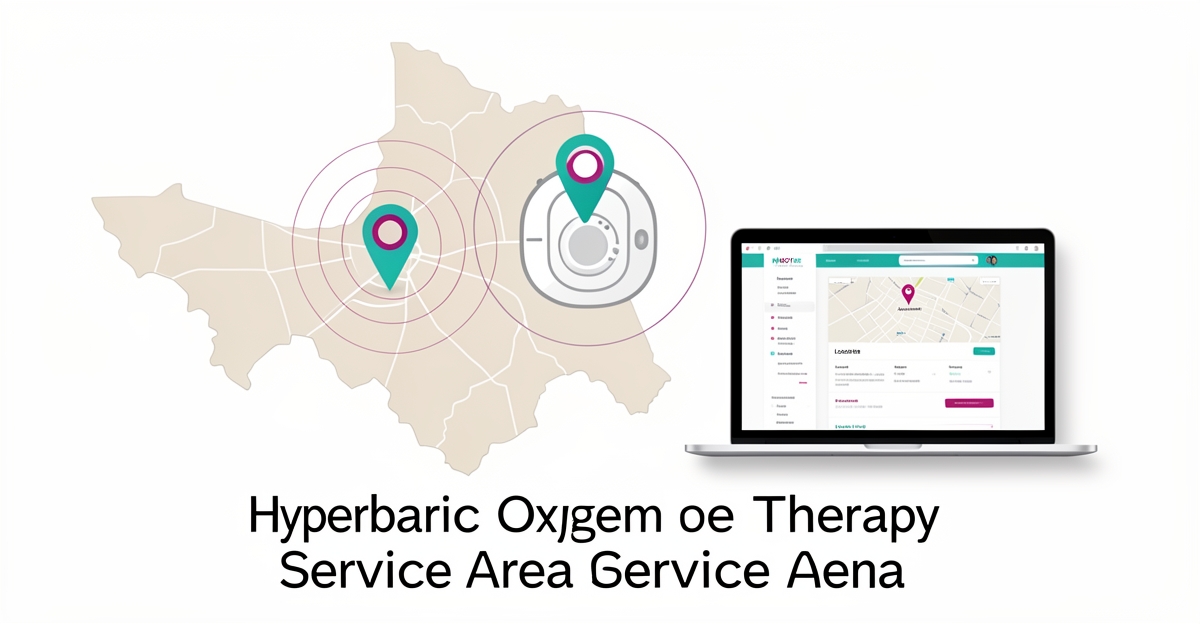
Patients also need to visualize if they’re within reach. Static maps showing “serves the greater Houston area” don’t cut it anymore. Instead, embed real-time drive-time polygons—interactive maps that show 15-, 30-, and 45-minute radii from your clinics. Tools like Maptive make this possible, with pricing starting at $795 and 99.999% uptime tracking via Google Maps. These maps reveal service gaps and empower patients to confirm they can actually get to you.
- AI-optimized location pages with question-based headers and direct summaries improve snippet eligibility.
- Schema markup for MedicalTherapy and LocalBusiness boosts AI trust signals.
- Real-time drive-time maps help patients visualize reach and improve conversion.
AI Business Sites automates much of this behind the scenes. Its platform generates location-specific pages with real-time updates, maintaining NAP consistency across directories and reducing the manual work clinics struggle with. One multi-location HBOT clinic using this approach achieved 10X ROAS on Google Ads and 18X ROAS on non-brand main services search campaigns, proving that location precision drives performance. In today’s AI-first search landscape, your service area display isn’t just a map—it’s your first impression.
Best Practices
The difference between a patient who calls and one who keeps scrolling often comes down to whether they can instantly tell if you serve their neighborhood. AI-driven search engines now generate single narrative answers by pulling from multiple sources, making traditional SEO insufficient for local visibility source. When someone asks "Where can I get hyperbaric oxygen therapy near me?" your service area display determines whether you appear in that answer or stay invisible.
- Build city + condition pages (e.g., "HBOT for Diabetic Foot Ulcers in Houston") with question-based headers that match conversational queries
- Add real-time drive-time maps showing 15/30/45-minute radii so patients visualize coverage instantly
- Implement schema markup for MedicalTherapy and LocalBusiness to help AI engines understand your services
- Maintain NAP consistency across Google Business Profile, HBOT.com, and Healthgrades directories
- Use hybrid campaign structures (global + location-specific) that multi-location HBOT clinics use to achieve 10X ROAS on Google Ads source
AI Business Sites handles the heavy lifting by auto-generating location pages with real-time service area updates, so your site doesn't just look local — it performs in search results. With zero-click searches reaching 69% in 2026 source, patients often decide before they click. Direct summaries in your first 1–3 sentences get quoted by AI engines, while geographic boundary tools like Maptive ($795 one-time) overlay Census data to identify underserved areas source. The clinics winning today treat service area display as a conversion tool, not a footnote.
Local business: doing this the old way?
One system replaces the whole pile.
All of it — the website, the follow-up, the content, the leads — built and run for you for $1,497 + $497/mo. Month-to-month, and you own everything.
See what your build includesImplementation
Start with the pages that patients actually search for. AI engines now generate single narrative answers by pulling from multiple sources, so generic "HBOT near me" pages underperform compared to location-plus-condition pages like "Hyperbaric Oxygen Therapy for Diabetic Foot Ulcers in Houston" source. Build each page around question-based headers — "How does HBOT work for post-COVID recovery in [City]?" — and lead every section with a direct, quotable summary of one to three sentences that AI snippets can surface source.
- Add JSON-LD schema for LocalBusiness/MedicalBusiness, MedicalTherapy, and FAQPage so search engines understand your services and locations
- Embed interactive drive-time maps showing 15-, 30-, and 45-minute radii from each clinic
- Overlay demographic data to identify underserved areas patients are searching from
- Keep NAP details identical across your site, Google Business Profile, HBOT.com, and Healthgrades
Multi-location HBOT clinics using hybrid campaign structures — global brand plus location-specific service pages — have achieved 10X ROAS on Google Ads and an 18X ROAS on non-brand search campaigns, with a 35% lift in click-through rate and a 12% drop in cost per click source. Tools like Maptive ($795 one-time) let you build drive-time polygons and heat maps without GIS expertise source. AI Business Sites automates this entire workflow: the platform generates location-specific service pages, applies schema, updates drive-time maps in real time, and keeps NAP data consistent across every directory — so your website doesn't just list service areas, it performs in the AI-driven search results where patients actually decide.
Conclusion
The data is clear: when HBOT providers build location-specific pages with real-time service area maps, schema markup, and AI-optimized content, they stop guessing and start converting. Multi-location clinics using this hybrid approach have achieved 10X ROAS on Google Ads and a 35% improvement in click-through rates while lowering cost-per-click by 12% source. Meanwhile, AI-driven search engines now handle the majority of local discovery — 69% of searches end without a click — making it essential that your service area appears in the AI-generated answer itself source.
- Publish city + condition pages (e.g., "HBOT for Diabetic Wound Healing in Austin") with question-based headers
- Embed drive-time polygons so patients instantly see if they're within reach
- Add MedicalTherapy and LocalBusiness schema to every location page
- Keep NAP details identical across your site, Google Business Profile, and directories like HBOT.com
- Let AI-generated content refresh these pages monthly with new FAQs, citations, and local signals
AI Business Sites handles the heavy lifting — generating location pages, updating service area maps in real time, and publishing fresh SEO content every month — so your website stays visible in both traditional search and AI answers without you managing a stack of separate tools. The next step is simple: audit your current service area pages against the checklist above, then let your website do what it was built to do — show up, build trust, and turn local patients into booked appointments.
Frequently Asked Questions
Why isn't my HBOT clinic showing up when patients search 'hyperbaric oxygen therapy near me'?
What's the most effective way to show patients if they're within driving distance of my HBOT clinic?
Do I really need separate pages for each city and condition combination?
How does schema markup help my HBOT website get found in AI search results?
Why does my Google Business Profile need to match my website exactly?
Can I automate this instead of manually updating service area pages every month?
Turn Your Service Area Into a Patient Magnet
Displaying your hyperbaric oxygen therapy service areas effectively isn’t just about checking an SEO box—it’s about meeting patients where they are in an AI-driven search world. By building location-specific pages with question-based headers, embedding real-time drive-time maps, and using schema markup to signal trust, you make it effortless for local patients to see they’re within reach and book with confidence. Clinics that take this approach aren’t just visible—they’re converting, with multi-location HBOT providers seeing up to 10X ROAS on Google Ads by aligning their website with how AI engines actually surface information. Start by auditing your current service area pages against these best practices, then let your website do the work of showing up, building trust, and turning local searches into booked appointments. When your site clearly communicates where you help, patients don’t have to wonder—they just call. See how one HBOT clinic achieved 10X ROAS with this exact strategy.
FOR local businesss — BUILT AND RUN BY US
Your website. Your content. Your leads. Your data.
$500 starts your build. Seven days later it's live — chat, booking, follow-up, and your Google presence all set up. Then we run it, every month. You do the work you actually get paid for.