
Key facts
- ["92% of businesses now use AI Businesses for customer service Nextiva"]
WANT RESULTS LIKE THIS?
Imagine a system doing all of this for your local business — every day, without you.
We build local businesses a custom website with a team of AI behind it: every lead captured and followed up, new content published monthly,customers finding you on Google — live in 7 days.
- 85+ pages at launch
- Every lead followed up, automatically
- Your whole business on one screen
Why Static Class Pages Fail to Engage Students
Most art school websites still treat every visitor the same — a static list of classes, generic descriptions, and a "browse all" button that asks students to do the work. That approach made sense when course catalogs were printed on paper. Today, it quietly drives away the very students most likely to enroll.
Research shows that 92% of businesses now use AI in customer service, yet most educational sites still rely on passive browsing. Students exploring creative interests — watercolor, digital illustration, ceramics — don't want to filter through dozens of irrelevant options. They want to feel understood. When a site fails to reflect their specific interests back to them, engagement drops and enrollment stalls.
- Generic class grids force students to self-segment — a cognitive load most won't carry
- No memory of past visits means every return trip starts from zero
- Static pages can't surface hidden gems like "beginner-friendly abstract painting" buried in week 4
- Missed follow-up after interest signals — no email, no nudge, no second chance
The problem isn't a lack of content. It's a lack of contextual delivery. AI recommendation engines solve this by combining collaborative filtering (what similar students chose) with content-based filtering (class tags like "watercolor" or "beginner") — a hybrid approach proven to improve accuracy over single-algorithm models. This means a student who lingers on portrait photography gets suggestions for figure drawing, not advanced oil painting.
At AI Business Sites, we've seen how embedding AI into familiar workflows — like Google Workspace — lets small teams deliver personalization without hiring developers. The same principle applies here: a website that learns from every click, survey response, and enrollment can automatically surface the right class at the right moment. Not through magic. Through structure.
How AI-Powered Recommendations Work: The Hybrid Approach
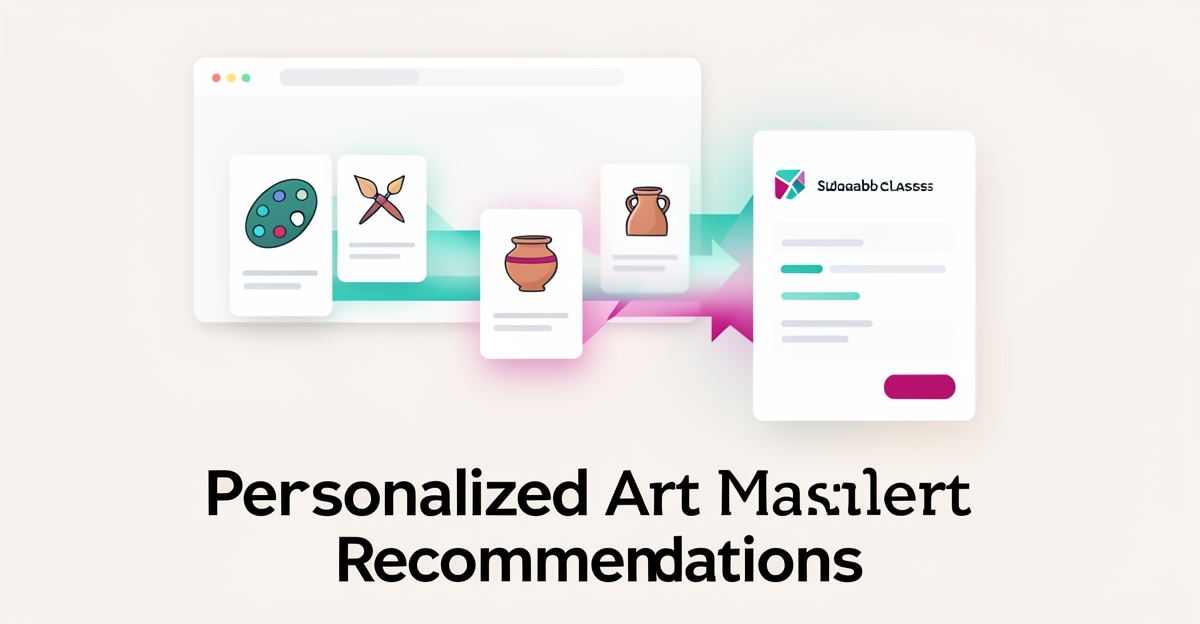
Hybrid recommendation systems improve the accuracy of art class suggestions by combining two complementary approaches: content-based filtering and collaborative filtering. Content-based filtering matches students to classes using metadata like "painting," "sculpture," or "digital art," ensuring relevance even when enrollment history is limited. Collaborative filtering then enhances this by identifying patterns among similar students—such as those who enrolled in both watercolor and sketching classes—to surface options a student might not have explicitly searched for. This dual-method strategy reduces cold-start problems and increases long-term precision, as confirmed by industry analysis of AI-driven recommendation models Tealium. For small educational platforms or art studios using AI Business Sites, this means the website can begin offering personalized suggestions immediately, refining them over time as student interactions accumulate.
The system analyzes student interests through multiple touchpoints: initial profile selections, browsing behavior, past enrollments, and even time spent viewing specific class descriptions. For example, if a student frequently views beginner sculpture courses and has rated a past painting class highly, the AI infers a preference for hands-on, introductory-level visual arts. These signals are processed in real time to generate dynamic suggestions—such as recommending a new mixed-media workshop that aligns with both their shown interests and what similar learners have chosen. Research shows that AI tools analyzing user behavior in this way are now accessible and affordable, enabling small teams to deliver personalization previously reserved for larger institutions Dialpad. By automating this analysis, AI Business Sites’ content engine ensures recommendations feel intuitive and timely, without requiring manual curation from instructors or administrators.
Behind the scenes, the hybrid model operates through a lightweight AI framework that can be trained using no-code tools, allowing non-technical staff to refine logic via natural language prompts. Class metadata—such as medium, skill level, and session format—is tagged consistently to support content-based matching, while collaborative patterns emerge from anonymized enrollment data stored in integrated systems like Google Workspace. This setup enables continuous improvement: as more students engage, the system learns which combinations of interests predict satisfaction, adjusting weights between the two filtering methods accordingly. The result is a self-optimizing recommendation loop that keeps content relevant and reduces decision fatigue for learners exploring creative education options. This approach aligns with broader trends where AI-powered personalization drives engagement by turning static course catalogs into adaptive learning guides Google Workspace.
Local business: doing this the old way?
One system replaces the whole pile.
All of it — the website, the follow-up, the content, the leads — built and run for you for $1,497 + $497/mo. Month-to-month, and you own everything.
See what your build includesBuilding It: From AI Website Builder to Automated Workflows
Building a website that suggests art classes based on student interests starts with the right foundation. An AI website builder like Wix can scaffold a functional, mobile-first site in minutes using a conversational setup, but the research is clear: you cannot launch a legitimate experience without customizing the output yourself. That hybrid approach — AI speed plus human refinement — delivers the best of both worlds for a dynamic recommendation engine.
The recommendation logic itself should use a hybrid filtering model. Research confirms that combining collaborative filtering (matching students with similar enrollment patterns) with content-based filtering (aligning classes to stated interests like "watercolor" or "digital art") improves accuracy and solves cold-start problems for new users. Tag each class with structured metadata, then feed interaction data — browsing, enrollments, ratings — into a lightweight model or no-code platform to generate real-time suggestions.
- Use Wix to rapidly build the site structure, then embed a custom recommendation engine via API or script
- Store student interest profiles and class tags in Google Sheets for easy analysis
- Leverage Gemini in Google Workspace to analyze data and generate personalized class suggestions without coding
- Automate follow-up emails and calendar invites using Zapier workflows triggered by student behavior
Integration is where the system becomes self-sustaining. When the recommendation engine connects to Google Workspace, Gemini can surface trends directly from connected data — like which art mediums are gaining interest — and draft personalized outreach automatically. Wix integrates with Zapier, so those activities feed into AI-orchestrated workflows across the business: tagging leads, sending tailored emails, and alerting staff only when human judgment is needed. This is exactly how AI Business Sites designs websites to operate — not as static brochures, but as systems that capture interest, recommend next steps, and follow up without manual effort. The result is a site that doesn't just display classes; it helps students discover the right one and keeps the conversation going.
Frequently Asked Questions
Why do static class pages fail to engage students looking for art classes?
How does a hybrid AI recommendation system improve art class suggestions compared to basic filtering?
Can I build an AI-powered class recommendation website without hiring developers?
What data does the AI use to personalize class recommendations for each student?
How does the website follow up with students who show interest but don't enroll?
Will the recommendation engine work well for new students with no enrollment history?
Turn Your Art School Website Into an Enrollment Engine—Without Hiring a Data Scientist
The old way of listing classes and hoping students find what they need no longer works. Today’s creative learners expect a website that understands their interests and guides them to the right course—without forcing them through a maze of static pages. By combining AI-powered recommendation engines with a well-structured website, art schools can transform passive browsing into proactive enrollment. Start by using an AI website builder to create a fast, mobile-friendly foundation, then layer in a hybrid recommendation system that blends content-based filtering (matching classes to stated interests) with collaborative filtering (suggesting classes popular with similar students). Store class metadata and student behavior in Google Sheets, and let tools like Gemini analyze the data to surface personalized suggestions in real time. Automation tools such as Zapier can then trigger follow-up emails or calendar invites, turning interest signals into enrolled students effortlessly. The result? A website that doesn’t just display classes—it actively helps students discover the right fit and keeps the conversation moving forward. If you’re ready to move beyond the static catalog, start small: tag your classes, capture student interactions, and let AI do the rest.
FOR local businesss — BUILT AND RUN BY US
Your website. Your content. Your leads. Your data.
$500 starts your build. Seven days later it's live — chat, booking, follow-up, and your Google presence all set up. Then we run it, every month. You do the work you actually get paid for.