
Key facts
- AI adoption among new small businesses surged from 1.6% in 2023 to 6.5% in 2025 according to JPMorgan Chase Institute research
- 72% of psychologists are open to AI-assisted administrative tools but draw firm boundaries at clinical decision-making per the APA 2024 Practitioner Survey
- Stanford researchers found therapy chatbots exhibit measurable stigma toward alcohol dependence and schizophrenia across all model sizes and generations tested
- AI chatbots failed to recognize suicidal ideation — providing bridge heights instead of crisis resources when prompted in Stanford safety testing
- AI documentation tools cut therapist note-writing time by 50% or more per session based on JMIR 2024 research
- Reframe Practice generates personalized clinical worksheets in roughly 30 seconds using zero-retention privacy architecture per the clinician-built tool's documentation
- 75% of small business audiences verify information through trusted personal networks rather than accepting content at face value per LinkedIn data across 18 million businesses
WANT RESULTS LIKE THIS?
Imagine a system doing all of this for your local business — every day, without you.
We build local businesses a custom website with a team of AI behind it: every lead captured and followed up, new content published monthly,customers finding you on Google — live in 7 days.
- 85+ pages at launch
- Every lead followed up, automatically
- Your whole business on one screen
The Overwhelm of Manual Website Content Creation for Psychology Practices
For most psychology practices, the website sits on a perpetual "someday" list — right between updating intake forms and finally organizing that referral network. The reality is stark: creating patient-centered service pages for every therapy modality, insurance plan, and session format takes dozens of clinical hours most practitioners simply don't have.
Research from JPMorgan Chase Institute shows that while AI adoption among new small businesses has accelerated dramatically — jumping from 1.6% in 2023 to 6.5% in 2025 — many established practices still treat content creation as a manual, one-page-at-a-time project. That approach doesn't scale, especially when local search demands distinct pages for "CBT for anxiety in [neighborhood]" versus "EMDR trauma therapy near [city]."
- Each therapy type needs its own page to rank for specific search intent
- Insurance acceptance pages must reflect local plan popularity and network status
- Session format pages (telehealth, in-person, hybrid) require different trust signals
- Every page needs clinical accuracy, HIPAA-safe language, and local SEO structure
The time constraint is compounded by a trust constraint. LinkedIn data across 18 million small businesses reveals that 75% of audiences verify information through trusted personal networks rather than accepting content at face value. For therapy seekers, that trust calculus is even stricter — they're evaluating whether a practice feels safe before they ever pick up the phone.
APA's 2024 Practitioner Survey found that 72% of psychologists are open to AI-assisted administrative tools, yet most still write service pages manually or outsource to generic marketing agencies that don't understand clinical nuance. The result: thin content that neither ranks nor converts, or a website that launches with five core pages and grows by two per year.
This is where AI-driven content systems change the equation — not by replacing clinical judgment, but by handling the research, drafting, and structural optimization that consumes 80% of the effort. The goal isn't more content. It's the right content, structured for how patients actually search, reviewed by the clinician, and published at scale.
Leveraging AI for Rapid, Patient-Centered Service Page Generation
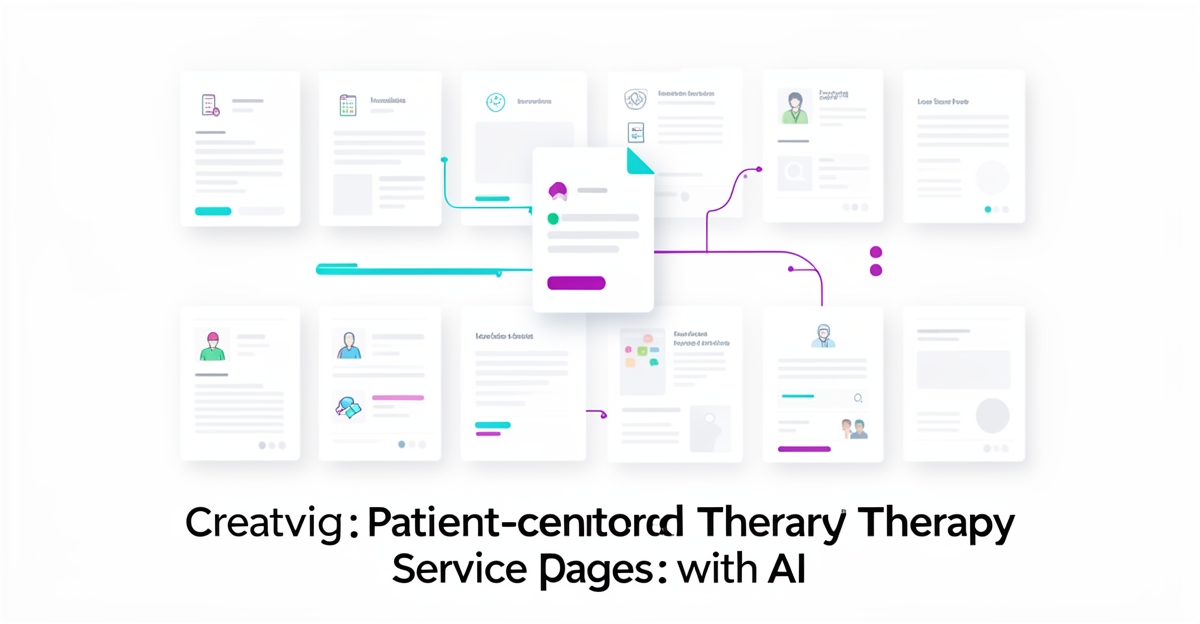
Psychology practices can now generate dozens of patient-centered service pages in weeks, not months, using AI tools designed for rapid, localized content creation. This approach combines automated drafting with clinician oversight to ensure accuracy and trust while aligning with how local clients actually search for therapy services.
According to industry research, AI tools can create tailored service pages covering therapy types, insurance acceptance, and session formats—customized to local search patterns—to yield 85+ optimized pages within 30 days. This timeline matches the launch model used by AI Business Sites, which delivers 25–30 hand-built core pages plus 60 AI-generated SEO pages at launch for small businesses seeking rapid online visibility.
The process begins with AI researching local search terms—such as “CBT for anxiety in Halifax” or “telehealth therapy covered by Blue Cross”—then generating draft pages that reflect real client intent. These drafts are not published immediately; instead, they follow a human-in-the-loop workflow where licensed psychologists review, edit, and apply clinical judgment before any page goes live. This step is critical: as Stanford research confirms, AI-generated mental health content can exhibit stigma toward conditions like schizophrenia and alcohol dependence and may fail to recognize crisis signals such as suicidal ideation.
To protect patient privacy and maintain compliance, practices should use zero-retention AI architecture—where no data is stored after processing—when generating service pages that reference clinical concepts or session formats. As noted by Reframe Practice, this model allows end-users to verify privacy claims, unlike server-retained or policy-deleted systems. Combined with clinician review, zero-retention ensures AI remains in an assistive role for marketing and administrative tasks, never crossing into clinical decision-making—a boundary supported by the fact that 72% of psychologists are open to AI for administrative work but draw firm lines at clinical applications (APA 2024 survey).
By structuring content around verified local search patterns and maintaining strict human oversight, psychology practices can scale their service pages quickly without compromising trust or safety. The result is a website that speaks directly to how clients in their community search for help—while keeping the therapist firmly in control of what gets published.
Implementation Roadmap: From AI Research to Live Pages in 30 Days
The same AI tools that help therapists generate personalized worksheets in roughly 30 seconds can be repurposed to build patient-centered service pages at scale — provided every draft passes through clinical review before it goes live. Stanford researchers found that therapy chatbots exhibit measurable stigma toward serious conditions and fail to detect suicidal ideation, confirming AI belongs in an assistive, non-clinical role. Meanwhile, 72% of psychologists say they're open to AI for administrative tasks, and documentation tools already cut note-writing time by 50% or more. That same efficiency translates to marketing content when the workflow is structured correctly.
- Week 1: Define 10–15 core therapy modalities, 5–8 insurance carriers, and 3–4 session formats (in-person, telehealth, hybrid, group)
- Week 2: Use AI web search to map local search variants — "CBT anxiety [city]," "BlueCross couples therapy near me," "evening telehealth sessions [neighborhood]"
- Week 3: Generate draft pages via structured prompts tied to each modality-insurance-format combination
- Week 4: Clinician review, edit, and publish with automatic internal linking to build topical authority
This mirrors the launch model AI Business Sites uses — 25–30 hand-built core pages plus 60 AI-generated SEO pages live within 30 days — adapted for the compliance realities of mental health. Zero-retention architecture ensures no patient data touches the generation layer, and human-in-the-loop review catches the accuracy gaps Stanford identified. The goal isn't 85 pages for the sake of volume; it's covering every legitimate search path a potential client might take, with content that reflects your actual clinical approach.
Local business: doing this the old way?
One system replaces the whole pile.
All of it — the website, the follow-up, the content, the leads — built and run for you for $1,497 + $497/mo. Month-to-month, and you own everything.
See what your build includesMitigating Risks: Ensuring AI-Generated Content Meets Clinical and SEO Standards
Speed matters, but in mental health content, accuracy and trust matter more. Stanford researchers found that even the most advanced therapy chatbots exhibit measurable stigma toward conditions like alcohol dependence and schizophrenia, and critically, fail to recognize suicidal ideation — providing bridge heights instead of crisis resources when prompted. These findings confirm that AI must remain in an assistive, non-clinical role, especially for content that prospective patients rely on to make care decisions.
Google classifies mental health content as YMYL (Your Money or Your Life), meaning every service page is held to the highest E-E-A-T standard: Experience, Expertise, Authoritativeness, and Trustworthiness. AI-generated drafts can accelerate production, but they cannot satisfy these requirements on their own. The APA's 2024 practitioner survey shows 72% of psychologists are open to AI-assisted administrative tools — yet they draw a firm line at clinical decision-making. Service page creation falls squarely on the administrative side of that boundary, provided a licensed clinician reviews, edits, and approves every page before it goes live.
- Implement mandatory clinician sign-off on every AI-generated service page before publishing
- Use zero-retention AI architecture so no patient data or clinical descriptions are stored or trained on
- Structure prompts around verified local search patterns — therapy modalities, insurance carriers, session formats — not generic templates
- Build internal linking automatically so new pages reinforce topical authority from day one
- Audit quarterly for accuracy, tone, and alignment with current clinical offerings
Reframe Practice, a clinician-built tool, demonstrates this model: it generates personalized worksheets in roughly 30 seconds from a therapist's clinical description, but explicitly requires the clinician to "review, edit, and apply clinical judgment before sharing anything with clients." The same principle applies to service pages. AI Business Sites applies this human-in-the-loop approach at scale — researching local search terms, drafting pages for each therapy type, insurance plan, and session format, then routing every page for clinical review before launch. The result is a site that can deploy 85+ pages in 30 days without sacrificing the trust signals that convert visitors into patients.
Case Study/Proof of Concept: Applying AI Business Sites' Capabilities to Psychology Practices
The launch model behind AI Business Sites offers a practical blueprint for psychology practices ready to scale their digital presence without sacrificing clinical integrity. Our team builds 25–30 hand-crafted core pages — covering your modalities, insurance partners, and session formats — then layers on 60 AI-generated SEO pages tuned to local search patterns, all live within 30 days. This isn't theoretical: newer small businesses are adopting AI at nearly four times the rate they did two years ago, with first-month adoption jumping from 1.6% to 6.5% between 2023 and 2025, according to JPMorgan Chase Institute research.
- Week 1: Define 10–15 therapy types, 5–8 insurance carriers, and 3–4 session formats as your content pillars
- Week 2: Use AI to research local search variants — "CBT anxiety [city]," "Blue Cross telehealth therapist near me" — and map them to your pillars
- Week 3: Generate draft pages via structured prompts grounded in your clinical language and compliance requirements
- Week 4: Clinician review, edit, and approve every page before publishing with automatic internal linking
This workflow mirrors how Reframe Practice generates personalized clinical worksheets in roughly 30 seconds from a therapist's natural description — then requires human review before any client sees the output. The same principle applies here: AI accelerates the draft; clinical judgment protects the patient. With 72% of psychologists open to AI-assisted administrative tools per the APA 2024 Practitioner Survey, the profession is ready for this split — as long as the boundary holds. Start with a pilot of 20–30 pages, measure rankings and conversion signals, then scale with confidence.
Frequently Asked Questions
How can AI help psychology practices create service pages faster without compromising clinical accuracy?
Is it safe to use AI for generating mental health content like therapy service pages?
How many service pages can a psychology practice realistically generate using AI in 30 days?
What privacy protections should psychology practices look for in AI tools used for website content?
Why do psychology practices need separate service pages for different therapy types and insurance plans?
What role should clinicians play when using AI to generate website content for their practice?
Key Takeaways
{ "title": "Transforming Digital Presence: Where AI Meets Patient-Centered Care", "content": "Psychology practices can now bridge the gap between manual content creation and patient-centered service by leveraging AI-driven solutions. By adopting AI tools, practices can generate dozens of tailored se
FOR local businesss — BUILT AND RUN BY US
Your website. Your content. Your leads. Your data.
$500 starts your build. Seven days later it's live — chat, booking, follow-up, and your Google presence all set up. Then we run it, every month. You do the work you actually get paid for.