
Key facts
- Residential solar contracted by 31% in 2024 as rising rates amplified customer acquisition pressure according to industry analysis
- Referral leads from satisfied homeowners remain the single cheapest source of new solar customers per market research
- Traditional surveys capture sentiment from only 5–10% of customers, leaving most success stories invisible per industry data
- Automated documentation systems improved first-time approval rates from roughly 30% to 90% in some deployments per field operations research
- AI tools enable solar companies to generate one blog post and three social posts weekly without large marketing teams per competitive analysis
- Agentic AI systems ingest 40-page proposal PDFs and extract structured financial data for automated negotiation workflows per clean tech reporting
- Human-in-the-loop architecture requires human sign-off before publication, with full data lineage on every AI output per enterprise adoption models
WANT RESULTS LIKE THIS?
Imagine a system doing all of this for your local business — every day, without you.
We build local businesses a custom website with a team of AI behind it: every lead captured and followed up, new content published monthly,customers finding you on Google — live in 7 days.
- 85+ pages at launch
- Every lead followed up, automatically
- Your whole business on one screen
The Local Trust Gap: Why Solar Businesses Need Authentic Case Studies
Building trust in a new neighborhood takes more than a logo on a truck — it takes proof that feels local. Homeowners researching solar want to see a project down the street, not a generic portfolio from three states away. Yet most solar companies struggle to produce that proof at scale, leaving a credibility gap that paid ads can't fill.
The economics make this gap expensive. Customer acquisition costs in residential solar have climbed into the low thousands of dollars per sale, and the segment contracted by 31% in 2024 as rising rates amplified the pressure. Meanwhile, referral leads from satisfied homeowners remain the single cheapest source of new customers — pre-qualified, high-trust, and nearly free to acquire. The problem isn't a lack of happy customers; it's the bottleneck of turning their results into published, location-specific stories.
- Manual case study creation takes hours of writing, photo sorting, and client coordination per project
- Traditional surveys capture sentiment from only 5–10% of customers, leaving most success stories invisible
- Without local details — utility rates, incentives, permitting timelines — generic stories fail to convince nearby prospects
- Inconsistent documentation means production data, timeline milestones, and approval records never reach marketing
Field operations are already generating the raw material. Automated documentation systems now capture before-and-after photos, quality-control metrics, and first-time approval rates that have jumped from roughly 30% to 90% in some deployments. AI sentiment analysis scans every conversation and interaction to flag delighted customers without relying on low-effort, turning post-install engagement into a systematic referral and review engine. The data exists — it just isn't being assembled into the trust assets that drive local decisions.
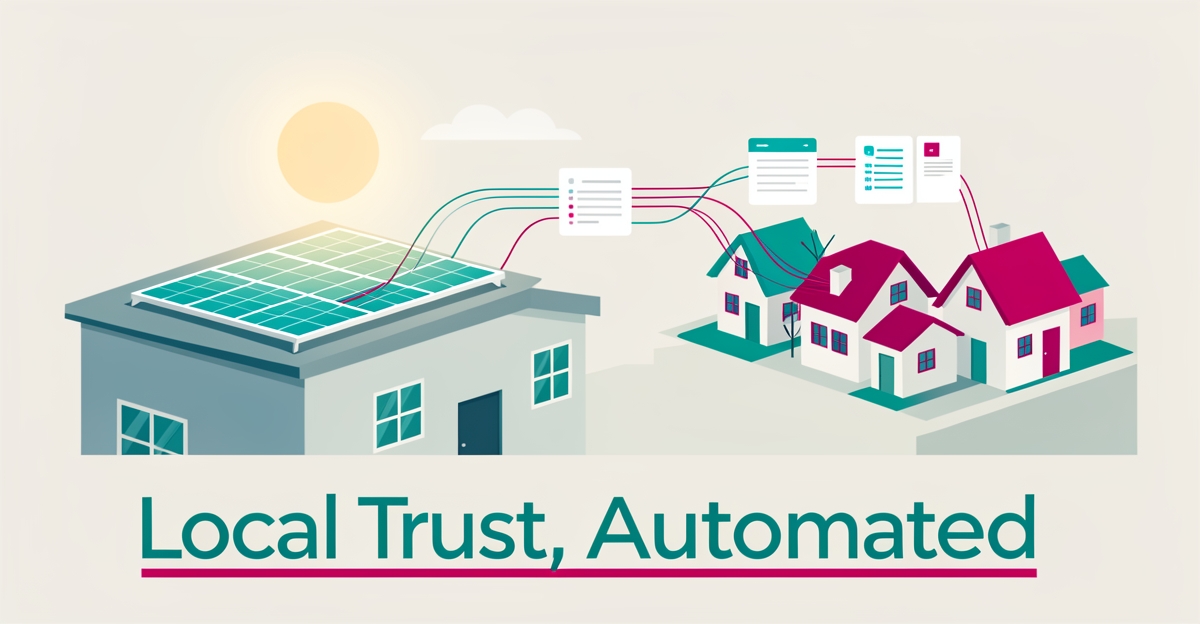
AI Business Sites bridges that gap by letting the website itself research, draft, and publish location-specific case studies from structured project data. The AI content engine pulls installation specs, production verification, customer feedback, and photos — then grounds each story in the homeowner's actual utility territory, incentive stack, and neighborhood context. A human reviews the draft, approves it, and the site publishes with automatic internal linking to relevant service and location pages. The result: a growing library of authentic, hyper-local proof that compounds trust in every service area — without adding a single marketing task to the installer's plate.
Leveraging AI to Automate Case Study Generation: A Research-Backed Approach
AI can automate solar project case studies by combining proven capabilities already in use across the industry. AI-driven content engines already enable solar companies to generate one blog post and three social posts per week without large marketing teams, demonstrating the feasibility of AI-powered writing at scale industry research. Automated documentation systems like SiteCaptureAI capture structured project data, photos, and approval metrics on job sites, reducing truck rolls by up to 80% and back-office overhead by about 70% industry research. This creates a ready stream of visual and performance data — before/after photos, production verification, timeline milestones — that serves as raw material for case studies.
AI sentiment analysis further enables the identification of satisfied customers willing to participate. Bodhi Assisted Insights analyzes customer sentiment from conversations, surveys, and interactions to classify feedback as positive, negative, or neutral, overcoming the typical 5-10% survey response rate industry research. By flagging highly satisfied homeowners automatically, AI triggers outreach for testimonial and photo permission, turning post-install engagement into a systematic source of case study candidates. This directly supports the finding that referral leads from satisfied homeowners are the "single cheapest source of new customers" for solar companies industry research.
To ensure credibility and safety, the case study generator should adopt a human-in-the-loop architecture. AI drafts the case study with full data lineage — source photos, production metrics, customer quotes — while the business owner reviews and approves before publication industry research. This mirrors proven enterprise adoption models where agents handle detection, analysis, and drafting, but humans retain decision and execution authority. Every output carries transparent sourcing, building trust through accuracy before expanding automation scope. For maximum local impact, each auto-generated case study should include location-specific details such as utility rates, available incentives, permitting timelines, and neighborhood production data. Grounding stories in local specifics increases marketing relevance and effectiveness, transforming generic installations into relatable proof that resonates with nearby prospects industry research. AI Business Sites integrates these capabilities into its platform, enabling solar contractors to publish trustworthy, location-based case studies automatically while maintaining full control over final output.
Local business: doing this the old way?
One system replaces the whole pile.
All of it — the website, the follow-up, the content, the leads — built and run for you for $1,497 + $497/mo. Month-to-month, and you own everything.
See what your build includesPractical Implementation: 5 Steps to Auto-Generate Location-Based Case Studies
Practical Implementation: 5 Steps to Auto-Generate Location-Based Case Studies
Automating solar project case study generation not only saves time but also amplifies local credibility. By leveraging existing AI capabilities and industry best practices, solar businesses can systematically produce impactful, location-specific case studies. Here’s how:
1. Extend AI Content Engines for Case Study Generation AI tools already generate 1 blog post and 3 social posts weekly for solar companies source. Extend this capability to include a "Case Study" content type, pulling from structured project data (specs, production metrics, feedback) for drafts that require minimal human editing.
2. Tap Automated Documentation for Raw Materials Systems like SiteCaptureAI capture project data, photos, and approval metrics, achieving 90% first-time approval rates and reducing back-office overhead by 70% source. Integrate these systems to collect case study essentials automatically.
3. Identify Case Study Candidates with AI Sentiment Analysis AI analyzes customer sentiment, overcoming low 5-10% survey response rates source. Use this to flag satisfied customers for automated outreach, streamlining permission and asset collection.
4. Implement Human-in-the-Loop for Credibility Adopt Invertix’s model: "Detection, analysis, and drafting = agent. Decision and execution = human" source. Ensure AI-drafted case studies undergo mandatory human review before publication to maintain trust and accuracy.
5. Ground Case Studies in Local Specifics Highlight local utility rates, incentives, and production data to make case studies relatable. For example, a case study in Austin could mention the City of Austin’s Solar Ready Initiative and how it benefited a local homeowner, directly addressing the needs and concerns of nearby prospects.
By following these steps, solar businesses can leverage AI to generate case studies that not only build trust but also resonate deeply with local audiences, setting them apart in a competitive market.
Frequently Asked Questions
Why are traditional solar company case studies ineffective for building local trust?
How much do customer acquisition costs (CAC) in residential solar typically amount to, and how has the market performed recently?
What is the most cost-effective source of new customers for solar companies, according to research?
How does AI sentiment analysis improve the process of identifying case study candidates among solar customers?
What is the 'human-in-the-loop' architecture in AI-generated case studies, and why is it important?
How does automating solar project case study generation impact the efficiency of solar businesses?
Key Takeaways
{ "title": "Harnessing AI to Bridge the Local Trust Gap in Solar", "content": "The solar industry's local trust gap is a costly hurdle, with customer acquisition costs soaring into the low thousands of dollars per sale and the residential sector contracting by 31% in 2024. By leveraging AI to automa
FOR local businesss — BUILT AND RUN BY US
Your website. Your content. Your leads. Your data.
$500 starts your build. Seven days later it's live — chat, booking, follow-up, and your Google presence all set up. Then we run it, every month. You do the work you actually get paid for.