
Key facts
- The global healthcare transportation market is projected to reach **$155.78 billion by 2032** at a **6.60% CAGR** according to research.
- Erie County's senior transportation office handles **dozens of daily requests** manually via a single phone line.
- Medicaid requires **72-hour advance notice** for Non-Emergency Medical Transportation as per New York State's Medicaid program.
- By 2030, **1 in 6 people globally** will be 60+ years old, driving demand for healthcare transportation according to forecasts.
- 79% of the 63 million U.S. family caregivers provide transportation for older adults as noted by AARP.
- AI Business Sites can launch a **85+ page website in 30 days** as per AI Business Sites.
- North America dominates the healthcare transportation market due to strong **Medicaid/Medicare support** according to market research.
WANT RESULTS LIKE THIS?
Imagine a system doing all of this for your local business — every day, without you.
We build local businesses a custom website with a team of AI behind it: every lead captured and followed up, new content published monthly,customers finding you on Google — live in 7 days.
- 85+ pages at launch
- Every lead followed up, automatically
- Your whole business on one screen
The Bottleneck: Why Manual Scheduling Fails Senior Transportation
Every morning, the phone starts ringing — and it doesn't stop until the last ride is booked. Erie County's senior transportation office fields dozens of daily requests through a single phone line, each one requiring manual entry, eligibility checks, and scheduling coordination that can stretch across days.
The structural constraints are baked into the system. Medicaid's Non-Emergency Medical Transportation program requires 72-hour advance notice and prior approval from a transportation manager for every trip, with health-related appointments taking priority over food access, personal business, or social activities. New York's tiered service model — five levels from public transit to ambulance — means each request must be evaluated for medical appropriateness and cost-effectiveness before a single vehicle is dispatched. Non-medical destinations like pharmacies, gyms, and grocery stores are explicitly excluded.
- Health trips require two weeks' advance scheduling; non-medical trips need one week
- All requests route through two regional call centers covering 62 counties
- Zero cost to members for eligible medical transportation, but strict eligibility gates
- Voluntary $8 contribution suggested for one-way trips
When 79% of the nation's 63 million family caregivers provide transportation for older adults, the volume isn't a surge — it's the baseline. Human-only intake can't keep pace with demographic reality: by 2030, one in six people globally will be 60 or older, driving a healthcare transportation market projected to reach $155.78 billion. The bottleneck isn't capacity — it's capture.
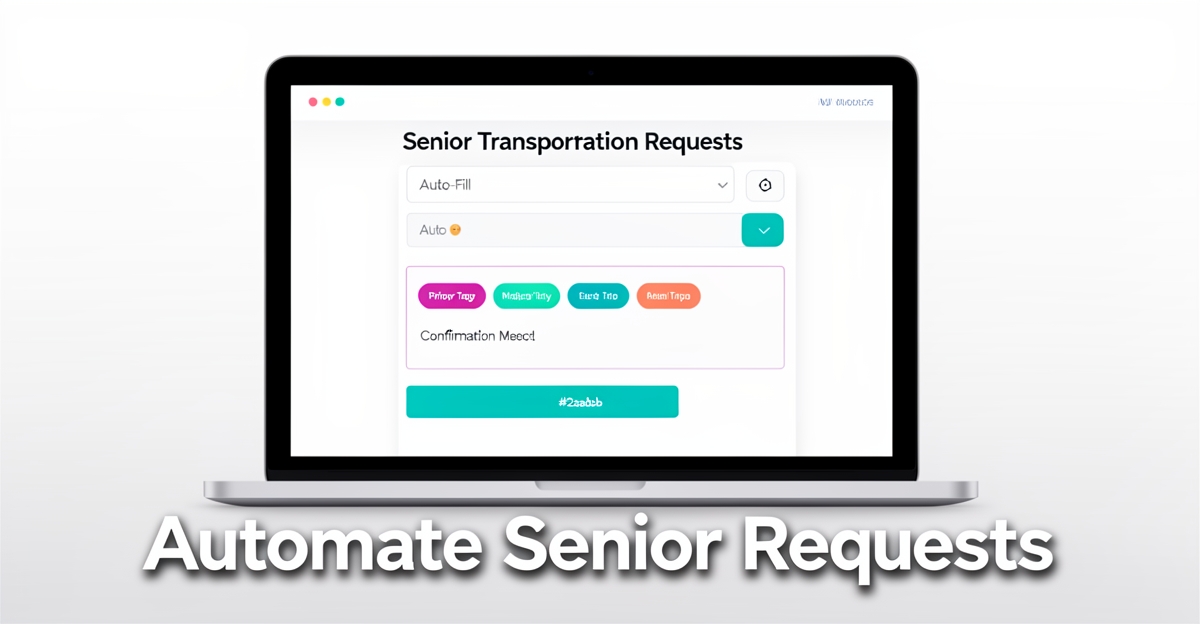
A website built for this workflow doesn't replace human judgment. It becomes the first line of intake, triaging requests by urgency, eligibility, and trip type before a scheduler ever opens a calendar. AI Business Sites builds this capture layer directly into the site — syncing forms, tagging priority levels, and triggering personalized follow-ups so no request sits in voicemail limbo. The automation handles the routing logic; the team handles the exceptions.
What an Automated Intake System Actually Needs to Handle
Building an Efficient Automated Intake System for Senior Transportation Requests
As senior transportation services handle dozens of requests daily, a smart website can revolutionize the process by automatically capturing, triaging, and responding to inquiries. An automated intake system must satisfy several critical workflow requirements to ensure seamless operation.
Real-Time Form Capture & Immediate Response An automated system should instantly capture requests through user-friendly forms, integrated with an AI-driven workflow. This ensures no request falls through the cracks, a challenge many manual systems face, especially with the growing demand for senior transportation driven by an aging population (projected to reach 1.4 billion by 2030) according to global healthcare trends.
Medical vs. Non-Medical Triage Logic Inspired by New York Medicaid's tiered service levels, the system must differentiate between medical and non-medical requests, prioritizing health-related trips (e.g., doctor appointments) over non-medical ones (e.g., grocery shopping), as seen in Erie County's transportation program which prioritizes health trips. This tiered approach ensures compliance with Medicaid's five service tiers, from public transit to ambulance services as outlined by New York State's Medicaid program.
Advance Notice Validation & Geographic Eligibility Checks The system should enforce advance notice requirements (e.g., 72 hours for Medicaid trips in New York) as required by New York State's Medicaid program and check geographical eligibility, limiting non-medical trips to nearest available facilities if necessary, aligning with Erie County's service area restrictions detailed here.
Personalized Confirmation Sequences After successful intake, the system should trigger personalized confirmation sequences, ensuring users receive clear details about their trip, including mode of transport, pickup time, and any specific requirements, enhancing the user experience valued by older adults as highlighted by AARP's transportation insights.
Key Workflow Requirements at a Glance:
- Real-Time Capture: Instant form submission processing
- Tiered Triage: Medical vs. non-medical request prioritization
- Smart Validation: Advance notice and geographical eligibility checks
- Personalized Responses: Automated, detailed confirmation sequences
The Website's Role: Structure, Route, Ensure Critically, the website does not make decisions but structures the intake process, routes requests appropriately based on predefined logic (like Medicaid's service tiers), and ensures nothing falls through the cracks. For example, AI Business Sites' automation capabilities can sync forms, send alerts, and trigger next steps without human input, streamlining the process for senior transportation services.
With the global healthcare transportation market projected to reach $155.78 billion by 2032 cited in market research, and given the challenges of manual processes in current systems (like Erie County's phone-based scheduling), an automated website is poised to transform senior transportation management, offering efficiency, scalability, and a better user experience.
By integrating these requirements, an automated intake system can significantly enhance the efficiency and accessibility of senior transportation services, addressing the growing demand driven by demographic shifts and the need for technological innovation in healthcare logistics.
Designing for the Rider: Accessibility, Spontaneity, and Trust
Designing for the Rider: Accessibility, Spontaneity, and Trust
When building a website to automate senior transportation requests, it's crucial to prioritize the human experience, particularly for a demographic that values spontaneity and personal touch. According to AARP research, 79% of caregivers provide transportation for older adults, highlighting the need for a system that accommodates both caregivers' and seniors' preferences. Moreover, seniors place a high value on spontaneity, yet current manual systems often fail to deliver this due to rigid scheduling requirements.
Ensuring WCAG-level accessibility is not just a regulatory necessity but a moral imperative for senior-focused services. This means designing the website with features such as high contrast modes, clear navigation, and compatibility with screen readers. For instance, AARP notes persistent accessibility challenges in public transit, such as broken wheelchair lifts, despite ADA requirements. A website that embodies accessibility can help bridge this gap by providing an equally usable online platform for all, regardless of physical ability.
While spontaneity is valued, the reality of operational constraints (like the 72-hour advance notice for Medicaid transportation) must be clearly communicated to users. The website should intuitively guide users through the process, distinguishing between same-day request capabilities for private-pay services and the necessity of advance planning for Medicaid-eligible trips. Shayna Gleason of the International Transportation Learning Center emphasizes the need for systems that balance spontaneity with the limitations of current paratransit services, suggesting a tiered approach to request handling could enhance user experience.
- Web Interface: Simple, intuitive design for those comfortable with digital platforms.
- Voice Assistance: For users who prefer or require voice interactions, ensuring compatibility with popular voice assistants.
- Chat Functionality: Offering real-time text support for queries or requests, staffed by an AI assistant that can handle basic inquiries and route complex ones appropriately.
Trust is fostered when the system remembers returning users, greet them warmly, and transparently displays the status of their requests without requiring a login. This personal touch, combined with the assurance of AI-driven automation that ensures no request falls through the cracks, can significantly enhance the user experience. Katherine Freund of ITNAmerica highlights the importance of a personal approach in transportation services, which an AI system can emulate through tailored interactions and memories of user preferences.
- Tiered Request System: Automatically prioritize health-related trips over non-medical requests, reflecting Erie County's operational model.
- Dynamic Notification System: Inform users of the status of their requests in real-time, whether through email, SMS, or in-app notifications.
- Memory Function for Returning Users: Enhance trust by recognizing repeat users and pre-populating their information where appropriate.
By grounding the design in the needs and preferences of seniors and their caregivers, and leveraging insights from AARP's transportation services overview, the website not only automates requests efficiently but also provides a compassionate, user-centric experience. As the global healthcare transportation market is projected to reach USD 155.78 billion by 2032, with a CAGR of 6.60%, investing in such a platform positions it well for the growing demand in senior transportation services.
AI Business Sites, with its expertise in crafting automated, user-friendly websites, can play a pivotal role in developing a platform that seamlessly integrates these design principles, ensuring seniors and their caregivers experience a transformative shift in how transportation requests are managed.
Sources:
Local business: doing this the old way?
One system replaces the whole pile.
All of it — the website, the follow-up, the content, the leads — built and run for you for $1,497 + $497/mo. Month-to-month, and you own everything.
See what your build includesHow AI-Driven Workflows Close the Loop Without Human Lag
Senior transportation providers often field dozens of requests a day, and every minute spent manually confirming, routing, or chasing details is a minute a rider waits. The difference between a smooth day and a backlog comes down to what happens the instant a form is submitted.
Research shows that AI-driven workflows can sync forms, send alerts, and trigger next steps without human input, ensuring no request is missed. MediDrive's analysis confirms that automated software handles the capture, triage, and response cycle end to end. In practice, that means a rider or caregiver submits a request and immediately receives a personalized email confirmation tailored to the trip type — medical, nutrition, personal business, or social — while the dispatcher gets an internal alert with the right priority tag already applied.
The system doesn't stop at the first touch. Follow-up sequences automatically engage when a request is incomplete, when a 72-hour advance notice window applies, or when a Medicaid prior-approval check is required — constraints documented in New York's Medicaid transportation rules. Tag-based routing sends each request to the correct queue based on medical necessity and cost-effectiveness, mirroring the tiered priority structure used by Erie County's aging services.
- Instant, personalized email confirmations keyed to trip type
- Internal dispatcher alerts with priority tags pre-applied
- Automated follow-ups for incomplete requests or pending approvals
- Weekly digests so owners see the full picture without daily logins
The AI Business Sites platform handles this entire layer — form sync, CRM tagging, approval reminders, and scheduled digests — inside the same system that runs the website. No separate automation tool, no middleware, no manual handoff. With the global healthcare transportation market projected to reach $155.78 billion by 2032 at a 6.60% CAGR, the operators who close the loop automatically will be the ones who scale without adding headcount.
Launch Fast, Iterate With Real Requests, Own the Whole Stack
Most senior transportation providers still run on phone logs, spreadsheets, and a patchwork of disconnected tools that can't keep up with dozens of daily requests. A website built to automate the entire intake-to-dispatch workflow changes that — and it doesn't take months to launch.
85+ pages live within 30 days, including a Google Business Profile optimized from day one so the service shows up in local search and Maps immediately. The AI content engine then publishes roughly 14 new SEO pages every month — blog posts, service pages, location pages — each automatically linked to the existing site structure so topical authority compounds without manual effort.
- The business owns the code, the content, the domain, and every lead record — no platform lock-in, no renting your own website
- Every request from web forms, phone calls, chat, or external referrals lands in one unified CRM with instant, personalized follow-up sent automatically
- A visual automation builder handles tagging, pipeline movement, alerts, and recurring tasks — over 25 trigger types and 20+ actions, no code required
- The AI assistant manages daily admin: drafting emails, generating documents, scheduling follow-ups, even writing the weekly newsletter — staff only step in for exceptions
The global healthcare transportation market is projected to reach $155.78 billion by 2032 at a 6.60% CAGR, driven by an aging population where 1 in 6 people globally will be 60+ by 2030. With 79% of the 63 million U.S. family caregivers providing transportation for older adults, demand for automated, reliable intake is only accelerating. A website that captures, triages, and responds to every request in real time — while building its own search presence monthly — becomes the operational hub that replaces the duct-taped stack.
Frequently Asked Questions
How does an automated website handle the 72-hour advance notice requirement for Medicaid transportation?
Can the website distinguish between medical and non-medical trip requests like Erie County's system does?
What happens if a senior or caregiver submits an incomplete request through the website?
Is the website accessible for seniors with vision or mobility impairments?
How quickly can a senior transportation website like this be launched and start capturing requests?
Does the system replace human dispatchers or just support them?
The Website That Works While You Sleep
A website that captures, triages, and responds to senior transportation requests in real time isn't a future-state ambition — it's a practical replacement for the phone logs, spreadsheets, and disconnected tools that can't keep pace with dozens of daily requests. The workflow is already defined: Medicaid's 72-hour advance notice, tiered service levels by medical necessity, geographic eligibility checks, and personalized confirmations that riders and caregivers can trust. What changes is who does the heavy lifting. AI-driven workflows handle the capture layer — syncing forms, tagging priority, triggering follow-ups, and sending weekly digests — so human judgment stays focused on exceptions, not intake. With the global healthcare transportation market projected to reach $155.78 billion by 2032 and 1 in 6 people globally reaching age 60 by 2030, the operators who automate the loop now will be the ones who scale without adding headcount. The site launches in 30 days with 85+ pages, a search-optimized Google Business Profile, and an AI content engine that publishes 14 new SEO pages every month — building topical authority while the intake system runs itself. Ready to see what that looks like for your service area? Start with a conversation about the workflow you already know.
FOR local businesss — BUILT AND RUN BY US
Your website. Your content. Your leads. Your data.
$500 starts your build. Seven days later it's live — chat, booking, follow-up, and your Google presence all set up. Then we run it, every month. You do the work you actually get paid for.