
Key facts
- The global water parks market is projected to grow from USD 6.6 billion in 2025 to USD 14.4 billion by 2035, an 8.0% CAGR according to Future Market Insights.
- 42.9% of water park attendance is dominated by the 'Up to 18 years' age group, emphasizing the need for family-friendly communication as per market data.
- Outdoor water parks face substantial challenges due to weather and seasonal variations, necessitating efficient update systems as highlighted in industry analysis.
- Tickets drive 54.30% of revenue in water parks, making clear, timely communication critical for revenue protection according to market insights.
- The US water parks market is expected to grow at a 6.8% CAGR from 2025 to 2035, indicating a growing need for automated solutions as reported by Future Market Insights.
WANT RESULTS LIKE THIS?
Imagine a system doing all of this for your local business — every day, without you.
We build local businesses a custom website with a team of AI behind it: every lead captured and followed up, new content published monthly,customers finding you on Google — live in 7 days.
- 85+ pages at launch
- Every lead followed up, automatically
- Your whole business on one screen
The Cost of Manual Weather Updates During Summer Storms
Summer storms don't just clear the slides — they flood the front office. When lightning forces a closure, operators scramble to update the website, call waiting families, brief the phone team, and email ticket holders, all while monitoring radar. Every minute spent copying the same message into five different tools is a minute guests spend wondering whether to pack up or wait it out.
Research confirms that weather dependency ranks among the top operational challenges for outdoor water parks, creating significant disruptions during peak season. The global water parks market is projected to grow from USD 6.6 billion in 2025 to USD 14.4 billion by 2035 at an 8.0% CAGR, with the United States maintaining a 6.8% growth rate — meaning more parks, more guests, and more storms to manage. Meanwhile, the "Up to 18 years" age group dominates attendance at 42.9% of the market, so unclear communications hit families hardest.
- Staff juggling website banners, phone scripts, and email lists simultaneously
- Guests arriving after closure because one channel wasn't updated
- Revenue loss from confused ticket holders who don't rebook
- Brand damage when safety updates feel disorganized
AI Business Sites builds websites that handle this chaos automatically — a single update in the admin platform pushes the closure notice to your website banner, briefs your AI phone assistant with the latest script, and emails every booked guest instantly. The same system that runs your CRM, newsletter, and project boards keeps guest communications in sync without adding another tool to manage.
How Automated Multi-Channel Notifications Solve the Problem
When a summer storm rolls in, the last thing your team needs is a scramble to update the website, record a new phone greeting, and email every booked guest — one channel at a time. Research shows that outdoor waterparks face substantial challenges due to weather and seasonal variations, creating a clear need for efficient update and notification systems that work in unison rather than in silos (industry analysis).
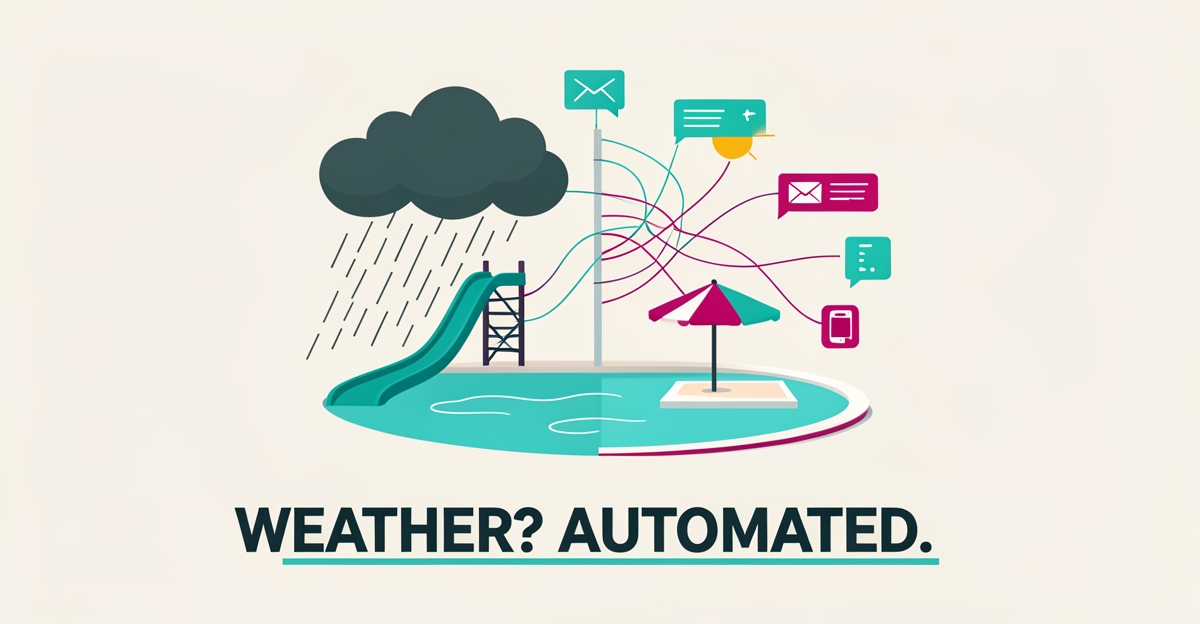
A unified approach solves this by letting a single status change — "closed for lightning" or "reopening at 2 PM" — propagate instantly across every touchpoint. The website banner updates, the AI phone assistant begins sharing the new message, and booked guests receive an email or SMS automatically. This mirrors the industry's broader shift toward integrating technology to enhance guest experiences and operational efficiency (market research).
The stakes are real. With the "Up to 18 years" age group representing 42.9% of water park attendance and tickets driving 54.30% of revenue, families need clear, timely information they can trust (market data). A fragmented process — where the website says one thing and the phone line says another — erodes that trust and drives complaints.
- Website banner reflects the current status the moment you change it
- AI phone assistant answers calls with the latest update, no hold music required
- Booked guests receive email or SMS notifications automatically
- Staff stay focused on safety and operations, not manual communications
This kind of synchronization is exactly what AI Business Sites was built to handle — a website that runs your business operations, not just your marketing. The platform's automation engine connects your channels so one update does the work of five, keeping guests informed and your team out of the chaos.
Local business: doing this the old way?
One system replaces the whole pile.
All of it — the website, the follow-up, the content, the leads — built and run for you for $1,497 + $497/mo. Month-to-month, and you own everything.
See what your build includesImplementing a Unified System Without Adding Complexity
Weather closures disrupt more than just guest plans—they create operational chaos for water park teams scrambling to update every channel manually. During summer storms, staff often waste hours switching between website editors, phone systems, and email platforms to keep visitors informed, time that could be spent ensuring safety or preparing for reopening. This manual juggling act increases the risk of outdated information slipping through cracks, leading to frustrated guests who arrive to find the park closed despite outdated online listings showing open hours.
Implementing a unified notification system doesn’t require adding new tools or complicating existing workflows. With AI Business Sites, weather updates flow through your current website admin—change the status once, and the system automatically pushes the update to your homepage banner, triggers your AI voice assistant to inform callers, and emails booked guests with revised details. This synchronization happens in real time, eliminating the need for duplicate efforts across disconnected platforms. For example, when a thunderstorm forces an early closure, updating your site’s weather alert once instantly reflects everywhere guests might check—no more logging into separate systems to repeat the same message.
The approach aligns with industry trends showing growing technological readiness for automation in weather-dependent leisure markets. Research indicates the global water parks market is projected to grow from USD 6.6 billion in 2025 to USD 14.4 billion by 2035, driven partly by demand for seamless guest experiences according to market analysis. Additionally, 42.9% of water park visitors fall into the "Up to 18 years" age group, making clear, accessible communication critical for family audiences as demographic data shows. These factors highlight why operators benefit from systems that deliver consistent updates across channels guests actually use.
Automating weather closures through your existing website turns a reactive scramble into a proactive, hands-off process. Instead of treating notifications as isolated tasks, they become part of your site’s natural operation—like updating hours or posting new attractions. This reduces staff burden during high-stress weather events while ensuring guests receive accurate information wherever they look: on your site, through your phone system, or in their inbox. The result isn’t just time saved; it’s fewer missed connections and greater trust when weather forces changes to the day’s plan.
- Update your website banner once to reflect closures or delayed openings
- Trigger your AI voice assistant to inform callers automatically
- Send personalized emails to booked guests with revised details
- Ensure all channels show consistent, real-time information
By embedding automation into your current website framework, water parks avoid the complexity of managing multiple standalone systems while gaining reliability during unpredictable weather. This approach keeps your team focused on guest safety and park operations—not on chasing down every channel to repeat the same update. When storms roll in, your site works for you, not the other way around.
Frequently Asked Questions
How does automating weather closure updates actually save time for water park staff?
Will automating weather notifications require us to buy new software or complicate our current setup?
Why is clear communication during weather closures especially important for water parks?
Can automated systems really prevent guests from showing up after a closure has been announced?
Is there research supporting the need for better weather notification systems in the water park industry?
How fast do automated weather updates reach guests across different channels?
One Update, Every Channel Covered
Summer storms will always roll in, but the scramble to notify guests doesn't have to. By centralizing weather and hours updates in a single platform, water parks eliminate the fragmented workflows that leave families arriving at closed gates or calling unanswered phones. A single status change now propagates instantly — updating the website banner, briefing the AI phone assistant, and emailing booked guests — so staff stay focused on safety and reopening, not repetitive data entry. With the "Up to 18 years" age group driving 42.9% of water park attendance, clear, consistent communication isn't just operational hygiene; it's revenue protection and trust-building. The next storm is a chance to test a simpler approach: update once, reach everywhere, and let your website handle the busywork it was built for. See how AI Business Sites unifies your guest communications so the next weather event feels like business as usual.
FOR local businesss — BUILT AND RUN BY US
Your website. Your content. Your leads. Your data.
$500 starts your build. Seven days later it's live — chat, booking, follow-up, and your Google presence all set up. Then we run it, every month. You do the work you actually get paid for.