
Key facts
- AI reduces unplanned downtime in fleet maintenance by up to 50% according to industry research
- Fleet maintenance AI cuts costs by 25–40% as noted by OxMaint
- AI predicts fleet maintenance issues weeks in advance, reducing breakdowns by 70% per OxMaint data
- Manual fleet maintenance communication wastes significant manager time, with AI offering a proactive solution highlighted by Michelin
- AI-driven automation in fleet management improves fuel efficiency by 15–20% as reported by OxMaint
WANT RESULTS LIKE THIS?
Imagine a system doing all of this for your local business — every day, without you.
We build local businesses a custom website with a team of AI behind it: every lead captured and followed up, new content published monthly,customers finding you on Google — live in 7 days.
- 85+ pages at launch
- Every lead followed up, automatically
- Your whole business on one screen
The Communication Gap in Fleet Maintenance
Traditional fleet maintenance communication often leaves managers waiting in uncertainty. When a vehicle goes in for repair, updates typically arrive only after a problem is discovered or a deadline is missed, creating a reactive cycle that frustrates stakeholders and stalls decision-making. This gap isn't just inconvenient—it directly impacts operational planning and trust between fleets and their maintenance providers.
Despite AI's proven ability to cut maintenance costs by 25–40% and reduce unplanned downtime by up to 50% through predictive analytics, most shops still rely on phone calls or sporadic emails for client updates. Fleet managers report spending excessive time chasing information that should be automatically available, turning what could be a streamlined process into a manual burden. The technology exists to transform this dynamic, yet its application for client-facing communication remains underutilized in the industry.
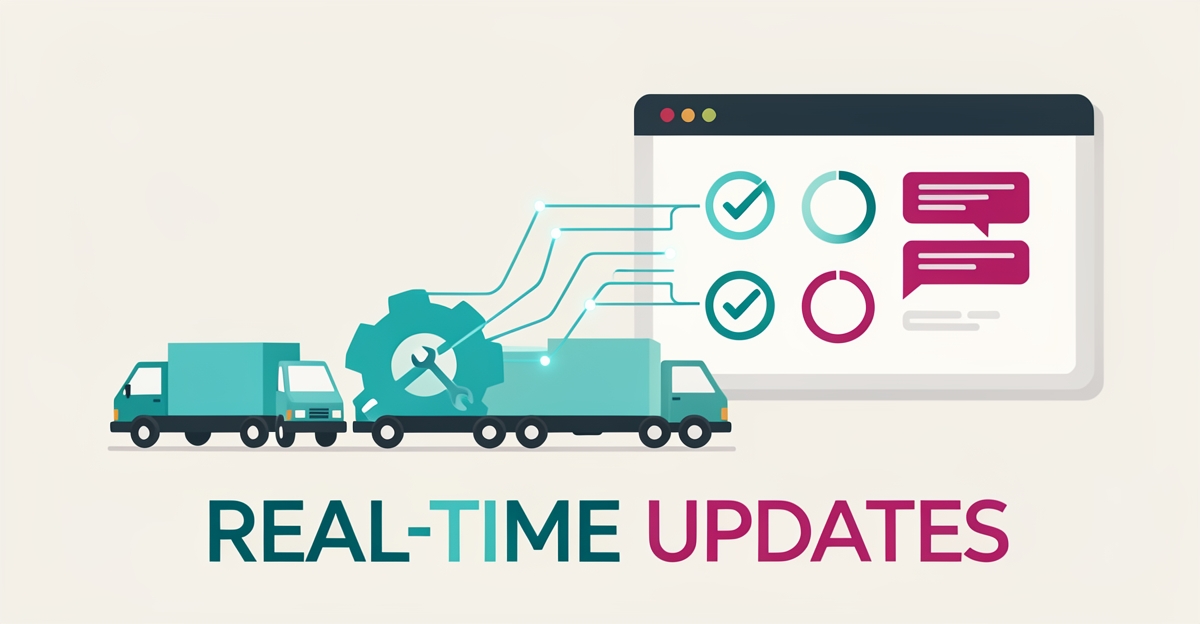
AI systems already generate the insights needed for better communication—transforming sensor data into clear reports and recommendations that enhance operational efficiency. By repurposing these existing capabilities, maintenance providers can automate status updates at key workflow milestones: when diagnosis is complete, parts are ordered, repairs begin, and vehicles are ready for pickup. Two-way messaging built on these same AI frameworks allows managers to ask questions or approve changes without phone tag, keeping them informed without adding work to their day.
This shift from reactive to proactive communication doesn't just improve satisfaction—it aligns with how AI is already reshaping fleet operations. When maintenance providers use their existing AI infrastructure to keep clients updated, they close the information gap that has long plagued the industry. The result is fewer follow-up calls, faster approvals, and stronger partnerships built on transparency rather than guesswork. For fleet managers tired of being left in the dark, this approach turns maintenance communication from a pain point into a competitive advantage.
How AI Transforms Client Updates with Real-Time Insights
Fleet maintenance clients expect transparency about their vehicles' status, yet traditional communication methods often leave them waiting for updates. AI transforms this dynamic by converting operational data into clear, timely messages that keep clients informed without adding work for service teams.
Modern fleet AI systems generate predictive alerts and maintenance workflow triggers that can be seamlessly repurposed into client-friendly status messages using existing platform capabilities. For instance, when AI detects an anomaly weeks before failure—a capability that reduces unplanned downtime by up to 50% and results in 70% fewer breakdowns—it can automatically trigger a notification explaining the predicted issue and recommended action according to industry research. These insights, which already enhance operational efficiency through clear reports and recommendations as noted by experts, become the foundation for proactive client communication.
Service teams can configure automated updates at key maintenance milestones: when diagnosis is complete, parts are ordered, repair begins, quality checks pass, and the vehicle is ready for pickup. Each trigger pulls from the same AI-generated data that prioritizes maintenance tasks to prevent wear and reduce downtime as demonstrated by fleet management platforms. The system translates technical workflow events into plain-language status messages—such as "Your truck's brake system inspection is complete; parts ordered for replacement tomorrow"—delivered via email or SMS based on client preferences.
This approach leverages existing AI automation frameworks rather than requiring new infrastructure. By transforming internal predictive maintenance capabilities—like those that cut maintenance costs by 25–40% per market analysis—into external client updates, fleets build trust through transparency. Clients receive consistent, accurate information about their vehicles' health and service progress, reducing inquiry volume while improving satisfaction. The result is a communication system that runs automatically, using the very insights that make fleet operations more efficient to keep clients informed every step of the way.
Local business: doing this the old way?
One system replaces the whole pile.
All of it — the website, the follow-up, the content, the leads — built and run for you for $1,497 + $497/mo. Month-to-month, and you own everything.
See what your build includesImplementing Two-Way Communication Without Added Work
Keeping fleet managers informed during repairs shouldn't require constant phone calls or manual email drafting from your shop staff. AI-powered communication systems can automate status updates at critical repair milestones while enabling two-way dialogue that feels personal but runs on autopilot. This approach ensures clients stay in the loop without adding administrative burden to your team.
Research shows that AI-driven automation transforms fleet data into actionable insights, enabling proactive communication that keeps stakeholders informed according to industry analysis. By setting up triggers based on workflow events—like diagnosis completion, parts ordering, or repair initiation—your system can automatically generate and send clear, concise updates via email or SMS. These messages pull directly from your shop's management system, translating technical progress into client-friendly language without any staff intervention.
Two-way capabilities let fleet managers respond with questions or approval requests, which the AI routes appropriately or answers instantly using your shop's knowledge base. For example, if a client asks about estimated completion time after receiving a "repair in progress" alert, the AI can reference real-time job data to provide an accurate update. This reduces repetitive follow-ups while maintaining transparency, directly supporting the goal of keeping clients updated through intelligent automation as noted in fleet maintenance research.
Implementing this starts with mapping your repair workflow to identify key communication points—such as when a vehicle enters the bay, when parts are secured, or when quality checks begin. At each stage, configure automated triggers that initiate personalized messages. The system can also learn from past interactions to refine message timing and content, ensuring updates feel relevant rather than repetitive. Over time, this creates a self-improving communication loop that adapts to client preferences and shop patterns.
The result is fewer interruptions for your technicians and service advisors, who no longer need to pause work for status calls. Meanwhile, fleet managers receive timely, consistent information that helps them plan vehicle rotations and minimize operational disruption. This balance—achieved through AI handling the routine while preserving space for human judgment when needed—exemplifies how your website doesn't just sit there; it actively runs parts of your business by turning internal data into client value.
Frequently Asked Questions
How can AI improve communication between fleet maintenance providers and their clients?
What are the key benefits of using AI for fleet maintenance client updates?
How does AI-driven two-way messaging work in fleet maintenance communication?
Can AI predict and notify clients about potential vehicle issues before they occur?
Is there a significant ROI for fleets adopting AI-powered maintenance and communication systems?
Do AI-powered fleet maintenance systems require new infrastructure or can they leverage existing data?
From Reactive Updates to Proactive Partnerships
The communication gap in fleet maintenance isn't just an inconvenience — it's a bottleneck that slows decisions, erodes trust, and keeps both shops and fleet managers operating reactively. AI changes this by turning the predictive insights already powering maintenance workflows into automated, client-facing updates at every milestone: diagnosis complete, parts ordered, repair underway, quality check passed, vehicle ready. Two-way messaging built on the same framework lets managers ask questions or approve work without phone tag, while shop staff stay focused on the repair. The result is fewer follow-up calls, faster approvals, and partnerships built on transparency instead of guesswork. Fleets using predictive maintenance already see up to 50% less unplanned downtime; extending that intelligence to client communication closes the loop entirely. If your maintenance updates still rely on manual calls or sporadic emails, the next step is simple: map your repair workflow, identify the key communication points, and let your existing AI infrastructure handle the rest. Your website can do more than showcase your services — it can run the communication that keeps clients coming back.
FOR local businesss — BUILT AND RUN BY US
Your website. Your content. Your leads. Your data.
$500 starts your build. Seven days later it's live — chat, booking, follow-up, and your Google presence all set up. Then we run it, every month. You do the work you actually get paid for.