
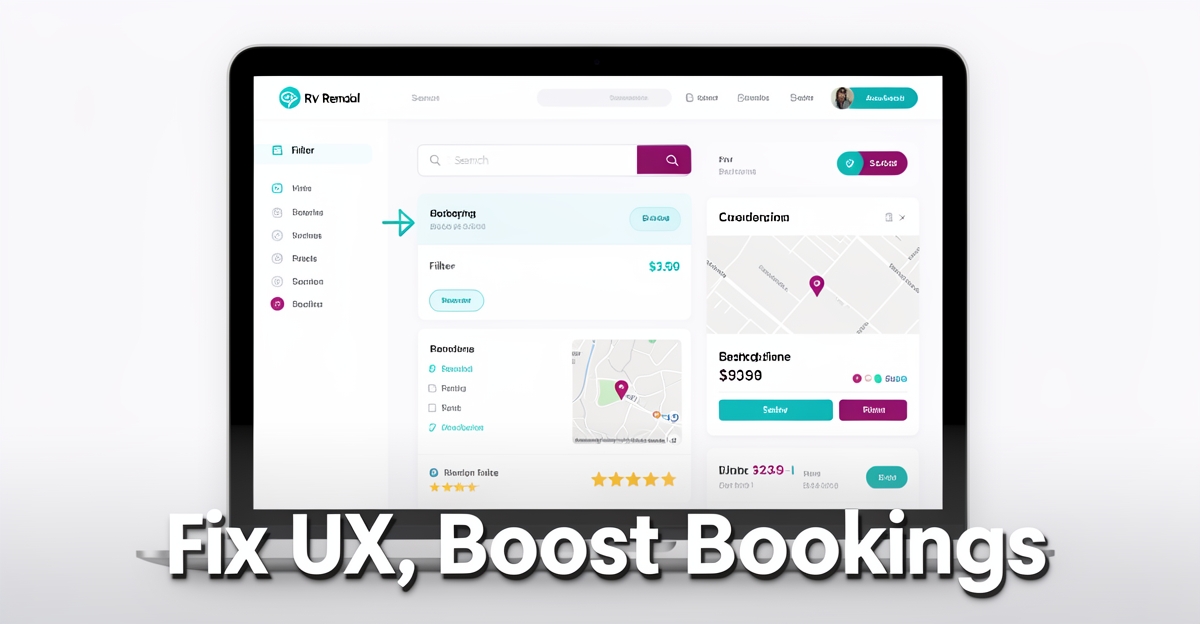
Key facts
- 30% of users abandon RV rental sites because the booking search isn't the first thing they see according to Baymard Institute travel UX research
- 40% of travel sites lose users immediately by not providing essential filters like bed configuration and pet policy per Baymard Institute
- Up to 83% of users abandon listings that hide total pricing, duration, or restrictions based on Baymard Institute findings
- 57% of travel sites fail to embed maps on detail pages, forcing renters to Google pickup addresses per Baymard Institute research
- 85% of travel sites lack third-party reviews, leaving most without credible trust signals according to Baymard Institute
- 50% of Outdoorsy trips now depart within the same week, making last-minute booking the norm per AFAR Magazine
- RV listings with 4+ photos receive 7x more inquiries than those with fewer photos based on Campanda marketplace data
WANT RESULTS LIKE THIS?
Imagine a system doing all of this for your local business — every day, without you.
We build local businesses a custom website with a team of AI behind it: every lead captured and followed up, new content published monthly,customers finding you on Google — live in 7 days.
- 85+ pages at launch
- Every lead followed up, automatically
- Your whole business on one screen
The Hidden Cost of a Clunky RV Rental Site
Most RV rental websites don't lose customers at checkout — they lose them before a visitor even clicks "search." The friction starts on the homepage, where 30% of users abandon sites because the booking search isn't the first thing they see, according to Baymard Institute's travel UX research. In a market where 50% of Outdoorsy trips now depart within the same week, that hesitation is a revenue leak measured in thousands of dollars per month.
The problem compounds on the search results page. 40% of travel sites fail users immediately by not providing essential filters like bed configuration, pet policy, or generator availability (Baymard Institute). Without those filters, a family of four burns minutes clicking through Class A motorhomes that sleep two — and leaves. On the listing page, the leak widens: up to 83% of users abandon listings that hide total pricing, duration, or restrictions (Baymard Institute). No map? 57% of sites fail to embed one, forcing renters to Google the pickup address — where competitors wait.
- Missing filters force high-intent visitors to do manual work your site should automate
- Hidden pricing creates "blind booking" distrust that kills conversions
- Text-only addresses leak users to Google Maps — and your competitors
- Absent third-party reviews leave 85% of sites without credible trust signals
These aren't design preferences. They're measurable abandonment rates backed by empirical user testing. A website that acts as a 24/7 digital concierge — instantly guiding visitors to availability with transparent pricing, visual maps, and social proof — converts lookers into bookers while you sleep. That's the difference between a static brochure and a site that runs your business with you.
Your Website Should Act Like a 24/7 RV Concierge
Your Website Should Act Like a 24/7 RV Concierge
Imagine an RV rental website that never sleeps, always ready to assist potential renters instantly. This isn't just a vision; it's a necessity for thriving in today's competitive RV rental market, where 50% of trips are now booked last-minute source. A smart RV rental website acts as a 24/7 digital concierge, guiding visitors seamlessly to available RVs with transparent pricing, hyper-specific filters, and visual location maps. This automated sales machine converts lookers into bookers without human intervention.
Research by Baymard Institute shows that 40% of travel sites lose users immediately due to missing filters source. For RV rentals, this means including filters for:
- Sleeping capacity and RV type (e.g., Class A, travel trailer)
- Amenities (generator, AC, bathroom)
- Pet policy and license requirements
These filters, prominently displayed on the homepage's search widget, reduce abandonment rates by ensuring users quickly find relevant RVs.
Up to 83% of users abandon listings that hide pricing or restrictions source. Successful RV rental websites display:
- Total price (rental, fees, insurance, mileage)
- Exact duration and cancellation policies
- High-quality photos and videos of the RV (Campanda found listings with 4+ photos receive 7x more inquiries) source
57% of sites fail by not providing maps on detail pages source. Embedding Google Maps on RV detail pages shows:
- Pickup location proximity to airports/highways
- Nearby campsites with direct booking links
This visual context prevents "Google leakage" and builds trust.
Websites built by AI Business Sites come with an AI assistant that acts as this 24/7 concierge. It:
- Answers questions instantly through live chat or voice calls
- Automates lead follow-ups to prevent missed opportunities
- Generates content (e.g., blog posts, newsletters) to attract and retain customers
- Manages projects and client approvals seamlessly
By leveraging these capabilities, RV rental websites can eliminate friction, build trust, and convert more visitors into bookers. In an industry where RVshare saw a 650% growth in bookings source, having a website that acts as a tireless concierge is no longer a luxury, but a necessity for survival and success.
Local business: doing this the old way?
One system replaces the whole pile.
All of it — the website, the follow-up, the content, the leads — built and run for you for $1,497 + $497/mo. Month-to-month, and you own everything.
See what your build includes5 Fixes That Cut RV Rental Abandonment in Half
The post-pandemic RV boom has turned last-minute bookings into the norm — half of all Outdoorsy trips now depart within the same week, and average rental lengths have stretched to eight-plus days. With that surge comes zero patience for friction. Research from Baymard Institute shows that up to 83% of users abandon listings that hide pricing, duration, or restrictions, while 40% leave immediately when essential filters are missing. A website that acts as a 24/7 digital concierge — guiding visitors instantly to the right RV with transparent details — converts lookers into bookers before they bounce to a competitor.
Here's the step-by-step checklist AI Business Sites uses to eliminate the five friction points killing RV rental conversions:
- Add RV-specific filters: bed configuration, pet policy, generator/solar, license requirements, and hookup compatibility — Baymard found 40% of travel sites fail users by omitting these
- Make the booking search the hero above the fold with "Where," "When," and "Guests" fields pre-filled for last-minute searchers — 30% of users abandon sites where search isn't immediately visible
- Show total price upfront on every detail page: rental + fees + insurance + mileage, plus exact dates, restrictions, and cancellation policy
- Embed Google Maps on RV detail pages showing pickup location, airport/highway distance, and nearby campgrounds — 57% of sites fail here, forcing users to Google and risking competitor poaching
- Integrate third-party reviews from Google, Trustpilot, or RV-specific platforms — 85% of sites lack them, yet 70% of users read up to 20 reviews during planning
Campanda's marketplace data backs every fix: listings with four-plus photos earn seven times more inquiries, and owners who communicate instantly secure six times more bookings. When your website handles the busywork — surfacing the right filters, displaying all-in pricing, mapping pickup logistics, and showcasing verified reviews — it becomes an automated sales machine that runs itself.
How to Turn Lookers Into Bookers in 48 Hours
Here’s your polished section for the blog article:
A single weekend is all it takes to turn your RV rental website from a passive brochure into a 24/7 booking machine. While competitors waste time manually updating listings or waiting for emails, your site can start converting lookers into bookers automatically—without lifting a finger after setup. The secret? AI-powered tools that handle the heavy lifting while you focus on growing your business.
Start by deploying an AI assistant to answer visitor questions instantly. Research shows that 40% of travel sites lose users immediately because they can’t find essential filters—like bed configuration or pet policies—without digging through pages of irrelevant listings. A live chat that can recall past conversations, pull RV specs from your inventory, and respond in real time slashes abandonment by cutting the friction out of the search process. Pair it with an instant auto-response email system, and you’ll close the gap between "just browsing" and "ready to book" before competitors even hit send.
Next, automate your follow-ups to nurture leads that aren’t ready to commit. Baymard found that up to 83% of users abandon listings when pricing, duration, or restrictions aren’t clear upfront. Instead of relying on manual reminders, set up a visual automation builder that tags leads based on their behavior (e.g., "viewed Class C RVs but didn’t book") and triggers personalized emails—like "Your top 3 RVs at $129/night are still available!"—without your team lifting a finger. For last-minute bookers, where 50% of trips now depart within the same week, this means capturing high-intent leads while they’re still searching.
Finally, generate fresh content to feed Google’s algorithm and keep your site ranking. A single AI content engine can research, write, and publish 14+ localized RV rental guides per month, each optimized for searches like "pet-friendly RVs near Denver" or "solar-powered Class A rentals for summer road trips." Unlike static sites that require manual updates, this system builds topical authority overnight by linking new pages to your existing inventory pages—boosting SEO while you sleep.
- Deploy an AI chat that remembers past visitors and answers RV-specific questions instantly
- Automate instant, personalized email responses to every lead—no delays, no dropped replies
- Use a visual automation builder to tag leads and send timed follow-ups based on their behavior
- Generate 14+ local SEO pages monthly with an AI content engine that links them automatically
Within 48 hours, your RV rental site will stop being a digital brochure and start working as your automated sales concierge—converting lookers into bookers while competitors scramble to keep up. The best part? You own the code, the content, and the leads. No subscriptions, no surprises. Just a website that runs itself.
Frequently Asked Questions
Why do most RV rental websites lose customers before they even start searching?
What's the primary reason users abandon RV rental search results pages?
Why is transparency in pricing crucial for RV rental listings?
How does the absence of maps on RV detail pages impact user behavior?
What percentage of sites lack third-party reviews, and why is this a problem?
How can high-quality visuals impact inquiries for RV rentals?
Turn Your RV Rental Site Into a 24/7 Booking Machine—Before Competitors Steal Your Customers
Your RV rental website isn’t just a digital brochure—it’s either a revenue engine or a leaky funnel that sends high-intent visitors straight to competitors. As we’ve seen, 40% of travelers abandon sites immediately because essential filters like bed configuration or pet policies are buried, 30% can’t even find the booking search when they land, and up to 83% bounce from listing pages that hide pricing or restrictions. These aren’t design opinions; they’re measurable abandonment rates that cost RV rental businesses thousands in lost bookings every month. The difference between a site that converts and one that frustrates comes down to one question: Does your website act as a tireless digital concierge, or does it force visitors to do the heavy lifting? By prioritizing hyper-specific RV filters, transparent pricing, visual location maps, and third-party reviews, you can eliminate friction at every step and transform your site into a self-running sales machine. Start with a homepage search widget that puts availability top-of-mind, then ensure every detail page answers critical questions before they’re asked. The RV rental market isn’t waiting for perfect websites—it’s rewarding the ones that move fast, communicate instantly, and convert effortlessly. Your next booking could be one frictionless search away.
FOR local businesss — BUILT AND RUN BY US
Your website. Your content. Your leads. Your data.
$500 starts your build. Seven days later it's live — chat, booking, follow-up, and your Google presence all set up. Then we run it, every month. You do the work you actually get paid for.