
NEWS.AR—AI Website Design & Marketing

Your Next Customer Might Ask ChatGPT, Not Google. Is Your Business in the Answer?

When a prospect asks ChatGPT for a recommendation, your business is either in the answer or it doesn't exist. Here's how AI citation visibility works and how to earn it.

AI Website Design & MarketingNovember 5, 2026
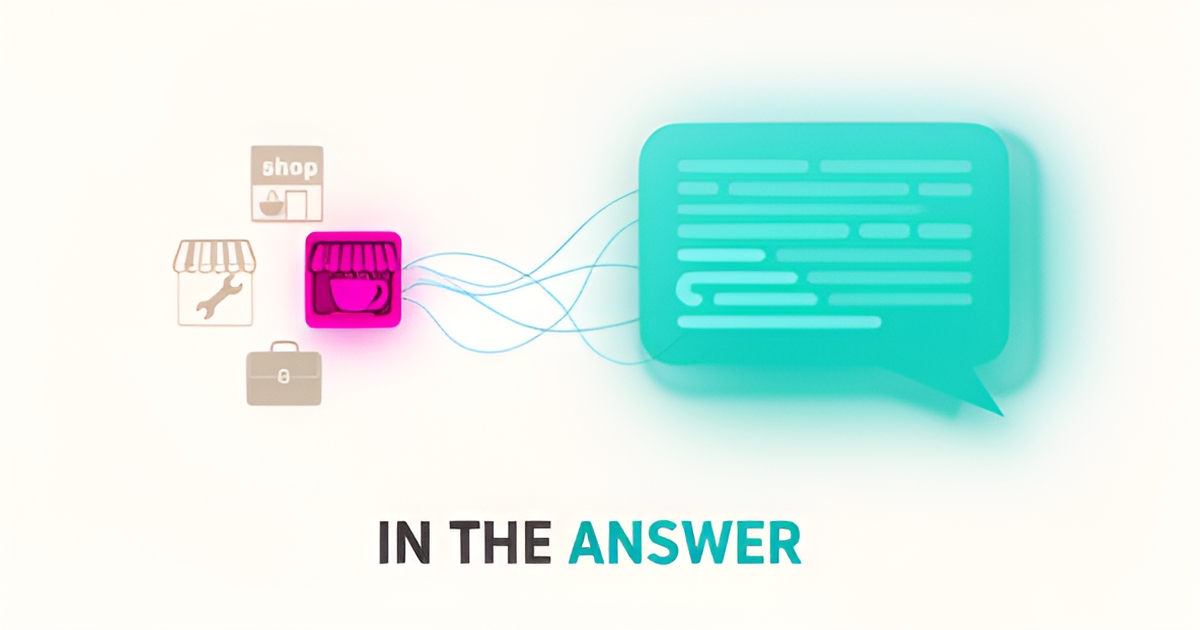
Flat illustration of an AI chat assistant citing a highlighted small business storefront, with the headline 'In the Answer' about AI search visibility.

TL;DR

Search is shifting from Google result pages to AI answers, and small businesses that aren't being cited by ChatGPT, Perplexity, and Gemini are becoming invisible to a growing share of buyers.

Key points

  • 01A growing share of product and service research now happens inside AI assistants rather than traditional search results
  • 02AI assistants build answers from content they can verify, so fact-checked, well-structured pages get cited and generic pages get skipped
  • 03Most small businesses have no way to know whether AI assistants mention them at all, because traditional rank trackers don't measure it
  • 04A weekly measure-target-edit-report loop that tracks both rankings and AI citations is now practical for small businesses, not just agencies
  • 05Owning your content and data matters more as AI search grows, because your material is what feeds the citations

Somewhere in your city this week, a homeowner opened ChatGPT and typed something like "who are the best HVAC companies near me that do financing?" They didn't scroll ten blue links. They read one answer. If your business isn't in it, you weren't option eleven. You weren't an option at all. This is the quiet shift happening under small business marketing right now, and most owners haven't noticed because their analytics still show Google traffic doing fine. It is doing fine. It's the future traffic that's moving.

Search used to be a list. Now it's an answer.

For twenty years, SEO meant one thing: rank a page, get the click. That bargain is eroding. When someone asks ChatGPT, Perplexity, Google's AI Mode, or Gemini for a recommendation, the assistant reads a pile of sources and names a few businesses. The rest are excluded from the conversation entirely. The numbers behind this vary by study, but the direction doesn't. Younger buyers especially are starting research inside AI tools, and when the AI names three plumbers, the homeowner calls one of the three. You can have a gorgeous website, five hundred reviews, and a decade of good work, and still never make the shortlist, because the assistant never had a reason to cite you.

Why AI assistants cite some businesses and skip others

Here's what's actually happening under the hood, and it's less mysterious than it sounds. These assistants prefer sources they can verify. If your pricing page states clear numbers, your service pages carry structured data, and your claims are consistent across your site, you're citable. If your site is a five-page brochure with vague copy, no specifics, and no supporting detail, the model has almost nothing to work with. There's a lesson in this that predates AI by a decade: content with real facts wins. A comparison page that says "our standard furnace tune-up costs $189 and takes 45 minutes" is usable by a person and by a model. A page that says "we offer competitive rates and unbeatable service" is useful to neither. This is also why publishing volume matters. Assistants can only cite what exists. A site with 85 pages covering each service, each service area, and honest comparisons is simply present in more conversations than a site with six pages. And freshness counts. A blog that stopped in 2023 reads, to a model, like a business that stopped in 2023.

The measurement gap most owners don't know they have

Here's the uncomfortable part. Even businesses doing solid traditional SEO usually have no idea whether AI assistants mention them. Rank trackers watch Google positions. Analytics watches visitors who already came. Neither tells you what ChatGPT said when a prospect asked for a recommendation in your category. The fix is a new kind of metric that some in the industry call AI citation share of voice: how often does the assistant name you, versus your competitors, when asked the questions your buyers actually ask. It's measurable. You can query the major assistants on a regular schedule, log who gets named, and track your share over time, alongside conventional Google and Bing rankings. For a small business owner, the point isn't to become an analytics nerd. The point is that you can't improve what you never measure, and this is now a measurable thing that directly feeds your phone.

What a realistic weekly loop looks like

The businesses getting this right run a simple cycle every week. Measure: pull rankings, clean traffic numbers, and AI citation results. Target: pick the keywords and question clusters worth winning, and map each to exactly one page so you don't compete with yourself. Edit: publish content aimed at those targets, refresh pages that are decaying, and add internal links so the site reads as a connected whole rather than a pile of loose articles. Report: write down what moved, what didn't, and what's next week's plan. Then repeat. Done by hand, that loop is several hours a week of fairly technical work, which is why it used to belong to agencies with retainers. Done with AI agents doing the research, drafting, and verification, it's becoming something a small business can afford to run continuously. The key is verification. Content written quickly and published without fact-checking is exactly the kind of thing AI assistants learn to distrust, and human readers aren't far behind. A pipeline that checks every claim and every price against a real source before publishing is now a genuine competitive edge, not a luxury.

Ownership matters more now, not less

One more thing worth saying plainly. As search becomes something done to your content rather than on your website, the question of who owns that content gets sharper. If your site lives inside a rented platform you can't export, your articles, your service pages, and your data all belong to the landlord. When you leave, the citations dry up too, because the pages do. Businesses that own their code, their content, their domain, and their lead data can move hosts, change tools, or renegotiate anything without losing the asset that AI search actually rewards: a body of real, verified, published work. If a vendor ever tells you that you can't export your own website, treat that as the loudest warning in the conversation.

Conclusion

You don't need to abandon Google. It still sends most local traffic today, and it will for a while. But the buyers who ask an assistant for a recommendation are the fastest-growing slice of the market, and they never see a search results page. The businesses those assistants name will be the ones with specific, verified, frequently published content and someone measuring the citations every week. That's a solvable problem, and it's considerably easier to solve before your competitors notice it. AI Business Sites includes a full SEO team in every plan: rank tracking, AI citation monitoring across the major assistants, 14+ new keyword-targeted pieces of content every month, and a weekly report showing exactly what moved. If you want to see how your business currently stacks up, book a demo and we'll walk you through it.