
NEWS.AR—

Why Your Website Needs to Be AI-Agent Ready (And How to Tell If It Is)

As search evolves beyond traditional rankings, small businesses need websites that AI agents can understand and use. AI Business Sites delivers this through machine-readable, fact-checked content and agent-ready design—no technical expertise required.

September 26, 2026
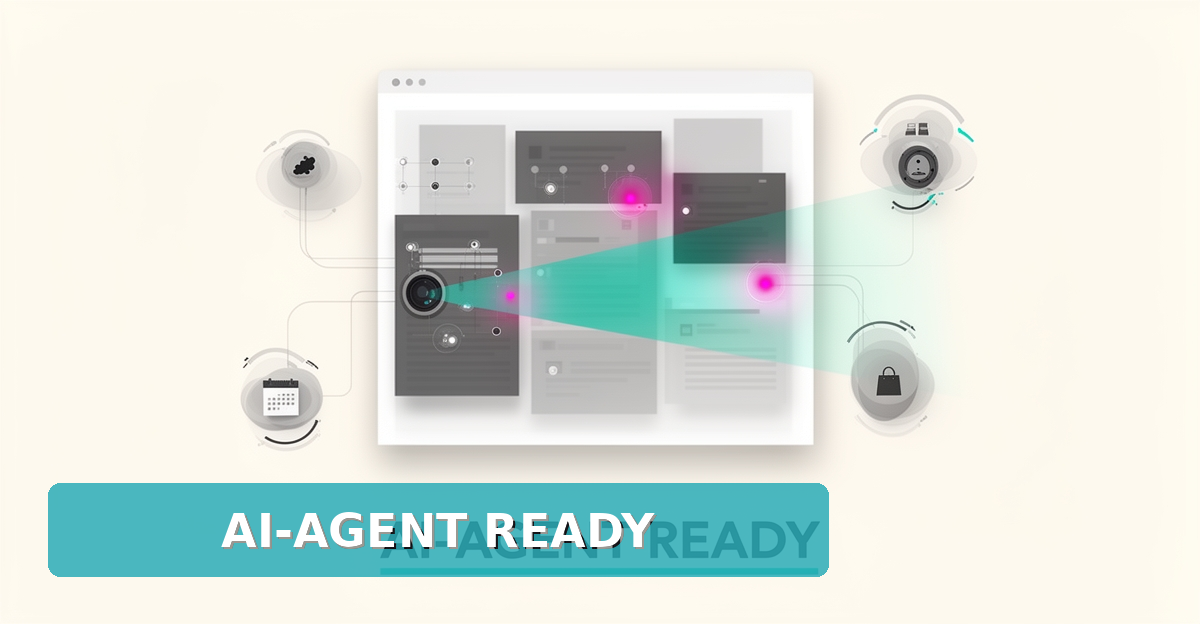
Flat illustration of a website's structured data being scanned by an AI agent, with teal and magenta accents and the headline AI-Agent Ready.

TL;DR

As search evolves beyond rankings, small businesses need websites that AI systems can understand, cite, and interact with—AI Business Sites delivers this through fact-checked content, structured data, and agent-ready design.

Key points

  • 01Traditional SEO metrics like rankings no longer capture whether AI systems can accurately represent your business or enable actions like booking or purchasing.
  • 02AI Business Sites builds websites with machine readability in mind, including schema markup, structured data, and citation-backed comparison pages that score ≥85/100 before publishing.
  • 03The platform’s AI assistant and voice agent are designed to be discoverable and interactive by both humans and AI systems, supporting agent readiness in real-world workflows.
  • 04Transparency features like live agent feeds, confidence scores, and human approval workflows mirror evidence-based diagnostics, helping businesses verify what their site actually exposes to AI crawlers.
  • 05By focusing on tangible outcomes—lead capture, quote conversion, job completion—AI Business Sites positions itself as a foundational layer for AI-ready digital operations, not just another website provider.

For years, small business owners measured online success by one question: ‘Does my website rank?’ But in late 2026, that question no longer tells the full story. As generative AI becomes embedded in search results and AI agents begin performing tasks like price checks, appointment bookings, and service comparisons, businesses need to know whether their digital presence can be understood, trusted, and used by non-human visitors. It’s no longer enough to appear in blue links—you must be machine-readable, factually sound, and action-ready. This shift has given rise to new frameworks like Generative Engine Optimization (GEO) and agent readiness, yet the tools meant to measure them often conflate technical health with citation frequency, leaving owners confused. AI Business Sites was built for this moment—not as a reaction to SEO’s evolution, but as a system designed from the ground up to meet the demands of an AI-mediated search landscape.

The Problem with Traditional SEO in an AI-First World

The SEO industry is facing a terminology crisis. Terms like 'AI visibility,' 'GEO,' and 'citations' are used inconsistently across platforms, often measuring different phenomena—some track rankings in AI overviews, others measure how often a brand is mentioned in chatbot responses, and still others assess technical crawlability. This fragmentation makes it difficult for small business owners to determine what they should actually be improving. Worse, many tools promise guaranteed AI rankings or citation counts, despite the opaque and ever-changing nature of how large language models select and present information. As highlighted in recent industry analysis, modern search now includes AI-generated overviews, agent-based research, and real-time data extraction—rendering outdated the simplistic focus on keyword positions. Today’s growth teams must evaluate whether their site is technically accessible to crawlers, whether humans grasp its value proposition, whether AI systems can extract accurate facts, and whether agents can navigate to pricing, documentation, or APIs to complete tasks. Without clarity on these layers, businesses risk investing in vanity metrics while missing real opportunities to be discovered and used by the next generation of search.

How AI Business Sites Builds for Machine Readability

From the outset, AI Business Sites designs every website to be understandable not just to people, but to AI systems. This begins with structured data and schema markup embedded across all content types—service pages, blog posts, location guides, and especially comparison pages. Unlike generic AI-generated content that risks hallucination, each piece undergoes a rigorous validation pipeline: prices and claims are deterministically verified against scraped sources, and a separate fact-check model audits every statement for grounding. Pages must score at least 85/100 on accuracy to auto-publish; lower scores trigger a repair loop or human review. This commitment to factual integrity directly supports GEO by increasing the likelihood that AI systems will cite the site as a trustworthy source. Additionally, the platform automatically generates internal links based on topical relevance, reinforcing thematic clusters that help AI understand context and relationships between concepts. Every published page also includes a 1200×630 AI-generated featured image with legible text, brand styling, and alt text—optimized for visibility in visual discovery formats like Google Discover. These aren’t just SEO best practices; they’re foundational elements of an agent-ready website.

Designed for Interaction: Where Humans and AI Agents Meet

Machine readability is only half the battle. A website must also be usable—by both human customers and AI agents attempting to perform tasks like checking service availability, extracting pricing, or initiating a booking. AI Business Sites addresses this through its AI assistant and dual voice systems. The embedded WebRTC voice agent (included in the $497/month plan) allows website visitors to speak directly to the site in their browser, asking questions and receiving answers from the business’s knowledgebase—all while capturing lead information. Separately, the AI Receptionist add-on provides a dedicated phone number that the AI answers 24/7, handling calls, booking appointments, and logging transcripts. Beyond voice, the AI assistant can be summoned via text or voice from any screen in the operating system, enabling real-time research, document generation, or web automation—for example, navigating a competitor’s site to extract pricing data. These aren’t theoretical capabilities; they’re live, observable features visible in the platform’s Mission Control, where users can watch agent runs unfold with confidence scores and step-by-step timing. This transparency ensures that the AI isn’t working behind a black box—it’s visible, auditable, and correctable through human approval workflows.

Transparency as a Diagnostic Advantage

In an environment where trust in AI-generated content is low, AI Business Sites differentiates itself by making its processes visible. The platform’s Mission Control provides a live feed of every AI agent action—what’s running, what finished, what failed, and what needs human input. Users can click into any run to see an Agent Watch timeline, stage by stage, much like observing a production line. This mirrors the evidence-based diagnostic approach advocated by tools like AuditMe, which emphasize understanding what a site actually exposes to crawlers and AI systems rather than chasing inflated scores. By showing confidence scores on content, highlighting unverified claims, and requiring human approval before publishing AI-generated emails, social posts, or review replies, the system invites owners to participate in quality control. This isn’t just about oversight—it’s about building a website that earns trust through verifiable accuracy. When an AI agent cites your comparison page in a response, you can know it’s because the price was cross-checked against a vendor’s website, not guessed. That level of accountability is becoming a competitive advantage in AI-mediated search, where misinformation can damage credibility faster than ever.

From Visibility to Action: Measuring What Matters

Ultimately, AI Business Sites shifts the focus from whether your site ranks to whether it works. The platform’s value isn’t measured in abstract SEO scores, but in tangible business outcomes visible in the CRM and reports: leads captured from chat and voice interactions, quotes approved online, jobs scheduled and completed, invoices paid, and review requests sent after service. The included Jobs & Estimates module exemplifies this—AI drafts quotes from call transcripts, customers approve them with e-signature, the job appears on the calendar, and payment is collected via the client’s own Stripe account, triggering an automated review request. This end-to-end loop—quote to job to invoice to review—is something competitors often charge extra for, yet here it’s included in the monthly fee. By owning the Stripe account and ensuring money flows directly to the business, AI Business Sites reinforces its core promise: you keep what you build. In a world where AI systems are beginning to initiate transactions, having a website that doesn’t just describe your business but actively runs it is no longer optional—it’s the table stakes for competing in local service markets.

Conclusion

The days of measuring online success by keyword rankings alone are over. As AI agents become active participants in search—answering questions, comparing services, and even completing transactions—businesses need websites that are not only visible but understandable, trustworthy, and usable by non-human visitors. AI Business Sites was engineered for this reality, combining fact-checked content, structured data, agent-ready interfaces, and transparent AI workflows into a single managed system. It doesn’t promise guaranteed rankings because it knows those are fleeting; instead, it delivers a digital foundation that earns citations, supports actions, and adapts as search evolves. For small business owners who are experts in their trade but not in prompting APIs or managing AI pipelines, this isn’t just convenience—it’s competitiveness. In the age of AI-mediated search, the best website isn’t the one that ranks highest—it’s the one that works hardest, quietly and reliably, behind the scenes.