
NEWS.AR—AI Website Design & Marketing

What Should Your AI Answer, and What Should It Hand Off? A Small Business Owner's Guide

Meta's 2026 WhatsApp pricing change and new escalation requirements signal a shift: the question isn't whether to automate, it's what to automate. Here's the framework.

AI Website Design & MarketingNovember 17, 2026
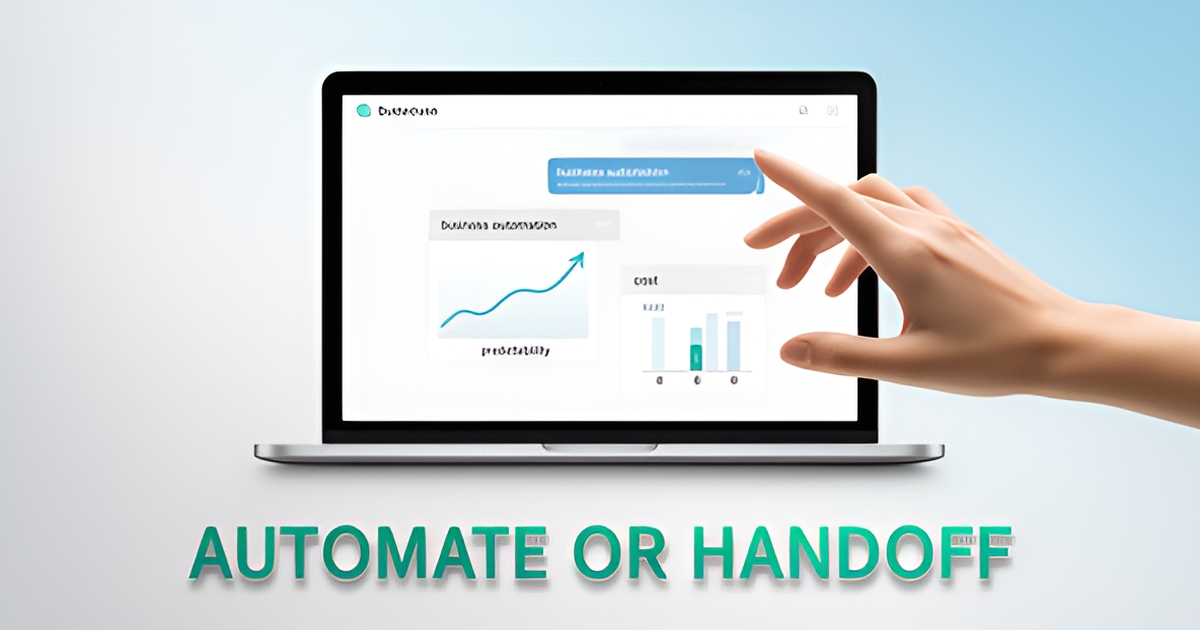
A minimalist digital illustration showing a chatbot on a laptop screen with a human hand reaching in to take over the conversation, featuring brand color accents and clean flat design, 18 words.

TL;DR

As platforms and regulators tighten rules on automated messaging, the businesses winning with AI aren't the ones automating everything, they're the ones deciding what AI may answer and what must reach a human.

Key points

  • 01Automation decisions should come down to two questions: how predictable is the request, and what does a wrong answer cost?
  • 02Meta started charging for WhatsApp customer-service replies on October 1, 2026, making careless, chatty bots measurably expensive.
  • 03Platforms like Meta now require a clear path to a human whenever replies are automated, and good handoffs carry the full conversation context.
  • 04A maturing engineering consensus holds that AI should propose while deterministic systems verify, which is why fact-checked, approval-gated AI beats free-range chatbots.
  • 05Human-in-the-loop governance isn't a limitation on AI, it's the feature that makes it safe enough to run a business on.

There's a quiet shift happening in how businesses use AI, and it has nothing to do with new models. The question has moved from "can we automate this?" to "should we, and under what constraints?" Two things pushed it there. First, Meta started charging for WhatsApp customer-service replies on October 1, 2026, ending free-tier treatment beyond 1,000 free messages per number each month. Suddenly a chatty bot costs real money. Second, a string of high-profile AI failures, from fabricated legal citations to healthcare chatbots giving dangerous advice, has convinced both regulators and platform owners that unsupervised automation is a liability. If you run a small business and you're thinking about putting AI in front of your customers, this shift matters to you. Here's how to think about it.

Two questions decide what AI should handle

Strip away the vendor noise and the automation decision comes down to two screening questions. How predictable is the request? And what does a wrong answer cost you, in money, trust, safety, or legal exposure? Bookings, hours, service descriptions, pricing FAQs, order status. These are highly predictable, and a wrong answer costs you a bit of embarrassment. Automate them. A customer asking whether you're open on Saturday deserves an instant answer at 11pm, and no human needs to be awake to give it. Now consider a customer describing chest pain, a dispute about a botched job, or a question about whether a medication is safe for their allergy. Low predictability, high cost of error. These belong with a human, every time. The failure stories that made the news, including a widely cited health platform case where an AI assistant allegedly recommended a drug to an allergic patient, all share the same root cause: nobody asked the second question before shipping.

The platform rules are catching up to the ethics

Even if you'd never ask these questions yourself, the platforms you operate on are asking them for you. Meta's business policy now requires a prompt, clear, direct path to a human whenever replies are automated on WhatsApp. That's not a suggestion; it's a condition of operating. The same platform got stricter about pricing too. Since October 1, 2026, service replies are billed per delivered message after the monthly free tier, priced by category and recipient country. Meta classifies your messages itself, marketing, utility, authentication, based on content, and misclassification triggers near-instant template rejection. The practical design lesson: send one complete, well-composed message instead of five short ones, and review your rates every quarter, since Meta can only adjust pricing on the first day of a quarter. One more caution worth your attention: unofficial WhatsApp clients and bulk-messaging shortcuts can get your number terminated. Losing a number your customers already know costs far more than doing the setup properly through the official Business Platform.

AI proposes, architecture decides

There's a doctrine circulating in engineering circles called Intelligence From Architecture, and its core idea is worth understanding even if you never read the technical literature. The distinction it draws is between capability and authority. An AI system can be technically able to do something without having permission to do it. The doctrine's principle goes like this: intelligence proposes, architecture constrains, governance authorizes, determinism enforces. In plain terms, the language model suggests, but the system around it decides what actually happens. Prohibited actions should be structurally impossible, not merely instructed against. Critical outcomes should be reproducible, not dependent on whether the model was having a good day. This sounds abstract until you see it working. Consider a content engine that publishes comparison pages with pricing tables. A system built on this doctrine doesn't let the model write a price from memory. It re-verifies every number against scraped sources, and anything it can't confirm becomes "contact for pricing" instead of an invented figure. Every claim gets audited for grounding, and pages that score below a quality threshold land in a human review queue instead of going live. The engine can't publish a price it can't source, because the architecture makes it impossible, not because it was told nicely.

What good handoff looks like

The escalation path deserves as much design attention as the automation itself. When your AI can't or shouldn't handle something, the handoff should carry the whole conversation with it. Nothing frustrates a customer more than explaining their situation twice, once to the bot and again to the person it transferred them to. A few practices separate good systems from bad ones. Pass full context on handoff, so the human picks up mid-thread instead of starting over. Be honest about staffed hours rather than letting the bot guess when someone will reply. And route by consequence: a lead asking for a quote can wait an hour; a complaint about safety can't. This is also where the missed-call problem lives for most service businesses. The majority of callers won't leave a voicemail anymore; they call the next business on Google. A system that captures the caller's details, logs the transcript, and routes it to you with a summary solves that without asking you to answer your phone from a rooftop at 2pm.

Why governance is the selling point, not the fine print

If you've been hesitant about AI because it feels like handing your business to something you can't control, that instinct is correct, and the good news is the industry has moved your way. The platforms that work in production are the ones with approval queues, confidence thresholds, and visible logs of what the AI did and why. You should be able to see every customer-facing draft before it goes out, or set the system to auto-approve only what it's confident about. The right setup means AI handles the predictable volume, humans handle the consequential edge cases, and you can see which is which at a glance. When someone tries to sell you automation without that visibility, ask the second question: what does a wrong answer cost? If they can't answer, you have your answer.

Conclusion

The businesses getting real value from AI right now aren't the ones that automated the most. They're the ones that drew the line deliberately. Predictable, low-stakes work goes to the machines, with a fact-checking architecture underneath and a human approval step where it counts. Consequential conversations go to people, with the full context attached. If you want that setup without becoming a systems engineer, it exists as a done-for-you service: a custom website with an AI back office, live in 7 days, with chat and voice agents that capture leads and route them to you, fact-checked content, and an approval inbox where you stay in control. One flat monthly fee, everything included, and you own it all. Cancel anytime. Start your build and see the difference governance makes.