
NEWS.AR—

The Per-Seat Software Tax: Why Service Businesses Keep Paying Extra for Features They Should Already Have

Review requests, e-signature, and pipelines shouldn't be premium add-ons. Inside the per-seat pricing model squeezing service businesses — and the flat-rate alternative.

October 2, 2026
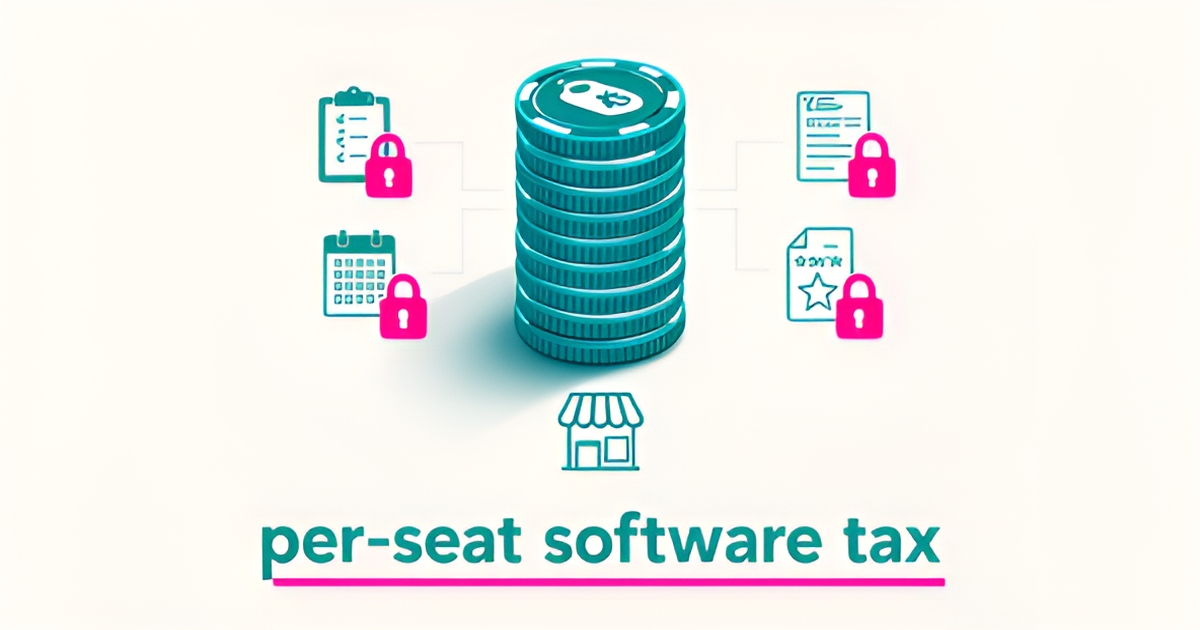
Flat illustration of stacked per-seat user icons with price tags looming over a small business, with gated feature icons in teal and magenta.

TL;DR

Trades and service businesses are quietly paying a premium for features like review requests, e-signature, and pipelines that field-service software gates behind add-ons — and an all-inclusive flat-rate model is starting to challenge that norm.

Key points

  • 01Field-service platforms like Jobber, Housecall Pro, and ServiceTitan commonly charge per seat and gate features such as review requests, e-signature, and pipelines behind paid add-ons.
  • 02The core operational loop of a service business — quote, job, schedule, invoice, payment, review — is increasingly being bundled into all-inclusive platforms rather than sold piecemeal.
  • 03AI-drafted quotes generated directly from call transcripts are emerging as a differentiator: the conversation becomes the quote without manual data entry.
  • 04Small business owners also face the 'missed-call economy,' where callers who reach voicemail simply move on to the next listing.
  • 05Ownership matters: businesses are increasingly favoring platforms where code, content, data, and even the payment relationship (via their own Stripe account) belong to them.

If you run a plumbing company, an HVAC business, or a cleaning service, you have probably noticed something odd about your software bill. You pay a monthly subscription. Then you pay per seat for each technician. Then you discover that the review-request feature — the one that politely asks happy customers to leave a Google review — is an add-on. So is e-signature. So, sometimes, is the pipeline view that helps you track jobs from bid to invoice. It is a strange arrangement: the software company knows exactly which parts of your daily workflow you cannot live without, and it prices each of them separately. Industry observers have started calling this the per-seat software tax, and for small service businesses, it adds up fast.

How the Add-On Model Became the Default

The field-service software category matured around a simple pricing insight: service businesses will pay for anything that shortens the distance between a phone call and a paid invoice. Platforms such as Jobber, Housecall Pro, ServiceTitan, and Workiz built excellent tools around that loop — quoting, scheduling, dispatching, invoicing. But the business model that emerged rewards fragmentation. Core functionality sits in the base plan, while the features that directly drive revenue — automated review requests, document e-signature, advanced pipelines — sit behind upgrade prompts. A five-person shop can easily find itself paying several hundred dollars a month once seats, add-ons, and a separate website subscription are tallied. And there is a second, quieter cost: the website itself. Most field-service platforms do not include one, so owners buy a website builder subscription, a booking widget, and a review-management tool, and spend their evenings trying to make them all talk to each other.

The All-Inclusive Counter-Trend

A newer model is pushing back. Done-for-you platforms — such as AI Business Sites, built by AIQ Labs — bundle the entire stack into one flat price: a $1,497 one-time setup and a $497 monthly fee with no tiers and no per-seat charges. The setup includes a custom website launching with 85 or more pages within seven days of kickoff, alongside a configured CRM, lead capture, and full Google presence. The monthly fee covers hosting, 14 or more new SEO content pieces every month produced by a 12-agent content pipeline, 24/7 chat and browser-based voice agents, and — critically for trades businesses — the entire quote-to-invoice loop: AI-drafted quotes, online customer approval with e-signature, a job board and calendar, invoices with online card payment, and automated review requests. In this model, the review request is not a premium feature. It is simply part of the loop, the same way the invoice is.

The Quote That Writes Itself

The most interesting shift is where AI enters the picture. Traditionally, the quote-to-job workflow began with manual data entry: someone listens to a call, opens the software, and types in line items. Newer systems collapse that step. When a customer calls and the conversation is captured as a transcript, an AI assistant can propose a line-item quote — services, materials, quantities, tax, and a validity date — for the owner to approve from their phone. The customer then approves and signs on a mobile-friendly page with no login required, and the approved quote automatically becomes a job on the calendar. Some platforms even track when the customer opened the quote, giving owners a nudge-worthy signal: the quote was viewed at 2:14 and never answered. That single thread — conversation to quote to signed job — is where the economics of the software category may be decided, because it touches the moment a business actually earns its money.

The Missed-Call Economy

There is also a behavioral reality driving the shift. Most callers no longer leave voicemail. A homeowner with a burst pipe calls the first plumber on Google, and if nobody answers, they call the second. Every unanswered ring is a quote that never happens. This is why 24/7 answering — whether through a website voice agent that visitors talk to in their browser, or a dedicated AI receptionist answering a real phone line — has moved from novelty to necessity. The same logic applies to follow-up speed: leads that get a branded response within seconds dramatically outperform those that sit in an inbox until the owner climbs out of an attic at 6 p.m. Systems that capture every lead from chat, form, booking, or call, and respond instantly, are not a luxury for a busy trade — they are the difference between a full calendar and an empty one.

Ownership: The Exit Clause That Should Be Standard

The final piece of the argument is about what happens when a business leaves. SaaS lock-in is an old story: content trapped in a proprietary builder, leads locked in a vendor's database, a domain registered in someone else's name. The counter-model makes ownership explicit — the client owns the code, the content, the data, and the domain, and can exit with a complete code repository and a full database export. Even the payment relationship transfers: card payments for stores and invoices flow directly into the business's own Stripe account, so the platform never touches the money. Month-to-month terms with 30 days' notice replace multi-year contracts. The pitch, in essence, is that the software should keep customers by doing the work, not by holding their assets hostage.

Conclusion

None of this means the established field-service platforms are bad products — many are excellent at dispatching, scheduling, and invoicing. But the pricing architecture they popularized was built for a market that tolerated add-ons, and that tolerance is wearing thin as AI-driven systems make full-stack delivery cheaper to provide. For a service business owner evaluating software in 2026, the questions worth asking are simple: Does the price change when I hire a sixth technician? Do I pay extra to request reviews, collect signatures, and track pipelines? And if I leave, do I walk away with everything — or just a cancellation email? The platforms that answer those questions well are the ones worth building on.