NEWS.AR—AI Website Design & Marketing

The Demo Isn't the Deployment: How to Evaluate AI Tools for Your Small Business

AI vendors demo well. A 22-million-loan study and a $2.3B evaluation market explain why small business owners should demand audit trails, approval controls, and bounded scope before buying.

AI Website Design & MarketingNovember 9, 2026
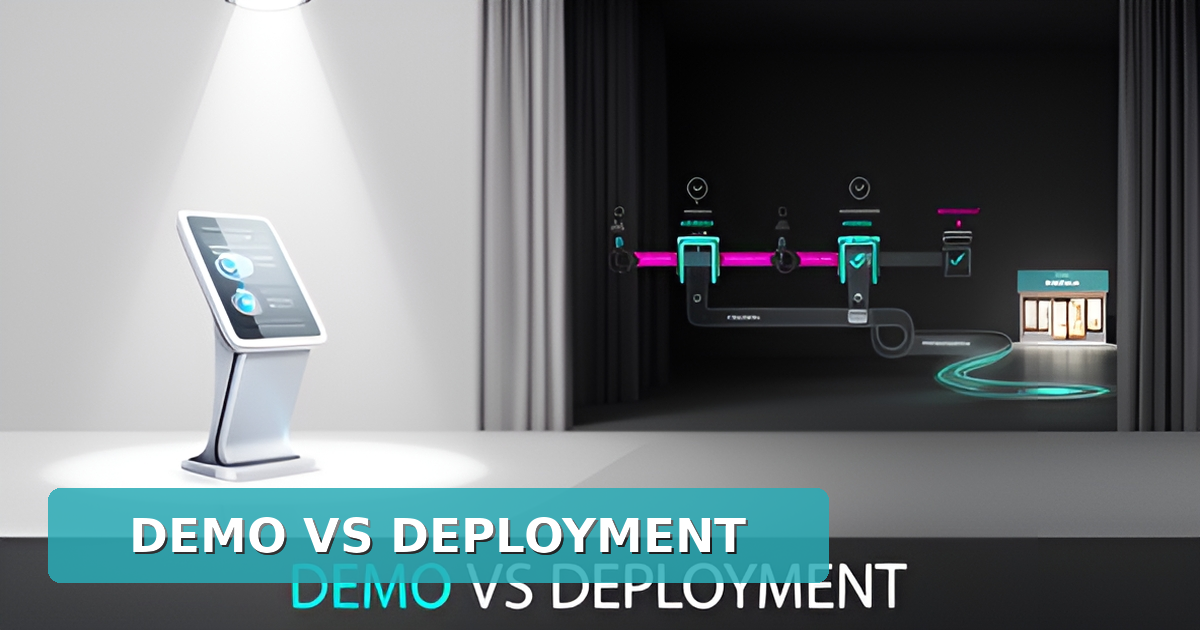
Flat illustration contrasting a spotlighted AI demo stage with an audited, gated deployment system behind the curtain, accented in teal and magenta.

TL;DR

The AI industry is shifting from capability demos to proof, and small business owners should apply the same evidence-based scrutiny when choosing AI tools that enterprises now do.

Key points

  • 01A 22-million-loan NBER study found AI debt collectors underperformed humans, showing that fluent conversation doesn't equal good outcomes
  • 02The $2.3B data labeling market has shifted from volume to quality, with evaluation and audit layers built on top of AI systems
  • 03When buying AI tools, demand audit trails, approval controls, and bounded scope rather than trusting demo performance
  • 04Voice AI works best on bounded tasks like answering, routing, and booking, not high-consequence judgment calls
  • 05A managed, done-for-you system gives small businesses the same governance discipline enterprises are now required to have

If you've sat through an AI vendor demo in the past year, you've probably had the same experience as most small business owners: the technology sounds impressive in a controlled setting, and then you're left wondering whether it will actually work for your business, with your customers, under your rules. You're right to wonder. The most interesting thing happening in AI right now has nothing to do with new capabilities. It's the growing demand for proof that those capabilities hold up in real conditions.

What a 22-Million-Loan Study Revealed

In April 2025, researchers published a National Bureau of Economic Research working paper (Choi, Huang, Yang, and Zhang) examining roughly 22 million delinquent-loan cases from a Chinese consumer-finance company between April 2021 and December 2022. The question was simple: do AI debt collectors perform as well as human ones? The answer was sobering. Borrowers made payment promises to AI callers more often, but they broke those promises more often too, and long-run repayment came in measurably lower than the human baseline. The study has become a touchstone for skepticism about AI in finance, though it deserves nuance. The scripts used in that portfolio predate today's generative voice AI, and the findings come from a single lender in one market. The sophisticated takeaway isn't that voice AI can't work. It's that a promise to pay isn't a payment, and fluency isn't evidence. Any business evaluating a voice agent should ask what outcome is actually being measured, over what window, and against what baseline.

The $2.3B Market That Grew Up Around Checking AI's Work

A parallel story is unfolding in the data labeling market, which researchers estimate at $2.32B in 2026, with some projections reaching nearly $30B for annotation tooling by 2034. Those are third-party estimates, so treat them as directional. The more telling shift is qualitative. Labeling used to be a volume business: pay per item, annotate as fast as possible. In 2026, it has largely reframed itself as data evaluation. Buyers now want rubric design, gold-standard test sets, and multi-layer quality control, with consensus scoring and adjudication workflows built in. Domain experts, including attorneys and clinicians, are replacing generic crowd workers. Evaluation-as-a-service, red teaming, and post-training services are sold alongside annotation. The reason is blunt: industry analyses attribute up to 85% of AI model failures to bad data, and even 10% label noise can cut model accuracy by around 5%. The entire supply chain is building verification layers, because buyers have learned the hard way that an AI system is only as trustworthy as what taught it and what checks it.

What This Means When You're the Buyer

Most small business owners won't hire a data labeling vendor or commission an econometric study. But the same evaluation discipline applies to every AI tool you're considering, from a website chatbot to a phone-answering assistant. Here's a practical checklist. First, ask what the tool is allowed to do on its own, and where a human has to approve. If a vendor can't show you an approval queue or a confidence threshold, that's a gap. Second, ask for the audit trail. Every AI action on your business's behalf should be logged: what it said, to whom, when, and why. Third, run a hard pilot. Vendors in the labeling market now recommend testing 50 to 200 genuinely ambiguous items rather than easy ones, and the same logic applies to you. Give the tool your trickiest customer questions, not your easiest. Fourth, demand bounded scope. A voice agent that answers questions, routes calls, and books appointments against your real availability is doing verifiable work. An agent that improvises payment terms or makes judgment calls about a distressed customer is doing something else entirely, and the NBER study suggests you should be cautious about that something.

Why Bounded AI Wins for Small Business

There's a reason the bounded approach keeps showing up in serious deployment frameworks. When a governance framework for collections voice agents circulates, its core advice is consistent: start with a narrow, counsel-approved scope, run the AI path alongside the existing human process, keep disputes and handoff failures visible alongside success metrics, and pause the workflow if any safety-critical event gets mishandled, regardless of how the financials look. That philosophy translates well to a bakery, a plumbing company, or a dental clinic. The AI should handle the work that's frequent, low-risk, and easy to verify: answering common questions from your actual documents, capturing leads, booking against real availability, sending the follow-up. You stay in control of the work that's consequential: quotes, disputes, exceptions, and judgment calls. This is also where the governance features matter more than the demo. Transcripts logged on every call. Drafted responses waiting in an approval queue instead of firing off blind. Confidence scores you can set thresholds on. A system where silence from you means nothing goes out, rather than everything.

The Managed-System Advantage

Enterprise consultancies have started arguing that regulated AI deployments need forward-deployed engineering: embedded teams who work inside the client's environment rather than shipping generic software over a wall. Small businesses need the same thing at a different scale. You don't have a compliance department or an AI evaluation budget, so the verification layer has to come built into whatever you buy. That's the real argument for a done-for-you, managed platform over a pile of subscriptions you assemble yourself. When the same team that builds your AI system also runs it, monitors it, and improves it monthly, the audit trail, the approval controls, and the bounded scope aren't features you have to configure. They're how the system ships. You talk to it, review what it drafted, and approve or reject with one tap. The alternative, six SaaS tools duct-taped together, leaves you as the unpaid integration engineer and the uncredited quality auditor.

Conclusion

The AI conversation has moved past 'does it work?' to 'can you prove it works, safely, in your environment?' That's a healthy shift, and it favors businesses that choose tools with evidence built in: logged actions, human approval, fact-checked output, and a scope the AI doesn't quietly expand. If you're evaluating AI for your business this year, don't buy the demo. Buy the system that shows its work. If you want to see what that looks like in practice, our platform runs every capability we sell, and you can take a live tour before you talk to anyone.