
NEWS.AR—AI Website Design & Marketing

Braze's New AI Decisioning Tool Tests a Billion Message Combinations — So Who Runs It for a Small Business?

Enterprise marketing just moved to per-person AI decisioning, automated QA, and chat-based operation. The lesson for small businesses isn't to buy the platform — it's to make sure the same loop is running for you.

AI Website Design & MarketingOctober 14, 2026
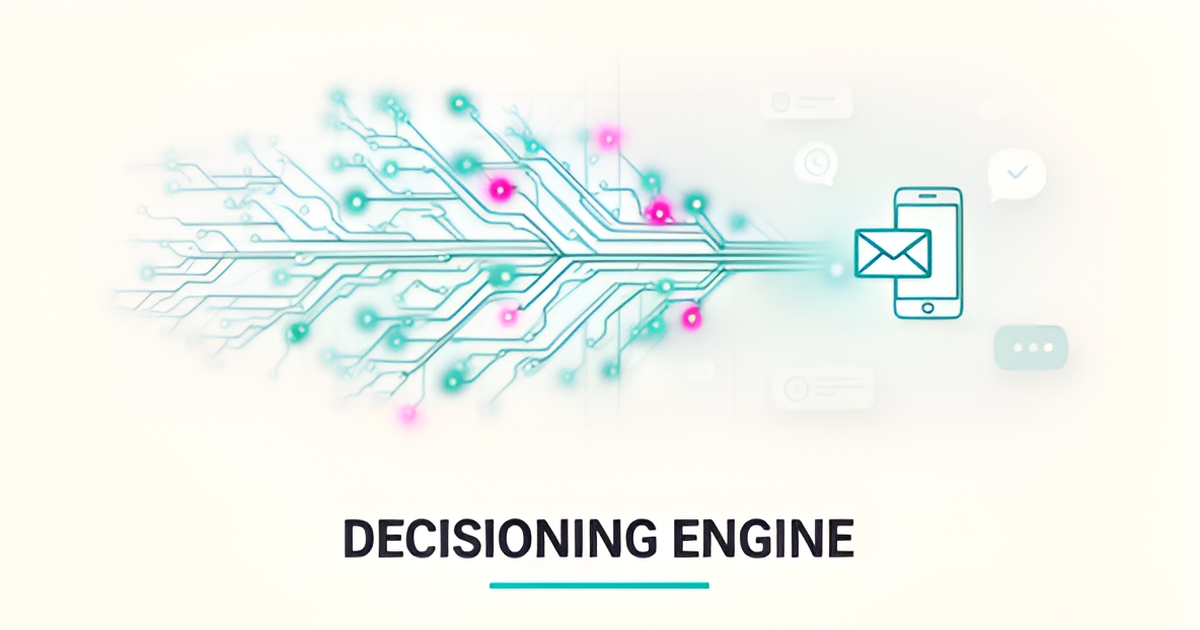
Flat illustration of an AI decisioning engine branching a billion message paths toward one recipient, with teal and magenta accents and the headline Who Runs It.

TL;DR

Braze's launch of Decisioning Studio Go shows enterprise marketing is moving to per-person AI decisioning, QA gates, and conversational interfaces — capabilities small businesses can now get through a managed system rather than an enterprise platform they'd have to learn and operate themselves.

Key points

  • 01Braze announced Decisioning Studio Go on October 13, an AI decisioning tool that tests over a billion combinations of subject lines, creative, timing, and frequency per individual recipient
  • 02The suite includes Agentic Standards, a pre-send QA tool that reviews copy, links, and compliance with human approval where required — an admission that AI speed creates a governance bottleneck
  • 03Operator Connect lets marketers run Braze functions from inside ChatGPT, Claude, and Microsoft Copilot, signaling that conversational interfaces are replacing dashboards
  • 04The shift confirms that static audience segments and traditional A/B testing are being replaced by self-optimizing, per-person message selection
  • 05Small business owners don't need an enterprise platform to benefit — the same decisioning, QA, and conversational patterns are now available through done-for-you systems that are operated for them, not by them

On October 13, customer-engagement platform Braze announced a suite of AI products headlined by Decisioning Studio Go — a tool that uses AI decisioning agents to test more than a billion combinations of subject lines, creative assets, calls to action, timing, and contact frequency, all evaluated on a per-recipient basis. Fixed audience segments and conventional A/B tests, the message implied, are on their way out. The announcement is aimed at the world's most sophisticated marketing teams. But buried in it are three signals that matter to a very different audience: the local service business owner — the contractor, salon operator, or clinic manager who will never sit down and learn an enterprise marketing platform. Those signals are worth unpacking, because they point to where small business marketing is heading, and to a question most small businesses haven't asked yet: if AI can run the marketing, who runs the AI?

From A/B Testing to a Billion Decisions Per Person

Traditional marketing optimization works like this: split your list into two groups, send version A to one and version B to the other, see which performs better, and repeat next month. It's slow, and it optimizes for the average recipient rather than any actual person. Decisioning Studio Go represents the other end of the spectrum. Instead of picking one winning message for everyone, AI agents evaluate combinations of variables for each individual — what subject line this person responds to, what time they tend to engage, how often they want to hear from you before they tune out. The company says marketers can deploy these agents in minutes without technical teams, a deliberate simplification of its earlier, more customizable Decisioning Studio Pro. For small business owners, the takeaway isn't that you should buy this tool. It's that the underlying idea — messages that improve themselves based on real responses — has become the standard, not the exception. The same principle already shows up in accessible forms: outreach systems that run competing message variants against each other, let the reply data decide the winner, and quietly rotate in better versions overnight. Static A/B testing is being retired everywhere, including at the enterprise level.

The Bottleneck Nobody Expected: Checking the Work

The most interesting product in Braze's announcement may be the least glamorous one. Agentic Standards is a pre-send quality control layer that reviews campaign copy, links, personalization logic, and compliance before anything goes out, reporting pass, warning, or fail. It can suggest or apply fixes, with human approval where required, and every check is logged for audit. Why does a company selling AI speed also sell AI supervision? Because the two problems are linked. When AI lets a team produce campaigns in minutes, the human review process becomes the constraint — and the risk. Sportsbet, a Braze customer in a heavily regulated industry, endorsed the tool for catching missing unsubscribe links and segment eligibility errors, the kinds of small mistakes that carry real legal consequences under rules like CAN-SPAM. This is a lesson every business adopting AI should internalize, regardless of size. Generation speed without verification creates exposure. Any serious AI marketing system — enterprise or small business — needs approval gates, compliance checks, and audit trails built in. If a tool promises to blast out campaigns with no review layer, that's not efficiency; it's a liability with a monthly subscription.

The Dashboard Is Losing to the Conversation

The third signal is Operator Connect, which makes Braze functions accessible from inside ChatGPT, Claude, Microsoft Copilot, and other compatible AI systems. Marketers can analyze performance, generate content, or troubleshoot without ever opening the Braze platform itself. That's a notable admission from a company whose product is, at its core, a dashboard. The industry is converging on a simple insight: people don't want to learn another piece of software. They want to ask for what they need in plain language and get it. For small business owners, this is the most relevant trend of the three. Most are already wary of AI — not because they don't want what it does, but because they dread learning yet another tool. The emerging answer in enterprise software is to bolt your existing platform into a chat assistant. The alternative, arguably better answer for a small business, is a system designed from the start so that conversation is the primary interface — where asking for a report, a quote, or a follow-up email is how the work gets done, and the dashboard is just for review.

What This Means for a Five-Person Business

Here's the honest gap between the announcement and its audience. Decisioning Studio Go, Agentic Standards, and Operator Connect are built for organizations with marketing teams — people whose job is to supervise campaigns, review QA reports, and interpret performance data. A plumbing company with six trucks doesn't have that person. Buying an enterprise-grade AI decisioning platform would just add a sophisticated system nobody has time to operate. But the capabilities themselves are becoming table stakes. Customers increasingly expect instant answers, fast follow-up, and relevant communication — the same expectations that drive Braze's enterprise clients. The question for a small business isn't whether to adopt per-person optimization, automated quality checks, or conversational AI. It's whether those things are operated by you, or for you. That distinction is where the market is splitting. Enterprise vendors sell tools that skilled teams run. A growing category of done-for-you platforms — of which AI Business Sites is one — sells the operated system itself: the outreach engine that self-optimizes, the compliance checks and approval gates, the AI that answers customers by chat and voice, all set up, customized, and managed on the owner's behalf. The business owner runs the company; the system runs the marketing loop.

Three Questions to Ask Before Adopting Any AI Marketing Tool

Whether you're evaluating an enterprise platform or a managed service, Braze's launch offers a useful checklist: 1. Does it optimize per person, or per segment? If it still relies on fixed audiences and manual A/B tests, it's a generation behind. 2. What checks the work? Look for pre-send review, compliance features like unsubscribe handling and suppression lists, and a clear audit trail. Speed without governance is a risk, not an advantage. 3. Who operates it? If the honest answer is 'you will, after training,' budget for that learning curve — or look for a model where the operation is included. Free or powerful tools are only free if your time is. Those three questions separate the tools that will actually run from the ones that will sit unused after week two.

Conclusion

Braze's October 13 announcement is, on its surface, an enterprise product launch. Read it as a forecast instead. Per-person AI decisioning, automated quality control with human approval, and conversational access to your own business systems are all becoming the default — at every scale. For a small business owner, the practical move isn't to chase the enterprise tools. It's to make sure the same loop — messages that improve themselves, work that gets checked before it ships, and systems you can simply talk to — is running somewhere in your business. The best version of that loop is one you never have to operate at all. If your marketing could test, verify, and improve itself while you're on a job site, what would you do with the hours it hands back? That's worth a conversation — and for many owners, it starts with a single decision: stop buying tools, and start hiring the team.