
NEWS.AR—

AI Has Split Into Two Markets — and Small Businesses Are Picking the Wrong One

ChatGPT Work's September upgrades are impressive — and beside the point for most service businesses. The AI market has split in two, and the layer you pick determines whether AI actually pays off.

October 1, 2026
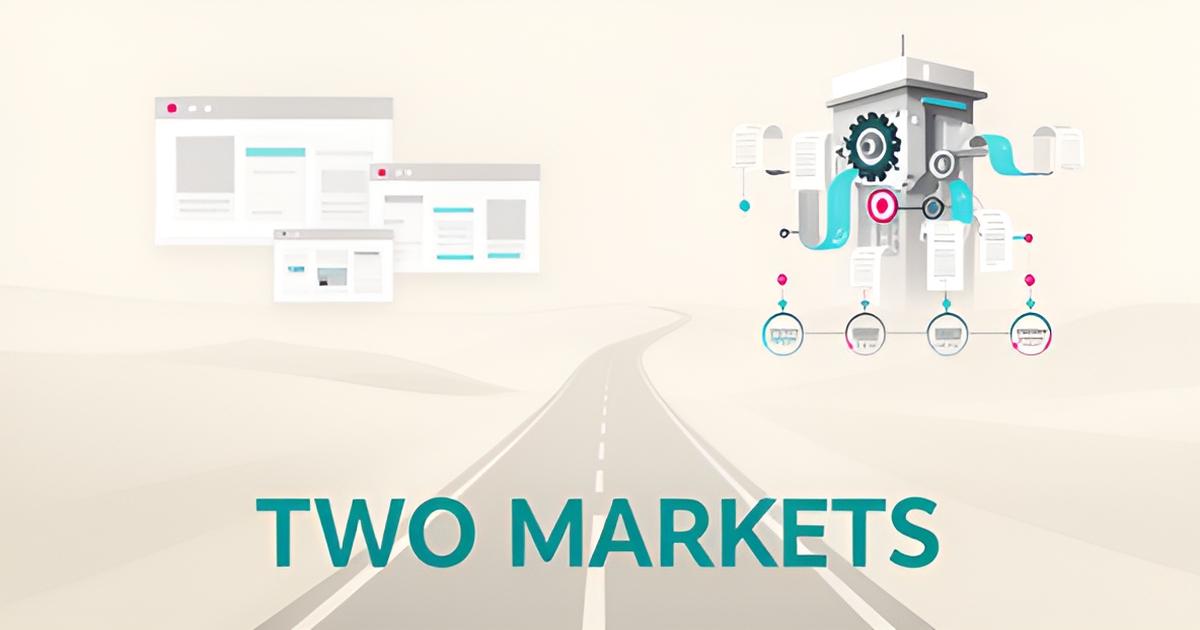
Flat illustration of a path splitting into two roads: one toward scattered generic AI tools, the other toward an integrated business system, with teal and magenta accents.

TL;DR

The agentic AI market has split into horizontal tools like ChatGPT Work that amplify technical operators and vertical business operating systems that run operations for you — and for a service business, the difference decides whether AI actually pays off.

Key points

  • 01The agentic AI market in 2026 has bifurcated into horizontal work tools (ChatGPT Work, Claude Cowork) and vertical business operating systems that run operations end-to-end.
  • 02ChatGPT Work's September upgrades — browser automation, voice control, scheduled tasks — still require a skilled operator who architects prompts, monitors capacity, and manages security.
  • 03Salesforce's 2026 survey shows AI agent adoption in service organizations jumped from 39% to 66% year over year, with 70% of adopters seeing value within 60 days.
  • 04Trust is the new battleground: 40% of U.S. consumers trust retailer emails less when they know AI wrote them, making human-in-the-loop governance essential.
  • 05For local service businesses, the winning approach is a done-for-you system that owns outcomes — leads captured, quotes approved, invoices paid — not another tool to learn.

If you've followed AI news this fall, you've watched ChatGPT Work grow into something remarkable. In September alone, OpenAI added browser automation on authenticated sites, real-time voice control, and scheduled webhook-triggered tasks, alongside new GPT-6 models rolling out across paid tiers. It's genuinely impressive — and for many small business owners, it's also completely beside the point. That's because the agentic AI market has quietly split into two distinct categories, and knowing which one you're shopping in is the single most important AI decision a service business will make this year.

Layer 2: Powerful Tools That Still Need a Driver

The first category — what industry analysts now call horizontal agent platforms — includes ChatGPT Work, Claude Cowork, Cursor, and similar systems. These are built for individual knowledge workers: analysts, marketers, engineers, and builders who want to spin up research pipelines, code dashboards, or automate browser flows themselves. The September 2026 ChatGPT Work release is a case study in how capable these tools have become. The platform can now navigate real websites visually, operate on signed-in accounts, write and execute code in a secure sandbox, and run scheduled tasks — effectively AI employees on a timer. But read the practical guidance from experienced users and a pattern emerges: break work into small sequential tasks, always request a plan before execution, monitor usage capacity so runs don't die halfway through, never share credentials, and back up before destructive operations. That's a skill set. It's prompt design, capacity management, security hygiene, and backup discipline. The tool amplifies a human driver — it doesn't replace the need for one. For a contractor, a clinic owner, or a restaurateur, the honest question isn't whether ChatGPT Work is powerful. It is. The question is who operates it on a Tuesday afternoon while you're on a job site.

Layer 3: Systems That Own Outcomes, Not Outputs

The second category is where the market is heading fastest: vertical business operating systems that embed AI agents directly into core workflows — answering calls, managing CRM records, scheduling jobs, quoting work, collecting payments, and requesting reviews. The enterprise data backs this up. Salesforce's 2026 State of Service survey found that AI agent adoption in service organizations jumped from 39% to 66% in a single year, and 70% of adopters saw measurable value within 60 days. Even more telling is what buyers now evaluate. According to recent platform comparisons, enterprise purchasers have moved past asking whether an AI can answer questions. They demand action execution depth — whether the agent can actually write to systems of record, update a CRM, schedule an appointment, or process a refund, with governance and audit trails behind every action. A chatbot that retrieves answers is no longer interesting. A system that closes the loop from phone call to signed quote to paid invoice to posted review is.

The Trust Problem Nobody's Pricing In

There's a second, quieter signal in the research that matters enormously for small businesses: trust erosion. A 2026 Litmus study found that 62% of marketers now use AI regularly or deeply, and 40% of U.S. consumers say they trust retailer emails less when they know AI wrote them. Speed without judgment is the risk. The same surveys flag the failure mode clearly — an automation agent sending the wrong offer to an entire list is a high-severity incident, while a clumsy subject line is a minor one. The winning formula, across every credible analysis, is AI drafts plus human judgment on the moments that matter. That's why governance features — approval gates, confidence scores, human-in-the-loop review before anything customer-facing goes out — have shifted from nice-to-have to table stakes. Any business adopting AI in 2026 should insist on them.

What This Means for a Local Service Business

Map these two categories onto a real business — say, a five-tech plumbing company — and the choice becomes concrete. The Layer 2 route means subscribing to a horizontal AI tool, learning to operate it, wiring it to a website, a CRM, a calendar, and a phone system, then maintaining all of it. The engines are inexpensive or even free, but someone still has to build the car, connect it, keep it running, and teach it the business. That's a technical project, not a Tuesday. The Layer 3 route means hiring a system that runs the loop for you: the call comes in, the AI drafts a line-item quote from the conversation, the customer approves and signs it online, the job lands on the calendar, the invoice goes out with a payment page, and the review request follows the payment — with a human approving the drafts along the way. It also means consolidating what has become a per-seat software tax. Field-service platforms commonly charge per technician and gate features like review management and e-signature behind paid add-ons, while the business still needs a separate website, a separate content effort, and a separate phone solution. A flat-rate alternative that includes the website, the content engine, the CRM, and the full quote-to-review loop in one monthly price directly attacks that stack.

How to Evaluate Which Layer You're Buying

When you look at any AI offering this fall, ask four questions. First: who operates it? If the answer is you — your prompts, your integrations, your maintenance — you're buying Layer 2, and you should budget the time and skill that requires. Second: does it execute actions or only produce text? Writing a quote draft is useful; getting it approved, scheduled, invoiced, and reviewed is the outcome that pays. Third: where are the approval gates? Systems with human-in-the-loop review by default will protect your reputation as AI content floods every channel. Fourth: what do you own if you leave? Code, content, data, and domain should be yours — and month-to-month terms with a clean exit are a sign the vendor plans to keep you by doing the work, not by contract.

Conclusion

The agentic AI market's split into horizontal tools and vertical operating systems isn't a temporary phase — it's the permanent structure of the industry. Raw intelligence is commoditizing fast, and differentiation has moved up the stack to who runs the system and who owns the outcomes. If you're a technical operator who enjoys architecting AI workflows, Layer 2 tools are genuinely excellent and getting better monthly. But if you run a service business and your competitive advantage is your trade — not your prompt engineering — the decision is simpler than the marketing makes it seem. Don't buy a more powerful tool. Hire a system that answers the phone at 7 PM, drafts the quote, books the job, collects the payment, and asks for the review — while you approve the drafts from your truck. That's what a done-for-you AI business operating system is for: a custom website live in 7 days with 85+ pages, an AI back office running the follow-up, and everything owned by you. If that sounds like the Tuesday you'd rather have, it starts with a build.