
NEWS.AR—AI Website Design & Marketing

AI Customer Support Went Mainstream in India. Small Businesses Everywhere Should Pay Attention.

AI customer support has become table stakes from Mumbai to Montreal. The real question for small businesses isn't which tool to buy, it's who's going to set it up and keep it running.

AI Website Design & MarketingNovember 1, 2026
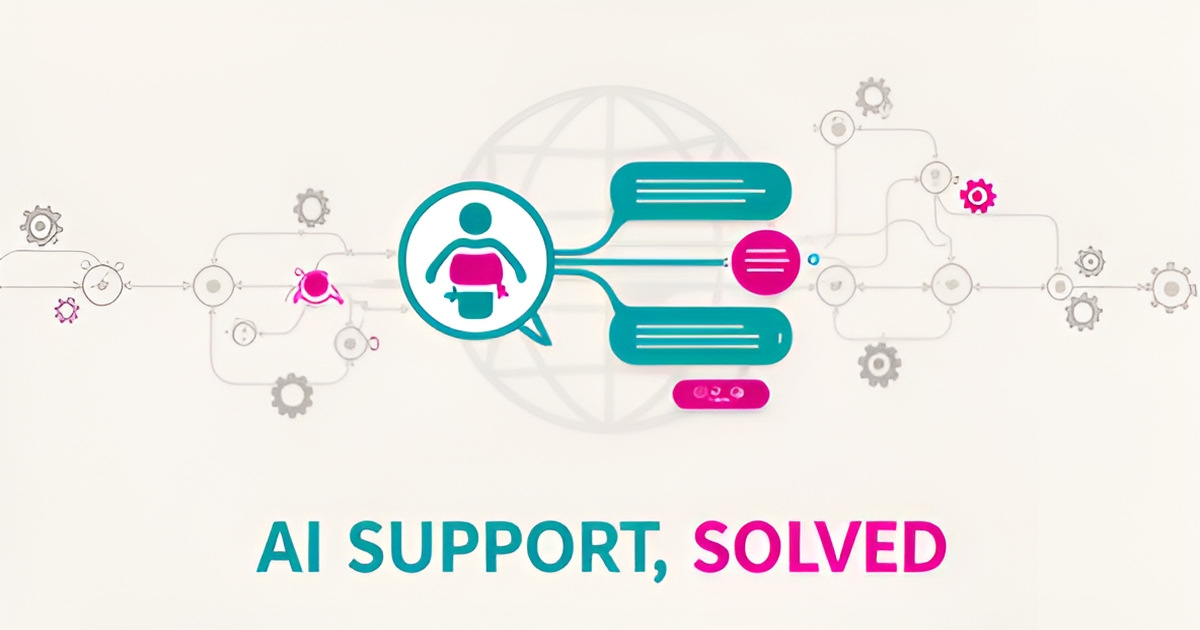
Flat illustration of AI chatbot support flowing into human handoff and CRM systems with teal and magenta accents.

TL;DR

A 2026 roundup of India's AI support software shows autonomous answering has become standard worldwide, but every tool in it still demands setup and training the average owner never does, which is the gap a done-for-you approach fills.

Key points

  • 01By mid-2026, Indian businesses in e-commerce, banking, healthcare, and logistics had broadly adopted AI support platforms, confirming the technology is table stakes globally.
  • 02The platforms profiled, including Yellow.ai, Freshdesk's Freddy AI, and Zoho Desk's Zia, share a common pattern: AI handles routine volume and escalates complex cases to humans with context.
  • 03Every tool in the category is software the buyer must configure, integrate, and keep running, and that setup burden is where most small businesses stall.
  • 04The evaluation criteria that matter most for a small business, including data ownership, human approval of AI drafts, and whether captured leads land in a CRM, rarely appear in vendor roundups.
  • 05A done-for-you model, where the provider builds, trains, and manages the system for a flat monthly fee, sidesteps the learning curve entirely.

If you want a signal on where business software is heading, watch markets where margins are thin and price sensitivity is high. A recent roundup of AI customer support platforms in India, prepared for 2027 but drawing on data through mid-2026, makes the direction plain. By the middle of this year, businesses across Indian e-commerce, banking, healthcare, and logistics had broadly adopted AI-powered support. The technology has stopped being a differentiator there. It's infrastructure. That matters for a small business owner in Halifax or Houston just as much as one in Mumbai, and the reasons why are worth unpacking.

What the Indian Market Tells Us

The roundup, published by Inventiva, profiles ten platforms actively used in India as of July 2026. The details available cover three of them in full: Yellow.ai, Freshdesk with its Freddy AI layer, and Zoho Desk with its Zia assistant. A fourth, Jio Haptik, appears only in truncated form. Even with that partial picture, the pattern across the category is consistent and telling. Every serious platform now does roughly the same things. It answers across channels, including chat, email, phone, and WhatsApp. It handles multilingual conversations, tuned for the messy reality of how people actually talk. And it resolves routine questions on its own while passing complicated cases to a human, with the full conversation history attached so the customer never repeats themselves. Yellow.ai, the enterprise entry, handles voice, chat, email, and messaging in Hindi, Tamil, Telugu, Kannada, and English, with language models tuned for code-switching and regional accents. Freshdesk's Freddy AI triages tickets, suggests responses, and runs chatbots from a unified inbox spanning email, chat, phone, WhatsApp, Instagram, and Messenger. Zoho's Zia does ticket suggestions, sentiment analysis, auto-categorization, and knowledge-base chatbots, with plans priced in rupees and a free edition for budget-conscious buyers. None of this is exotic anymore. It's the baseline.

The Pattern Behind the Platforms

Strip away the branding and the category has consolidated around one model: deflection plus escalation. The AI absorbs the high-volume, repetitive, transactional questions. A human keeps the complex, context-heavy, emotionally loaded cases. Indian enterprises adopted this model because it solves three problems at once: high inquiry volumes, the need for support in many languages, and the expectation of consistent 24/7 service. Notice what's driving adoption, though. These are pressures every local service business already feels, just at a smaller scale. A plumbing company gets the same after-hours calls a bank does. A salon gets the same booking questions an airline does. The volume differs, and the budget differs, but the underlying problem, a customer with a question and nobody available to answer it, is identical. And the cost of failing to answer is identical too. The caller doesn't leave a voicemail anymore. They call the next business on the list.

The Part the Roundups Skip: Who Does the Setup

Here's where the story gets interesting for a small business owner. Every platform in that roundup is software the customer has to learn, configure, and integrate. Someone has to write the routing rules. Someone has to build the workflows. Someone has to load the knowledge base, connect the CRM, tune the escalation logic, and keep the whole thing maintained as the business changes. For an Indian enterprise with an IT department, that's a project with a budget and a project manager. For a contractor, a clinic, or a restaurant owner, it's a project that never starts. This is the real reason small businesses still miss calls even though the technology to answer them has been mature for years. It isn't the subscription cost that stops them. Zoho offers a free edition, after all. It's the setup nobody does, and the ongoing management nobody has time for. A tool you never configure is a tool that doesn't work, whatever the feature list says.

A Buyer's Guide the Vendor Lists Don't Give You

If you're a small business owner evaluating AI support, the standard criteria still apply. Check the language coverage. Check the channel coverage, and be honest about which channels your customers actually use. Check the quality of the escalation, because a bot that hands off a customer with no context creates a worse experience than no bot at all. Check the analytics, since you need to know resolution rates, and not just message counts. But add three criteria the roundups tend to skip. First, who owns the data? If you leave, do your conversations, your leads, and your customer records go with you, or do they live in someone else's cloud forever? Second, is there a human in the loop? The best systems draft replies, quotes, and review responses for your approval rather than firing them off unsupervised, and they improve from your corrections. Third, and this is the one that separates a support tool from a business system: does the AI write into your CRM? An answered question is nice. A captured lead, with a follow-up sequence attached, is revenue. A platform that answers, books, quotes, and follows up, with everything landing in one system you own, replaces a stack of subscriptions that don't talk to each other.

From Helpdesk to Back Office

The Indian market also shows where the category is heading. The roundup describes Yellow.ai's approach as agentic, meaning the AI resolves routine queries autonomously rather than just deflecting to a help article. That's the direction of travel everywhere. The next step past autonomous answering is autonomous operations: AI that doesn't just tell a customer your business hours but books the appointment. AI that takes the order, drafts the quote from the phone call, sends the invoice, and requests the review after the job closes. For a field-service business, that quote-to-invoice loop is the whole business, and having it run on autopilot, included in one monthly price rather than billed per seat, is a bigger deal than any single support feature. The support software industry built tools for people willing to operate software. The opportunity now is systems built for people willing to run a business and nothing else.

Conclusion

The India roundup is useful precisely because it isn't about your market. It shows what happens when AI support matures in a price-sensitive, high-volume environment: the technology standardizes, the pricing localizes, and adoption spreads from enterprises downward. The small businesses in that market, and in ours, don't lack access to the technology. They lack the time and technical appetite to deploy it. That's the gap a done-for-you model closes. You shouldn't have to learn software to stop missing calls. The system should learn your business, answer your customers, and hand you the parts that genuinely need a human. If you're curious what that looks like built end to end, AI Business Sites builds and runs the whole thing: the website, the chat and voice agents, the CRM, the content, and the follow-up, live in 7 days and managed for you. Book a consultation and see the system running before you decide anything.