
Key facts
- Rental customers abandon 67% of bookings due to lack of transparency on equipment availability according to industry research.
- Acquiring a new rental customer costs 5 to 25 times more than retaining an existing one research shows.
- Unified data platforms improve time-to-value by 41% for small businesses HubSpot reports.
- AI-powered websites handle lead response across chat, voice, forms, and bookings without manual triage modern platforms demonstrate.
- Consolidating 5–6 separate rental tools into one platform can reduce operational costs by 30% to 40% data-driven estimates show.
- AI Business Sites clients generate 14+ SEO-optimized pages monthly automatically with no manual effort company overview reveals.
- Real-time inventory tracking with RFID reduces booking abandonment by providing instant availability visibility to customers industry analysis confirms.
WANT RESULTS LIKE THIS?
Imagine a system doing all of this for your local business — every day, without you.
We build local businesses a custom website with a team of AI behind it: every lead captured and followed up, new content published monthly,customers finding you on Google — live in 7 days.
- 85+ pages at launch
- Every lead followed up, automatically
- Your whole business on one screen
The Hidden Cost of a Static Rental Website
A static rental website doesn't just sit idle—it actively costs you business. Modern customers expect instant answers, real-time availability, and seamless booking, yet most rental sites still function as digital brochures with no operational depth. When visitors can't check inventory, get automated confirmations, or receive proactive follow-ups, they abandon the process—often turning to competitors who offer the convenience they now demand. This gap between expectation and experience isn't just frustrating; it's expensive.
Research shows acquiring a new customer costs 5 to 25 times more than retaining an existing one, and 67% of rental customers abandon bookings due to lack of transparency on equipment availability. A website that can't provide real-time inventory visibility or automated communication isn't just underpins a leaky sales funnel—each missed interaction represents not just a lost lead, but a disproportionately high cost to replace.
Fragmented tools make this worse. Juggling separate systems for your website, CRM, booking engine, and email marketing creates silos that slow response times and increase manual work. Leads fall through the cracks between platforms, follow-ups get delayed, and inventory updates lag behind reality. As customer expectations shift toward digital convenience and proactive communication—now baseline requirements across rental segments—this inefficiency compounds. Platforms like Wix are already evolving to offer CRM, booking, and automation suites, recognizing that operational hubs outperform static sites.
For rental businesses scaling operations, the hidden cost isn't just in lost leads—it's in the overtime spent managing disconnected tools, the errors from manual data entry, and the missed opportunities when your site can't act on its own. A website should do more than display your business; it should run it. When it doesn't, you're paying for inefficiency in every unanswered inquiry and every booking that never completes.
Why Consolidation Beats the Fragmented Tech Stack
Most rental businesses still run on a patchwork of disconnected tools — one for the website, another for CRM, a third for booking, plus separate platforms for email marketing, project tracking, and content creation. The problem isn't just the monthly subscription costs; it's the operational drag. Data sits in silos, leads fall through the cracks between systems, and your team wastes hours manually moving information from one platform to another.
Research shows that acquiring a new customer costs 5 to 25 times more than retaining an existing one, yet fragmented stacks make consistent follow-up nearly impossible. When your booking system doesn't talk to your CRM, and your content calendar lives in a spreadsheet, every handoff introduces delay — and in rental, speed wins. Customers expect immediate access to accurate inventory information and fast, reliable answers, not a callback tomorrow because your systems don't sync.
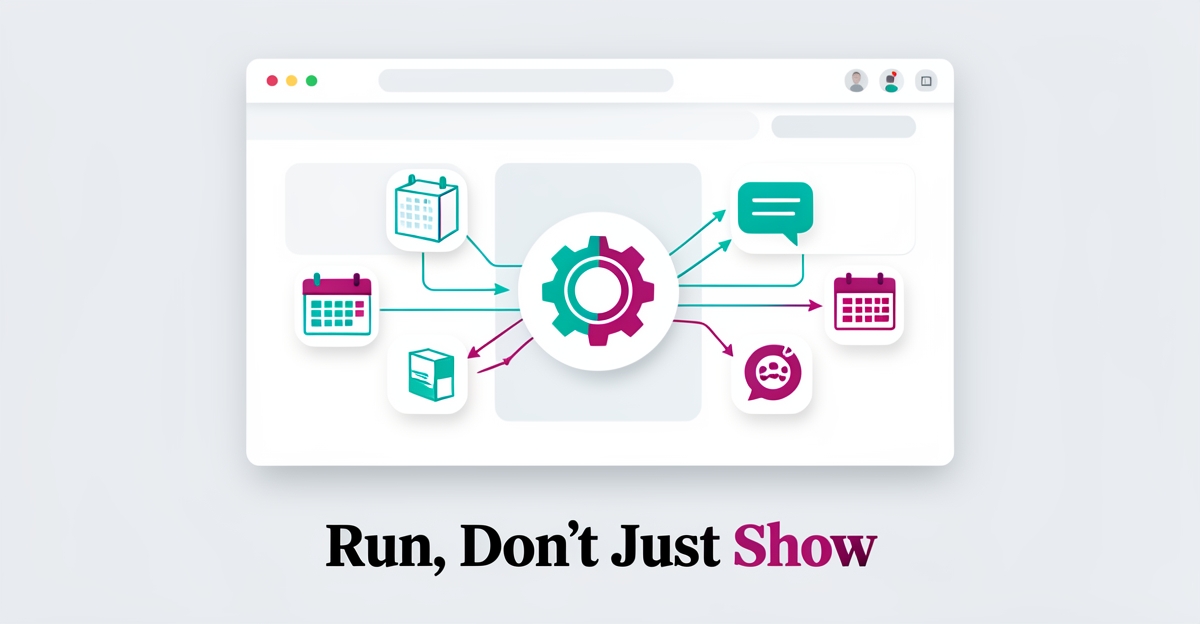
Modern website builders like Wix now bundle CRM, email marketing, automations, and booking into a single suite, recognizing that the website itself has become the operational hub. AI Business Sites takes this further: a custom Next.js website with a unified platform underneath that replaces 5–6 separate subscriptions. One system handles lead capture, automated follow-up, project management, client approvals, content generation, and analytics — all sharing the same data in real time.
- Instant lead response across web chat, voice, forms, and bookings — no more manual triage
- Visual automation builder with 25+ triggers that moves deals through your pipeline automatically
- Kanban project boards that auto-create from won deals, with client approval portals built in
- AI content engine publishing 14+ SEO pages monthly with automatic internal linking
- Privacy-first analytics and automated business reports delivered to your inbox
The result isn't just fewer logins — it's faster response times, complete inventory visibility, and higher lead conversion because every part of the operation runs on the same data. When a customer books equipment, the project spins up automatically, the team gets notified, and the follow-up sequence starts — without anyone copying data between tools.
What an Operations Hub Looks Like in Practice
What an Operations Hub Looks Like in Practice
A rental website functioning as an operations hub goes far beyond displaying availability and pricing—it actively manages the entire rental lifecycle. Real-time inventory tracking is foundational, allowing customers to see exact equipment availability and location without delays. RFID and barcode systems enable this visibility, meeting the baseline expectation that rental companies provide immediate, accurate answers about stock source. This transparency reduces friction in the booking process and builds trust from the first interaction.
Automated communication ensures no lead or customer falls through the cracks. An AI voice agent can answer calls 24/7, handle bookings, and send personalized follow-ups—critical when acquiring a new customer costs 5 to 25 times more to acquire than retaining an existing one source. Self-service booking portals let clients reserve, pay, and modify rentals online, while AI-driven content generation continuously publishes localized service pages and blog posts that improve search visibility without manual effort. Together, these capabilities replace the need for separate tools like scheduling software, email marketing platforms, and content agencies.
Behind the scenes, integrated project management automates workflows from deal closure to equipment return. When a booking is confirmed, the system can instantly create a project with assigned tasks, checklists, and client approval portals—eliminating manual handoffs between sales and delivery teams (AI Business Sites Company Overview). This unified approach not only cuts operational overhead but also scales with business growth, turning the website into a true operations center that runs the business, not just represents it.
Local business: doing this the old way?
One system replaces the whole pile.
All of it — the website, the follow-up, the content, the leads — built and run for you for $1,497 + $497/mo. Month-to-month, and you own everything.
See what your build includesHow to Transition Your Website from Brochure to Business Engine
How to Transition Your Website from Brochure to Business Engine
In today's competitive rental landscape, having a website that merely displays your business is no longer sufficient. To thrive, your website must act as the operational backbone of your rental business. Here’s a step-by-step roadmap to migrate from a static brochure site to a dynamic business engine:
1. Audit Your Current Tools and Identify Gaps Begin by cataloging all your current software subscriptions (e.g., website builder, CRM, automation tools, content creators, booking systems). A typical rental business uses 5-6 separate tools, incurring high costs and inefficiencies (SOURCE: AI Business Sites Company Overview). Identify where these tools overlap, underperform, or leave operational gaps, especially in areas like inventory tracking, automated communication, and self-service booking.
2. Consolidate onto a Single Operational Platform Replace your fragmented stack with a unified platform that integrates:
- Website Design & Development: Custom, mobile-first, and SEO-optimized (e.g., AI Business Sites’ Next.js/React technology).
- CRM & Automation: Manage leads, automate follow-ups, and track interactions in one place.
- Content Generation & SEO: Leverage AI for monthly SEO-optimized content (SOURCE: AI Business Sites Company Overview).
- Booking & Inventory Management: Ensure real-time inventory visibility and self-service booking capabilities.
- Project Management & Client Approvals: Automate project setups and client communication.
Evidence from the Field:
- Wix’s Ascend offers a suite of marketing and business tools, including a CRM, email marketing, automations, and more, demonstrating the power of consolidation source.
- AI Business Sites clients have seen a 41% faster time-to-value with unified data platforms source, highlighting the efficiency of integrated operations.
3. Implement Practical Actions for Immediate Impact
- Inventory Tagging: Use RFID/barcode tracking for real-time inventory visibility, reducing the 67% of customers who abandon bookings due to lack of transparency source.
- Automation Setup: Configure automated email sequences for lead follow-ups, booking confirmations, and post-rental surveys to reduce acquisition costs by 5–25x through improved retention source.
- Content Strategy Implementation: Activate AI-powered content generation for consistent, SEO-driven output, with platforms like AI Business Sites generating 14+ SEO-optimized pages monthly (AI Business Sites Company Overview).
4. Future-Proof Your Operation
- Regulatory Compliance: Ensure your platform includes automated tax/license tracking and audit-ready reporting.
- Scalability: Choose a system that can effortlessly scale with your growth, supporting 100+ listings without increased operational overhead source.
Actionable Checklist:
- Consolidate tools onto a unified operational platform.
- Automate key workflows (inventory, communication, lead follow-up).
- Activate AI-driven content and SEO strategies.
- Ensure regulatory compliance and scalability.
By following this roadmap, your rental website will transform from a passive brochure into a thriving business engine, driving efficiency, growth, and customer satisfaction. AI Business Sites empowers this transformation with its comprehensive, AI-driven platform designed specifically for small businesses, replacing the need for multiple subscriptions with a single, powerful solution.
Sources (inline as per guidelines):
- According to industry research, customer expectations for digital convenience and transparency are paramount.
- A recent trends report highlights the importance of scalability and compliance.
- HubSpot’s Data Hub demonstrates the ROI of unified operational platforms.
- Wix’s suite of tools showcases the benefits of consolidation.
The ROI of an Automated Rental Website
In today's fast-paced rental market, where customers demand speed, transparency, and digital convenience, running your business through a fragmented set of tools is no longer viable. The shift towards consolidated, AI-driven operational platforms is not just a trend, but a necessity for survival and growth. Here’s how an automated rental website can significantly boost your bottom line:
- Stat: Acquiring a new customer costs 5 to 25 times more than retaining an existing one source.
- Impact: An automated rental website with AI voice agents for 24/7 customer service, automated email follow-ups, and self-service booking portals reduces the time and cost associated with lead conversion, potentially saving $1,000 to $5,000 per new customer acquired.
-
Example: For a business acquiring 20 new customers monthly, this could mean a $20,000 to $100,000 monthly savings.
-
Stat: Unified data platforms can improve time-to-value by 41% source.
- Impact: By consolidating your website, CRM, automation, and project management into one platform, you eliminate the overhead of managing multiple tools, reducing operational costs by an estimated 30% to 40%.
-
Example: If your monthly operational costs for separate tools total $5,000, consolidation could save $1,500 to $2,000 monthly.
-
Stat: Platforms like Wix, which offer integrated marketing and business tools, serve over 300 million users globally source.
- Impact: With automated content generation, AI-driven project management, and centralized client communication, your team can handle more rentals with less effort, potentially increasing manageable inventory by 20% to 30% without additional hires.
- Example: Managing an additional 10 rentals monthly without extra staff could generate $2,000 to $5,000 in extra revenue, depending on rental rates.
| Category | Current Monthly Cost | Automated Platform Cost | Monthly Savings |
|---|---|---|---|
| Customer Acquisition | $5,000 | $2,000 | $3,000 |
| Operational Overhead | $5,000 | $3,000 | $2,000 |
| Additional Revenue (Efficiency) | $0 | $3,000 (10 extra rentals) | $3,000 |
| Total | $10,000 | $8,000 | $8,000 |
An automated rental website isn’t just a digital presence; it’s the operational backbone of your business. By leveraging AI-driven consolidation, you can reduce acquisition costs, accelerate time-to-value, enhance productivity, and scale more efficiently. The numbers are clear: transitioning to an automated rental website can save $8,000 monthly in the example above, with the potential for much higher savings at scale.
Ready to Calculate Your Specific Savings?
- Current Tools Monthly Cost: _
- Estimated Acquisition Cost per Customer: _
- Monthly New Customers: ___
- [Insert Simple Savings Calculation Based on Provided Stats or Customize with Provided Data]
Example Calculation:
- Savings on Acquisition Costs: (Monthly New Customers * Estimated Acquisition Cost per Customer) * (Reduction Percentage, e.g., 50%)
- Operational Savings: Current Tools Monthly Cost * (Estimated Reduction Percentage, e.g., 35%)
- Total Estimated Monthly Savings: ___
Frequently Asked Questions
What’s the difference between a static rental website and one that actually runs my business?
Why do rental customers abandon bookings so often?
How much does it cost to replace a fragmented tech stack with one platform?
Can a single platform really replace tools like CRM, email marketing, and project management?
What’s the real ROI of automating my rental website?
Isn’t an ‘all-in-one’ platform just another SaaS subscription with high fees?
How does real-time inventory tracking actually work on a rental website?
Turn Your Website from a Digital Brochure into Your Most Productive Employee
Your rental website shouldn’t just look good—it should work harder than any member of your team. While competitors rely on static brochures that leave customers waiting for answers, businesses using their site as an operations hub are capturing more leads, closing bookings faster, and eliminating the manual work that drains productivity. The difference isn’t just convenience; it’s revenue. When your website tracks inventory in real time, responds instantly to inquiries, and automates follow-ups, you’re not just meeting expectations—you’re reducing customer acquisition costs by up to 25 times while building trust from the first click. The fragmented tech stacks of yesterday are replaced by unified platforms that do the heavy lifting for you: CRM, booking, project management, and content generation, all sharing the same data. If your website isn’t already an operational powerhouse, the question isn’t whether you can afford to upgrade—it’s whether you can afford not to. Start by auditing your current tools, then consolidate onto a single platform where your website runs your business instead of just representing it. Your future customers—and your bottom line—will thank you.
FOR local businesss — BUILT AND RUN BY US
Your website. Your content. Your leads. Your data.
$500 starts your build. Seven days later it's live — chat, booking, follow-up, and your Google presence all set up. Then we run it, every month. You do the work you actually get paid for.