
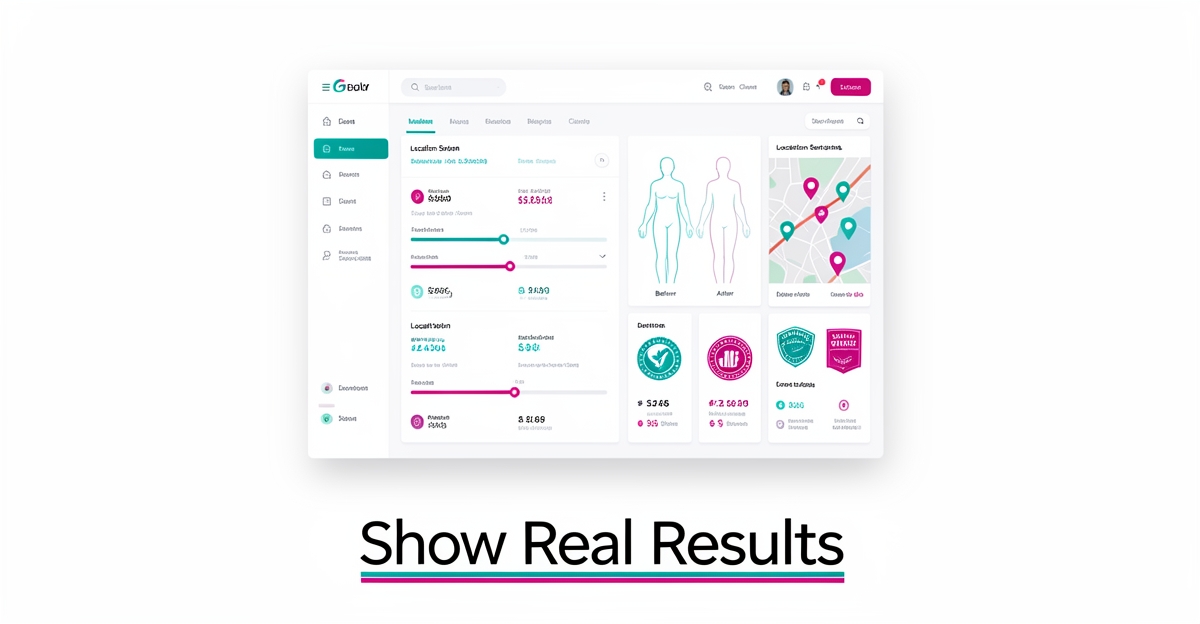
Key facts
- 67% of medical weight loss patients prioritize appearance improvements over scale numbers according to AbbVie research.
- Pharma brands hold only 6.9% of organic search share in generic drug queries per Terakeet analysis.
- Telehealth weight loss medication errors surged from 2,000+ in 2020 to 25,000+ in 2025 as reported by Pulmonology Advisor.
- 61% of medical weight loss patients experience midface volume loss post-treatment AbbVie data shows.
- 84 million annual searches for weight loss calculators/charts/tools are dominated by generic sites Terakeet reports.
- 1 in 5 adults have taken GLP-1 weight loss medications, despite a 1,500% rise in related poison control calls Pulmonology Advisor highlights.
- Mayo Clinic's 100,000+ expert-reviewed pages secure 18% search share, outperforming pharma brands according to Terakeet.
WANT RESULTS LIKE THIS?
Imagine a system doing all of this for your local business — every day, without you.
We build local businesses a custom website with a team of AI behind it: every lead captured and followed up, new content published monthly,customers finding you on Google — live in 7 days.
- 85+ pages at launch
- Every lead followed up, automatically
- Your whole business on one screen
The Trust Gap: Why Generic 'Success Stories' Are Killing Your Conversions
In the competitive landscape of weight loss clinics, a silent trust crisis is undermining the effectiveness of websites. Patients are no longer swayed by generic success stories or vague claims of weight loss. Instead, they crave authenticity, particularly in the context of appearance outcomes, which 67% of medical weight loss (MWL) patients now prioritize over scale numbers source. This shift, coupled with the distrust of telehealth services (marked by a 1,500% surge in poison control calls for weight loss medications source), leaves clinics with a daunting challenge: how to showcase real, multidimensional results to rebuild trust and drive conversions.
Generic success stories fail because they lack specificity and fail to address the holistic outcomes patients now expect. For instance, a simple "lost 30 lbs" testimonial pales in comparison to a detailed, timeline-rich narrative such as:
- Patient A: Achieved 22 lbs weight loss at 90 days, experienced 15% midface volume loss, and was treated with 1 syringe of Juvederm Voluma at week 10 for aesthetic restoration.
This level of detail not only builds credibility but also caters to the 61% of MWL patients who experience midface volume loss and the 50% dealing with skin laxity post-treatment source.
- 67% of MWL patients now focus on appearance improvement over weight reduction source.
- Telehealth's safety concerns (e.g., 25,000+ medication errors in 2025) erode trust in weight loss services source.
- Pharma brands' low search visibility (only 6.9% organic search share) highlights the need for clinics to own their narrative source.
To bridge the trust gap, weight loss clinics must adopt a new content strategy focused on:
- Structured, Timeline-Based Outcomes: Detailed, verifiable patient journeys highlighting both weight loss and aesthetic changes.
- Location-Specific Success Stories: Emphasizing local results to cater to high-intent, location-based searches.
- Transparency on Safety Protocols: Clearly outlining clinic safety measures to counter telehealth distrust.
Platforms like AI Business Sites can facilitate this shift by generating AI-driven, location-specific content that automatically links relevant service and location pages, enhancing both trust and local SEO performance. For example, AI can create "30/60/90-day result profiles" for each program, complete with verified weight loss percentages, facial volume changes, and side effects, all structured as schema-rich pages to improve search visibility.
By moving beyond generic testimonials and embracing transparency and specificity, weight loss clinics can not only rebuild trust but also capture the high-intent traffic currently dominated by generic and untrustworthy sources.
What Patients Actually Want to See: Aesthetic Outcomes, Timelines, and Local Proof
Patients aren’t just watching the scale—they’re watching their faces. Research shows that after medical weight loss, 67% of patients shift their goals toward appearance improvement, not just weight reduction, while 61% experience midface volume loss and 50% develop skin laxity. Yet most clinics still lead with vague testimonials or generic before/after photos that don’t reflect the full, nuanced journey. To build trust and rank locally, your website needs to showcase verifiable numbers, timeline-based progress, local relevance, and the aesthetic consequences of treatment—not just weight loss.
Start with hard data. Instead of saying “great results,” publish clinic-specific outcome metrics using real patient trajectories from your CRM. For example, a page titled “3-Month Semaglutide Results in [City]” could feature anonymized, HIPAA-compliant data like: “Patient A: 22 lbs lost at 90 days, 15% midface volume restoration achieved with 1 syringe of Juvederm Voluma at week 10.” This level of specificity aligns with how Mayo Clinic dominates search by offering expert-reviewed, data-driven pages that patients actively seek—18% of generic drug query visibility goes to providers who publish detailed, trustworthy information.
Next, map the timeline. Patients don’t just want to know if it works—they want to know when. Create schema-rich, date-stamped progress pages for each program (e.g., “60-Day Tirzepatide Outcomes in [Neighborhood]”) with verified weight loss ranges, facial volume changes, side effect timelines, and adherence rates. AI Business Sites makes this scalable by auto-generating these pages monthly from your actual data, then linking them internally to build topical clusters Google rewards. No manual link building required.
Don’t forget the local anchor. Patients search for providers “near me” with 84 million annual tool queries for weight loss calculators and charts—currently dominated by generic sites. Your clinic can own this space by publishing location-specific tools like a “[City] Weight Loss Predictor” that factors in your local patient base, program mix, and aesthetic outcomes. AI can generate these with real data inputs, schema markup, and auto-linking to your service pages—turning local search intent into clinic visits.
Finally, address the fear. With 25,000+ medication errors and 1,500% increase in poison control calls for GLP-1s, patients are wary of telehealth providers. Your site should counter this with transparency pages outlining your safety protocols, lab requirements, dosing schedules, and emergency contacts. AI can draft these from your SOPs, positioning your clinic as the accountable alternative in a crowded, unregulated market.
- Verifiable numbers: Publish clinic-specific outcome data (weight loss %, facial volume change, side effects, adherence) with real patient timelines.
- Timeline-based content: Create schema-rich “X-Day [Program] Outcomes in [City]” pages with date-stamped progress metrics.
- Local relevance: Build location-specific tools and pages that capture high-intent “near me” searches for weight loss calculators and outcomes.
- Aesthetic consequences: Showcase post-weight-loss facial volume loss and skin changes alongside treatment timelines—reflecting the full patient journey.
This isn’t just content—it’s a patient trust engine. AI Business Sites helps clinics publish 14+ new, locally grounded pages monthly, auto-link them for SEO strength, and keep every page current with real data. The result? A website that doesn’t just say it gets results—it shows them, ranks for the right queries, and turns skeptics into patients.
From Testimonials to Data: How to Build Location-Specific Result Pages That Rank
Generic testimonials like "I lost 30 pounds" no longer build trust — patients now expect proof of multidimensional outcomes, including aesthetic changes and program timelines. Yet most clinics still publish vague success stories instead of structured, location-specific result pages that reflect the full patient journey. This gap represents a major opportunity for clinics to differentiate in local search by turning CRM data into schema-rich, internally linked content that ranks and converts.
Start by transforming de-identified patient trajectories into "30/60/90-day result profiles" per program — for example, "Semaglutide 90-day outcomes in Austin" — using actual clinic metrics like weight loss percentage, midface volume change, and adherence rates. Ground these pages in verified outcomes: 67% of medical weight loss patients shift goals toward appearance improvement, and 61% experience midface volume loss post-treatment, making aesthetic consequences essential to showcase. Structure each page with schema markup for FAQ and HowTo rich results, embedding timeline visuals and provider quotes to reflect real local experiences.
Next, build location-specific service clusters that connect medical weight loss with facial restoration — a narrative 60% of GLP-1 aesthetics consumers now seek from providers offering both. Create co-branded pages like "Medical Weight Loss & Facial Volume Restoration in Downtown Denver" featuring shared patient journey timelines, HIPAA-compliant before/after galleries, and provider cross-referrals. Use AI Business Sites’ auto-linking engine to internally connect these pages to service and location content, reinforcing topical authority and helping Google recognize your clinic as a local authority on the full weight loss journey.
Finally, automate monthly "Real Patient Journey" blog posts by pulling consented CRM data — weight, labs, visits, aesthetic referrals — into AI-generated narratives like "Patient Journey: Maria, Seattle, 6-Month Semaglutide Program." These posts should include local landmarks, timeline visuals, and direct links to your location-specific result pages. Over time, this creates a self-improving internal link structure that boosts rankings while demonstrating E-E-A-T through authentic, clinic-calibrated content — turning your website into a trust engine that outperforms generic testimonials in both visibility and conversion.
Local business: doing this the old way?
One system replaces the whole pile.
All of it — the website, the follow-up, the content, the leads — built and run for you for $1,497 + $497/mo. Month-to-month, and you own everything.
See what your build includesThe Safety Trust Signal: Transparency Pages That Beat Telehealth Distrust
The safety crisis in telehealth prescribing isn't abstract — it's measurable. Medication errors surged from 2,000+ in 2020 to 25,000+ in 2025, while poison control calls for injectable weight loss drugs jumped 1,500% since 2019. Patients report 9x starting doses, confusing syringe measurements, and compounded drugs sourced overseas. As Dr. Marc-Andre Cornier notes, many online programs lack "proper evaluation... baseline... and proper supervision." This erosion of trust creates an opening for clinics willing to prove they do things differently.
Publishing a detailed "Our Safety Protocol" page turns accountability into a competitive signal. Instead of vague assurances, clinics can document the exact safeguards telehealth mills skip: baseline lab panels required before the first prescription, dose titration schedules with mandatory in-person check-ins, compounded drug policies aligned with FDA guidance, and emergency contact protocols patients can actually reach. Arthur Caplan calls current telehealth consent "not adequate... no probing to see if you understood anything." A published protocol that specifies informed consent steps — including comprehension checks — directly counters that critique.
- Baseline metabolic panel, thyroid, and renal function requirements
- Week-by-week titration schedule with in-person visit cadence
- Compounded drug policy: only when FDA-approved options are contraindicated
- 24/7 clinical escalation path — not a chatbot, a licensed provider
- Documented informed consent with teach-back verification
AI Business Sites helps clinics generate these pages directly from their actual SOPs — not marketing copy. The AI content engine pulls clinical workflows, provider protocols, and safety checklists already in use, then structures them into schema-rich pages that search engines recognize as authoritative health content. Because the platform auto-links new safety pages to service pages, location pages, and patient journey posts, the trust signal compounds across the site. One clinic's transparency becomes a topical cluster Google associates with expertise — the same model that gives Mayo Clinic 18% search share via 100,000+ expert-reviewed pages. The difference: your pages reflect your protocols, your patients, your city.
Automate Your Proof: A Monthly 'Real Patient Journeys' Content Engine
Most clinics publish vague before/after photos with no context—just numbers without timelines, locations, or provider insights. That’s why their "real results" pages fade into the background. You can change that by automating a monthly stream of location-specific, data-grounded patient journeys that turn raw CRM records into compelling blog content—complete with timeline visuals, local landmarks, and provider commentary—without lifting a finger after setup.
Your clinic’s CRM already holds the most powerful proof: patient trajectories tied to real programs, real providers, and real neighborhoods. Configure your AI content engine to pull de-identified, consented data and transform it into monthly "Real Patient Journeys"—posts that map weight loss timelines to local references like "Main Street Pharmacy" or "Central Park Clinic visits." Each journey includes a visual progress chart (30/60/90-day milestones), a map pin of the patient’s service area, and a short provider quote pulled from their chart notes (e.g., "Sarah’s adherence to her weekly semaglutide protocol led to a 14% facial volume preservation at 90 days—uncommon in her demographic."). The engine then auto-links each new post to your service, location, and FAQ pages, building the topical clusters Google rewards—while older content gets fresh internal links to keep the structure alive.
The automation handles the hard parts: consent verification, HIPAA-safe de-identification, and timeline alignment with your actual program durations. You choose the cadence—one post per month, or one per program per quarter. The content engine stitches the narrative together using your clinic’s real data, so every post reflects local outcomes, not generic claims. That’s a core reason healthcare publishers like Mayo Clinic command 18% of generic drug queries—their pages are rooted in evidence and locality, not vague testimonials. Meanwhile, pharma brands hold only 6.9% of that search share because their content lacks the granular, location-specific texture that builds trust at the local level.
Here’s what your automated engine delivers, at scale:
- Timeline fidelity: 90-day patient journeys mapped to your actual program structure—no filler content, just real milestones.
- Local anchors: Every story ties back to your neighborhood—pharmacies, parks, or landmarks patients recognize.
- Provider voice: Quotes pulled from chart notes and approved for publication, adding authenticity without manual interviews.
- Automated SEO: Internal linking engine keeps your topical clusters dense, so new posts strengthen older ones automatically.
- No editorial load: The system generates, schedules, and publishes—you review or approve in one click.
Clinics that publish this kind of structured, outcome-verified content don’t just rank higher—they convert more leads. Patients searching for "semaglutide results in [City]" are looking for proof tied to their reality: the pharmacy they pass daily, the provider they trust, the timeline they can follow. Your website becomes the go-to source for real local results, not another generic success story.
Frequently Asked Questions
Why are generic weight loss testimonials like 'I lost 30 pounds' no longer effective for clinic websites?
What specific aesthetic changes should weight loss clinics showcase to reflect real patient experiences?
How can a clinic's website compete with telehealth providers when patients are worried about medication safety?
Do location-specific result pages actually help with local SEO and patient conversions?
Can AI-generated content really produce trustworthy, HIPAA-compliant patient journey pages without manual work?
What makes Mayo Clinic's content strategy so effective in weight loss search, and can a small clinic replicate it?
Key Takeaways
{ "title": "From Trust Gap to Trust Engine: Revolutionizing Weight Loss Clinic Websites", "content": "The weight loss clinic industry faces a trust crisis, with generic success stories and telehealth safety concerns undermining conversions. Patients now prioritize **aesthetic outcomes over scale num
FOR local businesss — BUILT AND RUN BY US
Your website. Your content. Your leads. Your data.
$500 starts your build. Seven days later it's live — chat, booking, follow-up, and your Google presence all set up. Then we run it, every month. You do the work you actually get paid for.