
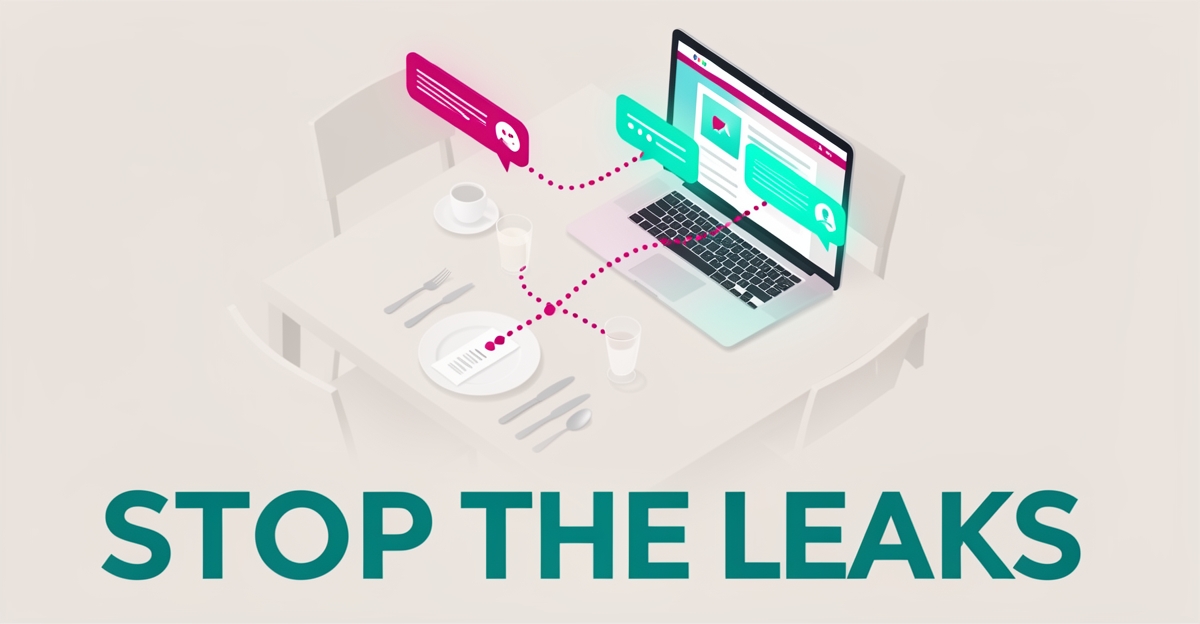
Key facts
- A single 4-top no-show costs $300 in lost revenue according to industry analysis
- Restaurants with 100 weekly reservations and a 5% no-show rate lose over $78,000 annually globally
- Global average no-show rates range from 5–20% depending on concept and region
- SMS reminders reduce no-shows by 30–50% according to studies
- Requiring credit card details at booking reduces no-show rates by up to 65% per TheFork data
- AI voice assistants can recover lost leads, with one case recovering $2,200 in 72 hours as reported
- 74% of diners are comfortable using AI for reservations and confirmations per Now Book It
WANT RESULTS LIKE THIS?
Imagine a system doing all of this for your local business — every day, without you.
We build local businesses a custom website with a team of AI behind it: every lead captured and followed up, new content published monthly,customers finding you on Google — live in 7 days.
- 85+ pages at launch
- Every lead followed up, automatically
- Your whole business on one screen
The $78,000-a-Year Mistake Most Restaurants Don’t Track
For restaurants, the cost of an empty table goes far beyond a single missed meal—it’s a steady drain on annual revenue that many owners never see coming. A single no-show for a party of four at an upscale restaurant with a $75 average check represents $300 in lost revenue, according to industry analysis. When scaled across a typical week, the financial impact becomes startling: a venue averaging 100 weekly reservations with just a 5% no-show rate loses over $78,000 annually. This figure isn’t an outlier—it’s a conservative estimate based on global averages, with fine dining establishments lacking deposit policies often seeing no-show rates climb to 25–30%, tripling that loss.
These losses compound quickly in an industry where the average pre-tax profit margin hovers around just 5%. Every abandoned reservation isn’t merely a missed opportunity—it’s wasted food, idle staff time, and turned-away walk-in guests who could have filled the gap. Research shows that 85%+ of reservation-based restaurants are affected by this issue, with no-show rates varying from 5–20% globally depending on concept and region. The problem is especially pronounced in markets where online booking dominates—72% of reservations are made via smartphones—yet many visitors browse a restaurant’s website, consider booking, and leave without completing the action, creating a recoverable pool of lost leads.
What makes this particularly frustrating is that proven interventions exist. Requiring credit card details at booking can reduce no-show rates by up to 65%, while deposits cut them by approximately 55%. SMS reminders alone lower no-shows by 30–50%. Yet many small restaurants lack the systems to implement these strategies consistently. This is where AI-powered follow-up transforms passive websites into active revenue protectors. By capturing visitors who abandon the booking flow and re-engaging them through personalized voice calls or automated messages, restaurants can recover leads that would otherwise vanish. One case study documented a restaurant recovering $2,200 in missed revenue within 72 hours of deploying an AI voice assistant—proof that timely, automated follow-up directly translates to reclaimed income. For a typical venue, closing even a fraction of this gap could mean the difference between breaking even and thriving.
- A single 4-top no-show at $75 average check costs $300 in lost revenue
- 5% no-show rate with 100 weekly reservations = $78,000+ annual loss per restaurant
- Global average no-show rate ranges from 5–20% depending on concept and region
Why Guests Ghost Your Reservation (And How Psychology Works Against You)
Visitors spend minutes browsing your menu, linger on your hours page, and even start a reservation—only to vanish without a booking. It’s the digital equivalent of a guest lingering at the host stand before walking out. The loss isn’t just a missed table; it’s a missed opportunity to turn curiosity into revenue. Research shows that 54% of UK diners prefer online reservations, and 72% of all reservations now happen on smartphones, yet many of those visitors never complete the booking flow. The result? A quiet hemorrhage of potential revenue slipping through unnoticed.
Behind every abandoned reservation lies more than just forgetfulness—it’s a mix of behavioral triggers and operational gaps working against you. Free reservations create no urgency; online bookings feel impersonal and easy to abandon; distant reservation dates seem theoretical, not real. And when those visitors finally do leave your site, they’re not just gone—they’re likely booking elsewhere because you never followed up. Toast found 17% of reservations were cancelled in Q3 2024 alone, highlighting just how fragile the booking-to-showup pipeline can be. Without a way to re-engage, your website becomes another digital storefront where leads walk in and walk out—without ever becoming customers.
These gaps aren’t just frustrating; they’re costly. A single 4-top no-show at an upscale restaurant costs about $300 in lost revenue. At a 5% no-show rate with 100 weekly reservations, that’s $78,000+ annually per restaurant. Across the UK, venues lose over £3,600 annually on average, with the industry racking up £17.6 billion in total losses. Yet the root causes aren’t guest malice—they’re forgetfulness, competing priorities, and unclear consequences. 74% of diners are comfortable using AI for reservations, which means technology can step in where human follow-up falls short.
- No psychological commitment from free reservations
- Distant booking dates feel theoretical, not real
- No automated re-engagement after visitors leave your site
- No immediate reminder or next-step prompt for incomplete bookings
- No integration between browsing behavior and follow-up outreach
The good news? These gaps are fixable. An AI assistant on your site can answer questions instantly, capture incomplete bookings, and follow up automatically—turning abandoned visits into booked tables. One restaurant recovered $2,200 in 72 hours after deploying an AI voice assistant to handle calls and reminders. Meanwhile, 74% of diners are comfortable using AI for reservations and booking confirmations, making it a natural fit for recovery workflows. The key isn’t just catching visitors before they leave—it’s creating the kind of frictionless, accountable experience that turns browsers into loyal guests.
What Actually Works to Recover Lost Leads (Beyond Just Reminders)
The difference between a reminder and a recovery system is the difference between hoping guests show up and knowing they will. Restaurants running sub-5% no-show rates aren't doing anything magical — they're just consistent about a handful of proven interventions that most venues either skip entirely or half-implement and forget.
- SMS reminders cut no-shows by 30–50% — a significant revenue recovery for the cost of a text message
- Requiring credit card details at booking reduces no-show rates by up to 65%, according to TheFork data
- Deposits lower no-show rates by approximately 55%, with prix fixe prepayment models holding below 5–8%
These aren't standalone tactics — they're layers of a system. Weeknights might need only automated reminders. Weekend prime time warrants card holds. Holidays and large parties call for deposits. The restaurants winning this game apply the right friction at the right moment, automatically.
That's where a smart website changes the equation. When your site captures every interaction — web chat, form fill, booking attempt, voice call — in one unified pipeline, the follow-up happens without you lifting a finger. AI Business Sites builds this into the foundation: an AI assistant that answers questions instantly, a voice agent that books appointments by phone, and automation that tags leads, triggers the right follow-up at the right time, and alerts you only when human judgment is actually needed.
The results compound. One restaurant recovered $2,200 in missed revenue within 72 hours of deploying an AI voice assistant. Another achieved an 85% reduction in no-shows — dropping from a 20–30% baseline to 4.5% — alongside a 45% increase in reservations and a 32% revenue increase. With 74% of diners already comfortable using AI for reservations and confirmations, the adoption barrier has effectively disappeared.
Local business: doing this the old way?
One system replaces the whole pile.
All of it — the website, the follow-up, the content, the leads — built and run for you for $1,497 + $497/mo. Month-to-month, and you own everything.
See what your build includesTurn Website Browsers Into Booked Tables with AI Voice Recovery
Turn Website Browsers Into Booked Tables with AI Voice Recovery
When visitors browse your restaurant’s website but leave without booking, those missed opportunities represent recoverable revenue—not just abandoned interest. Research shows that 72% of all reservations are made via smartphones globally, yet many users start the booking flow and never complete it, creating a pool of warm leads ready for re-engagement. Smartphone reservations dominate globally, making website abandonment a critical leak in the reservation funnel.
An AI voice assistant embedded on your site can capture these abandoning visitors by triggering a personalized voice follow-up when booking intent is detected but not fulfilled. Unlike generic chatbots, this assistant uses your restaurant’s actual menu, policies, and availability to speak naturally—answering questions, addressing hesitations, and guiding users back to complete their reservation. One restaurant recovered $2,200 in missed revenue within 72 hours of deploying such a system, proving that timely, voice-based re-engagement converts lost traffic into booked tables. AI voice automation recovered $2,200 in 72 hours in a real-world implementation.
The assistant doesn’t just react—it learns. It remembers returning visitors, so if someone browsed your weekend specials twice but didn’t book, the follow-up call references their prior interest: “Hi, I noticed you were looking at our Saturday brunch menu—would you like to reserve a table for two?” This builds psychological commitment without pressure. With 74% of diners comfortable using AI for reservations and confirmations, guests respond positively to this helpful, low-friction outreach. 74% of diners are comfortable with AI for reservations, making voice recovery both effective and guest-friendly.
For restaurants using AI Business Sites, this capability is built into the website’s core—no third-party tools or complex integrations needed. The AI assistant lives on your site, shares the same knowledge base as your web chat, and logs every interaction into a unified CRM. When a visitor abandons booking, the system triggers a voice call, captures their response, and either completes the reservation or tags them for nurture—turning passive browsers into active guests, automatically. This isn’t about adding another tool; it’s about letting your website do the work of following up so you can focus on serving the guests who show up.
A 3-Step Plan to Automate Lead Recovery and Never Miss Another Reservation
You've built a website that brings visitors in. Now you need a system that brings them back.
Most businesses lose leads not because visitors aren't interested, but because follow-up never happens — or happens too late. Research shows SMS reminders alone cut no-shows by 30–50%, yet most small teams don't have the bandwidth to send them consistently. An AI voice assistant changes that equation by handling the outreach automatically, at scale, with the same care a person would bring.
Here's how to set up a three-step recovery system that runs in the background while you focus on operations.
- Step 1: Deploy an AI voice agent that answers every call and captures every abandoned booking. When a visitor browses your site but doesn't complete a reservation, the system flags that intent. The AI voice assistant can follow up with a natural-sounding call — confirming details, answering questions, and securing the booking — without your staff lifting the phone. Voice AI captures orders and bookings missed during peak hours when staff are unavailable, directly protecting revenue that would otherwise vanish.
- Step 2: Automate multi-channel follow-up sequences tied to visitor behavior. A first-time visitor who abandons the booking page gets a gentle SMS nudge. A returning visitor who's booked before but didn't this time gets a personalized voice message referencing their history. Guest segmentation is critical: first-time offenders respond well to gentle follow-up, while repeat no-shows require stricter policies. The AI handles this logic automatically, escalating only when human judgment is needed.
- Step 3: Connect every interaction to a unified lead pipeline that triggers nurture sequences. Web chat, form fills, voice calls, and completed bookings all land in one place. From there, visual automation moves leads through stages — tagging, scoring, and sending the right message at the right time. One restaurant saw a 45% increase in reservations and 32% revenue growth after implementing this kind of integrated AI operations management.
AI Business Sites builds this recovery engine directly into your website — no separate CRM, no duct-taped tools, no new software to learn. Your AI assistant handles the calls, writes the follow-ups, segments the leads, and alerts you only when a deal needs your personal attention. The website does the heavy lifting; you just show up for the conversations that matter.
Frequently Asked Questions
How much money do restaurants lose from no-show reservations every year?
What’s the average no-show rate for restaurants?
Do SMS reminders really reduce no-shows?
Will requiring a credit card to book a table scare customers away?
Can AI really recover lost leads from my website?
Do diners actually like using AI for reservations?
Turn Your Website Into a Revenue-Generating Host
Lost reservations aren’t just empty tables—they’re a silent drain on thin margins, with a single 4-top no-show costing $300 and a modest 5% no-show rate adding up to over $78,000 in annual losses per restaurant. The good news? These losses are recoverable. Proven tactics like SMS reminders, credit card holds, and deposits already cut no-shows by up to 65%, and AI-powered follow-up takes this further by capturing abandoning visitors the moment they leave your site—turning browsers into booked tables with personalized voice calls and automated nudges that feel helpful, not pushy. For restaurants using AI Business Sites, this capability is built directly into the website: an AI agent that answers questions, captures leads, and follows up automatically, so you can focus on serving guests instead of chasing them. The result? More reservations, less waste, and revenue reclaimed from what was once just missed opportunity. Ready to stop losing leads and start filling tables? See how AI Business Sites can help your website work for you—learn more about the impact of AI on reservation recovery.
FOR local businesss — BUILT AND RUN BY US
Your website. Your content. Your leads. Your data.
$500 starts your build. Seven days later it's live — chat, booking, follow-up, and your Google presence all set up. Then we run it, every month. You do the work you actually get paid for.