
Key facts
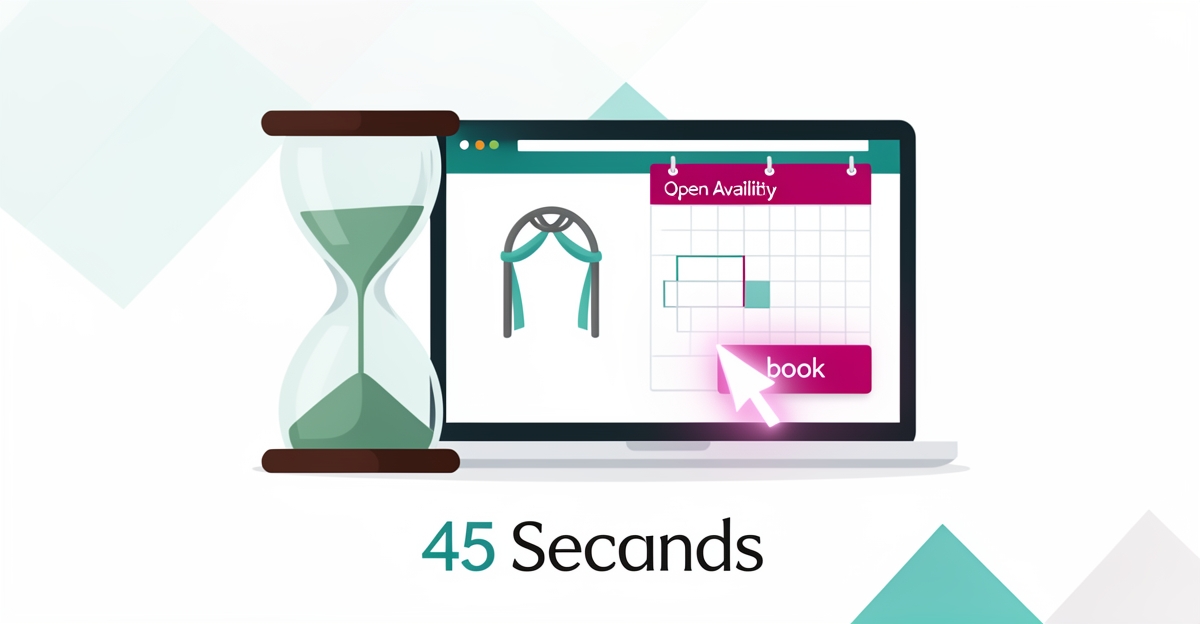
- Couples spend only 45 seconds on a website before deciding whether to inquire according to wedding venue research.
- 74% of consumers use digital tools to research wedding vendors per digital transformation data.
- Approximately 80% of couples rate reviews as "very important" when choosing vendors based on hospitality industry findings.
- Improving site speed can boost conversion rates by 4.6% on average according to industry statistics.
- Personalization at scale drives 3x higher revenue for wedding businesses per digital transformation research.
- The global online wedding planning market reached $7.8 billion in 2023 according to market data.
- Couples compare five or more officiants simultaneously during their vendor search based on digital research patterns.
WANT RESULTS LIKE THIS?
Imagine a system doing all of this for your local business — every day, without you.
We build local businesses a custom website with a team of AI behind it: every lead captured and followed up, new content published monthly,customers finding you on Google — live in 7 days.
- 85+ pages at launch
- Every lead followed up, automatically
- Your whole business on one screen
The 45-Second Reality: Why Most Officiant Sites Lose Couples Before They Inquire
You have roughly 45 seconds before a couple decides whether to reach out or keep scrolling. Research shows that on average, people spend about 45 seconds on a website before making a decision, and with 74% of consumers using digital tools to research wedding vendors, most couples are comparison-shopping five or more officiants at once. If your site doesn't answer their core questions in that window, they're gone.
- Vague service descriptions that leave couples guessing what you actually do
- Missing key details — pricing ranges, availability windows, and a clear step-by-step process
- No obvious next step beyond a generic "contact me" form that promises a reply "within 24 hours"
A generic contact form fails because couples aren't looking for a pen pal — they're looking for certainty. They want to know if you're available on their date, what you charge, and exactly how the process works before they invest emotional energy in an inquiry. When those details are missing, the form becomes a friction point, not a conversion tool. The fix isn't more copy — it's a website that surfaces availability, pricing context, and a guided next step automatically, so the couple gets answers while you're off performing ceremonies.
What Couples Actually Look For: Emotional Experience Over Service Lists
Most officiant websites read like a menu of packages — but couples aren't shopping for a service. They're shopping for confidence that their ceremony will feel personal, calm, and unmistakably theirs. Research shows 74% of couples use digital tools to research vendors, yet they spend only about 45 seconds on a website before making a decision. In that window, a list of "Standard," "Premium," and "Elopement" tiers tells them nothing about how you'll show up on their wedding day.
What they're actually evaluating: Will this person listen? Can they translate our story into something that doesn't feel scripted? Will they be a steady presence when nerves spike? Industry experts emphasize that couples buy the emotional experience, not the service list — they want to know what the ceremony will feel like, not what's included in a package. Wedding marketing specialists note that pages structured around ceremony tone, customization depth, and day-of presence consistently outperform those built around deliverables.
- Lead with the emotional outcome: "Your ceremony should sound like you — not a template"
- Show, don't tell: Share a 60-second video of you officiating a real moment (with permission)
- Describe your process as a collaboration, not a transaction
- Name the specific moments you handle: vows, ring exchange, family dynamics, unexpected tears
And nothing builds that confidence faster than social proof. Approximately 80% of couples rate reviews as "very important" when choosing vendors — far more than credentials, certifications, or years in business. A review that says "She calmed my mom down five minutes before the processional" carries more weight than any ordination certificate. Clear next steps — like an availability calendar and a simple inquiry form — then turn that trust into a conversation. At AI Business Sites, we've seen how websites built around emotional outcomes, not service menus, convert visitors into booked ceremonies because they answer the question couples are actually asking: "Will this feel like us?"
The Technical Gaps That Make You Invisible: SEO, Speed, and Mobile
When couples start planning their wedding, they turn to the internet first—searching for officiants who can bring their vision to life. Yet most officiant websites vanish in local search results, not because they lack charm, but because they’re technically invisible to the very algorithms that drive discovery.
The $7.8 billion digital wedding market hinges on visibility, and visibility begins with performance. A recent study found that improving site speed can lead to a 4.6% average conversion rate improvement—meaning a one-second delay doesn’t just frustrate visitors, it actively pushes them toward competitors. Yet many officiant sites still load slowly on mobile, where 74% of couples research vendors, sacrificing both rankings and revenue.
Technical SEO gaps compound the problem. Without proper schema markup, search engines struggle to understand your service area, availability, or even that you officiate weddings—critical for capturing high-intent queries like “officiant near me.” Location-specific pages, optimized with local keywords and structured data, signal relevance to Google and dramatically improve chances of appearing in the coveted local pack. Meanwhile, an unclaimed or poorly maintained Google Business Profile means missing out on map visibility, reviews, and the trust signals that 80% of couples weigh heavily when choosing vendors.
AI Business Sites builds websites that close these gaps from day one—hand-crafted for speed, mobile-first by design, and equipped with local SEO foundations including schema, location pages, and GBP optimization. Because in a market where couples spend just 45 seconds deciding, being found isn’t enough—you have to load fast, look professional, and guide them straight to booking before they scroll away.
Local business: doing this the old way?
One system replaces the whole pile.
All of it — the website, the follow-up, the content, the leads — built and run for you for $1,497 + $497/mo. Month-to-month, and you own everything.
See what your build includesFrom Passive Brochure to Booking Engine: What a Smart Officiant Website Does Differently
Most officiant websites function like digital brochures — pretty, informative, and entirely passive. They wait for a couple to feel motivated enough to fill out a form, then leave the officiant scrambling to respond before that lead goes cold. With research showing people spend roughly 45 seconds on a website before deciding, there is no room for friction between interest and action.
A smart officiant website flips this dynamic. Instead of a static contact page, it offers an availability calendar that lets couples self-book consultations instantly — no back-and-forth emails, no missed windows. Natural lead triggers like chat, voice, and forms all feed into a single pipeline, so every inquiry lands in one place with full context. Industry data confirms that personalization at scale drives 3x higher revenue, and an AI-powered site delivers exactly that: instant, personalized responses that reference the couple's ceremony style, date, and questions before the officiant even opens their inbox.
- Availability calendars that turn "let me check my schedule" into a booked consultation
- AI chat and voice agents that answer detailed questions 24/7 using your actual knowledge base
- Unified lead capture so web forms, calls, and chat conversations never slip through
- Automated nurture sequences that stay top-of-mind with couples who aren't ready to book yet
The result is a website that runs the business, not a project the officiant has to manage. AI Business Sites builds this capability directly into every custom website — handling the follow-up, the scheduling, and the lead nurturing automatically so officiants can focus on crafting ceremonies, not chasing emails. With 80% of couples rating reviews as "very important" in vendor selection, the same system also streamlines review requests and responses, turning happy clients into the social proof that closes the next booking.
Your 5-Point Fix Checklist: What to Change This Week
Your 5-Point Fix Checklist: What to Change This Week
Most wedding officiant websites lose bookings before a visitor even scrolls past the hero section. Research shows people spend only 45 seconds on a site before deciding whether to engage, and vague service descriptions or missing next steps are primary reasons they leave. Industry insights confirm that clear structure and emotional resonance are non-negotiables for conversion. Start by rewriting your hero and service pages to focus on the couple’s experience — not just your credentials — and pair every section with a single, obvious next step like “Check My Availability” or “See Sample Ceremonies.” This aligns with recommendations to prioritize emotional outcomes over service lists and ensures visitors know exactly what to do next.
Next, add real-time availability and self-scheduling directly on your site. Couples often abandon inquiry forms when they anticipate delays in response, especially outside business hours. With digital tool usage showing 74% of consumers research vendors online, enabling instant booking removes friction and captures leads when intent is highest. Platforms like AI Business Sites integrate scheduling natively, so your website handles availability checks and confirmations automatically — no back-and-forth emails or missed opportunities.
Then, claim and optimize your Google Business Profile while setting up a systematic review response process. Approximately 80% of couples weigh reviews heavily when choosing vendors, making reputation management a direct conversion lever. Trusted sources emphasize that proactive review engagement builds trust and improves local visibility. Pair this with location-specific service pages targeting towns or venues you serve — each page should include local keywords, schema markup, and links to your core service offerings. This creates topical depth that search engines reward, driving more than generic templates don’t.
Finally, deploy instant AI responses across chat, contact forms, and even voice channels to engage visitors the moment they reach out. Whether it’s a midnight question about vow customization or a same-day call about rescheduling, an AI assistant trained on your business can answer, capture details, and trigger follow-ups without delay. This turns passive browsing into active lead nurturing — ensuring no inquiry goes unanswered, and every couple feels seen from their first click.
Frequently Asked Questions
How long do couples typically spend on a wedding officiant's website before deciding to inquire or leave?
What are the primary reasons couples abandon wedding officiant websites without inquiring?
What do couples value more when choosing a wedding officiant: a list of services or the emotional experience?
How important are reviews in the decision-making process for couples choosing wedding vendors?
What technical aspects can make a wedding officiant’s website ‘invisible’ to potential clients?
How can a wedding officiant website be optimized to convert visitors into bookings more effectively?
Key Takeaways
{ "title": "From Click to Ceremony: Turning Insights into Bookings", "content": "In the fleeting 45 seconds that determine whether a wedding officiant website converts visitors into bookings, clarity, emotion, and technology converge as decisive factors. By addressing vague service descriptions, mis
FOR local businesss — BUILT AND RUN BY US
Your website. Your content. Your leads. Your data.
$500 starts your build. Seven days later it's live — chat, booking, follow-up, and your Google presence all set up. Then we run it, every month. You do the work you actually get paid for.