
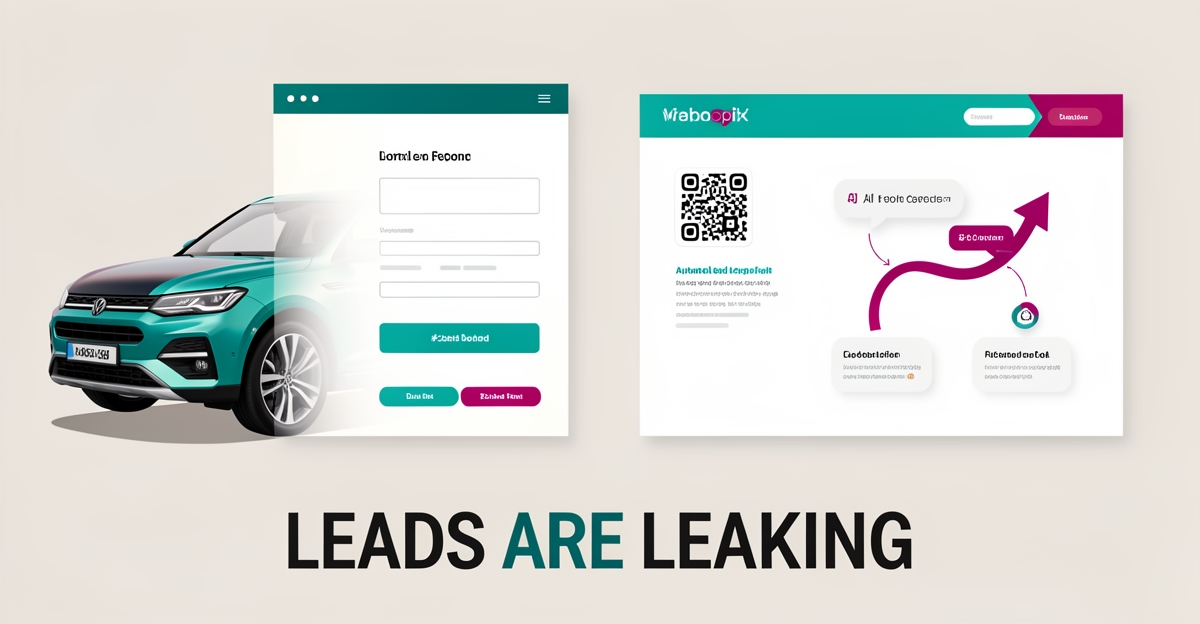
Key facts
- 90% of U.S. travelers noticed out-of-home ads in the past month according to OOH advertising research
- 66% of smartphone users took action after seeing an out-of-home ad per industry studies
- 100% of QR code traffic is mobile per QR code integration research
- The common claim of 30,000-70,000 daily impressions per wrapped vehicle has never been independently verified according to advertising experts
- Integrated lead generation requires acquisition, capture, qualification, and follow-up — not disconnected tools per auto industry analysis
- Speed and consistency in lead response directly correlate with close rates according to dealership research
- Most vehicle wrap shop websites function as static digital brochures that fail to capture high-intent leads per industry software analysis
WANT RESULTS LIKE THIS?
Imagine a system doing all of this for your local business — every day, without you.
We build local businesses a custom website with a team of AI behind it: every lead captured and followed up, new content published monthly,customers finding you on Google — live in 7 days.
- 85+ pages at launch
- Every lead followed up, automatically
- Your whole business on one screen
The Digital Brochure Problem: Why Static Sites Leak High-Intent Leads
The Digital Brochure Problem: Why Static Sites Leak High-Intent Leads
Imagine investing in a vehicle wrap that attracts thousands of potential customers, only to have your website fail to capture even a fraction of those leads. This is the harsh reality for many vehicle wrap shops, whose websites often function as little more than digital brochures—static, unresponsive, and incapable of converting high-intent leads. According to industry research, 66% of smartphone users take action after seeing an Out-Of-Home (OOH) ad, yet these leads often slip through the cracks due to outdated website design.
The automotive aftermarket, including vehicle wrap shops, is embracing technologies like AI and 3D visualizers, but this tech-savviness rarely extends to website functionality. Most sites lack the dynamic lead capture and automated follow-up mechanisms necessary to engage potential customers. For instance, a recent study highlights the importance of integrated lead generation tools, which many static sites fail to incorporate.
- Missed Opportunities: With 90% of U.S. travelers noticing OOH ads in the past month (News Source 1), the failure to capture subsequent digital inquiries is a significant lost revenue opportunity.
- Lack of Engagement: Static sites cannot respond to inquiries in real-time, leading to delayed follow-ups and a higher chance of losing leads to more responsive competitors.
- Ineffective Lead Nurturing: Without automated nurturing sequences, high-intent leads are not guided through the sales funnel, resulting in a lower conversion rate.
To transform your website from a passive brochure into an active sales tool, consider the following strategies:
- Integrate AI-Driven Lead Capture: Implement forms, chatbots, or QR codes (like those described in Web Source 6) that can capture and immediately respond to inquiries.
- Automate Follow-Up Processes: Use CRM systems to send personalized, timely follow-ups to leads, ensuring no opportunity is left unexplored.
- Embed Performance Tracking: Utilize analytics to understand website interactions and lead sources, making data-driven improvements to your strategy.
AI Business Sites understands the need for websites that not only attract but also convert leads. By integrating automated lead capture, AI-driven follow-ups, and performance tracking into your vehicle wrap shop’s website, you can finally bridge the gap between OOH advertising success and digital lead conversion. The key is moving beyond the static brochure model to a website that actively contributes to your sales pipeline.
For vehicle wrap shops, this might mean leveraging platforms that offer custom website design with built-in lead generation tools, ensuring that the website is not just a showcase but a sales-driven asset. By doing so, you can ensure that the 66% of mobile users who act after seeing OOH ads are met with a website that captures and nurtures their interest effectively.
What the Data Actually Says About Vehicle Wrap Marketing Effectiveness
The vehicle wrap industry loves its impression numbers — 30,000 to 70,000 daily views per wrapped vehicle is the figure you'll hear at every trade show and in every sales pitch. The problem? Those numbers have never been verified by independent research. They're marketing folklore dressed up as data, and relying on them undermines the credibility of every shop that repeats them.
What the research actually shows is more useful. According to OOH advertising studies, 90% of U.S. travelers noticed out-of-home ads in the past month, and 66% of smartphone users took action after seeing one. Those are measurable, cited statistics — not estimates — and they tell a clearer story: vehicle wraps work because they capture attention in the physical world and drive digital behavior.
- Visibility alone doesn't generate leads — integrated acquisition, capture, qualification, and follow-up do
- Credible, data-driven messaging outperforms inflated statistics with skeptical buyers
- Trackable mechanisms like QR codes convert physical impressions into measurable digital traffic
- Mobile-optimized landing pages are essential — 100% of QR code traffic is mobile
The shops winning at lead generation aren't the ones quoting the biggest impression numbers. They're the ones treating their website as the conversion engine it should be — capturing the interest their wraps create and turning it into qualified conversations. At AI Business Sites, we build websites designed around that full funnel: from the moment a prospect scans a code or clicks an ad, through automated follow-up that keeps the conversation moving without manual effort. A wrap gets them looking. Your website has to get them acting.
Turning Wrapped Vehicles Into Trackable Lead Sources with QR Codes
Turning Wrapped Vehicles Into Trackable Lead Sources with QR Codes
Imagine transforming every wrapped vehicle into a dynamic, trackable lead source, seamlessly bridging physical advertising and digital capture. By leveraging dynamic QR codes on vehicle wraps, businesses can turn impressions into attributable pipeline, revolutionizing the way they measure and capture leads.
The Power of QR Codes in Vehicle Wraps
According to industry insights on integrating QR codes with car wrapping (Source), 100% of QR code traffic is mobile, emphasizing the need for dedicated, mobile-optimized landing pages to capitalize on scans. For scannability, QR codes on vehicles should adhere to minimum size recommendations to ensure ease of use across various distances and lighting conditions.
Technical Requirements for Success
- Minimum Sizing for Scannability: Ensure QR codes are large enough to be scannable from a distance, typically no smaller than 2x2 inches for vehicle wraps.
- Dedicated Mobile-Optimized Landing Pages: Each QR code should direct to a fast, mobile-friendly page tailored to the vehicle wrap's message, enhancing conversion rates.
- UTM Tracking for Attribution: Implement UTM parameters to track which vehicles and locations drive actual leads, providing actionable insights for future campaigns.
Example of Effective QR Code Integration
| Component | Description |
|---|---|
| QR Code Size | Minimum 2x2 inches for easy scannability |
| Landing Page | Mobile-optimized, conversion-focused design |
| UTM Tracking | Tracks source, medium, and campaign for lead attribution |
Real-World Impact and Integration with AI Business Sites
By integrating QR code strategies with a self-feeding website structure, like those designed by AI Business Sites, vehicle wrap shops can automate lead follow-up and tracking. For instance, scans can trigger personalized, instant responses via the website's AI assistant, while UTM tracking feeds directly into the built-in CRM for transparent pipeline management. This holistic approach not only captures leads but also nurtures them through the sales funnel automatically.
Key Statistics Highlighting the Potential
- 90% of U.S. travelers noticed OOH ads in the past month, highlighting the potential reach of vehicle wraps (Source).
- 66% of smartphone users took action after seeing an OOH ad, underscoring the effectiveness of QR code-enabled vehicle wraps in driving engagement.
Actionable Takeaway
Transform your vehicle wraps into trackable, high-performing lead sources by:
- Integrating Dynamic QR Codes with minimum sizing for scannability
- Creating Dedicated, Mobile-Optimized Landing Pages for each wrap
- Utilizing UTM Tracking for precise lead attribution and campaign optimization
This strategic approach not only enhances the measurability of outdoor advertising but also seamlessly integrates with automated lead capture and follow-up systems, ensuring no lead goes unattended.
Local business: doing this the old way?
One system replaces the whole pile.
All of it — the website, the follow-up, the content, the leads — built and run for you for $1,497 + $497/mo. Month-to-month, and you own everything.
See what your build includesBuilding a Website That Captures, Qualifies, and Follows Up Automatically
Most vehicle wrap shop websites still operate like digital brochures — static pages that showcase work but do nothing to capture the high-intent leads standing right in front of them. The automotive aftermarket is rapidly adopting AI visualizers and 3D configurators, yet the website itself remains a passive asset, disconnected from the systems that actually turn interest into booked jobs.
Research on auto-industry lead generation confirms that effective conversion requires integrated systems across acquisition, capture, qualification, and follow-up — not disconnected tools bolted together after the fact. A lead generation analysis for the auto industry emphasizes that shops relying on fragmented workflows lose leads at every handoff. Meanwhile, dealership lead-capture research shows that speed and consistency in response directly correlate with close rates, especially when every inquiry — chat, form, or call — lands in a unified pipeline.
The shift is from static brochure to self-feeding lead engine. That means instant AI responses to every inquiry across channels, unified lead routing into a visual pipeline, automated nurture sequences for cold leads, and CRM-triggered follow-ups that fire without manual effort. QR code integration studies reinforce this: 100% of QR traffic is mobile, and shops using dedicated, tracked landing pages convert significantly more offline interest into measurable pipeline activity.
- Instant AI replies to every chat, form, and call — day or night
- All leads routed into one visual pipeline with source tracking
- Automated nurture sequences that re-engage cold prospects
- CRM-triggered follow-ups tied to deal stage, not memory
- Mobile-optimized landing pages for offline-to-online attribution
OOH advertising data shows 66% of smartphone users take action after seeing an out-of-home ad — but only if the digital destination is built to capture and qualify that action immediately. AI Business Sites builds websites on this exact architecture: a custom Next.js front end paired with a business operations platform that handles lead capture, qualification, and follow-up automatically. The website doesn't just display your work — it runs the lead engine behind it.
From Impressions to Pipeline: Measuring What Actually Drives Revenue
Most vehicle wrap shop websites function as static brochures, collecting impressions but failing to turn wrapped vehicles into measurable revenue streams. Without a system to trace leads from initial contact to closed deal, businesses operate on guesswork, mistaking traffic for traction and missing critical insights into what actually drives sales. The shift from vanity metrics to attributable revenue begins with treating the website as a core operations platform—one where every interaction feeds a trackable, automated funnel.
Integrating lead source tracking with CRM and automation enables shops to monitor which channels deliver real value, not just clicks. For example, 66% of smartphone users take action after seeing an out-of-home ad, but without UTM parameters or dynamic QR codes linked to mobile-optimized landing pages, that intent vanishes into untracked traffic. By capturing leads from web forms, voice calls, or chat and routing them into a unified pipeline, businesses gain visibility into response times, conversion rates, and deal velocity—turning anecdotal feedback into actionable data. Automation ensures no lead slips through delays; instant, personalized follow-ups dramatically increase the odds of conversion, especially when paired with lead scoring and nurture sequences.
Competitor review analysis further sharpens positioning by revealing gaps in service perception and customer expectations. Monitoring how rivals handle feedback—especially negative reviews—offers concrete insights for improving service delivery and messaging. When combined with automated review requests and AI-assisted responses, this creates a closed-loop system where every wrapped vehicle not only advertises the business but also feeds intelligence back into the website’s lead generation engine. Over time, this transforms the site from a passive expense into an active revenue driver, where performance is measured not in impressions, but in closed deals and customer lifetime value.
- Track lead source from first touch to closed deal using UTM parameters and CRM tagging
- Monitor automation performance: response times, conversion rates, and follow-up efficiency
- Analyze competitor reviews to refine service positioning and customer communication
- Use dynamic QR codes with mobile landing pages to capture and measure offline-to-online lead flow
- Trigger AI-driven nurture sequences for leads not ready to buy, keeping the pipeline warm
Frequently Asked Questions
Why do vehicle wrap shop websites often fail to convert leads?
What percentage of U.S. travelers notice Out-Of-Home (OOH) ads, and what action do they take?
Why are QR codes effective for vehicle wrap lead generation, and what’s a key requirement for their success?
What’s the issue with commonly cited vehicle wrap impression numbers (e.g., 30,000-70,000 daily views)?
How can integrating AI-driven lead capture and automated follow-up transform a vehicle wrap shop’s website?
Why is mobile optimization crucial for landing pages linked to vehicle wrap QR codes?
Your Wraps Are Working — Now Make Your Website Pull Its Weight
Vehicle wraps are doing their job: 90% of U.S. travelers notice out-of-home ads, and 66% of smartphone users take action afterward according to OOH advertising research. But if your website is still a static brochure, that intent disappears the moment a prospect picks up their phone. The shops turning impressions into pipeline aren't quoting bigger numbers — they're using dynamic QR codes, mobile-optimized landing pages, instant AI responses, and automated follow-up that qualifies and nurtures leads without manual effort. Your website should be the conversion engine that catches every bit of interest your wraps create. AI Business Sites builds custom websites with that full funnel built in: lead capture, qualification, automated nurture, CRM, content, and analytics — all running together so nothing slips through. You own the code, the content, and the data. No rented platforms. No duct-taped tools. Just a website that works as hard as your wraps do. Ready to stop leaking leads? Let's build a site that converts.
FOR local businesss — BUILT AND RUN BY US
Your website. Your content. Your leads. Your data.
$500 starts your build. Seven days later it's live — chat, booking, follow-up, and your Google presence all set up. Then we run it, every month. You do the work you actually get paid for.