
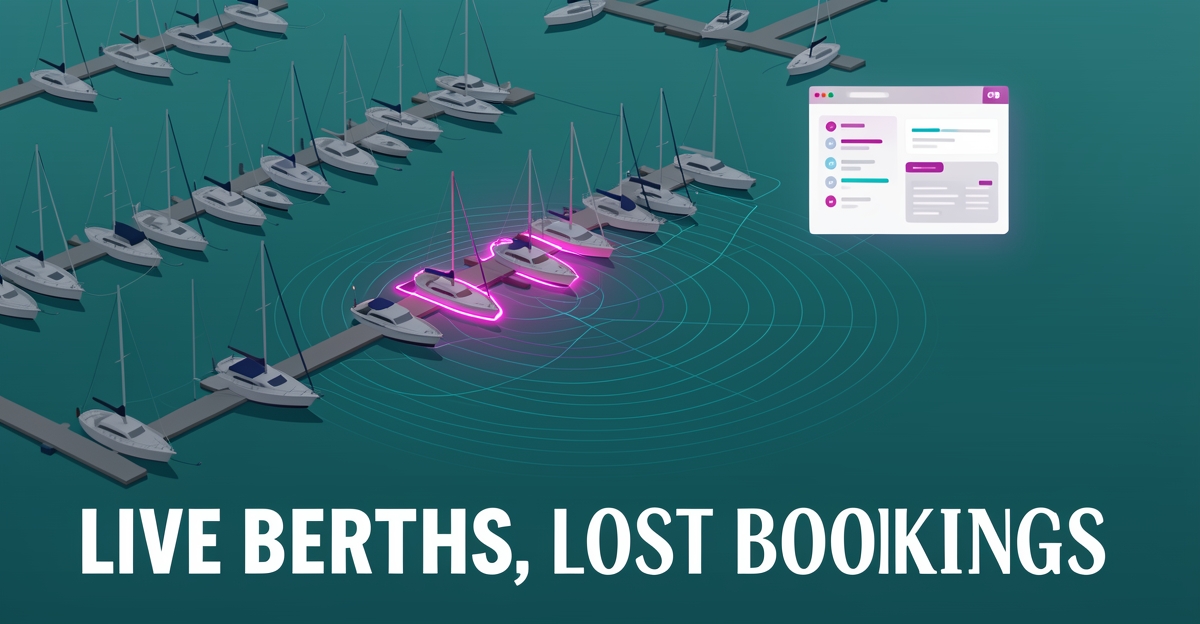
Key facts
- Over 80% of European marinas operate near full capacity during high season per ALG Global analysis
- 61% of small-to-mid-sized marinas struggle with double bookings and delayed responses according to Marina Match research
- Marinas adopting smart software see a 34% booking increase within 90 days per Marina Match findings
- The global marina market is expected to double in value over the next decade per ALG Global report
- Disconnected systems create phantom availability that erodes boater trust and drives them to competitors
- "AI is only as strong as the data behind it," emphasizes Elite Dynamics CRO Mikkel Oldenburg in industry commentary
- Real-time berth feeds with AI content updates transform static websites into live inventory tools that boost local SEO
WANT RESULTS LIKE THIS?
Imagine a system doing all of this for your local business — every day, without you.
We build local businesses a custom website with a team of AI behind it: every lead captured and followed up, new content published monthly,customers finding you on Google — live in 7 days.
- 85+ pages at launch
- Every lead followed up, automatically
- Your whole business on one screen
The Silent Revenue Killer: Static Berth Listings
The Silent Revenue Killer: Static Berth Listings
Marina websites are inadvertently driving away potential customers due to a glaring oversight: displaying outdated or static berth availability. This disconnect between the actual dock situation and the website's information leads to immediate booking abandonment, a phenomenon exacerbated by the expectation for real-time updates akin to those in hospitality and retail.
A staggering 61% of small-to-mid-sized marinas grapple with the dual challenges of double bookings and delayed responses, highlighting the crippling effect of outdated listing practices (a href="https://www.marinamatch.org/blog-detail/top-marina-management-software">industry research). The consequence is not just lost bookings but also eroded trust, as boaters increasingly seek marinas with live booking engines that offer transparency and efficiency.
The issue stems from a broader operational challenge. Disconnected systems lead to inefficiencies, with marinas often struggling to provide accurate, up-to-the-minute information. During peak seasons, when over 80% of European marinas operate near full capacity (a href="https://www.alg-global.com/blog/maritime/investing-marinas-opportunities-challenges-and-reasons-consider">ALG Global report), the inability to display real-time availability becomes particularly costly.
- Lost Bookings: Immediate abandonment due to mistrust in outdated information.
- Operational Inefficiencies: Double bookings and delayed responses exacerbate operational challenges.
- Competitive Disadvantage: Boaters favor marinas with live, trustworthy booking systems.
The solution lies in integrating real-time berth availability with AI-powered content updates, a strategy that not only enhances customer trust but also improves local SEO by ensuring website content is always current and relevant. For marinas, adopting comprehensive management software can lead to a 34% increase in bookings within 90 days (a href="https://www.marinamatch.org/blog-detail/top-marina-management-software">Marina Match), underscoring the potential for growth through digital transformation.
AI Business Sites understands the importance of dynamic, accurate online presence. By designing websites that can seamlessly integrate with real-time data feeds, marinas can ensure their online listings reflect the actual availability, reducing errors and enhancing the user experience. This approach aligns with the broader trend of marinas investing in digital solutions to meet evolving customer expectations and stay competitive in a growing market expected to double in value over the next decade (a href="https://www.alg-global.com/blog/maritime/investing-marinas-opportunities-challenges-and-reasons-consider">ALG Global).
For marinas looking to overcome the silent revenue killer of static berth listings, the path forward is clear: embrace integrated, AI-driven solutions that bridge the gap between operational reality and online presence.
Why Disconnected Systems Break the Booking Flow
The booking flow breaks long before a boater hits "reserve." Most marinas run their management software, website CMS, and Google Business Profile as separate islands — none of them talking to each other in real time. When a slip gets booked in the back office, the website still shows it open. When a cancellation frees up a premium berth, Google Maps keeps displaying "full." The result is a cascade of phantom availability that erodes trust and drives boaters to competitors who can confirm a spot instantly.
This disconnect isn't a minor technical oversight. Industry analysis shows that over 80% of European marinas operate near full capacity during high season, leaving zero margin for manual updates. Research also indicates that 61% of small-to-mid-sized marinas struggle with double bookings and delayed response times — a direct symptom of systems that don't synchronize. Staff simply cannot update the website, the booking engine, and the local listing fast enough to match real-time demand, especially when every berth turns over multiple times a weekend.
Elite Dynamics emphasizes that "AI is only as strong as the data behind it," and fragmented data foundations make real-time accuracy impossible. When availability lives in three different databases with three different update cycles, no amount of front-end polish can fix the core problem. The website becomes a static brochure instead of a live inventory tool.
- Management software records the booking but lacks a live API to the web CMS
- Website content updates require manual publishing workflows that take hours or days
- Google Business Profile pulls from a separate feed that refreshes on its own schedule
- No single source of truth exists for berth status across all customer touchpoints
AI Business Sites approaches this as a data unification challenge first. By connecting the marina's operational system directly to the website's content layer, real-time berth status becomes a live data feed — not a manual publishing task. The same structured data that powers accurate on-site availability also feeds Google Business Profile and local schema markup, so searchers see current openings the moment they search. When the underlying architecture determines whether a marina captures peak-season demand or loses it to competitors with faster, connected systems.
Local business: doing this the old way?
One system replaces the whole pile.
All of it — the website, the follow-up, the content, the leads — built and run for you for $1,497 + $497/mo. Month-to-month, and you own everything.
See what your build includesThe Fix: Live Availability Feeds Powered by AI Content Updates
The Fix: Live Availability Feeds Powered by AI Content Updates
The key to rescuing marina websites from the pitfall of outdated berth availability lies in harnessing the power of integration and artificial intelligence. By linking marina management software directly to the website via API, real-time berth status can be seamlessly displayed, eliminating the frustration of inaccurate information for potential customers. But that's just the first step.
AI-Driven Content Updates for Enhanced Trust and SEO
The next critical layer involves leveraging AI to automatically update not just the berth availability but also the surrounding content, schema markup, and internal links on the website whenever changes occur. This approach ensures that the website remains not only accurate but also dynamically optimized for search engines. Fresh, accurate content is a known SEO booster, and for marinas, this can lead to significant gains in local search visibility, driving more direct bookings.
Tangible Benefits Backed by Data
- Booking Boost: Marinas adopting smart software have seen a 34% increase in bookings within 90 days (as highlighted in a study by Marina Match), a trend that can be further amplified with AI-driven content updates enhancing user trust and search rankings.
- Operational Efficiency: Moving from disjointed systems to integrated platforms reduces operational headaches, such as double bookings, which plague 61% of small-to-mid-sized marinas (according to Marina Match).
- Market Edge: In a market where over 80% of European marinas operate near full capacity during high season (per ALG Global), staying ahead with digital transformation is crucial for attracting and retaining customers.
Implementation Strategy:
- Integrate Marina Management Software via API for real-time berth status updates on the website.
- Deploy AI Content Engine to automatically update webpage content, schema markup, and internal linking based on berth availability changes.
- Monitor and Adjust for continuous SEO improvement, ensuring the website ranks higher for local searches and attracts more direct bookings.
By embracing this solution architecture, marinas can transform their websites from static, trust-eroding platforms into dynamic, trustworthy, and SEO-optimized booking magnets. At AI Business Sites, we understand the importance of a website that not only reflects your business accurately but also works tirelessly to grow it, aligning perfectly with the needs of marinas seeking to leverage technology for competitive advantage.
From Implementation to Ongoing Operations
The gap between knowing you need real-time availability and actually delivering it comes down to execution. Most marinas already have the data trapped in their management software — the challenge is getting it onto the website where customers actually look.
Start by auditing every source that touches berth status: your marina management system, phone logs, radio check-ins, and any manual spreadsheets staff still rely on. Connect the primary system to your website through a webhook or API so availability changes flow automatically — no CSV uploads, no copy-paste delays. Configure AI to publish those changes as structured content updates across service pages, location pages, and booking widgets, keeping schema markup current so Google Maps reflects live status. Monitor booking conversion weekly to catch sync issues before they cost you a weekend.
- Audit all berth data sources — software, radio logs, spreadsheets, phone notes
- Connect marina management software to the website via webhook or API
- Configure AI to publish availability changes as structured content updates
- Monitor booking conversion and Google Maps accuracy weekly
When the website becomes the single source of truth, staff stop fielding "is slip 12 open?" calls and double bookings disappear. Research shows 61% of small-to-mid-sized marinas struggle with exactly these issues, while those adopting integrated software see a 34% increase in bookings within 90 days. Over 80% of European marinas operate near full capacity during high season, making real-time accuracy a revenue imperative, not a nice-to-have. AI Business Sites builds this integration into the website itself — so availability updates, content refreshes, and schema corrections happen automatically, keeping your search presence aligned with what's actually on the water.
Your Website Should Work as Hard as Your Dockhands
Static berth listings aren't just a technical oversight — they're a revenue leak that compounds every weekend your marina runs at capacity. The marinas capturing peak-season demand aren't the ones with the prettiest brochures; they're the ones whose websites reflect real-time availability the moment a slip opens or closes. That shift only happens when your management software, website content, and Google Business Profile all draw from the same live data feed, with AI handling the content updates and schema markup so your team doesn't have to. The payoff is measurable: marinas that connect these systems see a 34% increase in bookings within 90 days. If your website still requires manual updates to show what's actually available, it's not a marketing asset — it's a liability. Start by auditing every source that touches berth status, then connect your primary system to your site via API so availability flows automatically. AI Business Sites builds that integration into the website itself, so your online presence stays accurate, search-visible, and ready to convert every boater who searches for a slip — without adding another tool to manage.
FOR local businesss — BUILT AND RUN BY US
Your website. Your content. Your leads. Your data.
$500 starts your build. Seven days later it's live — chat, booking, follow-up, and your Google presence all set up. Then we run it, every month. You do the work you actually get paid for.