
Key facts
- Industrial equipment procurement spends 35–40% of its 12–18 week cycle on specification evaluation, costing 30–40 hours per category according to SpecLens
- AI-powered normalization reduces specification comparison time from 30–40 hours to under 20 minutes per category as seen with SpecLens
- 91% of hospitals comply with machine-readable pricing, yet usability issues persist, with users answering only 1.23 pricing questions correctly per AHA
- Technical compliance weighs 40–60% in capital equipment RFPs, often hindered by selective disclosure of specs noted by SpecLens
- AI cost calculators reduce estimation error by 30% and accelerate deal closures by 20–25% as reported by Capsquery
WANT RESULTS LIKE THIS?
Imagine a system doing all of this for your local business — every day, without you.
We build local businesses a custom website with a team of AI behind it: every lead captured and followed up, new content published monthly,customers finding you on Google — live in 7 days.
- 85+ pages at launch
- Every lead followed up, automatically
- Your whole business on one screen
The Specification Chaos Behind Unclear Pricing
The real bottleneck in industrial equipment pricing isn't the price itself—it's the specifications. Vendors describe the same capabilities in wildly different ways: one lists spindle speed in RPM, another in cutting speed at a given material hardness; positioning accuracy might appear as backlash, repeatability, or total error. This terminology chaos, combined with selective disclosure—where vendors omit weak points like accuracy to hide product flaws—makes direct comparison nearly impossible without manual normalization. As a result, procurement teams spend 30–40 hours per equipment category just aligning datasheets before they can even begin evaluating cost.
This specification evaluation phase consumes 35–40% of the typical 12–18 week procurement cycle, and with 4–6 vendors usually responding to an RFP, each with unique formats and disclosure levels, the workload compounds quickly. Technical compliance alone carries 40–60% weight in capital equipment decisions, meaning any ambiguity in specs directly impacts bid outcomes. Without standardized fields, buyers are left deciphering whether assessing a CNC machine or a filtration system, teams must manually translate, normalize, and score each specification—a process that is not only slow but prone to inconsistency and error.
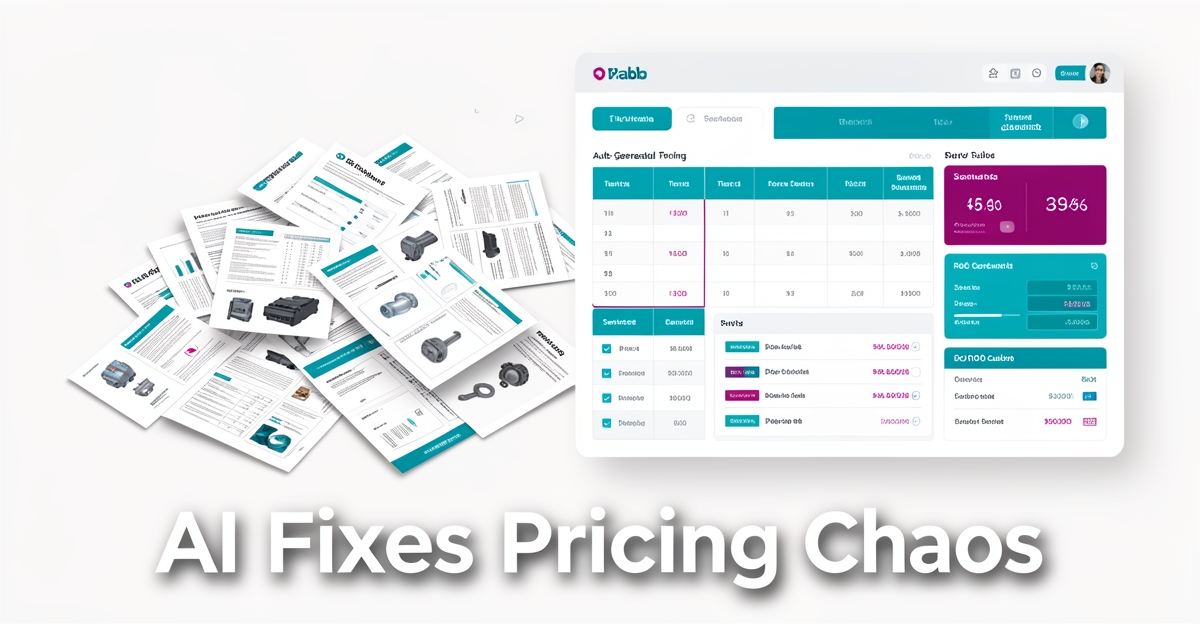
AI Business Sites helps address this upstream challenge by enabling websites to present specifications in structured, machine-readable formats that support automated comparison. When vendors' datasheets are normalized through AI-driven extraction and unit alignment—similar to SpecLens' approach, which cuts evaluation time from 30–40 hours to under 20 minutes—buyers gain access to apples-to-apples views of technical capabilities alongside pricing. This clarity doesn't just save time; it reduces the risk of overlooking critical omissions or misinterpreting performance claims, turning specification chaos into a foundation for confident, faster purchasing decisions.
Why Machine-Readable Pricing Alone Isn't Enough
Machine-readable pricing files are becoming the norm—but they’re not solving the usability problem they were meant to. In healthcare, where price transparency mandates have driven 91% of hospitals to post machine-readable files, researchers found consumers answered only 1.23 pricing questions correctly on average when given actual machine-readable data—compared to 2.76 correct answers for controls using standardized formats (PubMed). The files existed, but their inconsistent schemas and field names made them unusable for humans and machines alike.
Industrial equipment websites face the same breakdown between availability and clarity. Vendors post spreadsheets or PDFs with hidden specifications and non-standard units—spindle speeds listed as RPM in one file, cutting speed at material hardness in another, positioning accuracy buried under proprietary terms. These inconsistencies force buyers to spend 30–40 hours comparing just one equipment category before even reaching pricing (SpecLens). Technical compliance alone carries 40–60% weight in RFPs, yet manufacturers often omit critical parameters to mask product weaknesses (SpecLens). The result? Buyers can’t trust the data, and sellers lose deals to competitors who present specifications in a structured, comparable format.
What changes this isn’t just publishing more files—it’s standardizing the schema so both humans and AI can interpret them. When hospitals finally adopted consistent machine-readable formats, researchers noted that “consistent machine-readable files across all health systems facilitate the development of tools for estimating customer out-of-pocket costs” (PubMed). Industrial websites need the same foundation: a single vocabulary for specifications, pricing tiers, and service inclusions that AI can parse into dynamic tools like:
- Tiered pricing tables that auto-update when vendors change terms
- Service inclusion matrices that flag missing technical compliance specs
- ROI calculators that model total cost of ownership across capex, subscription, and outcome-based models
- Comparison dashboards that reduce evaluation time from days to minutes
For AI Business Sites clients, this schema standardization powers the AI assistant to generate these tools automatically from input fields—turning opaque datasheets into actionable pricing clarity at scale. A website built this way doesn’t just display pricing; it decodes complexity, letting buyers compare options and move forward with confidence.
Local business: doing this the old way?
One system replaces the whole pile.
All of it — the website, the follow-up, the content, the leads — built and run for you for $1,497 + $497/mo. Month-to-month, and you own everything.
See what your build includesAI-Powered Normalization and ROI Calculators as the Solution
AI-powered specification normalization transforms how industrial buyers evaluate equipment by collapsing hours of manual comparison into minutes of clear, actionable insight. Instead of wrestling with inconsistent terminology and selective disclosure across vendor datasheets, AI systems extract, normalize, and align specifications using confidence scoring and executive summaries—cutting evaluation time from 30–40 hours to under 20 minutes per equipment category. This near-instant alignment allows procurement teams to focus on value rather than decoding technical jargon, directly addressing the specification chaos that underpins pricing opacity in complex equipment sales.
Dynamic ROI calculators further streamline decision-making by modeling total cost of ownership across Equipment-as-a-Service (EaaS) models, where outcome-based, usage-based, and hybrid pricing structures defy simple side-by-side comparison. These tools accept input fields like usage intensity and output metrics to dynamically calculate 5-year TCO for capex, subscription, and performance-based options, reducing estimation error by 30% and accelerating deal closures by 20–25% for businesses that adopt them. By turning opaque pricing into transparent, interactive comparisons, AI eliminates the guesswork that stalls industrial procurement cycles averaging 12–18 weeks.
For AI Business Sites, this means embedding schema-standardized specification and pricing data directly into custom websites enables auto-generated tiered pricing tables, service inclusion matrices, and ROI tools that respond to real-time buyer inputs. Rather than presenting static PDFs or fragmented spec sheets, the platform uses AI to normalize vendor data behind the scenes—creating machine-readable, human-friendly outputs that support faster, more confident decisions. This approach doesn’t just simplify pricing; it redefines how industrial buyers evaluate complex equipment packages by making clarity the default, not the exception.
Frequently Asked Questions
Why do industrial equipment websites make pricing so confusing, even when they post the numbers?
How much time do procurement teams actually waste just trying to compare equipment specs before seeing pricing?
Does posting machine-readable pricing files actually help buyers understand costs better?
How does AI fix the specification chaos that hides true pricing in industrial equipment sales?
Can AI tools really help with complex pricing models like Equipment-as-a-Service (EaaS) where prices aren't straightforward?
What’s the risk if vendors leave out key specs like positioning accuracy—can buyers still trust the pricing they see?
From Specification Chaos to Confident Decisions
Industrial equipment pricing fails not because the numbers are hidden, but because the specifications behind them speak different languages. Vendors use inconsistent terminology, selective disclosure, and non-standard units — forcing buyers to spend 30–40 hours per category just to normalize datasheets before a single price comparison. The shift to Equipment-as-a-Service models only compounds this, layering outcome-based, usage-based, and hybrid pricing onto an already fractured foundation. Healthcare's price transparency mandate proved that publishing machine-readable files isn't enough: without schema standardization, usability actually decreased, with consumers answering 1.23 pricing questions correctly versus 2.76 for standardized formats (PubMed). The path forward is structured data — standardized schemas that AI can parse into tiered pricing tables, service inclusion matrices, and ROI calculators that model total cost of ownership across every pricing model. AI Business Sites builds websites with this infrastructure embedded, turning opaque datasheets into interactive decision tools that reduce evaluation time from days to minutes. If your website still presents pricing as static PDFs or fragmented spec sheets, you're not just behind — you're invisible to buyers who need clarity to move forward. Ready to see what structured, AI-decoded pricing looks like on your site? Let's talk.
FOR local businesss — BUILT AND RUN BY US
Your website. Your content. Your leads. Your data.
$500 starts your build. Seven days later it's live — chat, booking, follow-up, and your Google presence all set up. Then we run it, every month. You do the work you actually get paid for.