
Key facts
- The global railing market was valued at USD 7.5 billion in 2024 and is projected to reach USD 10.96 billion by 2033.
- SkyQuest Technology
- Handrail repair services market is forecasted to reach USD 0.3 billion by 2035 with a 6% CAGR from 2026-2035.
- Business Research Insights
- Ferric™ railing system at McPherson BPU remained in 'immaculate condition' after 14 years as of February 20, 2025.
- Handrail Design
- Automated quoting systems reduced quoting time from approximately 4 hours to 30 minutes.
- LightningCAD
- Production lead times were reduced by 3-4 days by bypassing drafting teams and going directly to manufacturing.
- LightningCAD
- Internal ROI on quoting software was described as 'massive — at least 80%' by Rodney Pudney, Design Engineer at Kattsafe.
- LightningCAD
- Delamere Industries offers a 5-year warranty and 100% satisfaction guarantee on all handrail products.
- Delamere Industries
- Delamere Industries has 20+ years of experience as an FDOT handrail manufacturer.
- Delamere Industries
WANT RESULTS LIKE THIS?
Imagine a system doing all of this for your local business — every day, without you.
We build local businesses a custom website with a team of AI behind it: every lead captured and followed up, new content published monthly,customers finding you on Google — live in 7 days.
- 85+ pages at launch
- Every lead followed up, automatically
- Your whole business on one screen
The Silent Trust Killers on Most Handrail Repair Websites
The Silent Trust Killers on Most Handrail Repair Websites
Handrail repair websites often falter in building trust with potential customers due to three glaring omissions: the lack of visual proof, absence of genuine customer voices, and insufficient display of verifiable credentials. Despite the handrail and railing market's projected growth from USD 7.5 billion in 2024 to USD 10.96 billion by 2033 (SkyQuest Technology), many websites in this niche fail to capitalize on this trend by neglecting basic trust signals.
Missing the Mark with Contractors and DIY Enthusiasts
Both contractors, who dominate procurement decisions based on technical specs and ease of installation (SkyQuest Technology), and DIY enthusiasts, who seek personalized, easy-to-install solutions (SkyQuest Technology), are left uncertain. Contractors look for code compliance, installation efficiency, and repeat business incentives, while DIYers seek clear guides, transparent tool requirements, and safety assurances. Yet, most websites fail to tailor their content to these distinct needs, missing opportunities to establish trust.
Key Statistics Highlighting the Trust Gap
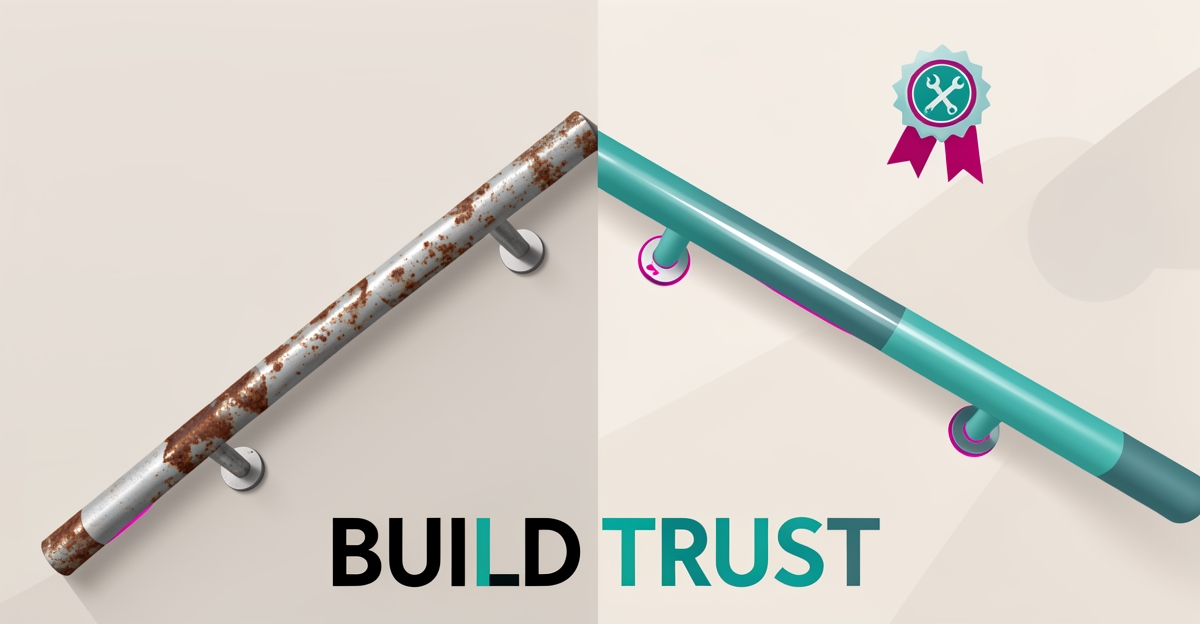
- Lack of Visual Proof: Only a handful of sites feature comprehensive before/after imagery or long-term performance case studies, such as the 14-year immaculate condition example highlighted by Handrail Design.
- Absent Customer Voices: Systematic collection of testimonials, video testimonials, and detailed project case studies is notably absent across the board.
- Insufficient Credentials: Manufacturer certifications, warranties (e.g., Delamere Industries' 5-year warranty), and satisfaction guarantees are not prominently displayed.
Actionable Solutions to Rebuild Trust
- Visual Proof Systems: Implement before/after imagery, 3D visualization tools, and long-term performance case studies.
- Segmented Trust Strategies
- For Contractors: Technical specs, code compliance, installation efficiency.
- For DIY Enthusiasts: Easy guides, tool transparency, safety checklists.
- Transparent Credentials
- Prominent display of certifications (e.g., FDOT approval by Delamere Industries).
- Clear warranties and satisfaction guarantees.
Conclusion
Handrail repair websites can bridge the trust gap by focusing on visual proof, tailored trust strategies for their target audiences, and the transparent display of credentials. By addressing these silent trust killers, websites can significantly enhance their credibility and attract both contractors and DIY enthusiasts in a growing market. For instance, leveraging AI-powered design tools, as seen with Mississippi Metal Magic's AI design capabilities, can further build trust by offering customizable, visual solutions that reduce uncertainty.
Sources (Inline as per guidelines)
- Industry research on market growth: SkyQuest Technology
- Importance of tailored strategies for contractors and DIY enthusiasts: SkyQuest Technology
- Example of long-term performance: Handrail Design
- Certification and warranty example: Delamere Industries
- AI design tool example: Mississippi Metal Magic
Two Audiences, Two Trust Languages: Contractors vs. DIY Homeowners
Most handrail repair websites treat every visitor the same — and that's exactly why they lose both contractors and DIY homeowners. The global railing market, valued at USD 7.5 billion in 2024, is splitting into two distinct audiences with fundamentally different trust languages. Contractors control procurement based on technical requirements and create repeat buying patterns, while DIY enthusiasts represent the fastest-growing segment enabled by modular kits and online access.
- Contractors need technical specs, code compliance data, and installation efficiency metrics — they're evaluating repeat-buyer reliability
- DIY homeowners need safety checklists, tool transparency, and visualization tools — they're evaluating personal risk and confidence
- Both audiences demand verifiable proof: 5-year warranties, FDOT certifications, and satisfaction guarantees like those Delamere Industries provides
A single trust signal — a generic testimonial or vague "quality guaranteed" badge — satisfies neither group. Contractors cite quoting consistency and production lead times as decision factors; one manufacturer cut quoting from 4 hours to 30 minutes and reduced lead times by 3-4 days using automated systems. DIYers, meanwhile, need to see the repair in their space before committing — AI-powered design tools now let customers visualize custom handrails in their actual environment, reducing uncertainty. The handrail repair services market is projected to reach USD 0.3 billion by 2035 at a 6% CAGR, but websites that don't segment their trust signals will capture neither audience. AI Business Sites builds websites that serve both languages natively — technical proof for contractors, visual confidence for DIYers — because a website that runs your business should speak every customer's dialect.
The Trust-Building Stack: Visual Proof, Verified Credentials, Transparent Quoting
Trust evaporates when a website asks you to believe without showing. The research reveals three pillars that rebuild it: visual proof that lasts, credentials you can verify, and quoting that doesn't leave you guessing.
Start with visual proof that goes deeper than a portfolio thumbnail. A 14-year performance case study from McPherson BPU documents a Ferric™ railing system still in "immaculate condition" after more than a decade of service — the kind of longitudinal evidence that answers the durability question before a prospect asks it. Pair that with 3D visualization tools that let customers see the repair in their actual space, and before/after galleries tied to specific project details. According to AI-powered design tools, this visualization capability reduces uncertainty and builds confidence before fabrication begins.
- Before/after galleries with project specifics — location, timeline, materials
- 3D visualization so customers see the repair in their space before committing
- Long-term performance case studies (14+ years) proving durability claims
Verifiable credentials close the gap between marketing claims and accountable proof. FDOT manufacturer certifications, 5-year warranties, 100% satisfaction guarantees, and U.S. manufacturing status aren't trust badges — they're contractual commitments. Delamere Industries backs all handrail products with a 5-year warranty and a 100% satisfaction guarantee while maintaining 20+ years as an FDOT handrail manufacturer. These are verifiable, specific, and enforceable — the opposite of vague "quality assurance" language.
Transparent quoting eliminates the trust tax of manual errors. Automated systems cut quoting time from approximately 4 hours to 30 minutes while generating real-time bills of materials that bypass drafting teams and go straight to manufacturing — reducing production lead times by 3-4 days. Rodney Pudney, Design Engineer at Kattsafe, describes the internal ROI as "massive — at least 80%." When a prospect sees an accurate, itemized quote in minutes instead of days, the message is clear: this business respects your time and owns its numbers.
AI Business Sites builds websites that embed this trust stack directly into the customer experience — visual proof galleries, credential displays, and automated quoting tools that work together instead of living in disconnected systems. The result is a site that doesn't just claim credibility; it demonstrates it at every touchpoint.
Local business: doing this the old way?
One system replaces the whole pile.
All of it — the website, the follow-up, the content, the leads — built and run for you for $1,497 + $497/mo. Month-to-month, and you own everything.
See what your build includesSystematizing Social Proof: From Ad Hoc Testimonials to Structured Evidence
Handrail repair websites often miss a critical opportunity: they fail to let their customers speak for them. Research shows that the absence of customer voices is a consistent weakness across the industry, leaving prospects to rely solely on claims rather than evidence. This gap undermines trust, especially when competitors showcase real experiences that validate their quality and reliability.
A structured approach to social proof transforms ad hoc praise into a dependable trust engine. Start by implementing a simple process to collect video testimonials shortly after project completion—when satisfaction is highest. Use guided questions that prompt clients to describe specific challenges, the repair process, and measurable outcomes like improved safety or restored access. These authentic clips become powerful verification tools that resonate more deeply than written quotes alone.
Pair video content with named case studies that include location details, project scope, and quantifiable results. For example, highlight a commercial handrail repair in Halifax that reduced maintenance calls by 40% over six months, or a residential stair rail upgrade in Dartmouth that passed a subsequent safety inspection with zero deficiencies. Such specifics turn vague promises into verifiable proof, addressing the research finding that detailed project documentation significantly boosts credibility.
Finally, systematize review management by automating post-service feedback requests and showcasing aggregated ratings alongside individual comments. Platforms like AI Business Sites streamline this by triggering review requests after job completion and displaying real-time feedback on the website—turning satisfied customers into ongoing trust signals without manual effort. This closed-loop system ensures social proof grows consistently, aligning with the recommendation that structured customer proof collection is essential for overcoming the trust gap in handrail repair services.
Your Website Should Build Trust While You Work — Not Just Sit There
Your Website Should Build Trust While You Work — Not Just Sit There
In the handrail repair industry, trust is paramount, yet many websites fail to deliver, losing potential customers due to a lack of visual proof, vague service details, and absent customer testimonials. According to a recent study on the railing market, contractors and DIY enthusiasts alike prioritize trust signals, but these are often missing from service provider websites.
A static website is a missed opportunity. It should be a trust-building engine that works autonomously, generating safety checklists, compelling before/after content, authentic customer testimonials, and location-specific case studies — all seamlessly linked into SEO-optimized clusters. AI Business Sites' approach is a prime example of how this can be achieved, where a custom website, powered by an AI-driven operations platform, automatically:
- Generates authentic customer testimonials and safety checklists to build confidence and credibility.
- Produces high-quality before/after content and location-specific case studies that resonate with local audiences.
- Links all new content into SEO clusters, enhancing visibility and trust signals with search engines.
Key Statistics Highlighting the Need for Trust-Building Websites:
- The global railing market, indicative of the broader handrail repair industry's growth potential, is projected to reach USD 10.96 Billion by 2033, growing at a 4.3% CAGR from 2026-2033.
- Handrail repair services themselves are forecasted to reach USD 0.3 Billion by 2035, with a 6% CAGR from 2026-2035, underscoring the demand for trustworthy service providers.
- A notable example of durability and trust is the Ferric™ railing system at McPherson BPU, which remained in "immaculate condition" after 14 years as of February 20, 2025, demonstrating the power of long-term performance as a trust builder.
Practical Solutions for Handrail Repair Websites:
- Automate Trust Signals: Leverage AI to generate and update safety checklists, testimonials, and case studies regularly.
- Segment Your Approach: Tailor content for contractors (emphasizing technical specs and efficiency) and DIY enthusiasts (focusing on ease of use and safety guides).
- Transparent Quoting Systems: Implement software for instant, accurate quotes to build trust through efficiency and reliability.
By adopting these strategies, handrail repair websites can transition from static, trust-deficient platforms to dynamic, trust-building engines that attract and retain customers, ultimately driving business growth. AI Business Sites exemplifies this shift, offering a comprehensive solution that integrates trust-building elements seamlessly into the website's core functionality, ensuring it works diligently while you focus on what matters most — your work.
Frequently Asked Questions
Why do handrail repair websites often struggle to build trust with potential customers?
What are the key differences in trust-building strategies for contractors vs. DIY enthusiasts in handrail repair?
How can handrail repair websites effectively use visual proof to build trust?
What is the projected market growth for the handrail and railing market, and how does this impact repair services?
How can automated quoting systems enhance trust in handrail repair websites?
Why is systematic collection of customer testimonials crucial for handrail repair websites?
Your Website Should Build Trust While You Work
The handrail repair market is growing — projected to reach USD 0.3 billion by 2035 — but growth only rewards businesses that prove they're trustworthy before the first conversation. Contractors need technical proof and quoting speed. DIY homeowners need visual confidence and safety clarity. Both need verifiable credentials, not vague promises. The websites winning this market aren't static brochures; they're trust-building engines that generate case studies, safety checklists, before/after galleries, and location-specific proof automatically — then link it all into SEO clusters that keep compounding visibility. AI Business Sites builds websites that do exactly that: custom sites with an operations platform underneath that handles the busywork of trust-building while you focus on the work. Your website should be your hardest-working employee. If it's just sitting there, it's time for one that doesn't.
FOR local businesss — BUILT AND RUN BY US
Your website. Your content. Your leads. Your data.
$500 starts your build. Seven days later it's live — chat, booking, follow-up, and your Google presence all set up. Then we run it, every month. You do the work you actually get paid for.