
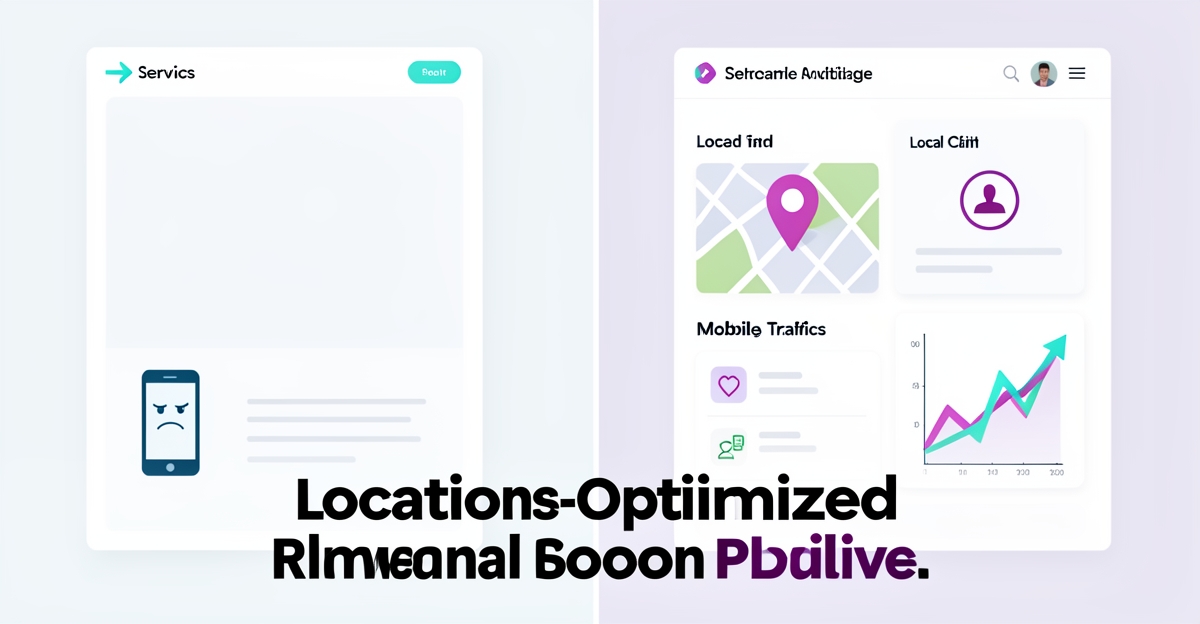
Key facts
- Over half of all web traffic comes from mobile devices according to industry research
- A one-second delay in page load time can significantly reduce conversions as shown in research
- Clinics that regularly update their Google Business Profile see stronger local rankings per industry research
- Generic service pages fail to rank for location-specific searches like 'physical therapy near me' confirmed by SEO specialists
- Physical therapy clinics rely heavily on local clients, making local SEO critical for visibility based on market trends
- Location-specific pages capture high-intent searches like 'knee pain treatment [Neighborhood]' that generic pages miss entirely supported by research data
- Consistent NAP across platforms builds trust signals Google uses to rank local businesses emphasized in expert insights
WANT RESULTS LIKE THIS?
Imagine a system doing all of this for your local business — every day, without you.
We build local businesses a custom website with a team of AI behind it: every lead captured and followed up, new content published monthly,customers finding you on Google — live in 7 days.
- 85+ pages at launch
- Every lead followed up, automatically
- Your whole business on one screen
The Local SEO Blind Spot: Why Your Generic Service Pages Aren’t Working
Generic service pages often miss the mark for physical therapy practices because they don’t reflect the local intent behind searches like "physical therapy near me" or "back pain treatment Halifax." Research shows that over half of all web traffic comes from mobile devices, and users on smartphones are frequently searching for nearby care while on the go. Without location-specific content, these pages fail to align with what search engines prioritize for local queries.
Industry research confirms that generic content lacks the geographic modifiers needed to rank for hyper-local searches, making it difficult for clinics to appear in results when potential patients look for treatment in their immediate area. This gap is especially problematic given that physical therapy relies heavily on attracting clients from a defined service radius.
When service pages omit city names, neighborhood references, or region-specific terminology, they blend into a sea of similar content that search engines struggle to differentiate. As a result, even well-written pages may not surface for queries like "sports injury rehab in Dartmouth" or "post-surgery PT Halifax," limiting visibility among high-intent local searchers.
To improve local SEO performance, clinics should tailor each service page to include location-based keywords in headings, body copy, and meta elements. This means creating distinct versions of core service pages for each neighborhood or suburb they serve, ensuring content reflects both the treatment offered and the community it serves. AI Business Sites supports this approach by building websites with hand-built core pages designed around actual services and service areas — not generic templates — so each location-specific page is primed to rank.
- Include city or region names in H1s and service descriptions (e.g., "Back Pain Treatment in Halifax").
- Reference local landmarks or neighborhoods to reinforce geographic relevance.
- Ensure NAP (Name, Address, Phone Number) consistency across all location-focused pages.
- Add schema markup for local business to help search engines interpret location data.
- Update content regularly with local events, seasonal injury trends, or community health initiatives.
By shifting from generic to geo-targeted content, physical therapy clinics can better match the language and intent of nearby searchers, increasing the likelihood of appearing in local pack results and driving more qualified traffic from patients actively seeking care in their area.
What Local Searchers Actually Want (And How to Give It to Them)
Generic service pages fail because they don’t speak to the exact needs of local searchers. When someone types “physical therapy near me,” they don’t want a generic page about back pain treatment—they want proof that your clinic is right there, ready to help, and trusted by their neighbors. Over half of web traffic now comes from mobile devices, which means your page must load fast on phones, not just desktops. And if your site lags by even one second, conversions can drop sharply—every click counts when someone’s in pain and searching urgently.
Local searchers have three non-negotiables, and your website must deliver on all three:
- Location-specific keywords that match what they’re typing. A page titled “Back Pain Relief” won’t rank for “best physical therapy clinic for knee pain in Halifax.” Instead, embed phrases like “physiotherapy clinic in [your city]” and “sports injury treatment near me” into headings, subheadings, and body copy. Consistency matters—your clinic’s name, address, and phone number (NAP) must appear identical across every online listing, from Google Business Profile to local directories.
- A fully optimized Google Business Profile that keeps your clinic visible on Maps and local search. Regular updates—posts about new services, photos of your facility, and timely offers—signal to Google that your profile is active and relevant. Positive patient reviews further boost local rankings, acting as social proof that future patients can trust.
- Mobile-first design that adapts instantly to any screen. If your site loads slowly on a phone, you’ve already lost the visitor. Optimize images, streamline navigation, and ensure every call-to-action—like “Book Now” buttons—is one tap away.
At AI Business Sites, we build service pages that answer those location-based searches before they’re even typed. Each page is hand-crafted around your actual services and service areas, not a generic template, and equipped with schema markup and internal linking that Google rewards with higher rankings. From day one, your Google Business Profile is configured to show up in local results, and every interaction—from web chat to phone call—lands in one place so nothing slips through the cracks. Your website doesn’t just sit there; it works, responds, and connects—so local patients find you before they find the next clinic.
Local business: doing this the old way?
One system replaces the whole pile.
All of it — the website, the follow-up, the content, the leads — built and run for you for $1,497 + $497/mo. Month-to-month, and you own everything.
See what your build includes3 Local SEO Fixes That Work in 30 Days or Less
Most physical therapy practices can't afford to wait months for SEO results. The good news: three targeted fixes can move the needle in 30 days or less when you focus on what Google actually rewards for local searches.
Start with your Google Business Profile. According to industry research, clinics that regularly update their GBP with posts, offers, and photos see stronger local rankings. Complete every field — hours, services, service areas — then add fresh photos weekly. Respond to every review within 24 hours. This signals activity to Google and builds trust with prospective patients searching "physical therapy near me."
- Audit NAP consistency across directories using a free tool like Moz Local or BrightLocal
- Add location-specific service descriptions: "back pain treatment Halifax" not just "back pain treatment"
- Post weekly updates — new equipment, staff certifications, seasonal injury prevention tips
- Enable messaging and respond promptly; engagement metrics factor into local pack placement
Next, rewrite your core service pages with geographic modifiers. SEO specialists confirm that generic pages fail to rank for location-specific queries like "physiotherapy clinic in [your city]." Replace broad headings with long-tail variants: "knee replacement rehab in Dartmouth" or "vestibular therapy Bedford." Keep each page focused on one service-one location combination. AI Business Sites builds this structure into every launch — 25 to 30 hand-built core pages plus 60 AI-generated SEO pages — so the topical clusters exist from day one.
Finally, fix page speed. Research shows over half of all web traffic comes from mobile devices, and a one-second delay in load time can significantly reduce conversions. Run your URLs through PageSpeed Insights. Compress images, enable browser caching, and eliminate render-blocking JavaScript. Target a mobile score above 90. Since mobile users dominate local search, this isn't technical polish — it's patient acquisition.
These three fixes compound. A faster site keeps visitors long enough to convert. Location-rich content matches how people actually search. An active GBP puts you in the map pack where high-intent patients click.
The Hidden Cost of Doing Nothing (And the ROI of Localized Content)
Most physical therapy practices don't ignore local SEO because they don't care — they ignore it because the cost of inaction stays invisible until the schedule has open slots that used to be full. Every month a generic service page sits unchanged, patients searching for "back pain treatment [City]" or "physical therapy near me" find competitors instead, and the practice pays for that silence in higher patient acquisition costs and empty treatment rooms.
Research confirms that physical therapy clinics rely heavily on local clients, making local SEO critical for visibility in the searches that actually drive appointments. Yet generic service pages fail to rank for these location-specific queries because they lack the geographic modifiers and neighborhood context that tell Google — and patients — where care happens. Over half of all web traffic comes from mobile devices, meaning most of those "near me" searches happen on phones while someone is in pain and looking for help immediately. A one-second delay in page load time can significantly reduce conversions, so slow, generic pages don't just rank poorly — they actively turn away ready-to-book patients.
The ROI of switching to localized content compounds across every marketing dollar spent:
- Location-specific pages capture high-intent searches like "knee pain treatment [Neighborhood]" that generic pages miss entirely
- Consistent NAP (Name, Address, Phone Number) across platforms builds the trust signals Google uses to rank local businesses
- Regular Google Business Profile updates with posts, offers, and photos signal an active practice worth recommending
- Patient reviews — actively managed and responded to — correlate directly with enhanced local rankings and online reputation
AI Business Sites builds this localization into every website from launch, hand-building core pages around actual service areas and generating ongoing content that targets the long-tail, location-modified searches patients actually use. The AI content engine researches, writes, and publishes new service pages, location pages, and blog posts monthly — each automatically linked to relevant existing pages so topical authority compounds without manual effort. Meanwhile, the platform handles Google Business Profile optimization as part of the build, not an add-on, so the search presence works in concert with the website instead of in isolation.
The hidden cost of doing nothing isn't theoretical. It's the patient who drove past your clinic to a competitor three blocks away because their "near me" search didn't show you. It's the marketing budget spent on ads to fill gaps that organic local visibility should have covered. It's the compounding disadvantage of watching competitors build review velocity and topical authority while generic pages sit static. Localized content isn't an SEO tactic — it's the difference between a website that exists and a website that fills the schedule.
Frequently Asked Questions
Why don't my generic service pages show up when people search 'physical therapy near me'?
How much does mobile traffic matter for my physical therapy clinic's website?
What's the fastest way to improve my clinic's visibility in local search results?
Do I really need separate service pages for each neighborhood I serve?
Does page speed actually affect whether patients book appointments?
What happens if I keep using generic service pages instead of localizing them?
Turn Local Searches into Filled Appointment Slots: The Local SEO Fix Your Physical Therapy Practice Can’t Afford to Miss
Generic service pages aren’t just a missed opportunity—they’re a hidden drain on your patient pipeline. When someone in pain searches “physical therapy near me” or “back pain treatment Halifax,” your website needs to speak their language *and* their location to even appear in the results. The fix isn’t complicated: swap broad headings for hyper-local content (“knee pain rehab in Dartmouth”), embed city names and neighborhood landmarks into your pages, and ensure your Google Business Profile is active with fresh photos, posts, and prompt review responses. Small tweaks like these can move the needle in 30 days by aligning your site with how real patients search and decide. At AI Business Sites, we build websites that don’t just sit there—they work. Each core page is hand-crafted for your actual services and service areas, and paired with an AI content engine that publishes location-specific pages and blog posts monthly, all optimized for local SEO. Your Google Business Profile is configured from day one, so you show up where high-intent patients are looking. If your website isn’t converting local searches into booked appointments, it’s time to stop leaving leads on the table. Audit your top service pages today: add location keywords to headings, update your NAP consistency, and post a new update to your Google Business Profile. One hour of focused changes now could mean a fuller schedule—and happier patients—next month.
FOR local businesss — BUILT AND RUN BY US
Your website. Your content. Your leads. Your data.
$500 starts your build. Seven days later it's live — chat, booking, follow-up, and your Google presence all set up. Then we run it, every month. You do the work you actually get paid for.