
Key facts
- 85% of homeowners prefer repairing good-condition electricals over replacement according to The Restart Project
- HVAC repair timelines spike to 7–14 business days during southern US summers per Consumer Repair Authority
- A fast but unreliable repair creates more disruption than a slower, consistent one found in operational efficiency research
- Estimates exceeding 21 days for standard repairs require written explanations to maintain consumer trust per consumer research
- No parts delivery estimate within 48 hours raises immediate concerns about provider reliability based on consumer benchmarks
- Major appliance repairs average 3–10 business days depending on parts availability reported by Consumer Repair Authority
- Simple electrical diagnostics take just 15–30 minutes while complex faults require 2–4 hours per repair expectation data
WANT RESULTS LIKE THIS?
Imagine a system doing all of this for your local business — every day, without you.
We build local businesses a custom website with a team of AI behind it: every lead captured and followed up, new content published monthly,customers finding you on Google — live in 7 days.
- 85+ pages at launch
- Every lead followed up, automatically
- Your whole business on one screen
The Hidden Cost of Uncertain Repair Timelines
When a homeowner searches for an electrician, they're not just comparing prices — they're calculating how long their household will be disrupted. Research shows that visibility of turnaround times directly impacts customer trust and conversion rates because consumers use this information to plan around service disruptions and evaluate provider commitments. Without clear timelines, potential customers default to competitors who offer that certainty, creating a silent leak in your lead pipeline that no amount of marketing spend can patch.
The data reveals a striking pattern: predictability often outweighs speed. A study on repair operations found that a fast but unreliable turnaround creates greater planning disruption than a slower but consistent one, leading to frequent re-sequencing of work and unreliable delivery commitments. This principle applies directly to electrical repairs — when homeowners know a panel upgrade takes 3–5 business days and that timeline holds, they can plan around it. When estimates shift without explanation, trust erodes faster than any single delay.
- 85% of consumers favor keeping good-condition electricals in use through repair or reuse rather than replacement
- Consumers expect written explanations when standard repair estimates exceed 21 days
- No parts delivery estimate within 48 hours raises immediate concerns about provider reliability
These thresholds aren't arbitrary — they're the decision points where a homeowner either books or bounces. Community repair data shows an estimated 30,000 repair attempts monthly across global events, confirming substantial demand for electrical and electronic repair services. Yet most electrical service websites display generic "fast service" claims instead of specific, category-based timelines that match what consumers actually evaluate.
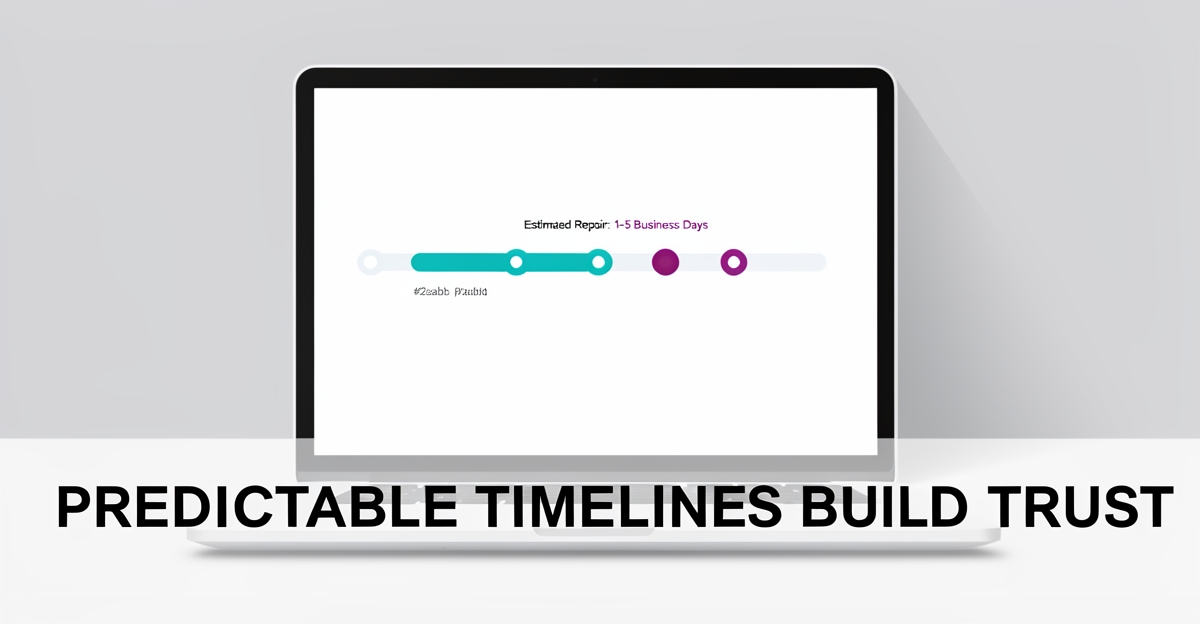
Consumer research establishes clear benchmarks: HVAC system repairs typically run 1–5 business days, major appliance repairs 3–10 business days, and plumbing fixture repairs same-day to 3 business days. Electrical repairs fall into similar expectation windows, but few providers publish them. AI Business Sites builds websites that automatically display current, accurate turnaround ranges for each service category — drawn from your actual job history and local conditions — so visitors see realistic timelines the moment they land on your service pages. When your website answers "how long will this take?" before the customer asks, you convert the leads your competitors lose to uncertainty.
What Reliable Turnaround Time Displays Actually Do For Your Business
When a homeowner searches for an electrician, they're not just comparing prices — they're calculating how long their kitchen will be without power or their HVAC system offline. Research shows that visibility of turnaround times directly impacts customer trust and conversion rates because consumers use this information to plan around disruptions and evaluate provider commitments. Without clear timelines, leads stall or disappear entirely.
Operational data confirms that a fast repair that slips repeatedly creates more disruption than a longer repair with a dependable completion window. Planners rely on estimated return-to-service dates to sequence work, assign labor, and manage delivery commitments — and the same principle applies to residential customers coordinating around their daily routines. Predictability beats speed when it comes to trust.
- HVAC system repairs typically range from 1–5 business days, stretching to 7–14 days during peak southern summers
- Major appliance repairs average 3–10 business days depending on parts availability
- Simple electrical diagnostics take 15–30 minutes while complex faults require 2–4 hours
Consumer behavior research identifies specific decision thresholds: estimates exceeding 21 days for standard repairs warrant written explanation, and no parts delivery estimate within 48 hours raises immediate concerns. When electrical service providers display transparent timelines that account for these variables, they reduce no-shows and last-minute cancellations because customers arrive with realistic expectations.
Global repair data reveals 85% of respondents favor keeping good-condition electricals in use through repair or reuse, representing a massive market that values transparency. AI Business Sites builds this capability directly into service area pages — automatically updating turnaround estimates based on local job data, seasonal demand patterns, and historical performance so electricians never manually adjust timelines while customers always see current, reliable information.
How to Show Turnaround Times That Convert (Without Manual Updates)
How to Show Turnaround Times That Convert (Without Manual Updates)
In the competitive landscape of electrical repair services, transparency is key. Consumers, who increasingly favor repair over replacement (with 85% preferring to keep good-condition electricals in use through repair or reuse ), rely on clear turnaround times to plan around disruptions and assess provider reliability. Displaying accurate, localized repair timelines can significantly increase trust and conversions, reducing lead loss. Here’s how to leverage AI-powered websites to automatically showcase these times without manual updates:
Electrical repair businesses can tap into this demand by showcasing real-time turnaround times on their websites. For instance, displaying standard turnaround ranges for common electrical services (e.g., "Emergency Electrical Repairs: Same Day - 2 Business Days") can help manage customer expectations. Seasonal adjustments, such as extending HVAC repair timelines to 7-14 business days during summer peaks in the southern US , demonstrate proactive planning and build trust.
Key Strategies for Implementation:
- Real-Time Turnaround Time Display: Integrate AI-powered systems that update timelines based on historical performance and current job data, ensuring accuracy without manual intervention.
- Category-Specific Estimates with Seasonal Adjustments: Establish and display standard turnaround ranges for common services (e.g., HVAC: 1-5 business days ) and adjust for known seasonal variations.
- Emphasize Predictability: Highlight the dependability of your estimates alongside speed, as a fast but unreliable timeline is more disruptive than a slower, consistent one .
For example, an electrical repair service in a region with harsh winters could display adjusted timelines for heater repairs during peak season, ensuring customers understand potential delays. By leveraging AI to analyze historical data and real-time workloads, these services can provide precise estimates (e.g., "Heater Repair: 3-5 Business Days During Winter Season") and automatically update them on their website.
Why This Approach Converts:
- Consumer Trust: Transparency in turnaround times directly correlates with increased trust, as consumers can plan effectively around service disruptions .
- Operational Efficiency: By emphasizing predictability, electrical services can reduce operational disruptions and increase planner confidence in scheduling labor and materials .
- Competitive Edge: Automatically updated, category-specific timelines differentiate your service in a market where 70% of consumers favor providers with clear, upfront information .
Actionable Takeaway: Implement an AI-powered website solution, like those offered by AI Business Sites, which can automatically display and update localized repair timelines based on your historical performance and real-time job data. This not only streamlines your operations but also provides the transparency consumers demand, driving higher conversion rates through trust and predictability.
https://therestartproject.org/data-and-insights/research/repair-day-2024/
https://consumerrepairauthority.com/consumer-repair-turnaround-time-expectations/
https://gesrepair.com/how-repair-turnaround-time-impacts-production-planning-efficiency
https://consumerrepairauthority.com/consumer-repair-turnaround-time-expectations/
Local business: doing this the old way?
One system replaces the whole pile.
All of it — the website, the follow-up, the content, the leads — built and run for you for $1,497 + $497/mo. Month-to-month, and you own everything.
See what your build includesTurnaround Time Thresholds That Make (or Break) Customer Trust
Most electricians lose leads not because their prices are too high, but because customers simply don't know when the lights will come back on. Research shows that visibility of turnaround times directly impacts customer trust and conversion rates, as homeowners rely on this information to plan around disruptions and evaluate whether a provider can actually commit to a timeline.
Consumer decision thresholds are surprisingly specific. Estimates exceeding 21 days for standard repairs warrant a written explanation, while the absence of a parts delivery estimate within 48 hours raises immediate red flags. Automotive repair benchmarks suggest that anything beyond 10 business days may indicate deeper operational issues — a standard that translates directly to electrical work where panel upgrades or rewiring projects can stretch without clear communication.
- Major appliance repairs: 3–10 business days
- HVAC system repairs: 1–5 business days (7–14 days during peak southern summers)
- Small appliance repairs: 5–14 business days
- Plumbing fixture repairs: Same day to 3 business days
Predictability outweighs speed. A fast repair that slips repeatedly creates more disruption than a longer, dependable window, forcing constant re-sequencing of work and eroding delivery commitments. When timelines are communicated consistently, planners — whether they're facility managers or homeowners coordinating around a family — can build schedules that hold together.
AI Business Sites builds this transparency into the website itself. The platform pulls historical job data and local demand patterns to display current, category-specific turnaround ranges on service and location pages — automatically updating as conditions change. Instead of a static "we're fast" claim, visitors see real estimates grounded in actual performance, with seasonal adjustments baked in. That's the difference between a website that sits there and one that earns trust before the first call.
Beyond the Estimate: Building a System That Keeps Promises
Beyond the Estimate: Building a System That Keeps Promises
When electrical repair customers are left hanging without a clear idea of when the job will be done, they often leave for good. This isn't just about speed; it's about reliability. A recent study highlights that a fast but unreliable turnaround time is more disruptive to operational planning than a slower, dependable one. For electrical services, where seasonal demand spikes (like the 7-14 business day HVAC wait times in the southern US summer reported by Consumer Repair Authority), predictability is key.
- Trust Through Transparency: Displaying clear, category-specific turnaround time estimates (e.g., HVAC repairs in 1-5 business days as seen in consumer expectations) on websites increases customer trust. 85% of consumers favor repair or reuse of good-condition electricals, indicating a market ripe for transparent service providers.
- Operational Efficiency: Reliable timelines reduce planning disruptions. For example, a dependable 3-10 business day turnaround for major appliance repairs helps planners sequence production and manage labor efficiently as noted in operational efficiency research.
To leverage these benefits, electrical repair businesses can:
- Implement Real-Time Turnaround Time Displays on websites, adjusted for seasonal demand spikes.
- Set Clear Communication Thresholds, such as providing written explanations for estimates exceeding 21 days as consumer research suggests.
- Track and Improve Consistency of turnaround times as a core performance metric, enhancing both operational efficiency and customer trust.
For businesses like those built by AI Business Sites, where websites are designed to run themselves with integrated operational tools, implementing such a system is streamlined. The AI-powered platform can automatically update turnaround times based on historical data and current workload, ensuring transparency and reliability. This not only positions the business as a more reliable partner but also reduces the operational overhead of manual updates and customer inquiries about wait times.
By focusing on predictable turnaround times, electrical repair services can differentiate themselves in a crowded market, retain more leads, and build long-term customer relationships founded on trust and efficiency.
Frequently Asked Questions
Why do customers leave electrical repair websites without hiring me?
How do turnaround times affect customer trust and conversion rates?
What specific turnaround time thresholds make customers concerned?
What are typical turnaround times for common electrical repairs?
Do customers prefer repair over replacement for electrical items?
How can I show accurate turnaround times on my website without manual updates?
Key Takeaways
{ "title": "Unlock Trust and Conversions with Transparent Turnaround Times", "content": "By embracing transparency in turnaround times, electrical repair services can unlock a powerful trust-driven advantage, directly boosting conversion rates. As highlighted, **85% of consumers favor repair over re
FOR local businesss — BUILT AND RUN BY US
Your website. Your content. Your leads. Your data.
$500 starts your build. Seven days later it's live — chat, booking, follow-up, and your Google presence all set up. Then we run it, every month. You do the work you actually get paid for.