
Key facts
- Generic closet galleries fail to solve specific storage pain points like limited reach or awkward corners
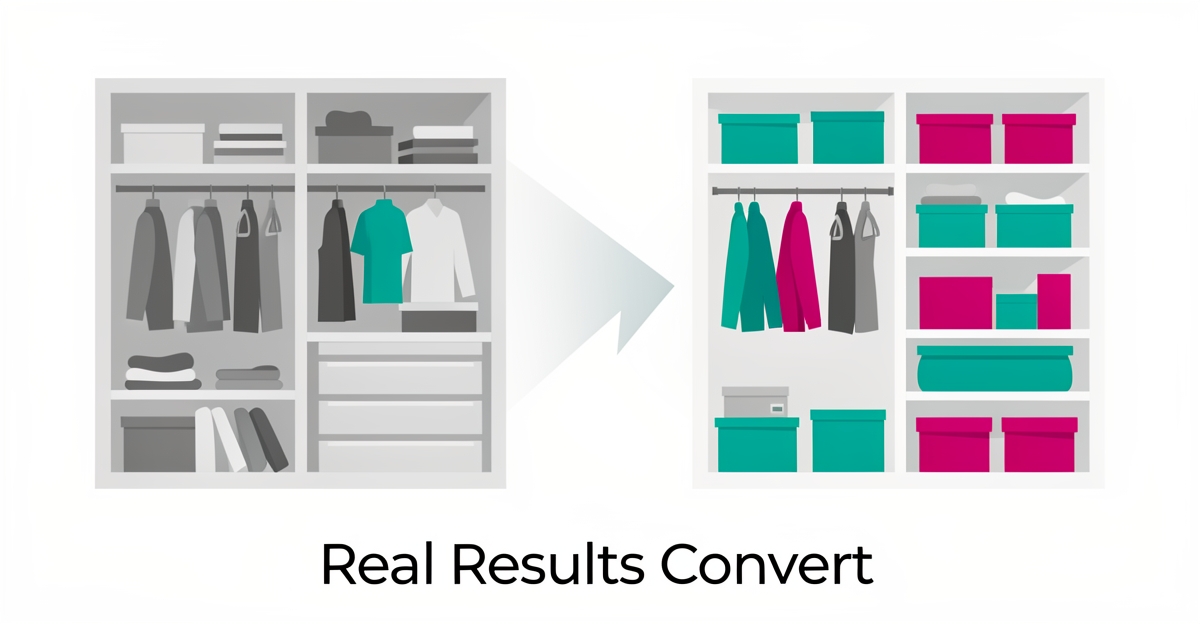
- Before-and-after transformation sequences build trust by showcasing real-world storage solutions
- Visual storytelling should focus on storage logic, not luxury, to prove functional relief to frustrated homeowners
- AI Business Sites uses an AI content engine to build high-converting, localized pages that align visual stories with local customer searches
- Automated website platforms can generate location-specific service pages that reflect local storage trends and home layouts
- AI Business Sites delivers approximately 14 new AI-generated SEO content pieces monthly as part of ongoing website maintenance
- AI Business Sites includes 25–30 hand-built core pages plus 60 AI-generated SEO pages at website launch
WANT RESULTS LIKE THIS?
Imagine a system doing all of this for your local business — every day, without you.
We build local businesses a custom website with a team of AI behind it: every lead captured and followed up, new content published monthly,customers finding you on Google — live in 7 days.
- 85+ pages at launch
- Every lead followed up, automatically
- Your whole business on one screen
The Generic Image Trap: Why Your Gallery Isn't Selling Storage
When a potential client lands on your website, they aren't looking for a generic mood board of a pristine, empty closet; they are looking for a solution to their specific storage chaos. Relying on stock photography or disconnected images often creates a barrier to conversion because these visuals fail to demonstrate the practical utility of your work. If your gallery looks like a catalog from a big-box retailer, you lose the chance to prove you can solve a unique, localized problem.
Most homeowners struggle with specific pain points, such as limited reach, awkward corner spaces, or a lack of vertical integration. When your website only displays generic room shots, you miss the opportunity to highlight your expertise in transforming those frustrations into functional, organized spaces. Potential customers need to see the "before and after" of a real-world transformation to understand the value of your craftsmanship.
To capture high-intent leads, your visual storytelling should focus on the utility and problem-solving nature of your work. Consider these elements when building out your gallery:
- Detail-oriented close-ups that show the quality of your hardware, shelving materials, and custom finishes.
- Transformation sequences that pair a cluttered, disorganized space with the final, optimized result.
- Contextual shots that demonstrate how a closet design fits into the specific architectural needs of local homes.
By showcasing real results, you build immediate trust. At AI Business Sites, we believe that your website should do more than just exist; it should actively serve as a portfolio that narrates your success stories. We help businesses structure these galleries so that every image serves a purpose—moving the visitor from passive browsing to reaching out for a consultation.
When your content is tailored to the specific storage needs of your local customers, you stop being just another vendor and start being the expert they need to hire. This approach to visual content ensures that your site works as hard as you do, converting visitors into leads by clearly demonstrating the value of your storage solutions.
By moving away from static, generic imagery and toward a gallery that highlights actual transformations, you create a compelling reason for potential clients to stay on your site.
Visual Storytelling That Proves Value Before the First Call
A gallery of polished, white closets looks professional, but it rarely convinces a frustrated homeowner to book a call. To convert, your images must stop selling "luxury" and start selling functional relief.
Most closet websites rely on generic aesthetics that fail to address the user's actual pain points. Instead, shift your focus toward storage logic, showing exactly how a custom layout solves a specific organization struggle.
The most effective way to prove value is through a structured narrative. A simple "before and after" photo is a start, but the real conversion happens when you explain the why behind the design.
To move a lead from curiosity to a consultation, structure your visual storytelling around these three elements:
- The Challenge: A photo of the cluttered space paired with the client's specific frustration, such as an overflowing shoe collection.
- The Strategy: A brief explanation of the custom storage logic used to reclaim the space, like introducing vertical shelving.
- The Result: A final image highlighting a tangible benefit, such as "doubled hanging space" or "eliminated morning clutter."
This approach transforms your portfolio from a lookbook into a proof-of-concept gallery. When a lead sees a transformation that mirrors their own chaos, the perceived risk of the investment vanishes.
Creating these tailored narratives across multiple service and location pages can be time-consuming for a busy business owner. AI Business Sites solves this by using an AI content engine to build high-converting, localized pages that align these visual stories with what local customers are actually searching for.
By grounding your visuals in real-world problem solving, you establish authority before the first consultation. You are no longer just selling shelves; you are selling a system for a stress-free morning.
When the visuals prove the value, the website's job shifts from convincing the lead to capturing them.
Once you have captured their attention with visual proof, the next step is ensuring your site captures their information instantly.
Local business: doing this the old way?
One system replaces the whole pile.
All of it — the website, the follow-up, the content, the leads — built and run for you for $1,497 + $497/mo. Month-to-month, and you own everything.
See what your build includesAutomating Custom Visuals: Scaling Local Relevance Without the Overhead
Most closet companies lose potential clients because their websites display generic stock photos instead of the specific storage transformations homeowners actually need to see. When a visitor cannot visualize a solution for their unique space, they bounce before ever contacting the business. This disconnect between customer intent and visual presentation is the primary reason storage lead generation stalls.
Despite this data void, the market reality remains clear: customers seeking custom storage solutions demand proof of capability, not abstract concepts. A website that fails to showcase real results is essentially invisible to high-intent local searchers. The absence of tailored visual storytelling means businesses are missing the chance to demonstrate how they solve specific spatial problems.
To bridge this gap, modern website platforms can automatically generate unique case studies that match local customer needs without manual overhead. Instead of relying on static templates, a smart website architecture can create tailored content pages that reflect the specific storage challenges of a local region. This approach ensures that every visitor sees a solution that feels relevant to their home, rather than a generic example from a different market.
Effective automation handles the heavy lifting of content creation by:
- Generating location-specific service pages that address local storage trends and home layouts
- Creating dynamic visual narratives that highlight actual client transformations and before-and-after results
- Updating case studies continuously to ensure the content remains fresh and search-engine optimized
- Linking new pages automatically to existing content to build a stronger topical authority for search engines
Businesses that adopt this strategy avoid the trap of static content that quickly becomes outdated or irrelevant. By letting the website run itself, owners can focus on delivering the custom installations while the digital presence works to capture and nurture leads. At AI Business Sites, we build custom websites designed to run your business with you, ensuring your content scales with your local relevance.
The result is a digital storefront that feels personal and immediate, converting curious visitors into qualified leads by showing them exactly what is possible in their own homes. The next step involves understanding how to structure these automated workflows to ensure they capture every inquiry without missing a beat.
Frequently Asked Questions
Why do my closet website photos look professional but still fail to bring in new clients?
What is the best way to show off my closet installations to get more leads?
Does using stock photography for my closet business hurt my search rankings?
I don't have time to write case studies for every closet project I finish. How can I keep my site updated?
What specific details should I include in my project photos to prove my expertise?
Turn Your Closet Gallery Into a Lead-Generating Machine
Most closet companies miss the mark by filling their websites with generic, empty-room photos that do nothing to prove they solve real storage problems. As we've seen, potential clients aren't looking for inspiration—they're looking for proof that you can fix their specific chaos: awkward corners, limited reach, or underused vertical space. The fix is simple but powerful: shift your gallery to showcase real transformations, detail-oriented close-ups of your craftsmanship, and contextual shots that reflect local home layouts. When your visuals tell a clear before-and-after story, you build trust faster and attract higher-intent leads. If you're ready to make your website work as hard as you do—showcasing your expertise while automating follow-ups and content—AI Business Sites helps service businesses build custom websites that convert visitors into clients, with built-in tools for lead capture, automated follow-ups, and ongoing content that ranks locally—then it's time to audit your gallery through your customer's eyes. Start by replacing one generic image with a real transformation sequence this week, and watch how it shifts the conversation from "nice closet" to "I need this in my home."
FOR local businesss — BUILT AND RUN BY US
Your website. Your content. Your leads. Your data.
$500 starts your build. Seven days later it's live — chat, booking, follow-up, and your Google presence all set up. Then we run it, every month. You do the work you actually get paid for.