
Key facts
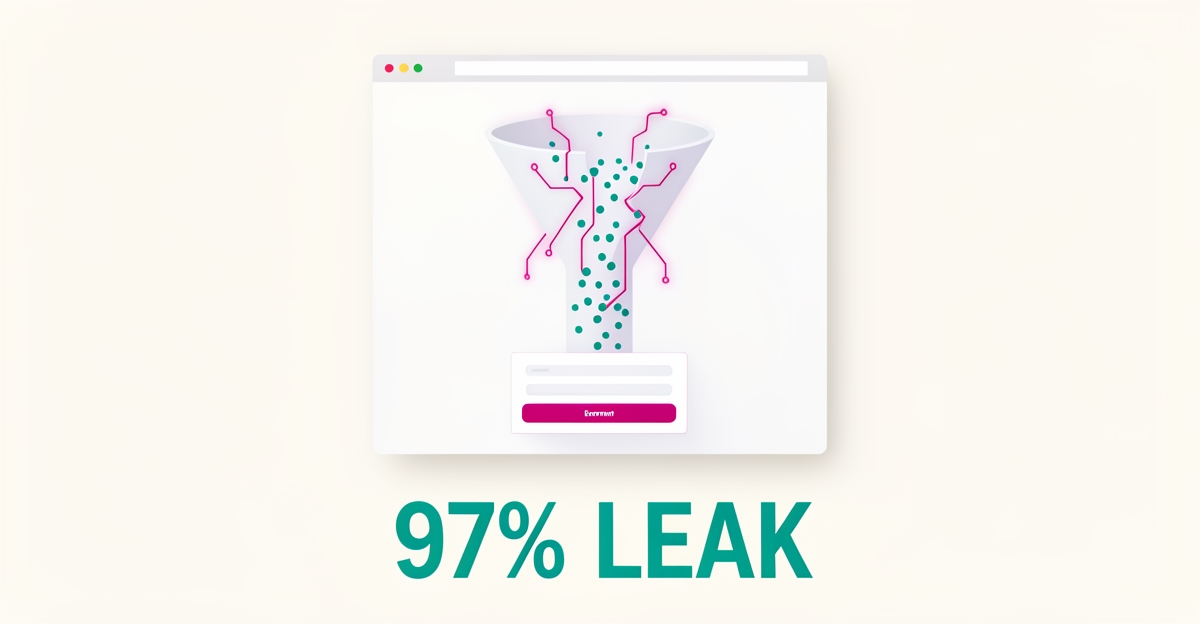
- 97% of ESL schools lose students on their website due to poor conversion optimization according to Collegis Education.
- Global eCommerce conversion rates average just 2.74% per Dynamic Yield benchmarks.
- Strategic website optimization can increase conversion rates by 35% as shown in a case study.
- 40% of online enrollments come from within 50 miles of the institution highlighting the need for localized marketing.
- Tablet users convert at the highest rate (2.89%) across all devices.
- A 3.5% conversion rate from 5,000 monthly visitors yields 175 inquiries, a 75-inquiry gap from a 2% rate representing significant lost revenue.
- EMEA regions achieve the highest conversion rates at 4.11% according to Invesp CRO benchmarks.
WANT RESULTS LIKE THIS?
Imagine a system doing all of this for your local business — every day, without you.
We build local businesses a custom website with a team of AI behind it: every lead captured and followed up, new content published monthly,customers finding you on Google — live in 7 days.
- 85+ pages at launch
- Every lead followed up, automatically
- Your whole business on one screen
The Hidden Cost of a Website That Doesn’t Convert
Most ESL schools pour thousands into SEO and paid ads, watching traffic climb while enrollment stays flat. The problem isn't visibility — it's what happens after a prospective student lands on the site. Research shows that high website traffic does not automatically translate to enrollment conversions; strategic optimization is required to bridge the gap between visibility and action. Without it, every marketing dollar spent driving visitors is effectively wasted on a leaky bucket.
The financial toll compounds quietly. Global eCommerce conversion rates average just 2.74%, with education-adjacent sectors like Consumer Goods at 2.43% and Multi-Brand Retail at 3.15% (Dynamic Yield benchmarks). For an ESL school receiving 5,000 monthly visitors, a 2% conversion rate means 100 inquiries — but a 3.5% rate, achievable through optimization, yields 175. That 75-inquiry gap represents tens of thousands in lost tuition revenue per year. One case study documented a 35% increase in web conversion rates purely through strategic website restructuring (Collegis Education case study), proving the revenue is already visiting — it just isn't converting.
Most schools misdiagnose this as a marketing problem. They double down on ads, SEO, or social media when the real bottleneck is on-site: inconsistent calls-to-action across priority program pages and user navigation friction disrupt the prospective student decision journey. The enrollment funnel itself is six stages deep — Prospect, Inquiry, Applicant, Acceptance, Deposit, Enroll — and prospects drop out at every transition (EAB enrollment funnel definition). Traditional funnels ignore the critical mid-funnel consideration phase where prospects have already expressed interest and are ready to engage (Collegis Education insights).
- Inconsistent CTAs that confuse visitors about the next step
- Navigation friction that buries program details behind generic menus
- No personalized pathways for visitors based on proficiency or goals
- Zero mid-funnel nurturing for prospects who browse but don't inquire
AI Business Sites builds websites that close these gaps by design — custom Next.js sites with AI-driven personalization that dynamically recommends courses based on visitor behavior, turning anonymous traffic into qualified leads. The platform handles the follow-up automatically, so schools stop losing students to silence after the first click.
Three Conversion Killers on Every ESL School Website
Many ESL schools lose potential students not because of low traffic, but because their websites fail to guide visitors toward enrollment. Research shows that even with strong visitor numbers, conversion rates in education and related sectors often fall below 3%, with inconsistent user experience acting as a silent barrier to sign-ups. Three specific issues repeatedly undermine conversion: inconsistent calls-to-action, navigation friction, and lack of personalization—each tied to measurable drops in engagement and completion rates.
Inconsistent CTAs across program pages create confusion and hesitation, directly disrupting the prospective student journey. When visitors encounter varying button text, placement, or messaging—such as "Learn More" on one page and "Apply Today" on another—they struggle to identify the next step, increasing bounce rates. A strategic website optimization case study found that redesigning high-priority landing pages with stronger, consistent CTAs and implementing ongoing A/B testing led to a 35% increase in conversions, proving that clarity and repetition in action prompts significantly improve outcomes. Without this consistency, even interested users may abandon the site before inquiring.
Navigation friction further compounds the problem, particularly when users cannot easily locate course details, schedules, or enrollment forms. Behavioral data analysis from the same study identified exit trends and friction points as critical first steps for improvement, noting that 64% more users moved from homepage to program pages after UX restructuring. When menus are overly complex or key information is buried, prospective students—especially those comparing multiple schools—quickly lose patience and leave. Streamlining site architecture to reduce clicks and highlight priority paths keeps users moving forward rather than out the door.
Finally, a lack of personalization fails to nurture mid-funnel prospects who have shown interest but need guidance to commit. Research confirms that personalized experiences—such as dynamic course recommendations based on browsing behavior—recover lost engagement and improve conversion relevance. For example, showing a visitor who viewed beginner grammar courses a suggestion like "Students who viewed this also enrolled in Intermediate Conversation" mirrors successful eCommerce tactics and aligns with the elongation of the enrollment funnel to include post-inquiry nurturing. AI Business Sites enables this through built-in personalization that adapts content in real time, turning passive browsing into active progression toward enrollment. Together, addressing these three barriers transforms a static website into a conversion-focused tool that respects the user’s journey and drives measurable results.
Turn Your Website Into a 24/7 Enrollment Machine
Most ESL schools treat their website like a brochure when it should function as a 24/7 enrollment counselor. The gap between traffic and enrollment isn't a marketing problem — it's a conversion architecture problem that starts with understanding exactly where visitors stall.
A comprehensive UX and performance audit reveals the friction points that generic analytics miss: inconsistent calls-to-action across program pages, navigation paths that dead-end, and exit trends that signal lost intent. Research shows this diagnostic approach is the critical first step for conversion improvement, with one institution achieving a 35% increase in web conversion rates after strategic restructuring without increasing marketing spend. The same study documented a 64% increase in users moving from homepage to program pages once navigation friction was removed.
Redesigning high-priority landing pages around clear, benefit-driven CTAs transforms a static information hub into an active enrollment tool. A/B testing then turns optimization into a continuous process rather than a one-time project. Test headlines that speak to outcomes ("Improve Your English in 3 Months") against brand-focused alternatives. Test CTA buttons that reduce commitment ("Start Your Free Trial") versus direct enrollment language. Test form fields that remove friction from scheduling consultations.
- Dynamic course recommendations based on browsing behavior — "Students who viewed Beginner English also enrolled in Intermediate Conversation"
- Exit-intent overlays offering a free level assessment or trial class when visitors show leaving signals
- Automated mid-funnel nurture sequences for prospects who viewed course pages but didn't inquire
- Localized landing pages for the 40% of online enrollments that come from within 50 miles of campus
The enrollment funnel doesn't end at inquiry — it elongates through consideration, where prospects have already expressed interest and are ready to engage. Marketing automation, retargeting, and personalized outreach extend engagement beyond that initial touchpoint. Data-driven personalization improves relevance at every stage, turning anonymous visitors into known prospects and known prospects into enrolled students. When your website handles the busywork of qualification, follow-up, and nurturing automatically, your team spends time only on conversations that actually need human judgment.
Local business: doing this the old way?
One system replaces the whole pile.
All of it — the website, the follow-up, the content, the leads — built and run for you for $1,497 + $497/mo. Month-to-month, and you own everything.
See what your build includesFrom Traffic to Tuition: How to Nurture Mid-Funnel Prospects
From Traffic to Tuition: How to Nurture Mid-Funnel Prospects
Thousands of potential students visit ESL school websites daily, yet only a fraction convert into enrolled students. The traditional enrollment funnel, which focuses on moving prospects linearly from awareness to enrollment, is outdated. Instead, ESL schools must elongate the funnel to engage mid-funnel prospects—those who have shown interest but need personalized nurturing to enroll.
A key challenge lies in the lack of personalization on ESL school websites. Dynamic course recommendations, driven by AI, can address this by suggesting relevant programs based on visitor behavior and interests (e.g., "Students who viewed Beginner English also enrolled in Intermediate Conversation"). This tactic, proven effective in eCommerce (Dynamic Yield), can guide mid-funnel prospects toward enrollment decisions.
Statistics Highlight the Need for Optimization:
- The global average eCommerce conversion rate is 2.74% (Marketing.Dynamicyield), indicating low conversion across sectors.
- 40% of online enrollments come from within 50 miles of the institution (Collegis Education), stressing the importance of localized marketing.
- Tablet users convert at the highest rate (2.89%) (Marketing.Dynamicyield), highlighting the need for mobile/tablet optimization.
- Automated Follow-Ups: Implement AI-driven email sequences for visitors who engaged with course pages but didn’t inquire, offering personalized support and reminders.
- Retargeting Campaigns: Use targeted ads to reach users who abandoned the enrollment process, tailoring messages to their interests (e.g., "Complete Your Application for Our Popular English Course").
- Personalized Content: Offer dynamic content (e.g., "Your Path to Fluency") based on browsing behavior, leveraging insights from enrollment funnel research.
AI Business Sites, with its custom-built websites and AI-driven personalization (like dynamic course recommendations), can transform the enrollment process. By automatically tailoring the user experience and streamlining the enrollment path, ESL schools can significantly improve conversion rates. For example, the platform's AI assistant can send instant, personalized responses to inquiries, reducing the gap between interest and enrollment.
Actionable Insight: A case study shows a 35% increase in conversions through strategic website optimization, proving that optimization, not just traffic, drives enrollment. ESL schools can replicate this by redesigning landing pages with stronger CTAs and leveraging A/B testing.
By focusing on these strategies, ESL schools can effectively nurture mid-funnel prospects, turning website traffic into tangible tuition.
Your Website Should Work as Hard as You Do
Your website isn’t just a digital brochure—it’s the most powerful salesperson your ESL school employs. Yet most schools treat theirs like a static business card: plug it in, hope for the best, and wonder why visitors vanish without a trace. The reality? A static website costs you students every day. Research shows that without strategic optimization, high website traffic fails to convert—even when you’re driving awareness with paid ads and SEO traffic alone doesn't drive enrollment; optimization does. When visitors land on a page that doesn’t guide them to the next step, they leave. And they rarely come back.
At AI Business Sites, we don’t build websites that sit idle. We build sites that act. Every page is designed to either answer a question or capture a contact—with built-in follow-ups that work while you sleep. Dynamic course recommendations appear based on what a visitor views, so students who browse beginner English are immediately shown intermediate conversation options. Intelligent CTAs adjust in real time: a visitor in Tokyo sees a “Start Your Free Trial” button, while a local parent gets “Schedule a Family Consultation.” And automated nurturing workflows maintain the conversation, sending personalized follow-ups when someone views a program but doesn’t apply.
It’s not magic—it’s automation grounded in real behavior. Studies show personalized experiences can lift conversions by up to 35% when high-priority landing pages are redesigned with stronger CTAs and continuous A/B testing. That’s why our platform doesn’t just track clicks—it learns from them. No-code workflows let you tag leads by interest, route high-value inquiries to your manager, and even auto-send a follow-up email when a visitor opens your site after hours. You own every lead, every follow-up, and every tool—no separate CRM, no extra dashboard, no manual exports. Just one system that grows with your school.
- Your website becomes a 24/7 enrollment engine. Every visitor gets guided, every inquiry nurtured, every question answered—even when your team is offline.
- No missed leads. Automated responses fire within seconds, responding to form fills, chat messages, and even missed calls.
- No duplicate work. Tag students by program interest, language level, or location—then let smart workflows move them forward without manual handoffs.
- No guesswork. Built-in analytics show which pages convert and which don’t—so you know exactly where to improve.
Most ESL schools lose students before the conversation even starts. Yours doesn’t have to. With the right website—one that works as hard as you do—every visitor becomes a lead, every lead becomes a conversation, and every conversation becomes an enrollment.
Frequently Asked Questions
Why do most ESL schools fail to convert website visitors into enrolled students?
What is the average global eCommerce conversion rate, and how does it relate to education?
How can inconsistent CTAs harm the enrollment process for ESL schools?
What role does navigation friction play in losing potential ESL students?
How effective is AI-driven personalization in converting mid-funnel ESL prospects?
Why is the traditional enrollment funnel outdated for ESL schools, and what's the alternative?
From Browsing to Belonging: Make Your Website Work for Your School
The gap between website traffic and enrolled students isn’t about visibility—it’s about what happens after the click. As we’ve seen, inconsistent CTAs, navigation friction, and a lack of personalization silently derail the enrollment journey, turning interested visitors into missed opportunities. But the solution isn’t more ad spend—it’s smarter design. By optimizing landing pages, implementing dynamic course recommendations, and nurturing mid-funnel prospects with automated follow-ups, ESL schools can turn passive browsing into active progression. One strategic restructuring already proved a 35% increase in conversions is possible without increasing marketing traffic. When your website works as hard as you do—answering questions, guiding decisions, and following up automatically—you free your team to focus on what matters: meaningful conversations that lead to enrollment. Ready to see how your site can become your most effective enrollment counselor? Explore how AI Business Sites builds websites that don’t just look good—they work.
FOR local businesss — BUILT AND RUN BY US
Your website. Your content. Your leads. Your data.
$500 starts your build. Seven days later it's live — chat, booking, follow-up, and your Google presence all set up. Then we run it, every month. You do the work you actually get paid for.