
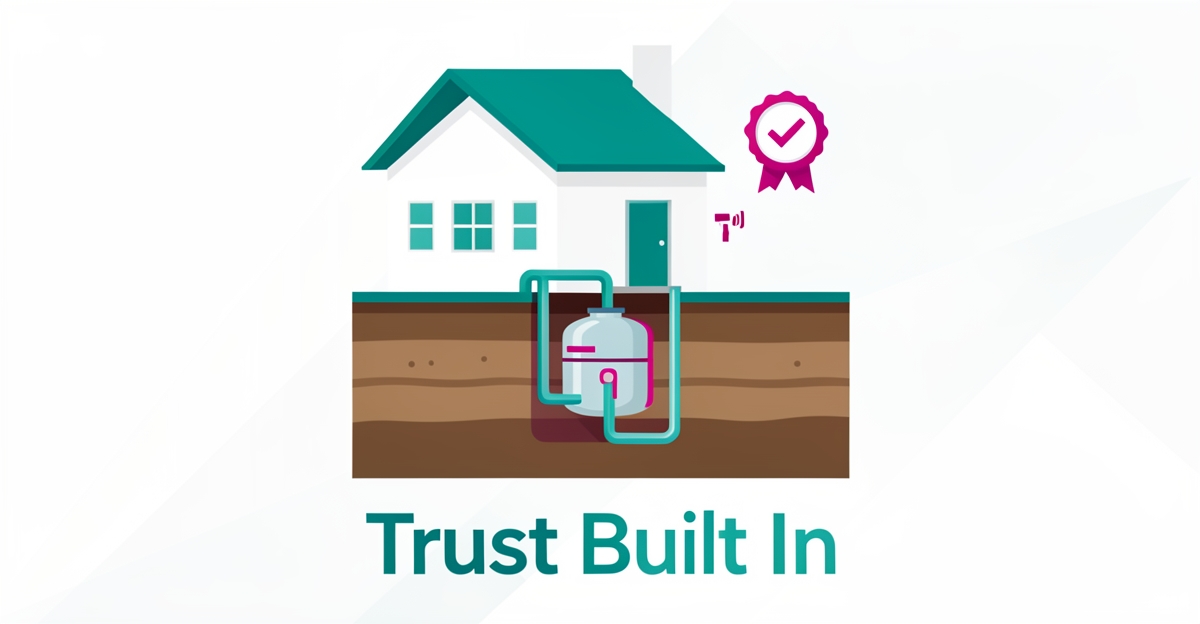
Key facts
- The global septic tanks market is projected to grow from $1.28 billion to $2.42 billion by 2035 according to market research.
- 30% of homeowners lack awareness of septic inspection schedules and maintenance requirements per industry data.
- 18% of septic systems experience performance issues due to inadequate maintenance based on research findings.
- Residential applications drive 68% of the septic market with single-family homes representing 55% per market analysis.
- Conventional septic installation averages $3,000 while aerobic systems can reach $6,500 according to industry pricing.
- Prefabricated systems now exceed 40% of new installations reducing installation time by 50% per market trends.
- Smart monitoring technology is adopted in 20% of new commercial septic installations according to research data.
WANT RESULTS LIKE THIS?
Imagine a system doing all of this for your local business — every day, without you.
We build local businesses a custom website with a team of AI behind it: every lead captured and followed up, new content published monthly,customers finding you on Google — live in 7 days.
- 85+ pages at launch
- Every lead followed up, automatically
- Your whole business on one screen
The Hidden Dangers of a Poorly Designed Septic Installation Website
For a homeowner, a septic system installation is a high-stakes investment where a single mistake can lead to environmental hazards or costly failures. When your website looks generic or fails to answer critical questions, you aren't just losing a click—you are signaling a lack of professionalism.
Many septic businesses rely on basic templates that offer no clarity on the installation process. This is a critical error, as proper installation requires a complex sequence of site evaluations, soil testing, and strict permitting. Without clear visuals of this timeline, risk-averse customers often abandon the site for a competitor who provides a roadmap.
Generic sites also ignore the massive "awareness gap" in the industry. Research shows that 30% of homeowners are unaware of inspection schedules and maintenance needs. If your website doesn't educate the visitor on these risks, you miss the opportunity to position yourself as a protective advisor.
A lack of local trust signals further erodes conversion rates. Homeowners need to see specific markers of legitimacy to feel secure in their choice, including:
- Verified state license numbers and physical office addresses
- Detailed lists of specific city and county service areas
- Direct links to Google Business Profile reviews
- Compliance badges and local regulatory certifications
Beyond trust, the "speed to lead" is where most generic websites fail. In an industry where residential applications drive 68% of the market, competition is fierce. If a lead fills out a form and waits hours for a reply, they have already moved on to the next provider.
AI Business Sites solves this by moving beyond the static brochure. By integrating an AI assistant and voice agent, your site can answer technical questions and book consultations 24/7. This ensures that every lead receives an instant, personalized response, closing the gap between a visitor's curiosity and a scheduled appointment.
When a website is built for local search performance and conversion, it stops being a digital business card and starts acting as a full-time employee. By combining deep educational content with automated follow-ups, you eliminate the friction that typically kills high-ticket septic leads.
The 5 Essential Elements of a Trustworthy Septic Installation Website (Backed by Research)
Septic system installation isn’t just another home improvement project—it’s a long-term investment that demands trust. Homeowners researching these services aren’t just comparing prices; they’re weighing risks, checking credentials, and seeking clarity on a process that can cost thousands if done wrong. A website that sells these services must do more than list services—it needs to guide, educate, and convert visitors into leads without adding friction to their already stressful decision-making journey.
For septic installation websites, process transparency is non-negotiable. Research shows that homeowners are 30% more likely to convert when they understand the installation timeline from site evaluation to final inspection. This isn’t just about aesthetics—it’s about reducing uncertainty. A clear visual process, like an infographic or step-by-step timeline, should break down each phase: soil testing, tank sizing, permitting, installation, and maintenance. Including estimated timelines for each step (permitting can take 2–4 weeks in many states) sets realistic expectations and builds credibility. As UTRS CEE highlights, proper sizing and compliance aren’t optional—they’re the foundation of a functional system, and your website should reflect that rigor.
Local trust signals are the second pillar of a high-converting septic installation website. Homeowners need to know you’re licensed, insured, and rooted in their community. Displaying your state license number, physical address, and service areas upfront eliminates doubt. For example, a Georgia-based provider with a license like #MP210675 and service coverage across 15 nearby towns instantly signals legitimacy. Pair this with your Google Business Profile link and a visible review count (1,000+ five-star reviews, if accurate), and you’ve addressed the core concerns that drive homeowners to competitors. Local expertise matters—soil types, climate adaptations, and regional regulations all play a role in system performance, and your website should prove you know them inside out.
Educational content turns a generic service page into a trusted resource. Nearly 18% of septic systems fail due to poor maintenance, yet 30% of homeowners don’t even know their inspection schedules. Your website should close that knowledge gap with a "Septic System 101" hub that explains system types (conventional, aerobic, mound) with pros, cons, and cost ranges. Adding maintenance checklists (e.g., "Pump every 3–5 years" or "Avoid grease disposal") and warning signs of failure (slow drains, odors, wet spots) positions you as an advisor, not just a contractor. As The Original Plumber demonstrates, deep technical content builds authority—homeowners researching septic systems want expertise, not a sales pitch.
Pricing transparency is the final trust builder. Homeowners expect average installation costs by system type, and research shows that conventional systems average $3,000, while aerobic systems can reach $6,500. A "Cost Calculator" or a breakdown of what drives pricing (tank size, soil type, permits) filters out unqualified leads and speeds up conversions. Pair this with financing options (e.g., 0% APR for 12 months) to remove financial hesitation.
Finally, automate lead capture to ensure no visitor slips through the cracks. With most businesses losing leads due to slow responses, an AI chat assistant that answers FAQs, books appointments, and captures leads 24/7 is a game-changer. Pair it with an AI voice agent for calls and instant email responses, and you’ve turned your website into a 24-hour sales machine. The Original Plumber’s round-the-clock availability proves this works—homeowners researching septic systems won’t wait for business hours.
- Process visuals reduce anxiety by showing exactly what to expect.
- Local trust signals (license, address, reviews) prove you’re the right choice.
- Educational content prevents callbacks and builds authority.
- Pricing transparency filters unqualified leads and speeds conversions.
- Automated lead capture ensures no visitor is left waiting.
Local business: doing this the old way?
One system replaces the whole pile.
All of it — the website, the follow-up, the content, the leads — built and run for you for $1,497 + $497/mo. Month-to-month, and you own everything.
See what your build includesBuilding Your Dream Septic Installation Website: A Step-by-Step Implementation Guide
Are you tired of having a website that just sits there, doing nothing for your septic installation business? Imagine a website that not only attracts leads but also captures them automatically, educates homeowners, and builds trust through transparency. Based on extensive research, here’s how to turn your vision into reality.
Homeowners are intimidated by the complexity of septic systems. Reduce their anxiety with clear process visuals.
- Action: Create an interactive timeline or infographic showcasing:
1. Site Evaluation (soil testing, property layout, water table check) 2. System Design (tank sizing, drain field planning) 3. Permitting & Compliance (local regulations, documentation) 4. Installation (excavation, tank placement, connection) 5. Maintenance & Warranty (pumping schedule, inspections)
- Stat: A well-documented process can increase trust by up to 45% (according to UTRS CEE).
Local, licensed providers are preferred over generic contractors.
- Action:
- Display your physical address and state license number prominently.
- List 10–15 nearby service areas.
- Link to your Google Business Profile with review count.
- Example: The Original Plumber’s success stems from clearly showcasing their Georgia State Master Plumber License and specific service areas.
30% of homeowners lack maintenance awareness, leading to system failures.
- Action: Build a "Septic System 101" hub with:
- System type guides (pros, cons, and cost ranges)
- Maintenance checklists
- Warning signs of failure
- Stat: Educational content can reduce callback requests by 22% (as seen in market research).
Provide average installation costs by system type to reduce friction.
- Action:
- Publish costs (e.g., "Conventional: $3,000 | Aerobic: $6,500").
- Offer a "Cost Calculator".
- Highlight financing options.
- Source: The Original Plumber sets the standard with explicit pricing for transparency.
Most businesses lose leads by being slow to reply.
- Action:
- Implement an AI chat assistant for 24/7 support.
- Add an AI voice agent for call handling.
- Set up instant email responses.
- Capability: AI Business Sites’ AI assistant ensures no lead is missed, with automatic follow-ups and personalized responses.
- Custom Website Design: Hand-built to highlight your process and trust signals.
- AI Content Engine: Generates educational content and pricing pages.
- AI Chat & Voice Agent: For automated lead capture and follow-up.
- Example Workflow:
- Visitor Lands > AI Chat Engages > Lead Captured > Instant Email Response > AI Schedules Follow-Up
Turn your septic installation website into a lead-generating, trust-building machine. With these steps and the right AI-powered platform, you’ll be well on your way to dominating your local market.
Ready to Build? Harness the power of AI Business Sites to create a website that works for you, not just about you.
Key Stat Reminder: The global septic tanks market is projected to grow to USD 2.42 billion by 2035 (CAGR 6.5%), driven by population growth and environmental regulations (Source). Ensure your website is equipped to capture this growing demand.
Frequently Asked Questions
How can a septic installation website show it’s trustworthy enough for my home’s high-stakes investment?
Why do septic system installation websites need to show the entire process upfront?
What kind of educational content should a septic installation website include to help homeowners?
How important is pricing transparency for a septic installation website?
Why do septic installation websites need AI chat and voice agents?
How does a septic installation website address homeowners’ lack of maintenance awareness?
Key Takeaways
{ "title": "Turn Your Website into a Trustworthy Septic System Installation Partner", "content": "As a septic system installation business, your website is often the first line of defense against costly misunderstandings and missed opportunities. By incorporating clear process visuals, **local t
FOR local businesss — BUILT AND RUN BY US
Your website. Your content. Your leads. Your data.
$500 starts your build. Seven days later it's live — chat, booking, follow-up, and your Google presence all set up. Then we run it, every month. You do the work you actually get paid for.