
Key facts
- California tracks 12+ U-Pick crop categories with overlapping harvest windows spanning 2–8 months each per the California Department of Food and Agriculture
- Southern California strawberries start in March while Northern California doesn't see them until May — a regional gap of weeks within the same state per the California Department of Food and Agriculture
- Washington's cherry season runs late June to mid-July, but Yakima Valley cherries arrive weeks before Green Bluff per Washington State Tourism
- SMS notifications to just 500 subscribers can drive $3,000–5,000 in U-Pick revenue per Farmzz
- Official agricultural agencies explicitly direct visitors to check individual farm websites for current produce and policies before planning per the California Department of Food and Agriculture
- Year-to-year volatility is the norm — Washington Tourism states produce availability and picking times can vary from year to year per Washington State Tourism
- Farms using fragmented channels (phone, Facebook, static pages) leave customers confused and fields empty during peak season
WANT RESULTS LIKE THIS?
Imagine a system doing all of this for your local business — every day, without you.
We build local businesses a custom website with a team of AI behind it: every lead captured and followed up, new content published monthly,customers finding you on Google — live in 7 days.
- 85+ pages at launch
- Every lead followed up, automatically
- Your whole business on one screen
Why Static Farm Websites Fail During Peak Season
Most U-Pick farms don't run on a single calendar — they run on dozens of overlapping ones. California alone tracks 12+ crop categories with windows spanning two to eight months each, varying by region and variety (California Department of Food and Agriculture). Blueberries might run June through July while raspberries stretch June through October, and Southern California strawberries start in March while Northern California doesn't see them until May (California Department of Food and Agriculture). A static "seasonal hours" page goes stale before the first basket is filled.
- Year-to-year volatility is the norm — not the exception
- Regional microclimates shift harvest timing by weeks within the same state
- Operational policies (appointments, containers, pre-picked vs. U-Pick) change per crop
- Customers rely on the farm website as the canonical source
Washington's tourism guide puts it plainly: "Produce availability and picking times can vary from year to year" and urges visitors to check individual farms for current produce and policies (State of WA Tourism). The California Department of Food and Agriculture echoes this, advising visitors to "check each farm's website to see what's in season before planning" because varieties and dates are subject to change (California Department of Food and Agriculture). Yet most farms still communicate through fragmented channels — phone, Facebook, a static webpage — leaving customers confused and fields empty.
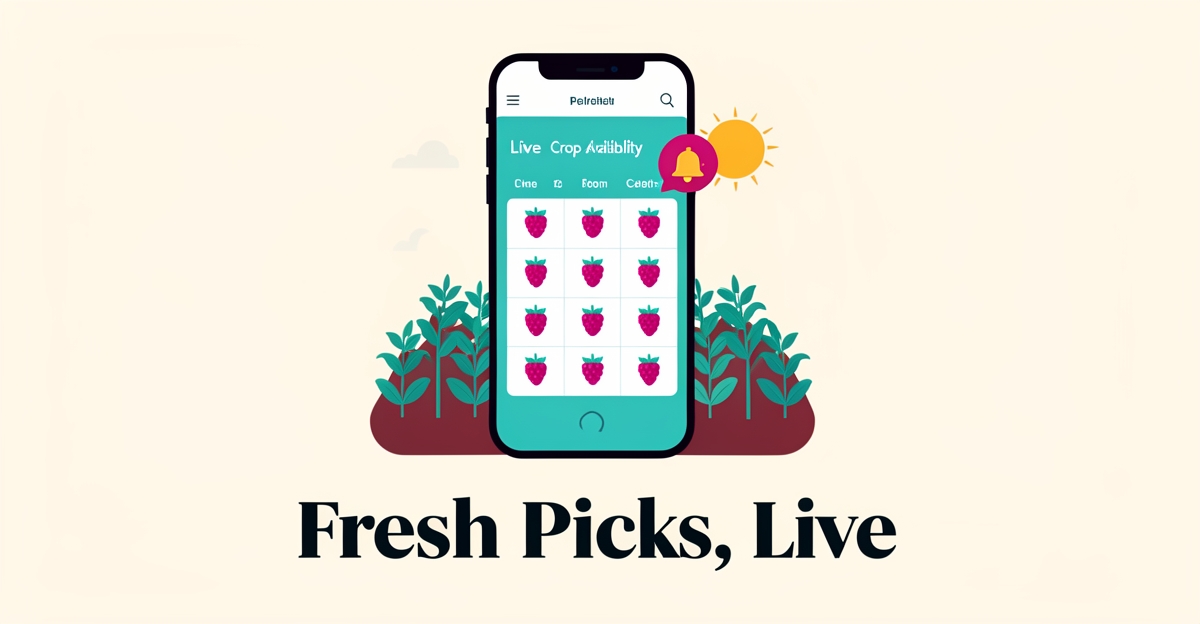
AI Business Sites builds websites that handle this complexity natively. A structured seasonal content engine tracks each variety with start/end dates, microclimate offsets, and policy flags — then surfaces a real-time "What's Pickable Now" panel that updates automatically. When cherry season shifts from late June to mid-July across regions (State of WA Tourism), the site reflects it without manual edits. The same system powers integrated notifications so farms can alert subscribers the moment a crop opens — the kind of timely communication Farmzz found drives $3,000–5,000 in revenue with just 500 subscribers (Farmzz). Static sites can't compete with that.
The Features That Make a Farm Website Actually Work All Season
The Features That Make a Farm Website Actually Work All Season
As U-Pick farms navigate the complexities of seasonal crop management, their websites must serve as the primary source of truth for customers seeking current pick windows and policies. Drawing from insights by the California Department of Food and Agriculture (CDFA) and Washington State Tourism, we've identified five critical features U-Pick farm websites need to thrive.
1. Per-Variety Seasonal Tracking with Granularity California's U-Pick season, for example, spans citrus (Nov–Mar), berries (Mar–Oct), and more, with individual berry varieties like blueberries (Jun–Jul) and ollalieberries (Jun–Jul) requiring precise tracking source. Websites must support individual content records per crop variety with start/end date fields and regional microclimate offsets.
2. Real-Time "What's Pickable Now" Displays Following CDFA's advice to "check each farm's website to see what's in season" source, a dynamic homepage module should auto-populate from the seasonal engine, showing crop status, pricing, and policies. For instance, a farm could highlight "Now Picking: Chandler Blueberries (Jun 12–Jul 15)" with a booking link.
3. Dynamic Policy Toggles Policies like appointment-only access (e.g., Olalla U-Pick Blueberries, July–Sept) source or container requirements should automatically appear when a crop goes live. This ensures consistency and reduces manual updates.
4. AI-Assisted Annual Recalibration Given the year-to-year variability in produce availability source, an AI-driven workflow can clone, pre-fill, and prompt farmers to update variety records, streamlining the annual refresh process.
5. Integrated Notifications for Crop Status Changes Leveraging Farmzz's finding that SMS notifications can drive $3,000–5,000 in revenue with 500 subscribers source, websites should trigger customizable notifications (SMS, email, Google Business Profile updates) when crops become pickable, leveraging a single source of truth.
By incorporating these features, U-Pick farms can ensure their websites not only keep pace with seasonal demands but also enhance customer trust and operational efficiency. AI Business Sites, with its custom-built websites and integrated AI platforms, is uniquely positioned to support these dynamic needs, ensuring farms can focus on what matters most — growing and sharing their produce with the community.
Local business: doing this the old way?
One system replaces the whole pile.
All of it — the website, the follow-up, the content, the leads — built and run for you for $1,497 + $497/mo. Month-to-month, and you own everything.
See what your build includesHow AI-Powered Websites Maintain Accuracy Without Daily Updates
U-Pick farms face a constant challenge: crop availability shifts weekly, policies change with the season, and customers rely on accurate, real-time information to plan their visits. Keeping a website manually updated through these fluctuations is not just time-consuming — it’s nearly impossible without dedicated staff.
AI Business Sites addresses this by embedding a structured content engine directly into the website’s foundation. Rather than treating content as static pages, the system models each crop variety as a dynamic record with fields for start and end dates, regional microclimate adjustments, pricing, and operational policies like appointment requirements or container rules. When a farm clones last year’s berry varieties and adjusts the dates based on current conditions, the engine recalculates what’s pickable now across the entire site — updating the homepage “Currently Available” module, individual crop pages, and policy banners all at once.
Behind the scenes, automated workflows handle the annual recalibration process with minimal farmer input. Using historical averages and regional extension service data, the AI assistant pre-fills date ranges for each variety, flags crops not being offered this year for review, and presents a conversational interface where the farmer confirms or adjusts each entry — such as “Your Chandler blueberries started June 12 last year — same this year?” Once confirmed, the system publishes all updates in a single batch, ensuring consistency across the site without manual copy-pasting.
These changes trigger integrated notifications automatically. When a crop status shifts to “Now Picking,” the system can send an SMS blast to subscribers, update the Google Business Profile, post a website banner, and include the update in the next newsletter — all pulling variety name, pricing, and policies directly from the source record. This eliminates the fragmentation Edible Austin noted, where farms juggle phone, Facebook, and website updates inconsistently. Instead, the website becomes a single source of truth, maintaining accuracy not through daily effort, but through intelligent, connected automation.
Frequently Asked Questions
Why does a static farm website become inaccurate during peak U-Pick season?
What features should a U-Pick farm website have to stay accurate all season?
How do regional microclimates affect U-Pick crop timing, and why should my website reflect my specific location?
Can AI really help update my farm's website each year without me doing all the work?
Are SMS notifications from a farm website actually effective for driving customer visits and revenue?
Why do customers rely on a farm's website instead of social media or phone calls for U-Pick information?
Harvesting Success: The Future of U-Pick Farm Websites
As U-Pick farms navigate the intricacies of seasonal crop management, it's clear that static websites are a relic of the past. The key to success lies in dynamic, AI-driven websites that accurately reflect the ever-changing landscape of crop availability, regional microclimates, and operational policies. By embracing features like per-variety seasonal tracking, real-time 'What's Pickable Now' displays, and integrated notification systems, farms can transform their online presence into a powerful tool for customer engagement and revenue growth. For farms ready to leap into this future, exploring custom, AI-powered website solutions (like those offered by AI Business Sites) can be the first step towards a bumper crop of efficiency and customer satisfaction. Discover how your farm can thrive with a website that works as hard as you do — learn more about harnessing AI for your U-Pick farm's success.
FOR local businesss — BUILT AND RUN BY US
Your website. Your content. Your leads. Your data.
$500 starts your build. Seven days later it's live — chat, booking, follow-up, and your Google presence all set up. Then we run it, every month. You do the work you actually get paid for.