
Key facts
- 87% of marketers use generative AI in at least one recurring workflow according to industry adoption data
- AI touches only 15.12% of all marketing activities on average per industry research
- AI-driven campaigns deliver 22% higher ROI and 32% more conversions than non-AI efforts per Omnibound research
- Median mid-market AI tool spend tripled from $1,200 to $3,400 per month in one year per Omnibound data
- 74% of companies struggle to achieve and scale value from AI initiatives per industry research
- AI content drafting delivers the highest application ROI at 3.2x per McKinsey Global AI Survey
- Only 6–30% of marketing organizations have fully integrated AI across their workflows per industry adoption data
WANT RESULTS LIKE THIS?
Imagine a system doing all of this for your local business — every day, without you.
We build local businesses a custom website with a team of AI behind it: every lead captured and followed up, new content published monthly,customers finding you on Google — live in 7 days.
- 85+ pages at launch
- Every lead followed up, automatically
- Your whole business on one screen
The AI Marketing Paradox: High Adoption, Low Impact
Nearly every marketing team now uses AI, yet most have remarkably little to show for it. According to industry adoption data, 87% of marketers use generative AI in at least one recurring workflow — but that AI touches only 15.12% of all marketing activities on average.
This is the central paradox of modern marketing: adoption breadth is high, but adoption depth is not. Only 6–30% of marketing organizations have fully integrated AI across their workflows, and the same research shows 74% of companies struggle to achieve and scale value from their AI initiatives.
The pattern is easy to recognize. A business adds a chatbot widget to the website. Someone experiments with an AI writing tool for the occasional blog post. Maybe there's an email assistant in the mix. Each tool operates in isolation — a blog post here, a chatbot there — with no connection to the CRM, no revenue attribution, and no system that compounds over time.
This is "pilot purgatory," and it happens for predictable reasons:
- Disconnected tools can't share context — DIY no-code chatbots structurally cannot integrate with CRMs, process transactions, or deliver revenue attribution, according to chatbot implementation research
- Tool sprawl is accelerating — AI marketing tools grew from 1,200 in 2024 to over 3,800 in 2026, while median mid-market AI tool spend tripled from $1,200 to $3,400 per month in a single year (Omnibound)
- Scaling requires expertise most teams lack — insufficient expertise (42%) and data accuracy concerns (45%) rank among the top barriers to AI adoption, per WalkMe's adoption analysis
The real problem isn't tool selection. It's integration depth. A chatbot that can't see your CRM is just a widget. A content engine that doesn't know your services, service areas, and customer questions is just a text generator. Without a unified system where every AI interaction feeds a shared knowledge base and every lead flows into a trackable pipeline, each tool remains an isolated experiment.
This is why the DIY-vs-managed debate matters. DIY tools validate use cases cheaply — $0–100 per month and a few hours of setup, per Aimakers' breakdown. But when marketing needs to drive revenue, the research consistently points toward integrated solutions. AI-driven campaigns deliver 22% higher ROI and 32% more conversions than non-AI campaigns — but achieving those numbers requires the kind of deep integration that off-the-shelf tools don't provide.
At AI Business Sites, this integration-first reality shapes how we think about marketing platforms entirely. The question isn't which AI tool to add next — it's whether your tools work together as a system.
Why DIY Tools Hit a Ceiling at Revenue Generation
No-code chatbot and content tools may seem like a low-cost entry point, but they hit a hard ceiling when it comes to revenue generation. Priced between $0–100 per month with a setup time of just 2–4 hours, these DIY platforms excel at handling FAQs and capturing basic leads — yet they fundamentally lack the infrastructure needed to turn conversations into sales. As research confirms, they cannot integrate with CRMs, process transactions, or maintain the multi-turn context required for complex customer journeys, making revenue attribution nearly impossible source. This structural limitation means businesses using these tools are left guessing which interactions actually drive revenue, undermining any attempt to measure or optimize marketing ROI.
Beyond functional gaps, third-party widgets introduce hidden costs that erode their initial affordability. Ongoing subscription fees accumulate over time, vendor branding appears on customer-facing interfaces, and critical conversation data is often locked behind paywalled tiers — effectively turning ownership into a rental agreement source. For businesses focused on growth, this creates a frustrating trade-off: save money upfront but sacrifice control, scalability, and the ability to close the loop between engagement and revenue.
That said, DIY tools still have a valid role in the early stages of marketing experimentation. They are ideal for validating whether customers engage with automated support or testing simple lead capture mechanisms before investing in deeper integration. However, when the goal shifts from validation to revenue generation — such as qualifying leads, processing bookings, or attributing sales to specific campaigns — these platforms fall short. The data shows that AI-driven marketing delivers 22% higher ROI, 32% more conversions, and 29% lower acquisition costs compared to non-AI efforts, but only when the technology is tightly integrated into revenue-generating workflows source. DIY tools, by design, operate outside that loop.
For service businesses aiming to move beyond brochure websites and into AI-powered operations that quote, schedule, invoice, and follow up autonomously, the limitations of no-code solutions become a strategic liability. AI Business Sites addresses this gap by combining a managed AI assistant, CRM, and SEO content engine into a single owned platform — one where the chatbot doesn’t just answer questions but actively participates in the revenue cycle, from initial inquiry to final review request, all while preserving full data and code ownership.
The Managed Platform Advantage: Consolidation Over Tool Sprawl
The Managed Platform Advantage: Consolidation Over Tool Sprawl
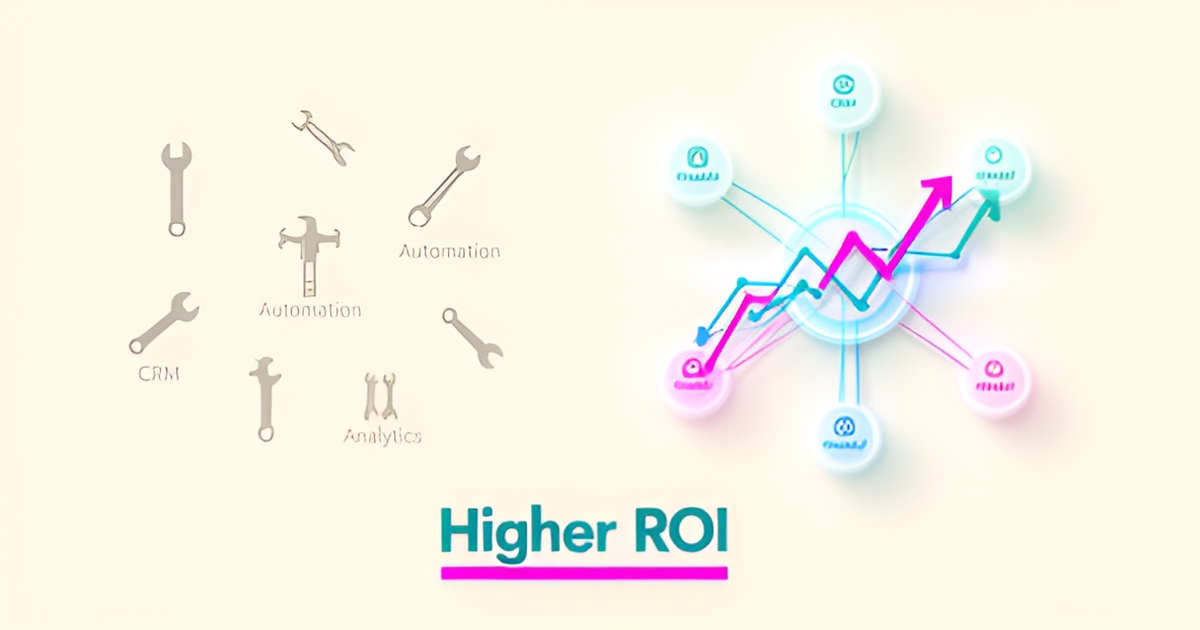
The explosion of AI marketing tools has created a paradox: while 87% of marketers use generative AI in at least one workflow, they apply it to only 15.12% of all marketing activities on average. This gap between adoption and execution depth stems from tool sprawl—AI marketing tools grew from 1,200 in 2024 to 3,800+ in 2026, and median mid-market spend tripled from $1,200/month to $3,400/month in one year. DIY approaches amplify this fragmentation, forcing businesses to juggle disconnected subscriptions for chatbots, CRM, content creation, and analytics—each requiring separate setup, maintenance, and expertise.
An integrated managed platform solves this by unifying core functions. AI Business Sites’ managed model combines an AI assistant CRM chatbot with an SEO content engine, handling hosting, grounding, CRM wiring, content pipelines, and ongoing optimization. This directly tackles the top barriers to AI adoption: 42% of marketers cite lack of expertise, and 45% struggle with data accuracy issues. By managing the technical stack and grounding responses in the client’s own knowledgebase, the platform eliminates the need for businesses to become AI integrators while ensuring responses are fact-based and brand-aligned.
The ROI evidence confirms that managed deployment unlocks returns DIY leaves on the table. AI content drafting delivers the highest application ROI at 3.2x, and AI-driven campaigns generate 22% higher ROI versus non-AI efforts. When a single managed system handles both the chatbot’s lead qualification and the content engine’s SEO-optimized publishing—complete with automated internal linking and fact-checked comparison pages—businesses avoid the integration costs and execution gaps that plague DIY stacks. For local service businesses, this means a website that doesn’t just exist but actively runs the business: capturing leads, drafting quotes from calls, scheduling jobs, and publishing 14+ new SEO pieces monthly—all under one managed fee. The result is not just reduced tool sprawl, but a cohesive system where AI drives measurable marketing outcomes without requiring the owner to manage the machinery.
Local business: doing this the old way?
One system replaces the whole pile.
All of it — the website, the follow-up, the content, the leads — built and run for you for $1,497 + $497/mo. Month-to-month, and you own everything.
See what your build includesWhat Effective Looks Like: The Quote-to-Review Loop in Action
The quote-to-review loop turns every customer interaction into revenue and reputation. When a call comes in, the AI drafts a quote from the transcript, the customer approves and e-signs online, the job schedules automatically, the invoice collects payment via the business's own Stripe account, and a review request fires post-completion. This closed loop replaces the fragmented workflows of field-service software like Jobber, Housecall Pro, or ServiceTitan, where each step — quote approval, e-signature, review requests — often requires paid add-ons and per-seat pricing.
Businesses using AI-driven marketing see 22% higher ROI, 32% more conversions, and 29% lower acquisition costs compared to non-AI campaigns, according to industry research. AI Business Sites builds this loop into its $497/month managed platform, eliminating tool sprawl and vendor lock-in. Unlike per-seat models that gate essential features behind costly tiers, the system owns the code, content, data, and Stripe relationship — so the business keeps its revenue stream and customer insights when scaling or switching providers.
The managed approach wins where marketing must drive revenue. DIY tools may handle simple FAQs at $0–100/month, but they cannot integrate with CRMs, process transactions, or maintain complex context — capabilities required for a true quote-to-close loop. By contrast, AI Business Sites delivers a done-for-you operating system where the AI team runs the quote, job, invoice, and review cycle without technical overhead. As the research notes, only 6–30% of marketing organizations fully integrate AI across workflows, yet those that do report average ROI of 3.7x per dollar invested. The platform closes this execution gap by handling setup, monitoring, and improvements — so the owner runs their business while the system runs the rest.
Ownership removes the hidden costs of renting. Third-party widgets add monthly fees, display vendor branding, and lock conversation data behind paywalls — a dynamic described as "renting a chatbot, and the landlord's name is on the door." AI Business Sites avoids this trap: clients own everything, from the React/Next.js codebase to their Stripe account and knowledgebase. If they leave, the full site exports to a GitHub repo in their name. The model is simple: we keep you by doing the work, not by locking you in. For service businesses where every quote, job, and review impacts the bottom line, this integrated, owned loop turns marketing into a measurable revenue engine.
Decision Framework: Match Your Platform to Your Marketing Maturity
Decision Framework: Match Your Platform to Your Marketing Maturity
Choosing the right AI marketing platform starts with an honest assessment of where your business stands. For simple validation — like testing a basic FAQ chatbot to answer common customer questions — DIY tools offer a low-risk entry point. No-code solutions cost $0–100/month and can be deployed in 2–4 hours, making them ideal for proving a concept without technical overhead. However, these tools hit hard limits when marketing must drive real business outcomes: they cannot integrate with CRMs, process transactions, or maintain complex context across conversations, which restricts their ability to qualify leads or attribute revenue.
As your needs evolve beyond validation, the decision shifts. If your marketing must generate revenue, sync with operational systems like scheduling or invoicing, or scale content production consistently — think 10+ pieces monthly — a managed platform becomes the logical next step. This is where the hybrid path insight from Aimakers.co proves practical: start DIY only to learn what your customers truly need, then graduate to a managed solution when limitations emerge. The data shows AI-driven campaigns deliver 22% higher ROI and 32% more conversions than non-AI efforts, but only when the technology is deeply integrated into revenue-generating workflows — something DIY tools structurally cannot support.
Use this four-question checklist to guide your choice:
- Do you need CRM integration to track leads and deals?
- Will transactions happen on your website (bookings, sales, payments)?
- Is your content volume exceeding 10 pieces per month?
- Does your team lack hands-on AI expertise for setup and maintenance?
Answering "yes" to any signals that managed support — not DIY — aligns with your maturity level. AI Business Sites helps service businesses make this transition smoothly, handling the technical lift so you can focus on running your business. To see if this approach fits your goals, book a free strategy call to assess your specific use case and platform fit.
Frequently Asked Questions
Is a DIY chatbot or AI tool enough for marketing a small business?
What does a managed AI marketing platform cost compared to DIY tools?
Why do most AI marketing tools fail to deliver ROI?
Can I just use multiple cheap AI tools instead of one integrated platform?
What ROI should I expect from AI-driven marketing?
How do I know when to switch from DIY tools to a managed platform?
From AI Experiments to Real Revenue: The Integration Imperative
The data is clear: while nearly every marketing team dabbles in AI, most remain stuck in pilot purgatory—using tools in isolation without connecting them to CRM, revenue tracking, or scalable workflows. DIY solutions excel at validation but hit a hard ceiling when marketing must drive real business outcomes, lacking the infrastructure for lead qualification, transaction processing, or closed-loop attribution. What moves the needle isn’t more tools, but a unified system where every AI interaction feeds a shared knowledge base and every lead flows into a trackable pipeline—exactly what AI Business Sites delivers as a managed, done-for-you platform. If you’re ready to stop juggling subscriptions and start turning conversations into revenue, book a free strategy call to see how an integrated AI operating system can work for your business.
FOR local businesss — BUILT AND RUN BY US
Your website. Your content. Your leads. Your data.
$500 starts your build. Seven days later it's live — chat, booking, follow-up, and your Google presence all set up. Then we run it, every month. You do the work you actually get paid for.