
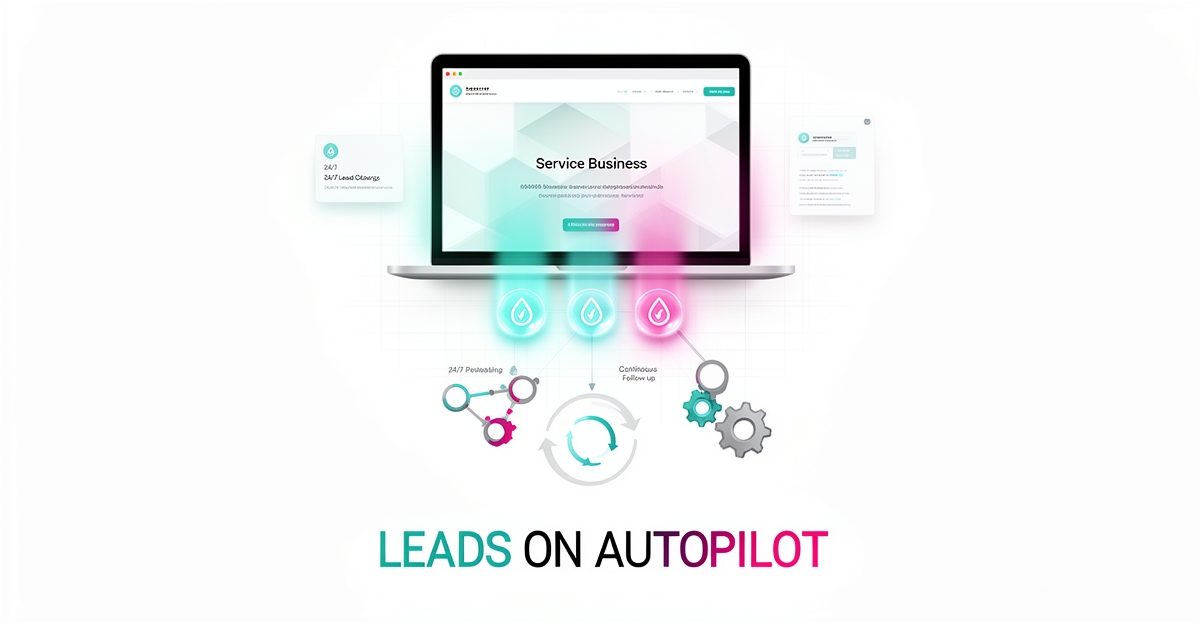
Key facts
- Roast My Web delivers prioritized revenue-impact recommendations in ~2 minutes according to its audit tool
- Roast My Web is used by 6,300+ individuals and agencies per its user base
- Unbounce AI optimization is powered by more than two billion conversions according to the platform
- Unbounce claims landing page visitors convert and spend twice as much vs ecommerce product pages in its marketing
- HubSpot serves 299,000+ customers in 135+ countries per its corporate site
- HubSpot says its Customer Agent resolves ~65% of customer inquiries automatically in its AI claims
- MassMonopoly Contractor Marketing costs $4,999 one-time setup plus $999/month per agency pricing
WANT RESULTS LIKE THIS?
Imagine a system doing all of this for your local business — every day, without you.
We build local businesses a custom website with a team of AI behind it: every lead captured and followed up, new content published monthly,customers finding you on Google — live in 7 days.
- 85+ pages at launch
- Every lead followed up, automatically
- Your whole business on one screen
Why Most Service Business Websites Fail to Convert
Most service business websites fail to convert because they are built as digital brochures rather than lead-capture systems. While a brochure site might list services and contact details, it leaves revenue on the table every time a visitor calls after hours, fills out a form that disappears into an inbox, or hits a page that loads too slowly on a phone.
The gap between a brochure and a conversion system comes down to what happens in the critical minutes after someone lands on your site. Research on service business websites shows that most callers who reach voicemail simply hang up and dial the next business on Google — the missed-call pain that costs contractors and clinics thousands in lost jobs each month. A conversion-focused site answers immediately, whether through an embedded voice agent that talks to visitors in their browser or a chatbot that qualifies the lead and books the appointment before the competitor even knows the phone rang.
Lead leakage compounds when businesses stitch together six to ten separate tools to handle what should be one system. You pay for a website builder, a CRM, a review app, a scheduling tool, an email platform, and a field-service app like Jobber or Housecall Pro — each with its own login, per-seat pricing, and integration gaps. Agencies that specialize in contractor marketing note that when these tools don't talk to each other, leads fall through the cracks: the form submission never triggers a follow-up email, the quote sits unviewed, or the review request never fires after the invoice is paid.
The cost isn't just the monthly subscriptions. It's the hours spent copying data between systems, the leads that go cold because follow-up took two days instead of two minutes, and the jobs that never close because the quote required a phone call instead of a one-tap approval. Platforms that integrate the full loop — from the first click through the quote, job, invoice, and review request — eliminate these leaks by design. AI Business Sites builds this into a single system where the website, CRM, content engine, and field-service operations run together, so the lead captured at 9 PM becomes a scheduled job by 9 AM without manual handoffs.
A conversion system also requires content depth that brochure sites lack. Service businesses need individual pages for every service and every city they serve — not a single "Services" page — because Google rewards topical authority and specific answers. Done-for-you platforms now launch with 85+ pages and publish 14+ new pieces monthly, using AI pipelines that research, verify, and interlink content automatically. Brochure sites, by contrast, sit static while competitors capture the search traffic for "emergency plumber in [city]" or "AC repair cost."
The difference shows up in the data: businesses that treat their website as a system — with instant lead response, automated follow-up, and integrated operations — convert visitors at rates brochure sites can't match. The question isn't whether you need a website; it's whether your website is working while you're on a job site, or just sitting there looking pretty.
What a High-Converting Service Website Actually Needs
A service website that only looks good is a brochure that leaks leads. The sites that actually convert treat the web presence as an operating system — capture, follow up, quote, sell, and request reviews without manual handoffs.
Audit data defines the baseline. Roast My Web evaluates sites across design, UX, conversion, mobile responsiveness and SEO, delivering prioritized revenue-impact recommendations in ~2 minutes. Its criteria map directly to what service businesses need: clear value proposition, trust signals, mobile usability, fast load, schema markup, conversion-focused copy, and frictionless contact or booking flows.
Agency experience reinforces the system view. MassMonopoly stresses that strategy, design, SEO, AI visibility, content and campaigns must work as a cohesive system, not isolated elements. Their Growth Hub unifies lead tracking, rankings, reviews and social performance in one view, reflecting the integrated lead-to-revenue loop service businesses require.
A high-converting service site is non-negotiable on these features:
- Mobile-first design and instant lead capture with chat and voice that push leads straight into CRM
- Clear CTAs and automated follow-up so every form, chat or call triggers a branded auto-response within seconds
- Trust signals including reviews, schema markup and proof that the site is built for local search
- An integrated quote-to-review loop that turns approved quotes into scheduled jobs, invoices and automated review requests
Scale matters for visibility. AI Business Sites launches with 85+ pages — 25–30 hand-crafted core pages plus 60 AI-generated SEO pages — and publishes 14+ new pieces per month. That velocity builds topical authority for local service queries that manual blogging cannot sustain.
Ownership and portability remain critical differentiators. The platform guarantees client ownership of code, content, lead data, knowledgebase, media and domain, with a month-to-month contract and 30-day notice. On exit, the complete React/Next.js codebase is pushed to a GitHub repo in the client’s name with a full database export.
Landing page tools optimize a narrow slice of the funnel. Unbounce is built for paid-traffic conversion with AI optimization powered by more than two billion conversions and Smart Traffic routing. It does not replace a full business website with service pages, blogs, local SEO structure, CRM and field-service operations.
For service businesses, the best website is a managed system that closes the office loop end-to-end, not a template that looks professional but stops at the contact form. Integrated capture, automation and ownership are the real conversion drivers.
Local business: doing this the old way?
One system replaces the whole pile.
All of it — the website, the follow-up, the content, the leads — built and run for you for $1,497 + $497/mo. Month-to-month, and you own everything.
See what your build includesThe Shift to Done-for-You AI Business Operating Systems
The line between a website and a business operating system is disappearing for service companies. Owners are tired of duct-taping six SaaS tools together and watching leads leak between them.
The market is moving away from DIY builders toward fully managed platforms that build, launch and run the entire digital presence. Industry commentary notes that for contractors, the right website, local visibility, reviews, and follow-up need to work together as one managed program, not as isolated elements. That integration is why integrated platforms are now favored over standalone templates for service businesses.
Conversion-focused features are non-negotiable. A popular audit tool used by 6,300+ individuals and agencies evaluates sites across design, UX, conversion, mobile responsiveness and SEO, delivering prioritized revenue-impact recommendations in about ~2 minutes. The criteria it uses — clear value proposition, trust signals, mobile usability, fast load, schema markup and frictionless contact flows — define what a high-converting service site must deliver.
Done-for-you AI business operating systems bundle those requirements into one flat fee and one team. The model replaces a patchwork of builder, CRM, chatbot, content scheduler and field-service app with a custom React/Next.js site plus an AI back office that is set up, trained and run for the client. Launch size is typically 85+ pages, with ongoing content velocity of 14+ pieces per month and a field-service module for quotes, jobs, invoicing and reviews.
The value is the closed loop. Instead of a brochure, the site captures leads 24/7 via chat and voice, routes them into a CRM, auto-responds instantly, turns approved quotes into scheduled work, collects payment and requests reviews — all without the owner managing tools. Ownership and portability are built in, with code, content, lead data and domain remaining with the business and month-to-month terms.
What the shift looks like in practice:
- Website as system, not brochure: pages are built to answer, capture, sell and remember
- AI content engine at scale: multi-agent pipelines produce service/location/comparison pages with verification and featured images
- Lead-to-revenue loop native: chat/voice capture, CRM follow-up, jobs and invoicing, and automated review requests in one platform
Landing page specialists still matter for paid campaigns. Unbounce highlights AI optimization powered by more than two billion conversions with no-code A/B testing and Smart Traffic routing. That capability is valuable for campaign-specific pages, but it does not replace a full business website with service pages, blogs and local SEO.
For service businesses, the best website is no longer the prettiest template. It is a managed system that runs the business behind the site.
How to Evaluate and Choose the Right Platform
Picking a website platform for a service business is not about templates. It is about whether the site can close the office loop from first click to paid invoice without duct-taping six subscriptions together.
Service businesses win when the website, CRM, lead capture, content engine and field operations work as one system. Agency research stresses that strategy, design, SEO, AI visibility, content and campaigns must function cohesively, not as isolated tools. An integrated dashboard that unifies lead tracking, rankings, reviews and social performance reduces leakage between quote and review.
A practical evaluation starts with lead capture uptime and ownership.
- Integrated office loop. Require quote → job → schedule → invoice → review in one flat fee, not per-seat add-ons.
- AI content with fact-checking. Demand 14+ new pieces per month with a validation layer, e.g., a ≥85/100 grounding score before auto-publish.
- 24/7 capture. Browser-based voice agent plus FAQ chat included, with an optional dedicated phone number add-on for inbound calls.
- Full asset ownership. Code, content, lead data, domain and Stripe account must be yours, with month-to-month exit and GitHub export.
- Conversion audit validation. Run the live site through an audit tool that scores design, UX, mobile and SEO with prioritized revenue-impact fixes.
Integrated platforms outperform DIY builders for service businesses because they close the loop without multiple subscriptions. AI Business Sites, for example, delivers a custom React/Next.js site with 85+ pages at launch and 14+ new SEO pieces monthly, managed for $1,497 setup and $497/month. That scale of content velocity is now baseline for local search competition.
AI content at scale needs guardrails. Comparison pages should use deterministic price verification and claim-by-claim grounding audits, with a mandatory ≥85/100 score threshold before auto-publish. Every page should ship with AI-generated featured images, schema markup and internal linking that builds topical clusters Google rewards.
Lead capture must be continuous. A WebRTC voice agent embedded on the site lets visitors talk in-browser and pushes leads to CRM instantly, while a FAQ bot handles text. For real phone calls, a dedicated AI Receptionist add-on answers 24/7, books appointments and logs transcripts. This addresses the missed-call pain where most callers do not leave voicemail and call the next business on Google.
Avoid platform lock-in, per-seat fees and guaranteed ranking promises. Ownership means the domain is registered in your name, code is standard React/Next.js, and you can leave with everything on 30 days notice. Independent audit tools used by 6,300+ agencies show how conversion, mobile responsiveness and trust signals are measured objectively, giving you a data-driven improvement roadmap after launch.
Landing page specialists like Unbounce optimize paid traffic conversion but do not replace a full business website with service pages, blogs and local SEO structure. For most service businesses, the best website is a managed system that answers, writes, sells, remembers and owns its assets.
Key Takeaways
{ "title": "Your Website Should Work While You're on the Job Site", "content": "The research is clear: service businesses don't lose leads because their website looks unprofessional — they lose them because the site stops working the moment the owner steps onto a job. A brochure with a contact f
FOR local businesss — BUILT AND RUN BY US
Your website. Your content. Your leads. Your data.
$500 starts your build. Seven days later it's live — chat, booking, follow-up, and your Google presence all set up. Then we run it, every month. You do the work you actually get paid for.