
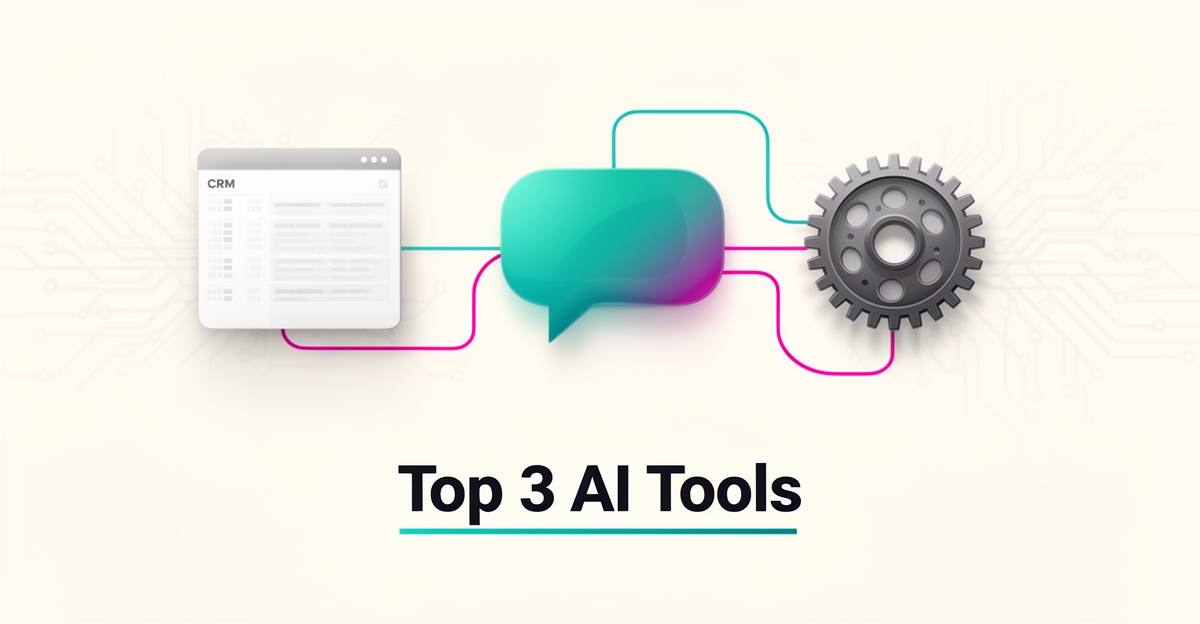
Key facts
- AI adoption surged 55% year-over-year with 78% of organizations using AI in 2024 according to U.S. Census Bureau data
- AI chatbots handle up to 70% of routine customer inquiries when integrated with CRM and automation systems based on industry analysis
- Over 70% of enterprises now use AI for real-time data integration across systems to prevent data silos from killing automation effectiveness per automation trend research
- 88% of organizations offer self-service automation capabilities to citizen developers enabling non-technical users to build workflows according to business process research
- 57% of organizations now use AI agents for multi-stage workflows as 2026 becomes the year of multi-agent systems per industry analysis
- 78% of executives say they'll need to reinvent operating models for agentic AI as coordinated AI networks replace single-purpose bots according to automation trend research
- The best chatbot platforms integrate deeply with CRM, data, and automation systems rather than operating as standalone widgets confirmed by platform research
WANT RESULTS LIKE THIS?
Imagine a system doing all of this for your local business — every day, without you.
We build local businesses a custom website with a team of AI behind it: every lead captured and followed up, new content published monthly,customers finding you on Google — live in 7 days.
- 85+ pages at launch
- Every lead followed up, automatically
- Your whole business on one screen
The Integration Gap Small Businesses Face Today
Most small businesses don't ignore AI because they doubt its value — they stall because the tools don't talk to each other. A website lives in one platform, the CRM in another, the chatbot in a third, and automations in a fourth. Every hand-off between them is a place where leads fall through.
Research shows the cost of that fragmentation. Industry analysis found that AI chatbots can handle up to 70% of routine customer inquiries, but only when they have full context from the CRM and can trigger follow-up automations. Meanwhile, automation trend data reveals that over 70% of enterprises now use AI for real-time data integration across systems — because siloed data kills automation effectiveness. Adoption is accelerating: 78% of organizations used AI in 2024, a 55% jump from the prior year.
The integration gap shows up in daily operations:
- A lead chats on the website, but the CRM never sees the conversation history
- The chatbot answers a pricing question, but can't book the appointment because it lacks calendar access
- An automation sends a follow-up email, but doesn't know the prospect already spoke to sales
- The owner manually copies data between tools — the very "administrative duties" AI was meant to eliminate
Platform research confirms the best chatbot builders integrate deeply with CRM, data, and automation systems — not as add-ons, but as a unified foundation. Market analysis notes that 2026 is the year of multi-agent systems: coordinated AI networks that share knowledge and execute complex workflows end-to-end. Single-purpose bots are giving way to systems that operate like a team.
AI Business Sites was built to close this gap. The platform combines a custom website, AI chatbot, voice agent, CRM, content engine, and visual automation builder in one managed system — so the conversation on the site becomes a lead in the CRM, which triggers a quote, which books a job, which sends an invoice, which requests a review. No duct tape required.
What Research Says About Effective AI Platforms
The AI tools market isn't short on options — it's short on tools that actually work together. Before picking any single platform, it helps to understand where the market is heading, because the trends reveal what "good" looks like.
Adoption is moving fast. According to U.S. Census Bureau data, 78% of organizations used AI in 2024 — a 55% increase from the previous year. Managers now rely on AI for everything from administrative duties and resource allocation to customer support and reporting, freeing time for strategy and decision-making.
Customer-facing AI is delivering measurable results too. One study on chatbot use in business found that AI chatbots can handle up to 70% of routine customer inquiries, letting human staff focus on complex issues. That's why the best chatbot platforms, as Salesforce notes, integrate deeply with CRM, data, and automation systems rather than operating as standalone widgets.
Looking ahead, the structure of AI tooling is changing. If 2025 was the year of AI agents, industry analysis suggests 2026 will be the year of multi-agent systems — coordinated networks of AI that share knowledge, verify each other's work, and execute complex workflows end-to-end. Already, 57% of organizations use agents to handle multi-stage workflows. The same analysis offers a caution: most AI automation platforms still struggle with reliability, governance, and real-world execution, promising autonomous operations but delivering only partial automation.
So what should small business owners look for? The research points to a consistent set of criteria:
- Deep CRM integration — chatbots and automation that connect directly to your customer data, not tools that sit beside it
- Reliability and governance — human oversight built in, since most platforms overpromise autonomy
- Real-time data flow — over 70% of enterprises use AI for real-time data integration across systems, because data silos kill automation effectiveness
- Low-code accessibility — 88% of organizations now offer self-service automation capabilities so non-technical users can build workflows
It's also worth noting that 78% of executives say they'll need to reinvent operating models for agentic AI, per automation trend research. For a small business, that reinvention doesn't have to mean rebuilding everything — it can mean choosing one integrated system where the assistant, CRM, chatbot, and automation builder already work together. That's the approach behind platforms like AI Business Sites, which combines these capabilities in a single managed system rather than asking owners to stitch together separate tools.
The takeaway: judge AI tools not by their feature lists, but by whether they handle routine work reliably, connect to your data, and keep a human in control.
Local business: doing this the old way?
One system replaces the whole pile.
All of it — the website, the follow-up, the content, the leads — built and run for you for $1,497 + $497/mo. Month-to-month, and you own everything.
See what your build includesHow to Evaluate Top AI Tools for Assistant CRM Chatbot Automation
Choosing the right AI platform for your business is no longer about finding the flashiest chatbot; it is about identifying a system that unifies customer relationships, intelligent conversation, and workflow execution. With 78% of organizations now using AI—a 55% jump from the previous year—the market is flooded with point solutions that promise autonomy but often deliver fragmented results.
The first criterion is deep CRM integration. Your AI assistant should not just answer questions; it must access customer history, update deal stages, and trigger follow-ups based on real-time data. According to Salesforce research on chatbot builders, the most effective platforms integrate deeply with CRM, data, and automation systems rather than operating as isolated widgets. This connectivity allows AI to handle up to 70% of routine inquiries while maintaining context across every interaction.
Next, evaluate workflow orchestration and multi-agent coordination. Modern business automation requires more than simple "if-this-then-that" rules. Look for platforms that support complex, multi-step processes where AI agents collaborate like team members—researching, drafting, verifying, and executing across departments. As industry analysts note, 2026 marks the shift from single agents to coordinated networks that verify each other's work and execute end-to-end workflows. The platform should offer visual builders with extensive trigger libraries and conditional logic, enabling you to map sophisticated business processes without writing code.
Real-time data integration forms the third pillar. Data silos kill automation effectiveness, which is why over 70% of enterprises now prioritize AI systems that sync instantly across their tech stack. Whether updating inventory, scheduling appointments, or processing payments, your platform must maintain a single source of truth. This capability becomes especially critical when deploying voice agents or chatbots that need current pricing, availability, and customer status to provide accurate responses.
Fourth, consider citizen development capabilities that empower your team to build and modify automations without IT bottlenecks. Research shows that 88% of organizations now offer self-service automation to domain experts who understand the business logic best. Look for low-code interfaces, drag-and-drop workflow designers, and natural language configuration that let your operations team—not just developers—refine how the AI behaves.
Finally, insist on human-in-the-loop governance. The most reliable platforms do not just automate; they escalate. Look for features like confidence scoring, approval queues for customer-facing actions, and transparent audit trails. This governance layer ensures that while AI handles routine work, human judgment guides complex decisions, maintaining quality and compliance.
At AI Business Sites, we built our platform around these exact criteria—integrating the assistant, CRM, chatbot, and automation builder into one managed system rather than forcing you to stitch together disparate tools. When evaluating your options, prioritize unified architecture over feature checklists; the goal is a cohesive AI workforce, not a collection of disconnected bots.
From Evaluation to Implementation With a Done-For-You System
Choosing the right AI stack is only half the battle. Most owners stall after evaluation because integration, training and upkeep remain technical projects.
The market is moving fast. Industry research shows 78% of organizations used AI in 2024, up 55% from the previous year. Adoption is driven by the need to automate repetitive work and free managers for strategic decisions.
AI chatbots now handle up to 70% of routine customer inquiries, letting human agents focus on complex issues. That shift explains why businesses want platforms where CRM, chatbot and automation are built together rather than duct-taped.
Implementation risk rises with complexity. Recent analysis notes most AI automation platforms still struggle with reliability, governance and real-world execution. Multi-agent coordination is becoming the norm, with 57% now using agents to handle multi-stage workflows.
A done-for-you path removes the integration burden. Instead of assembling tools, non-technical owners get a custom website plus an AI back office set up, trained and run on their behalf.
At AI Business Sites the move from selection to live deployment follows a practical sequence:
- Kickoff with a short business questionnaire, no technical homework required
- 7-day build of 85+ pages, knowledgebase, FAQ bot, CRM and automations, client approves before launch
- Launch with lead capture working day one, then ongoing content, maintenance and system improvement managed monthly
Ownership stays with the client. Code, content, lead data and domain are client-owned, with month-to-month service and 30 days’ notice to cancel.
The platform is designed for business operators, not engineers. The AI assistant manages CRM, documents, emails and website content through conversation, while the integrated assistant CRM chatbot and automation builder runs in one system.
Low-code access matters for adoption. Business process research finds 88% of organisations offer self-service automation capabilities to citizen developers. Over 70% of enterprises use AI for real-time data integration across systems to enable instant analytics and dynamic operations.
That is the implementation advantage of a managed system: the team handles hosting, connections, monitoring and teaching the business to the AI, so owners run their business while the system runs the rest.
Frequently Asked Questions
How does AI Business Sites solve the problem of disconnected AI tools like chatbots, CRM, and automation?
What does the $497/month plan actually include for a small business owner?
Is the AI Receptionist add-on necessary if I already have the website’s voice agent?
Can I really build workflows without coding or IT help?
What happens if I cancel the service—do I lose my website, data, or leads?
How fast can I get a live website with AI chatbot, CRM, and automation working?
Stop Stitching. Start Operating.
The question isn't which three AI tools to buy—it's whether you can afford to keep managing them separately. When your chatbot can't see your CRM and your automations can't access real-time data, you're not leveraging AI; you're babysitting it. With 78% of organizations now using AI, the competitive edge belongs to businesses that unify these functions into one coherent system. AI Business Sites eliminates the integration tax by delivering the assistant, CRM, chatbot, and automation builder as a single managed platform—live in seven days, owned entirely by you, no duct tape required. Ready to close the gap? Book a free strategy call to see what a unified system looks like for your business—no obligation, just clarity.
FOR local businesss — BUILT AND RUN BY US
Your website. Your content. Your leads. Your data.
$500 starts your build. Seven days later it's live — chat, booking, follow-up, and your Google presence all set up. Then we run it, every month. You do the work you actually get paid for.