
Key facts
- Bitrix24 reports 15,000,000 organizations have chosen its all-in-one workspace according to its platform data
- Bitrix24 claims +43% lead conversion rates for organizations using its unified platform per vendor marketing
- Bitrix24 claims to deliver 30x better value than using a set of separate work tools according to its positioning
- Per-seat competitors charge $7–$29 per user, including Teams at $7 and Wix at $29 per Bitrix24's pricing comparison
- Three website types can be inferred from platform features: standard business sites, online stores, and lead-generation pages based on documented capabilities
- Bitrix24 reports +26% task completion and +32% employee engagement among unified-platform organizations according to vendor claims
- Anchanto has processed 200M+ orders per year through its integrated e-commerce solutions according to company figures
WANT RESULTS LIKE THIS?
Imagine a system doing all of this for your local business — every day, without you.
We build local businesses a custom website with a team of AI behind it: every lead captured and followed up, new content published monthly,customers finding you on Google — live in 7 days.
- 85+ pages at launch
- Every lead followed up, automatically
- Your whole business on one screen
Why Website Type Confusion Costs Small Businesses Leads
A contractor pays for a website builder, a separate CRM, a booking tool, an invoicing app, and a review-request service — then wonders why leads slip through the cracks between them. The problem usually isn't any single tool. It's treating every website as the same kind of project when each type demands different capabilities.
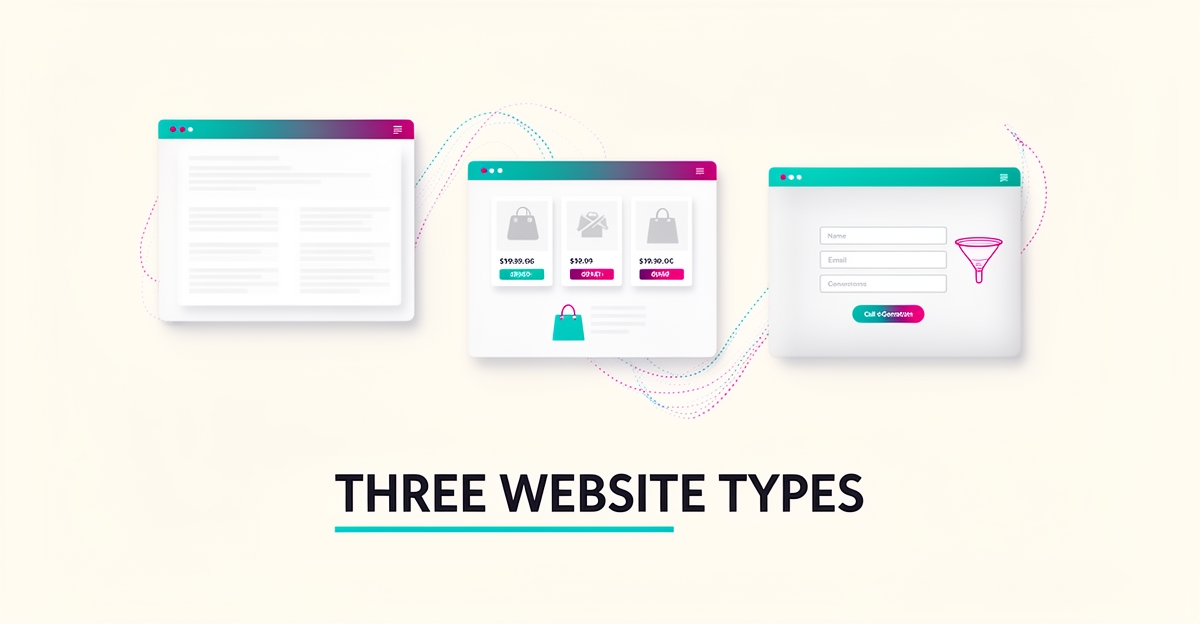
Most small business sites fall into one of three practical categories: a standard informational business site, an e-commerce or online store, and a lead-generation site built around forms and landing pages. Notably, even major platform vendors don't publish a formal taxonomy — these categories have to be inferred from what platforms actually build. Bitrix24, for example, doesn't define "three types of websites" explicitly, but its feature set reveals the same three use cases: a free website builder with templates for standard business sites, an online store feature for e-commerce, and web forms with CRM integration for lead capture.
The confusion gets expensive when owners buy one tool for all three jobs. A brochure-style site can't take orders. A store without lead capture wastes every visitor who isn't ready to buy. And a lead-gen site with no follow-up system behind it captures contacts it never converts — which is why we build lead capture and instant CRM follow-up into every site rather than treating it as a separate purchase.
The bigger signal is where the market is heading: consolidation. Bitrix24 positions itself as an all-in-one workspace that folds CRM, project management, communications, and website building into a single platform — explicitly claiming to replace separate SaaS tools. It claims to deliver "30x better value than using a set of separate work tools," and reports that 15,000,000 organizations have chosen the platform. Those are vendor claims, not independent audits, but the direction is telling.
Per-seat pricing is the pressure point driving this shift. Bitrix24's own pricing comparison lists competitors charging per user — Slack at $10, Teams at $7, Asana at $15, Salesforce at $25, HubSpot at $15, and Wix at $29 per user — which is why it emphasizes a flat-fee model with no per-user pricing. For a small team, those seats add up fast, especially when several tools overlap.
- A website that's just a brochure leaves leads unanswered after hours
- Five or six subscriptions duct-taped together create gaps where leads fall through
- Per-seat tools penalize you for every team member who touches the system
- Consolidated platforms reduce the number of places a lead can get lost
The lesson for owners choosing their first (or next) website: identify which of the three types your business actually needs, then pick a platform built for that job — ideally one that handles the follow-up work too. At AI Business Sites, that's the philosophy behind matching the website type to the business outcome, so the site captures and converts leads instead of just existing online.
Three Implicit Website Use Cases From Platform Features
Most small business owners asking "what are three types of websites?" expect a clean, textbook taxonomy. Here's the honest answer: the research data doesn't provide one. None of the analyzed sources explicitly defines or categorizes three website types, so any rigid framework presented here would be unsourced speculation rather than fact.
What the research does offer is a practical alternative. Based on platform features documented by Bitrix24, a workspace platform used by 15,000,000 organizations, three implicit website use cases can be inferred from the capabilities vendors actually build:
- Standard business websites — informational sites built through free website builders with templates, covering services, about pages, and contact details.
- Online stores and e-commerce sites — sites with a dedicated online store feature for selling products directly to customers.
- Lead-generation pages — web forms and landing pages connected to CRM integration, designed to capture and convert visitor information.
This feature-based lens matters more than it might seem. Rather than debating abstract categories, it asks a better question: what does the platform actually let your website do? Bitrix24's own positioning reflects this shift, consolidating website building alongside CRM, project management, and communications into one workspace — and claiming a 43% improvement in lead conversion rates for its users. Worth noting: that figure is a vendor marketing claim without independent verification, so treat it as directional rather than definitive.
The consolidation trend behind these three use cases is real, though. Businesses increasingly expect one platform to handle their informational pages, their selling, and their lead capture — instead of stitching together separate tools. Bitrix24 leans into this with flat-fee pricing it positions against per-user competitors, claiming 30x better value than a set of separate work tools.
This is exactly how we think about it at AI Business Sites. When we build for a client, the three use cases aren't separate products — a standard business site, an online store or booking system if they sell something, and lead capture wired into a CRM all ship as one connected system. The categorization question becomes less about picking a "type" and more about which capabilities your business needs switched on.
One caveat before you cite this framework elsewhere: the source relevance here is limited. Two of the three analyzed sources contained nothing on website typology at all, and the third requires inference rather than offering an explicit taxonomy. If you need a formally researched categorization, the honest recommendation is to consult additional sources dedicated to website strategy — not vendor feature pages.
Matching Use Cases To Platform Capabilities
Choosing the right website type starts with understanding your core business goal. Whether you need to share information, sell products, or capture leads, each purpose aligns with specific platform capabilities that determine how effectively your site will perform. Matching these use cases to the right tools ensures your website does more than exist—it actively supports your business operations.
For businesses focused on establishing an online presence through service details, company history, or contact information, an informational site is the ideal fit. Bitrix24 supports this use case with its free website builder, which includes customizable templates designed for standard business websites. This allows owners to launch a professional site quickly without coding or design expertise, making it suitable for local service providers, consultants, or brick-and-mortar shops aiming to be found online. Bitrix24’s free website builder enables this by offering drag-and-drop tools and pre-built layouts tailored to informational content.
When the goal shifts to selling products, managing inventory, or processing payments online, an e-commerce site becomes necessary. Bitrix24 addresses this through its dedicated online store feature, which supports product catalogs, shopping carts, and secure checkout processes. This capability is built into the platform, allowing businesses to start selling without integrating third-party tools. According to the platform’s documentation, this feature is designed for simplicity and scalability, helping small businesses manage orders and customer data in one place. The online store functionality is particularly beneficial for retailers, restaurants offering online ordering, or service providers selling packages or memberships.
For lead generation—such as collecting inquiries from service requests, newsletter signups, or quote forms—web forms integrated with CRM functionality are essential. Bitrix24 provides web form builders that connect directly to its CRM system, ensuring every submission is automatically tracked, followed up on, and nurtured through the sales pipeline. This eliminates manual data entry and reduces the risk of lost leads. The platform emphasizes this integration as a way to streamline marketing and sales efforts, especially for businesses relying on inbound inquiries. Web forms with CRM integration enable this seamless flow from capture to conversion.
By aligning your website’s purpose with the appropriate platform capability—whether informational, transactional, or lead-focused—you create a site that works as hard as you do. This strategic match ensures functionality, usability, and long-term value, turning your website into a true business asset rather than just a digital brochure. AI Business Sites helps businesses make this connection by building sites that are not only visually effective but operationally powerful from day one.
Local business: doing this the old way?
One system replaces the whole pile.
All of it — the website, the follow-up, the content, the leads — built and run for you for $1,497 + $497/mo. Month-to-month, and you own everything.
See what your build includesHow AI Business Sites Delivers All Three In One Done-For-You System
AI Business Sites delivers all three essential website types in a single done-for-you system, turning a fragmented approach into a unified business operating system. For lead generation, the platform builds custom sites with integrated CRM and instant follow-up workflows, capturing every inquiry and triggering automated responses without manual intervention. This directly addresses the pain point of missed calls and voicemail loss, where most potential customers hang up and call the next business on Google. For online selling, AI Business Sites includes a full commerce engine with Stripe integration, supporting products, services, restaurant menus, and event tickets — all managed through a single catalog system where orders can be placed by chat, voice, or the storefront. Finally, for standard business presence, every launch includes 85+ pages of SEO-optimized content, with 14+ new pieces published monthly to maintain local search visibility and authority. Bitrix24’s platform reflects this consolidation trend, noting that 15,000,000 organizations have chosen its all-in-one workspace to replace separate tools for CRM, project management, and website building. By combining lead capture, e-commerce, and content-driven business sites into one managed system — complete with AI-powered quoting, invoicing, and review requests — AI Business Sites eliminates the need for six duct-taped subscriptions. The result is a website that doesn’t just inform but actively runs the business: answering questions, writing content, selling products, following up leads, and remembering customer interactions — all while the owner focuses on their trade. This approach aligns with the growing demand for cost predictability and operational simplicity, where flat-fee models outperform per-user pricing structures in delivering long-term value. Bitrix24 highlights this shift, claiming its integrated approach delivers “30x better value than using a set of separate work tools.” AI Business Sites extends this principle to the website itself — not as a brochure, but as a working system that operates behind the scenes. With ownership of code, data, and domain retained by the client, and no long-term contracts required, the platform offers a rare combination of power, portability, and peace of mind. For service businesses tired of juggling tools, the promise is clear: one site, one price, one team running it all. Bitrix24 reinforces this model, reporting +26% task completion rates and +32% employee engagement among organizations using its unified platform — outcomes AI Business Sites aims to replicate through its done-for-you AI back office. The system doesn’t just build a website; it deploys an AI team that works 24/7 to move the business forward — no prompting, no maintenance, no missed opportunities. That’s the difference between having a website and having a business that runs itself. Anchanto underscores the scale of this opportunity, noting it has processed 200M+ orders per year for businesses using its integrated e-commerce and supply chain solutions — proof that unified platforms drive real-world efficiency at scale. AI Business Sites brings that same principle to the small business website: not another tool to learn, but a system that works for you. By handling the technical complexity behind the scenes, it lets owners do what they do best — serve customers, close jobs, and grow their business — while the website takes care of the rest. That’s not just convenience; it’s a competitive advantage in a market where speed, consistency, and follow-up win. And because the client owns everything — from the React/Next.js codebase to the lead data and Stripe account — there’s no lock-in, only continuity. Whether you’re quoting a job, taking an online order, or publishing a local service page, the platform ensures every action is tracked, optimized, and followed up — automatically. That’s how AI Business Sites delivers all three website types not as separate products, but as interconnected functions of a single, intelligent business presence. Reboot Online confirms that businesses investing in structured, content-rich websites see stronger long-term search performance — a benefit AI Business Sites amplifies through its ongoing SEO engine and fact-checked content pipeline. The result is a site that doesn’t just exist online, but actively contributes to revenue, reputation, and operational efficiency — day after day, month after month, with zero effort from the owner. That’s the promise of a truly done-for-you system: you run your business. We run the rest. Bitrix24 validates this approach, showing that organizations using all-in-one platforms report +43% lead conversion rates — a metric AI Business Sites targets through its integrated lead capture, instant follow-up, and AI-powered nurturing workflows. When your website answers, writes, sells, and remembers, it stops being a cost center and becomes your most reliable employee. That’s the future of the small business website — and it’s already live.
Choose Your Type And Start The Build
Choosing the right type of website starts with understanding what your business actually needs online. Most small businesses fall into one of three common use cases: a standard informational site to establish credibility, an online store to sell products or services directly, or a lead-generation focused site built to capture inquiries and convert visitors into customers. These categories align with the core capabilities found in platforms like Bitrix24, which offers a free website builder for standard business sites, an online store feature for e-commerce, and web forms with CRM integration for lead generation landing pages according to their platform documentation. With over 15 million organizations using Bitrix24 globally and claims of +43% lead conversion rate improvements, the platform demonstrates how consolidating these functions can drive measurable results as stated in their market positioning.
To audit your current needs, ask: Are you primarily sharing information about your business? Do you need to process payments or bookings online? Or is your main goal capturing leads and following up automatically? If you're a service provider like a contractor, clinic, or consultant, a lead-generation site with built-in CRM and automated follow-up may deliver the most immediate value. If you sell physical goods, food, or event tickets, an online store with inventory management and secure payments becomes essential. For others focused on visibility and trust, a clean, SEO-optimized informational site with service pages and blog content lays the foundation.
Once you’ve identified your primary use case, the next step is action. AI Business Sites builds websites tailored to these exact scenarios — combining your chosen functionality with AI-powered automation, monthly content generation, and full ownership from day one. You can book a free strategy call to discuss your specific goals and see how the platform matches your needs, or get started with a deposit to launch your custom site in just seven days — complete with 85+ pages, built-in CRM, AI chat and voice agents, and month-to-month flexibility so you stay in control.
Frequently Asked Questions
What are the three types of websites most small businesses need?
Why does using separate tools for a website, CRM, and invoicing cause leads to slip through the cracks?
How does Bitrix24’s pricing model compare to competitors like Slack or Salesforce in terms of cost predictability?
Can I own my website’s code, data, and domain if I use AI Business Sites?
Is the AI Receptionist included in the $497/month base plan of AI Business Sites?
What performance improvements does Bitrix24 claim for its all-in-one platform?
Your Website Type Is Set. Now Make It Work.
The three types of websites — informational, e-commerce, and lead generation — aren't competing options. They're different answers to the same question: what does your business need to do online? The expensive mistake isn't picking the wrong type. It's building a brochure when you needed a sales engine, or duct-taping six subscriptions together when one system would do. The market is moving toward consolidation for a reason: fewer gaps, fewer missed leads, lower cost. If your current site sits in one category but your business needs another, that's not a redesign — it's a rebuild. AI Business Sites handles all three types in one done-for-you system, live in seven days, with you owning everything. If you're ready to stop patching and start running, book a free strategy call and we'll map your site to your actual business goals — no obligation, no pressure.
FOR local businesss — BUILT AND RUN BY US
Your website. Your content. Your leads. Your data.
$500 starts your build. Seven days later it's live — chat, booking, follow-up, and your Google presence all set up. Then we run it, every month. You do the work you actually get paid for.